
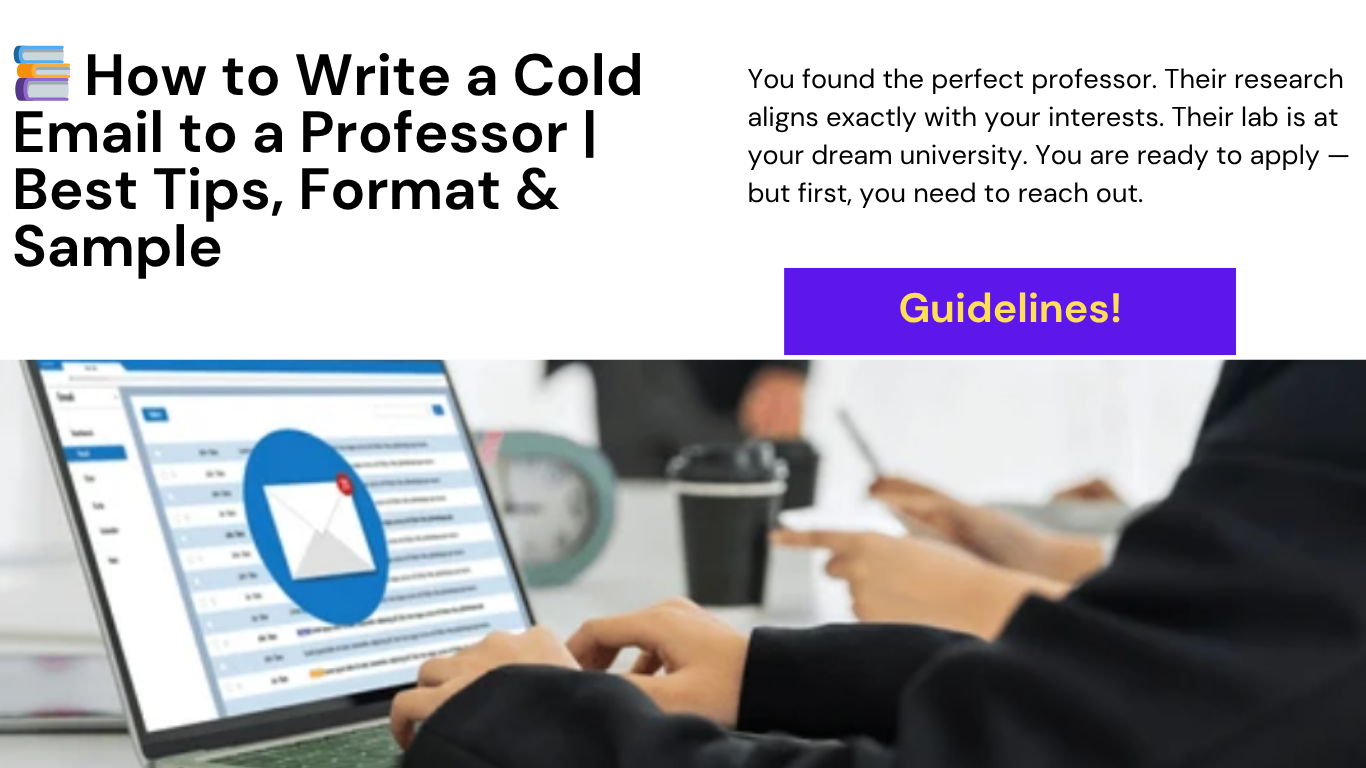
You found the perfect professor. Their research aligns exactly with your interests. Their lab is at your dream university. You are ready to apply — but first, you need to reach out.
So you open your inbox, start typing, and freeze.
What do you say? How formal should it be? How long? What if they never reply?
This is the exact moment most students give up or send a generic, copy-pasted email that gets ignored within seconds. The truth is, a well-written cold email to a professor can genuinely open doors — to PhD positions, research collaborations, supervised master’s programs, and even scholarship referrals. A poorly written one can silently close those same doors forever.
This guide will walk you through everything — the correct format, what to include, what to avoid, real sample emails, and the small details that make professors actually respond.
📚 What is a Cold Email to a Professor?
A cold email is an unsolicited message you send to someone you have never met or communicated with before. In the academic world, it means reaching out to a professor directly — without any prior connection — to express your interest in working with them, joining their research group, or seeking their supervision for a graduate program.
Unlike a job application where there is a formal process, a cold email is personal, direct, and often your first real impression. Professors receive dozens of these every week. Most are deleted without a second glance. Yours does not have to be.
📚 Why Cold Emails Matter for Students
Many students underestimate just how important a professor’s response can be. Here is why sending a strong cold email is worth the effort:
For PhD Applicants: In many countries — particularly the USA, UK, Canada, Germany, and Australia — having a professor who agrees to supervise you before you formally apply significantly strengthens your application. Some departments will not even review your application unless a faculty member has already expressed willingness to take you on.
For Research Positions: If you are looking for a paid or voluntary research assistant position, the professor is the decision-maker. Their lab, their funding, their choice.
For Scholarships: Many fellowship and scholarship applications require a letter of support or nomination from a faculty member. That relationship starts with your email.
For Networking: Even if the timing is not right, a positive first impression can lead to future opportunities, conference connections, or referrals to other supervisors.
📚 Before You Write — Do Your Homework
The most common reason cold emails fail is that they are clearly not personalized. Professors can tell immediately when a student has sent the same message to 50 people. Do this before you write a single word:
1. Read the professor’s recent publications Look up their Google Scholar, ResearchGate, or university faculty page. Find their most recent 2–3 papers. Understand what they are currently working on — not what they did five years ago.
2. Check if they are accepting students Some professors clearly state on their lab page whether they are taking new students. If they say “not accepting students,” respect that and move on.
3. Find the right email address Use the official university faculty page. Avoid guessing or using a generic departmental email. Many professors filter their inbox heavily, so a direct address is essential.
4. Know the program you are applying for Understand the degree, funding structure, and application deadline before you write. Professors appreciate students who have done their research.
5. Identify a genuine connection between your work and theirs This is not about flattery. It is about showing that you genuinely understand their research and can contribute to it.
📚 The Perfect Cold Email Structure
Here is the ideal structure for a professional cold email to a professor. Each section has a specific purpose — do not skip any.
🔹 1. Subject Line — Make It Count
The subject line is the first thing a professor sees. If it looks generic or vague, the email may never be opened.
Avoid:
- “PhD Application Inquiry”
- “Research Opportunity”
- “I want to study under you”
Better subject lines:
- “Prospective PhD Student – Interest in [Specific Research Topic]”
- “MSc Supervision Inquiry – [Your Name] | [Research Area]”
- “PhD Applicant Interested in Your Work on [Topic] – [Year] Entry”
Keep it clear, specific, and professional.
🔹 2. Opening — Introduce Yourself Concisely
Start with a brief, confident introduction. Do not write a full paragraph about your life story. Just the key facts.
What to include:
- Your name
- Your current degree/position and institution
- Your nationality (relevant for international students)
- The program and intake year you are applying for
Example: “My name is [Name], and I am a final-year BSc student in [Field] at [University], [Country]. I am writing to inquire about PhD opportunities in your research group for the September 2026 intake.”
🔹 3. Why This Professor — Show You’ve Done Your Research
This is the most important section of the email. It is what separates your message from a template.
Mention a specific paper, project, or finding from the professor’s work. Explain briefly why it connects to your own academic interests or experience. Be genuine — professors know when students are being vague or dishonest.
Example: “I recently read your 2024 paper on [topic] published in [journal], and I was particularly interested in your findings on [specific finding]. This directly relates to my final year research project, in which I investigated [related topic] using [method/approach].”
Two to three sentences is enough. You are not summarizing their work — you are showing you have read and understood it.
🔹 4. Your Academic Background — Keep It Brief
Give a short summary of your qualifications and relevant experience. Think of this as a highlight reel, not a full CV. You will attach your CV separately.
What to include:
- Degree(s) and GPA (if strong)
- Relevant research experience or thesis topic
- Any publications, presentations, or awards (if applicable)
- Relevant technical skills (lab techniques, programming languages, software, etc.)
Example: “I hold a BSc in [Field] with a CGPA of [X/4.0]. My undergraduate thesis focused on [topic], and I have hands-on experience with [relevant skills/methods]. I have also co-authored a paper currently under review in [journal].”
Keep this to three or four sentences maximum.
🔹 5. What You Are Asking For — Be Direct
Do not leave the professor guessing about what you want. State your request clearly and politely.
Examples:
- “I would be honored to be considered for a PhD position in your group for the 2026 intake.”
- “I wanted to inquire whether you are currently accepting master’s students for supervised research starting September 2026.”
- “I am writing to ask whether you would be open to a brief email exchange or virtual meeting to discuss potential research collaboration.”
Be clear, not demanding. One specific ask is better than multiple vague ones.
🔹 6. Funding Statement — Mention It If Relevant
If you are self-funded, applying for a scholarship, or have your own fellowship, mention it. This is very important because funding is often the number one reason professors hesitate to take on new students.
Examples:
- “I am currently preparing an application for the [Scholarship Name] and would require a letter of support from a faculty supervisor.”
- “I am fully prepared to self-fund my studies and am not requesting departmental funding at this stage.”
- “I am applying for the [Country] government scholarship, which covers full tuition and living costs.”
🔹 7. Closing — Professional and Gracious
End with appreciation for their time, mention that you have attached relevant documents, and invite a response without sounding pushy.
Example: “I have attached my CV and a brief research statement for your reference. I completely understand that you may be very busy, but I would be truly grateful for any guidance or response at your convenience. Thank you very much for your time.”
Sign off with:
- Sincerely,
- Best regards,
- Respectfully,
Then include your full name, degree, institution, and email address.
📚 Full Sample Cold Email — PhD Application
Here is a complete example you can use as a reference:
Subject: Prospective PhD Student – Interest in Climate Modelling Research | 2026 Entry
Dear Professor [Last Name],
My name is Ahmed Raza, and I am a final-year MSc student in Environmental Science at the University of Lahore, Pakistan. I am writing to inquire about potential PhD opportunities in your research group for the September 2026 intake.
I recently read your 2024 paper, “Regional Climate Sensitivity Under Anthropogenic Forcing,” published in Nature Climate Change. I was particularly drawn to your approach of integrating satellite-derived land surface data into regional climate models — a methodology I explored in a smaller capacity during my thesis on monsoon variability in South Asia.
I hold an MSc with a CGPA of 3.8/4.0, and my research has involved statistical downscaling of climate projections using Python and R. I have presented my thesis findings at a national environmental science conference and am currently working on a manuscript for journal submission.
I am applying for the [Scholarship Name] fellowship, which would provide full funding and would not require departmental support.
I have attached my CV and a brief research statement for your consideration. I would be very grateful for any response at your convenience, even if it is simply to let me know whether your group is currently accepting applicants.
Thank you sincerely for your time.
Best regards, Ahmed Raza MSc Environmental Science, University of Lahore ahmed.raza@email.com
📚 Common Mistakes to Avoid
These mistakes will almost certainly get your email ignored or deleted:
❌ Sending a generic mass email Professors can tell immediately. Even small personalizations make a huge difference.
❌ Making the email too long Your email should be no longer than 300–350 words. Professors are busy. Respect their time.
❌ Saying “I want to study under you” or “I am your big fan” This sounds unprofessional and even odd. Focus on research, not flattery.
❌ Not reading their research first Saying “your research is very interesting” without mentioning anything specific is a red flag.
❌ Starting with “Dear Sir/Madam” or “To Whom It May Concern” Always use the professor’s actual name. “Dear Professor [Last Name]” is the correct form.
❌ Asking about salary or visa before establishing interest These are practical questions for later. Your first email should focus entirely on research fit.
❌ Sending your entire life story Two or three focused sentences per section is ideal. This is not your full application.
❌ Following up the next day Give it at least 1–2 weeks before a polite follow-up. Professors are not sitting by their inbox waiting for student emails.
❌ Attaching too many files One CV and at most one research statement is enough for the first email.
📚 How Long Should the Email Be?
Aim for 250 to 350 words total. This is enough to make a strong impression without overwhelming the reader. If your email is longer than a full page, edit it down.
📚 When to Send Your Cold Email
Timing matters more than most students realize. Here are some guidelines:
- Send 4–6 months before the application deadline. This gives the professor time to respond and gives you time to incorporate their feedback or endorsement into your application.
- Avoid sending during holiday periods — December, late August, and exam periods tend to have very low response rates.
- Weekdays are better than weekends — Tuesday, Wednesday, and Thursday tend to see higher email open rates in professional settings.
- Send one email at a time — Do not reach out to 20 professors simultaneously without thought. Start with your top five and expand from there.
📚 What to Do If They Don’t Reply
No response after two weeks? You can send one polite follow-up email. Keep it very short:
“Dear Professor [Name], I hope this message finds you well. I wanted to gently follow up on my email from [date] regarding PhD opportunities in your group. I completely understand if you are busy, and I appreciate any response at your convenience. Thank you.”
If there is still no response after that, move on. It is not personal — professors are genuinely overwhelmed with emails. Apply to the program anyway if you believe it is the right fit.
📚 Quick Checklist Before You Hit Send
Before sending, run through this checklist:
✅ Subject line is specific and professional ✅ Addressed to the correct professor by name ✅ Mentioned a specific paper or project of theirs ✅ Introduced yourself briefly and clearly ✅ Explained the connection between your work and theirs ✅ Stated what you are asking for clearly ✅ Mentioned your funding situation (if relevant) ✅ Email is under 350 words ✅ CV is attached (and is up to date) ✅ Proofread for grammar and spelling errors ✅ Used a professional email address (not something like coolguy2005@gmail.com)
📚 Why This Matters More Than You Think
Many students put enormous effort into their SOP, their CV, and their scholarship essays — and then send a two-line cold email that reads like an afterthought. The cold email is often your very first human contact with the person who will decide whether to support your application. It deserves the same care and attention as every other part of your academic journey.
A great email can start a conversation. A great conversation can become a supervisory relationship. A supervisory relationship can change your entire career path.
Take the time to do it right.
📚 Related Guides on Gradualin
If you found this guide helpful, you might also want to read:
- 📚 How to Write a Statement of Purpose (SOP) for Scholarship – Step-by-Step Guide
- 📚 How to Make a CV for Scholarship Application – Guide with Template
- 📚 How to Write a Motivation Letter for Scholarship or University – Complete Guide
- 🌍 Explore all Guidelines & Resources on Gradualin
- 🎓 Browse Scholarships on Gradualin
- 🇺🇸 Fully Funded Scholarships USA 2026
- 🇬🇧 Fully Funded PhD Scholarships UK 2026
Writing a strong cold email is a skill — and like any skill, it gets better with practice. Use this guide as your foundation and personalize every email you send.