
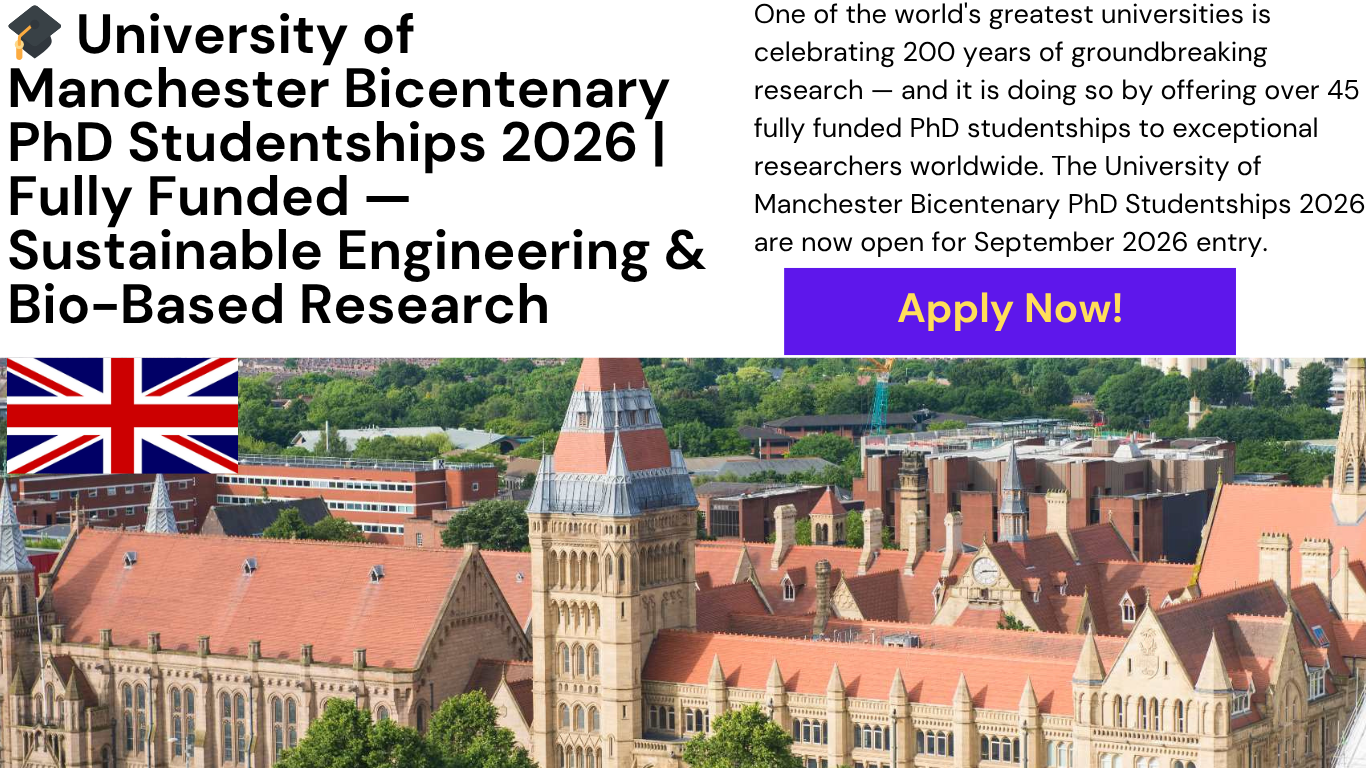
One of the world’s greatest universities is celebrating 200 years of groundbreaking research — and it is doing so by offering over 45 fully funded PhD studentships to exceptional researchers worldwide. The University of Manchester Bicentenary PhD Studentships 2026 are now open for September 2026 entry, and they cover everything — full tuition fees, a generous annual stipend, and access to one of the most prestigious doctoral research environments on the planet.
Among the exciting projects currently available is a cutting-edge PhD on bio-based fibre systems for circular material applications — a highly relevant and forward-thinking research opportunity in sustainable engineering. This guide covers everything you need to know.
🎓 Scholarship Overview
The Bicentenary PhD Studentships are the University of Manchester’s flagship doctoral funding programme, launched to mark the university’s 200th anniversary. Starting in September 2026, the Faculty of Science and Engineering is offering more than 45 fully funded PhD scholarships across major interdisciplinary research themes.
These studentships are available across the full breadth of science and engineering research at Manchester — from materials science and sustainable engineering to computer science, chemistry, and environmental sciences. They are open to all nationalities, making them one of the most accessible fully funded PhD opportunities at a Russell Group university in the UK.
🎓 Featured PhD Project — From Waste to Function
One of the highly relevant projects available under this scheme is:
“From Waste to Function: Engineering Bio-Based Fibre Systems for Circular Material Applications”
This PhD project sits at the exciting intersection of sustainable materials engineering, circular economy principles, and bio-based innovation. As global pressure grows to replace synthetic, petroleum-derived materials with renewable alternatives, bio-based fibre systems are emerging as a critical area of research.
The project focuses on developing and engineering fibre systems derived from biological or waste sources — transforming what would otherwise be discarded material into functional, high-performance materials with real-world applications. This includes work on fibre processing, material characterisation, performance optimisation, and end-of-life recyclability — all central pillars of the circular bioeconomy.
This is a particularly timely research area given the EU’s focus on circular economy legislation and the UK’s Net Zero and sustainability commitments — making graduates from this field highly sought-after in industry, policy, and academia.
🎓 Benefits & Funding
Each Bicentenary PhD Studentship provides:
- Full PhD tuition fees covered for the entire 4-year programme
- Annual stipend at the UKRI rate — £20,780 per year (2025/26 rate, subject to annual review)
- Duration: 4 years full-time
- Membership of the Faculty of Science and Engineering Doctoral Academy — a structured support and training community
- Access to world-class laboratories, research facilities, and equipment at one of the UK’s top research universities
- A dedicated expert supervisory team supporting your research throughout
- Strong industry links offering networking, collaboration, and career development opportunities
- Funding to travel for conferences, research collaboration, and professional development
- Access to the President’s Doctoral Scholar Award — an additional prestigious funding award available to the highest-calibre students admitted to Manchester
🎓 Eligibility Criteria
To be considered for the Bicentenary PhD Studentships, applicants must:
- Hold or expect to achieve a First Class or 2:1 UK Honours degree (or international equivalent) in a relevant discipline
- Ideally hold a Master’s-level qualification at merit or distinction (or international equivalent) — not mandatory but strongly preferred
- Demonstrate strong potential for academic research — this may include contributions to publications, conference presentations, research prizes, or project awards
- Have submitted a PhD application by the relevant project-specific deadline for a September 2026 start
- All nationalities are welcome — the Bicentenary Studentships are fully open to international and EU students
- English language proficiency is required for international applicants. The University of Manchester typically requires:
- IELTS: Minimum 6.5 overall (with no band below 6.0)
- TOEFL iBT: Minimum 90
- Other equivalent qualifications are accepted
Important: Only candidates who hold a formal offer for a PhD programme at Manchester will be considered for the studentship funding.
🎓 Who Should Apply
This opportunity is ideal for:
- Graduates in materials science, chemical engineering, environmental science, chemistry, mechanical engineering, or related disciplines interested in sustainable and bio-based materials research
- Researchers passionate about circular economy, sustainability, green chemistry, and bio-based innovation
- International students seeking a fully funded PhD at a Russell Group university in the UK
- Candidates with research experience or publications looking to join a world-leading research group
- Students who want structured doctoral training and career development alongside their research
Who should NOT apply:
- Students without a minimum 2:1 degree or international equivalent
- Applicants who cannot start in September 2026 — the start date is fixed and awards are not deferrable
- Those applying outside the specific advertised project deadlines
🎓 Research Themes at Manchester Faculty of Science & Engineering
The Bicentenary Studentships cover research across all major areas in the Faculty, including:
- Materials Science & Engineering — bio-based materials, composites, circular materials, advanced manufacturing
- Chemical Engineering — sustainable processes, green chemistry, bio-refinery systems
- Mechanical & Aerospace Engineering — sustainable design, lightweight materials, structural engineering
- Computer Science & AI — machine learning, data science, computational modelling
- Chemistry — synthetic chemistry, functional materials, catalysis
- Earth & Environmental Sciences — climate, sustainability, environmental impact
- Electrical & Electronic Engineering — smart systems, energy, sensors
- Physics & Astronomy — quantum technologies, advanced materials characterisation
- Fashion Business & Technology — sustainable textiles, circular fashion systems
🎓 Why Study at the University of Manchester
The University of Manchester is one of the world’s truly great research universities — and studying here means joining a tradition of discovery that includes no fewer than 25 Nobel Prize winners.
- Ranked top 30 in the world — QS World University Rankings 2026
- Russell Group member — one of the UK’s 24 leading research-intensive universities
- Located in Manchester, UK — one of the most exciting, affordable, and culturally vibrant cities in Europe
- Home to world-renowned research institutes including the National Graphene Institute and the Henry Royce Institute for Advanced Materials
- Strong industry partnership network across aerospace, automotive, energy, biotech, and consumer goods sectors
- The Doctoral Academy provides comprehensive training, mentorship, and professional development — giving PhD students far more than just a research degree
- Over 10,000 postgraduate researchers from more than 170 countries — a truly global academic community
- Awarded Silver in the Teaching Excellence Framework — reflecting commitment to high-quality academic experience
🎓 How to Apply — Step by Step
- Find a suitable project — browse the current Bicentenary PhD Studentship projects using the Faculty of Science and Engineering’s project search tool
- Contact a potential supervisor — before applying, email the lead supervisor of the project you are interested in to confirm their support and discuss the research
- Submit your PhD programme application online through the University of Manchester’s admissions portal — include all required documents
- Indicate your interest in the Bicentenary Studentship — in Section 9 of the application form, clearly state that you wish to be considered for Bicentenary PhD Studentship funding
- Await shortlisting — shortlisted candidates are nominated for interviews on a rolling basis until all studentships are filled
- Attend interview — if shortlisted you will be invited to a funding interview
- Receive offer — successful candidates receive a formal studentship award letter separate from their programme offer
Applications are reviewed on a rolling basis — apply as early as possible for the best chance of selection.
🎓 Required Documents
Your application typically needs to include:
- Completed online PhD programme application via the University of Manchester admissions portal
- Academic transcripts — Bachelor’s and Master’s degree certificates and transcripts
- Research proposal — outlining your interest in the specific project and your proposed research approach
- Academic CV — highlighting your academic record, research experience, publications, and relevant skills
- Personal statement — explaining your motivation and suitability for the project
- Two academic references — at least one from your most recent institution
- English language test scores — IELTS/TOEFL for international applicants
🎓 Important Dates
| Event | Date |
| Applications Open | Rolling — now open |
| PhD Start Date | September 2026 |
| Studentship Duration | 4 years full-time |
| Annual Stipend | £20,780 (UKRI rate) |
| Nationality | All nationalities welcome |
Note: Individual projects have their own specific deadlines. Check the project listing and contact the supervisor as soon as possible.
🎓 Official Sources
For project listings, funding details, and to apply:
👉 University of Manchester — Bicentenary PhD Studentships
👉 Faculty of Science & Engineering — Getting Started with Postgraduate Research
👉 Faculty of Science & Engineering — Fees & Funding
👉 Apply Online — University of Manchester
🎓 Scholarship Summary
| Detail | Information |
| University | University of Manchester |
| Country | United Kingdom 🇬🇧 |
| Programme | Bicentenary PhD Studentships |
| Number of Places | 45+ for September 2026 |
| Annual Stipend | £20,780 (UKRI rate) |
| Tuition Fees | Fully covered |
| Duration | 4 years full-time |
| Open To | All nationalities |
| English Required | Yes — IELTS 6.5 / TOEFL 90 |
| Start Date | September 2026 |
| Featured Project | From Waste to Function — Bio-Based Fibre Systems |
| Application | Rolling — apply now |
Explore more fully funded PhD scholarships in the UK at https://gradualin.com/category/scholarships/
Related reads on Gradualin: