

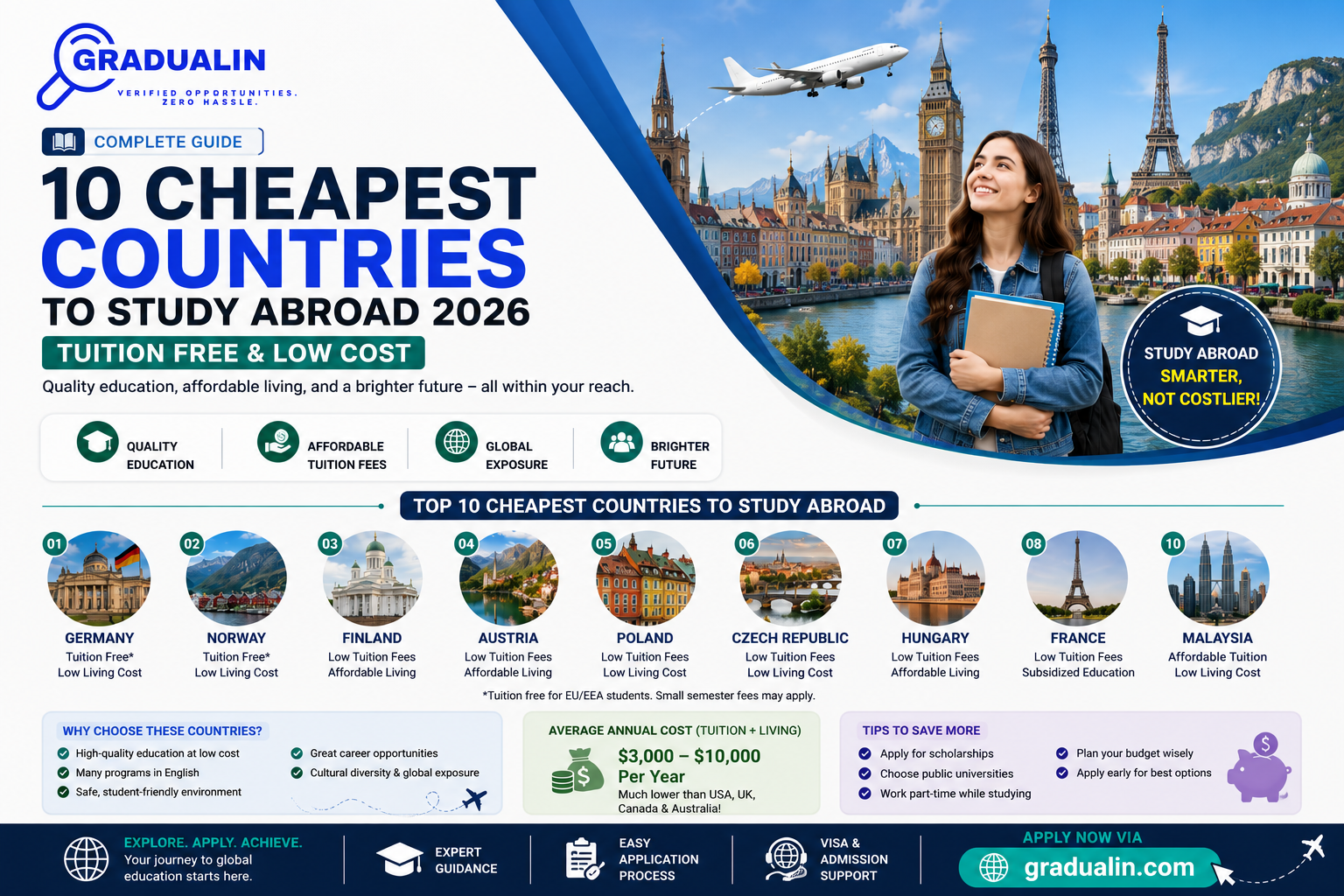
Studying abroad doesn’t have to drain your savings. While countries like the USA and UK can cost $30,000–$60,000 per year, there are at least 10 countries where you can complete your entire degree for under $15,000 total — including tuition, living expenses, and even flights. Some countries offer completely free tuition to international students, while others combine low fees with affordable living costs that make them accessible to students from any background.
This complete guide reveals the 10 cheapest countries to study abroad in 2026, with exact cost breakdowns, scholarship opportunities, work rights, and insider tips to make your dream education affordable. Whether you’re pursuing a Bachelor’s, Master’s, or PhD, these destinations prove that world-class education doesn’t require world-class wealth.
📚 Quick Information
| Detail | Information |
| Topic | Cheapest Countries to Study Abroad |
| Number of Countries | 10 Affordable Destinations |
| Cost Range | $0–$15,000 total per year |
| Tuition-Free Options | Germany, Norway, Finland, Austria (select programs) |
| Cheapest Living Costs | Poland, Taiwan, Mexico, Malaysia |
| Languages | English-taught programs available in all |
| Work While Studying | 20 hours/week in most countries |
| Updated | 2026 |
📚 Why Study in Cheaper Countries? The Smart Financial Decision
Let’s break down the math:
Traditional expensive destinations:
- 🇺🇸 USA: $30,000–$70,000/year (tuition + living)
- 🇬🇧 UK: £20,000–£35,000/year ($25,000–$44,000)
- 🇦🇺 Australia: AUD $30,000–$50,000/year ($20,000–$33,000)
Average 2-year Master’s degree in USA/UK: $80,000–$120,000 total
Same degree in affordable countries: $5,000–$20,000 total
You save: $60,000–$100,000 (enough to buy a house, start a business, or fund your PhD)
But here’s what most students don’t realize:
✅ Quality isn’t compromised – Many affordable countries have universities ranked in top 500 globally
✅ Better work-life balance – Lower costs mean less financial stress, more focus on studies
✅ Post-study opportunities – Most offer work visas and easier pathways to PR
✅ Cultural experience – Live like a local, not a tourist burning through savings
✅ Scholarship friendly – Lower costs make scholarships go further
The smartest students aren’t asking “Can I afford to study abroad?” — they’re asking “Which affordable country gives me the best ROI?”
This guide answers that question.
📚 The 10 Cheapest Countries to Study Abroad in 2026
We’ve ranked these by total annual cost (tuition + living expenses):
1. 🇩🇪 Germany – FREE Tuition + €850–€1,200/Month Living
Why Germany tops this list:
✅ Public universities charge ZERO tuition for Bachelor’s and Master’s (even for internationals)
✅ Only pay €250–€350/semester “contribution fee” (covers transport, admin)
✅ World-class engineering, business, and research programs
✅ Over 1,500 English-taught programs
✅ 20 hours/week work rights (€12 minimum wage = €960+/month)
✅ 18-month post-study work visa
Annual Cost Breakdown:
- Tuition: €0 (public universities)
- Semester Fee: €500–€700/year
- Rent: €300–€500/month (student dorms)
- Food: €200–€250/month
- Transport: Free (covered by semester fee)
- Health Insurance: €110/month (mandatory)
- Total per year: €10,000–€14,000 ($10,800–$15,200)
Best German Universities for Internationals:
- Technical University of Munich (TUM) – Top 50 globally
- Ludwig Maximilian University (LMU Munich)
- Heidelberg University – Oldest university in Germany
- RWTH Aachen University – Engineering powerhouse
- Free University of Berlin
Language: Most Master’s programs taught fully in English. German language helpful but not mandatory.
Scholarship Bonus: DAAD scholarships cover living costs for thousands of students annually. Check opportunities at Gradualin Scholarships.
2. 🇳🇴 Norway – FREE Tuition + High Living Costs (But Manageable)
The Norwegian model:
✅ All public universities FREE for everyone (Bachelor’s, Master’s, PhD)
✅ No tuition fees for international students
✅ High quality of life and education standards
✅ English widely spoken
✅ 20 hours/week work rights
✅ Permanent residency pathway after 3 years
Annual Cost Breakdown:
- Tuition: €0
- Semester Fee: €60–€80 (€120–€160/year)
- Rent: €400–€700/month (student housing)
- Food: €300–€400/month
- Transport: €50–€70/month
- Total per year: €12,000–€16,000 ($13,000–$17,400)
Yes, living costs are high — but free tuition + work rights balance it out.
Best Norwegian Universities:
- University of Oslo – Top 100 globally
- Norwegian University of Science and Technology (NTNU)
- University of Bergen
- University of Tromsø (Arctic University)
Insider Tip: Apply for Norwegian State Educational Loan Fund (Lånekassen) — international students can access loans/grants.
3. 🇫🇮 Finland – FREE/Low Tuition + €700–€900/Month Living
The Finnish advantage:
✅ PhD programs FREE for everyone
✅ Bachelor’s & Master’s: €0 for EU/EEA, €4,000–€18,000/year for non-EU (still lower than USA/UK)
✅ Many scholarships cover 50–100% of tuition for non-EU
✅ World’s best education system
✅ 25 hours/week work rights
✅ Safe, clean, high quality of life
Annual Cost Breakdown (Non-EU):
- Tuition: €4,000–€12,000/year (many scholarships available)
- Rent: €250–€500/month (student apartments)
- Food: €200–€250/month
- Transport: €30–€50/month
- Total per year: €10,000–€18,000 (often reduced by scholarships)
Best Finnish Universities:
- University of Helsinki – Top 100 globally
- Aalto University – Business and technology
- University of Turku
- Tampere University
Language: English-taught programs abundant. Finnish language not required but helpful.
For more on Finland scholarships, see: Finland Scholarships 2026 at Gradualin
4. 🇵🇱 Poland – €2,000–€4,000 Tuition + €400–€600/Month Living
Why Poland is the hidden gem:
✅ Extremely affordable tuition: €2,000–€4,000/year
✅ Low living costs: Among cheapest in Europe
✅ Central European location: Easy travel to rest of Europe
✅ Growing economy: Increasing international recognition
✅ 300+ English programs
✅ EU country benefits
Annual Cost Breakdown:
- Tuition: €2,000–€4,000/year
- Rent: €200–€350/month (student dorms)
- Food: €150–€200/month
- Transport: €15–€25/month
- Total per year: €6,000–€9,000 ($6,500–$9,800)
Best Polish Universities:
- University of Warsaw
- Jagiellonian University (Krakow) – Founded 1364
- Warsaw University of Technology
- AGH University of Science and Technology
Scholarship Note: Polish government offers numerous scholarships for international students.
5. 🇦🇹 Austria – FREE/€750–€1,500 Tuition + €800–€1,000/Month Living
Austrian education facts:
✅ EU/EEA students: €0 tuition
✅ Non-EU students: €750–€1,500/semester (€1,500–€3,000/year)
✅ PhD often FREE for all
✅ High-quality education system
✅ Central Europe location
✅ 20 hours/week work rights
✅ German + English programs
Annual Cost Breakdown (Non-EU):
- Tuition: €1,500–€3,000/year
- Rent: €350–€500/month (student housing)
- Food: €250–€300/month
- Transport: €50/month (student discount)
- Total per year: €10,000–€13,000 ($10,800–$14,100)
Top Universities:
- University of Vienna – Top 150 globally
- Vienna University of Technology
- University of Innsbruck
- Graz University of Technology
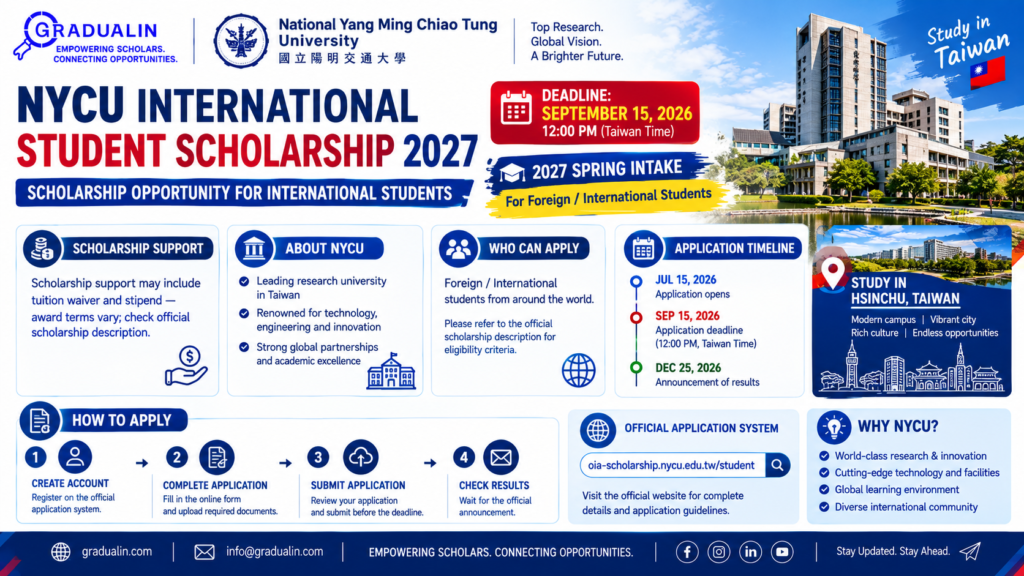
6. 🇹🇼 Taiwan – $3,000–$4,000 Tuition + $400–$600/Month Living
Asia’s best-kept secret:
✅ Very low tuition: $3,000–$4,000/year
✅ Affordable living: $400–$600/month total
✅ Excellent tech/engineering programs
✅ Safe and friendly culture
✅ 20 hours/week work rights
✅ Taiwan Scholarship Program available
Annual Cost Breakdown:
- Tuition: $3,000–$4,000/year
- Rent: $150–$300/month (dorms or shared)
- Food: $150–$200/month (eating out is cheap)
- Transport: $20–$30/month
- Total per year: $6,000–$9,000
Best Taiwanese Universities:
- National Taiwan University (NTU) – Top 100 globally
- National Tsing Hua University
- National Cheng Kung University
- National Chiao Tung University
Bonus: Taiwan offers generous government scholarships covering tuition + stipend.
7. 🇲🇽 Mexico – $2,000–$6,000 Tuition + $400–$700/Month Living
Latin America’s best option:
✅ Low tuition: $2,000–$6,000/year at private universities
✅ Public universities even cheaper (some free for internationals)
✅ Very affordable living
✅ Spanish + English programs
✅ Rich culture and climate
✅ Close to USA/Canada
Annual Cost Breakdown:
- Tuition: $2,000–$6,000/year (private), $0–$1,000 (public)
- Rent: $200–$400/month
- Food: $150–$250/month (street food incredibly cheap)
- Transport: $20–$40/month
- Total per year: $5,000–$11,000
Top Mexican Universities:
- National Autonomous University of Mexico (UNAM) – Top in Latin America
- Tecnológico de Monterrey (Tec de Monterrey)
- University of Guadalajara
- Instituto Politécnico Nacional
Note: Spanish proficiency helpful but English programs growing.
8. 🇨🇿 Czech Republic – €1,000–€12,000 Tuition + €500–€700/Month Living
Czech Republic benefits:
✅ Czech-taught programs: FREE
✅ English programs: €1,000–€12,000/year (varies widely)
✅ Low living costs for Europe
✅ Beautiful, historic cities
✅ Central European location
✅ EU country benefits
Annual Cost Breakdown (English programs):
- Tuition: €1,000–€8,000/year (average €4,000)
- Rent: €250–€400/month (Prague), less elsewhere
- Food: €150–€200/month
- Transport: €20–€30/month
- Total per year: €7,000–€13,000 ($7,600–$14,100)
Top Universities:
- Charles University (Prague) – Top 300 globally, founded 1348
- Czech Technical University
- Masaryk University (Brno)
Tip: Learn Czech and study completely free. Many students take 1-year Czech language course then enroll in free programs.
9. 🇲🇾 Malaysia – $3,000–$5,000 Tuition + $300–$500/Month Living
Southeast Asia’s education hub:
✅ Affordable tuition: $3,000–$5,000/year
✅ Very low living costs
✅ English widely spoken
✅ Safe and multicultural
✅ Branch campuses of UK/Australian universities at 1/3 the cost
✅ Growing post-study work opportunities
Annual Cost Breakdown:
- Tuition: $3,000–$5,000/year
- Rent: $100–$250/month (student accommodation)
- Food: $100–$150/month (local food very cheap)
- Transport: $20–$30/month
- Total per year: $5,000–$8,000
Best Malaysian Universities:
- University of Malaya (UM) – Top 70 globally
- Universiti Putra Malaysia (UPM)
- Monash University Malaysia (Australian branch)
- University of Nottingham Malaysia (UK branch)
Advantage: Study same degree as UK/Australia but pay Malaysia prices.
10. 🇭🇺 Hungary – €1,500–€7,000 Tuition + €400–€600/Month Living
Central Europe’s affordable choice:
✅ Low tuition: €1,500–€7,000/year
✅ Affordable living
✅ EU country benefits
✅ Strong medical programs (popular for international medical students)
✅ English-taught programs
✅ Scholarships available (Stipendium Hungaricum)
Annual Cost Breakdown:
- Tuition: €1,500–€5,000/year (average)
- Rent: €200–€350/month (Budapest)
- Food: €150–€200/month
- Transport: €30–€40/month
- Total per year: €6,500–€11,000 ($7,050–$11,950)
Best Hungarian Universities:
- Eötvös Loránd University (ELTE, Budapest)
- University of Szeged
- Semmelweis University (Medicine)
- Budapest University of Technology and Economics
Scholarship: Stipendium Hungaricum covers tuition + monthly stipend for many countries.
📚 Cost Comparison Table: All 10 Countries
| Country | Tuition/Year | Living/Month | Total/Year | Work Rights |
| 🇩🇪 Germany | €0 | €850–€1,200 | €10,000–€14,000 | 20 hrs/week |
| 🇳🇴 Norway | €0 | €1,000–€1,400 | €12,000–€16,000 | 20 hrs/week |
| 🇫🇮 Finland | €4,000–€12,000* | €700–€900 | €10,000–€18,000 | 25 hrs/week |
| 🇵🇱 Poland | €2,000–€4,000 | €400–€600 | €6,000–€9,000 | Part-time allowed |
| 🇦🇹 Austria | €1,500–€3,000 | €800–€1,000 | €10,000–€13,000 | 20 hrs/week |
| 🇹🇼 Taiwan | $3,000–$4,000 | $400–$600 | $6,000–$9,000 | 20 hrs/week |
| 🇲🇽 Mexico | $2,000–$6,000 | $400–$700 | $5,000–$11,000 | Limited |
| 🇨🇿 Czech Republic | €1,000–€8,000 | €500–€700 | €7,000–€13,000 | Part-time allowed |
| 🇲🇾 Malaysia | $3,000–$5,000 | $300–$500 | $5,000–$8,000 | Limited |
| 🇭🇺 Hungary | €1,500–€5,000 | €400–€600 | €6,500–€11,000 | Part-time allowed |
*PhD programs often free in Finland
📚 How to Choose the Right Cheap Country for You
Choose Germany if:
✅ You want completely free tuition
✅ You’re interested in engineering, sciences, or business
✅ You can handle cold winters
✅ You want strong post-study work options and PR pathway
Choose Norway/Finland if:
✅ Free tuition is priority
✅ You prefer high quality of life and safety
✅ You can budget for higher living costs (offset by work)
✅ You want progressive, English-friendly societies
Choose Poland/Hungary/Czech Republic if:
✅ You want the absolute lowest total cost
✅ You love European culture and travel
✅ You’re okay with learning some local language
✅ You want EU country benefits on a budget
Choose Taiwan/Malaysia if:
✅ You prefer Asian culture and climate
✅ You want even lower living costs than Europe
✅ You’re interested in tech, business, or engineering
✅ You want experience in growing Asian economies
Choose Mexico if:
✅ You want warm climate year-round
✅ You’re close to or familiar with Latin American culture
✅ You want to learn/improve Spanish
✅ You want proximity to USA/Canada
📚 Additional Ways to Cut Costs
1. Apply for Scholarships
Even in cheap countries, scholarships exist. DAAD (Germany), Erasmus+ (Europe), Taiwan Scholarship, and university-specific awards can cover living costs.
Browse Gradualin Scholarships Category for hundreds of opportunities.
2. Work Part-Time
Most countries allow 20–25 hours/week. At €10–€15/hour, you earn €800–€1,500/month — often covering entire living expenses.
3. Choose Smaller Cities
Berlin, Munich, Oslo expensive — but smaller university towns cost 30–40% less while offering same education quality.
4. Cook at Home
Eating out in Europe: €8–€15/meal. Cooking at home: €2–€4/meal. Save €300+/month.
5. Student Discounts
Museums, transport, software (Spotify, Adobe), gyms — student ID saves 30–50% on everything.
6. Shared Accommodation
Rent drops 30–40% when you share an apartment vs living alone.
7. Apply Early for Student Housing
University dorms often cheapest option but fill fast. Apply immediately after admission.
📚 Common Questions About Studying in Cheap Countries
Q: Is the education quality lower in cheap countries?
A: Not at all. Germany, Norway, and Finland rank among the world’s best education systems. Many universities in these countries rank in global top 200. Cheap ≠ low quality.
Q: Can I work while studying?
A: Yes, most countries allow 20–25 hours/week during semester, full-time during breaks. This can cover most/all living expenses.
Q: Do I need to learn the local language?
A: For English-taught programs, no. However, learning basics helps with daily life and opens more job opportunities. Some countries (Germany, Czech Republic) offer free programs if you study in local language.
Q: Are scholarships available in cheap countries too?
A: Absolutely. DAAD scholarships in Germany, Erasmus+ in Europe, Taiwan Scholarship, and hundreds of university-specific scholarships exist. Lower tuition makes scholarships go further.
Q: What about post-graduation work opportunities?
A: Most countries offer post-study work visas: Germany (18 months), Austria (12 months), Poland (9 months), etc. Many have pathways to permanent residency.
Q: How do living costs compare to my home country?
A: For students from USA/UK/Australia, these countries are much cheaper. For students from India, Pakistan, Bangladesh, costs are higher but manageable with part-time work + scholarships.
📚 Required Documents for Application
Standard requirements across these countries:
- Academic transcripts (Bachelor’s degree for Master’s, high school for Bachelor’s)
- Degree certificates
- Passport copy
- Statement of Purpose (SOP) / Motivation Letter
- Letters of Recommendation (2–3)
- CV/Resume
- English proficiency proof (IELTS/TOEFL/Duolingo or waiver — see our Study Without IELTS Guide)
- Financial proof (bank statements, scholarship letters, or blocked account)
- Health insurance (mandatory for visa)
- Visa application forms (country-specific)
📚 Step-by-Step: How to Study in a Cheap Country
Step 1: Choose Your Country & Universities (3 months before deadline)
Research programs, costs, and admission requirements. Shortlist 5–8 universities.
Step 2: Prepare Documents (2 months before)
Gather transcripts, write SOP, request recommendation letters, take English test if needed.
Step 3: Apply Online (By deadline)
Most universities use online portals. Application fees: €0–€100.
Step 4: Wait for Admission (2–8 weeks)
Universities send offer letters via email.
Step 5: Arrange Finances (Immediately after admission)
Apply for scholarships, education loans, or prepare blocked account (Germany requires €11,208 in blocked account for visa).
Step 6: Apply for Student Visa (2–3 months before start date)
Book visa appointment early. Processing time: 2–8 weeks depending on country.
Step 7: Book Accommodation (After visa approval)
Student dorms, shared apartments, or homestays. Book 1–2 months before arrival.
Step 8: Arrive & Enroll (1–2 weeks before semester)
Attend orientation, complete enrollment, open bank account, register residence.
Step 9: Start Classes & Apply for Part-Time Jobs
Most students find part-time work within first 2–3 months.
📚 Budget Planning Tool
Example: 2-Year Master’s in Germany
| Expense | Per Month | Per Year | 2 Years Total |
| Semester Fee | — | €600 | €1,200 |
| Rent | €400 | €4,800 | €9,600 |
| Food | €200 | €2,400 | €4,800 |
| Health Insurance | €110 | €1,320 | €2,640 |
| Books/Supplies | €30 | €360 | €720 |
| Personal/Entertainment | €100 | €1,200 | €2,400 |
| TOTAL | €840 | €10,680 | €21,360 |
| In USD | $910 | $11,580 | $23,160 |
With part-time work (€960/month): You earn €23,040 over 2 years — essentially studying for FREE while covering living costs.
📚 Success Stories: Real Students in Cheap Countries
“I completed my MS in Computer Science in Germany for just €12,000 total over 2 years — including flights. Same degree costs $80,000+ in USA.”
— Priya, India → Germany
“Poland was the best decision. My entire Bachelor’s + living expenses cost less than one semester at a UK university.”
— Ahmed, Egypt → Poland
“Taiwan surprised me. World-class tech education, $400/month living costs, and now I have a job here earning great salary.”
— Carlos, Mexico → Taiwan
📚 Frequently Asked Questions
Q: Can I study completely free including living costs?
A: Yes, with scholarships + part-time work. For example: DAAD scholarship in Germany covers €934/month + free tuition — that’s completely free education.
Q: Which cheap country has easiest student visa?
A: Germany and Poland have relatively straightforward processes with high approval rates for genuine students with proper documentation.
Q: Can I bring my family?
A: Most countries allow dependents but require additional financial proof (usually 50–75% more in blocked account/bank statements).
Q: What if I can’t afford the blocked account for Germany?
A: Apply for scholarships that cover living costs (DAAD, university scholarships), or consider Poland/Taiwan/Malaysia which don’t require blocked accounts.
Q: Are online degrees from these countries recognized?
A: Yes, if from accredited universities. However, for visa purposes, on-campus programs are usually preferred.
Q: How much can I save compared to USA/UK?
A: For a 2-year Master’s: $60,000–$100,000 savings compared to USA/UK, while receiving equivalent or better education.
📚 Why These Countries Offer Cheap Education
Government Funding: Many European countries believe education is a public good, heavily subsidized by taxes
Lower Operational Costs: Cost of living lower = universities spend less on salaries, facilities
Education Philosophy: Focus on accessibility over profit
Economic Strategy: Attract international talent who often stay and contribute to economy
Competition: Countries like Germany, Norway want to compete with USA/UK for global talent
No Education Industry Model: Unlike USA/UK, education isn’t commercialized in these countries
The result? You get world-class education without the debt burden. That’s not charity — that’s smart global education policy you can benefit from.
📚 Final Thoughts: Your Affordable Education Awaits
Studying abroad for under $10,000/year isn’t a dream — it’s reality in 10+ countries worldwide. The universities are excellent, the living is comfortable, the work opportunities exist, and the post-graduation prospects are strong.
The only question is: which country matches your goals?
- Want free tuition + strong engineering? → Germany
- Want Nordic lifestyle + free education? → Norway/Finland
- Want absolute lowest cost? → Poland/Hungary
- Want Asian experience + tech focus? → Taiwan/Malaysia
- Want European culture on budget? → Czech Republic/Austria
Your education should be an investment in your future — not a lifelong debt sentence.
For more study abroad resources:
- Fully Funded Scholarships Australia 2026
- Fully Funded PhD Scholarships UK 2026
- Fully Funded Scholarships USA 2026
- Study in Italy 2026 Guide
- Finland Scholarships 2026
Explore more at Gradualin:
📚 Summary: Cheapest Countries to Study Abroad 2026
| Rank | Country | Tuition | Total/Year | Best For |
| 1 | 🇩🇪 Germany | €0 | €10,000–€14,000 | Free tuition + strong economy |
| 2 | 🇳🇴 Norway | €0 | €12,000–€16,000 | Quality of life + free education |
| 3 | 🇫🇮 Finland | €0–€12,000 | €10,000–€18,000 | World’s best education system |
| 4 | 🇵🇱 Poland | €2,000–€4,000 | €6,000–€9,000 | Absolute lowest cost in EU |
| 5 | 🇦🇹 Austria | €1,500–€3,000 | €10,000–€13,000 | Central Europe + low tuition |
| 6 | 🇹🇼 Taiwan | $3,000–$4,000 | $6,000–$9,000 | Tech education + cheap living |
| 7 | 🇲🇽 Mexico | $2,000–$6,000 | $5,000–$11,000 | Latin culture + affordability |
| 8 | 🇨🇿 Czech Republic | €1,000–€8,000 | €7,000–€13,000 | Free if study in Czech |
| 9 | 🇲🇾 Malaysia | $3,000–$5,000 | $5,000–$8,000 | Cheapest in Asia |
| 10 | 🇭🇺 Hungary | €1,500–€5,000 | €6,500–€11,000 | Medical programs + scholarships |
Stay updated with the latest scholarships, jobs, and opportunities at Gradualin.com — your trusted guide to studying abroad for free.


One Response