

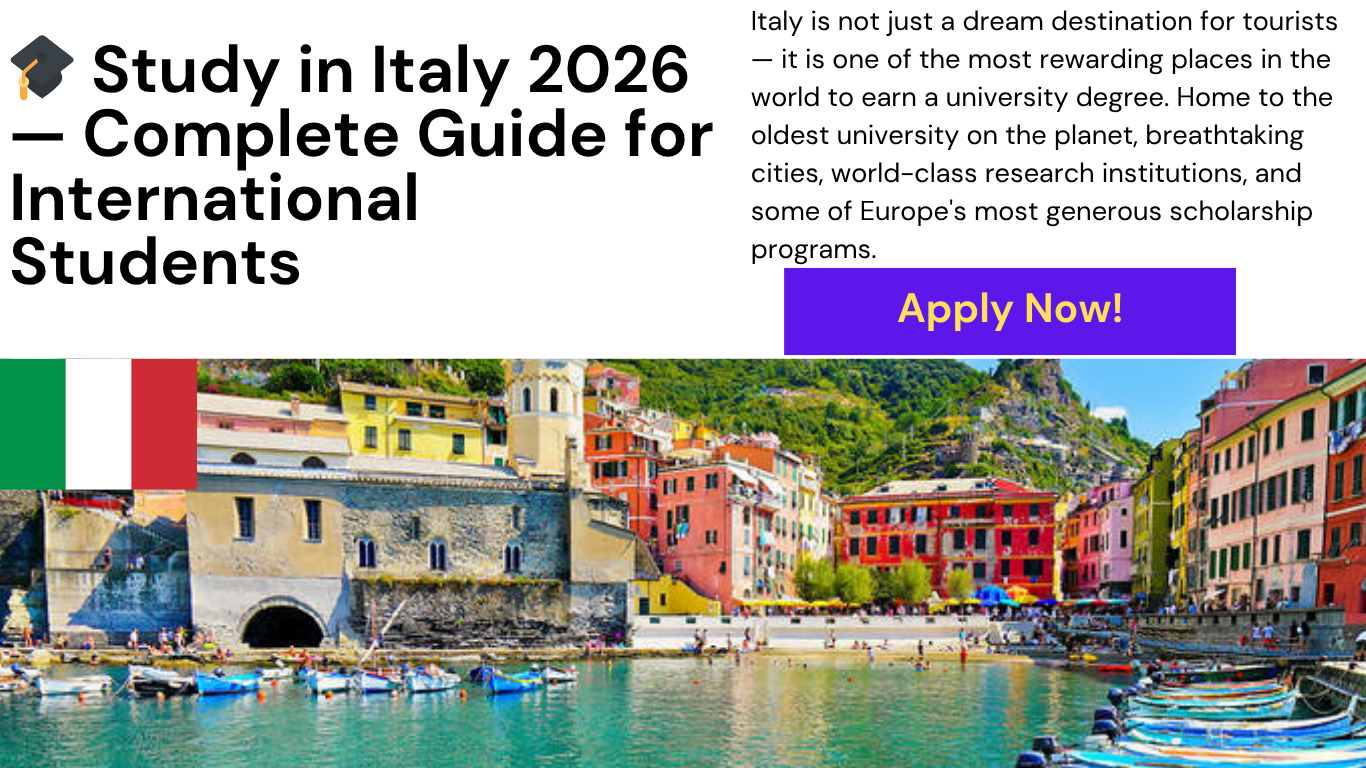
Italy is not just a dream destination for tourists — it is one of the most rewarding places in the world to earn a university degree. Home to the oldest university on the planet, breathtaking cities, world-class research institutions, and some of Europe’s most generous scholarship programs, Italy in 2026 offers international students an extraordinary opportunity to get a high-quality education at surprisingly low cost — and in many cases, completely for free. Whether you are eyeing a bachelor’s, master’s, or PhD, this guide covers everything you need to know: the best universities, available scholarships, costs, visa process, and exactly how to make your Italian study dream a reality.
🎓 Quick Summary
| Detail | Information |
| Country | Italy 🇮🇹 |
| Language of Instruction | Italian & English (many English-taught programs available) |
| Degree Levels | Bachelor’s, Master’s, PhD, Single-cycle |
| Top Scholarship | MAECI Italian Government Scholarship |
| Regional Scholarship | ER.GO (Emilia-Romagna) + other regional DSU bodies |
| Average Tuition | €156–€3,000+/year (income-based; often waived) |
| Average Living Cost | €700–€1,200/month depending on city |
| IELTS Required? | Depends on program — many programs do not require it |
| Student Visa Type | Type D Study Visa |
| Best Cities for Students | Bologna, Milan, Rome, Florence, Turin, Padua, Naples |
| Application Season | Varies by university — typically October–April |
🎓 Why Study in Italy in 2026?
Italy is one of Europe’s most compelling study destinations — and not just because of the food, the art, and the weather (though those certainly help). Here is why thousands of international students choose Italy every year, and why 2026 is a particularly strong time to apply:
1. Academic Excellence with Deep Roots The University of Bologna, founded in 1088, is the oldest university in the Western world. Italy’s academic tradition runs deeper than almost anywhere else on earth. Today, Italian universities are globally recognized for excellence in engineering, architecture, design, medicine, law, humanities, and natural sciences.
2. Remarkably Affordable Tuition Unlike the UK, USA, or Australia, Italian public universities charge income-based tuition fees — meaning your annual fees are calculated based on your family’s financial situation. Many international students from low- and middle-income countries pay as little as €156 per year in tuition, or even nothing at all if they qualify for a scholarship.
3. Generous Scholarship Ecosystem Italy has one of the most developed student financial aid systems in Europe. The national government, regional bodies, and individual universities all offer financial support — covering tuition, housing, meals, and cash stipends. The ER.GO system in Emilia-Romagna, for example, offers a package that combines all of these benefits simultaneously.
4. Hundreds of English-Taught Programs Italy has dramatically expanded its English-language offerings over the past decade. Today, hundreds of fully English-taught master’s and bachelor’s programs are available at Italian universities — making Italy accessible even if you do not speak Italian.
5. EU-Recognized Degrees An Italian degree is fully recognized across the European Union and internationally, opening doors to careers across Europe and worldwide.
6. Unbeatable Quality of Life From the canals of Venice to the hills of Tuscany, from Naples’ street food to Milan’s design scene — Italy offers a quality of life that is genuinely hard to match anywhere in the world. Student cities like Bologna, Padua, and Florence are safe, walkable, culturally rich, and built around university life.
🎓 Top Universities in Italy for International Students
Italy has dozens of excellent universities. Here are the most internationally recognized and student-friendly institutions:
🏛️ University of Bologna (UNIBO) Italy’s oldest and one of its most prestigious. Strong in law, engineering, sciences, and humanities. Offers numerous English-taught programs and has a strong international student community.
🏛️ Sapienza University of Rome One of the largest universities in Europe and consistently ranked among Italy’s top institutions. Excellent for medicine, engineering, architecture, and social sciences.
🏛️ Politecnico di Milano Italy’s leading technical university and one of the best engineering and design schools in Europe. If you are interested in engineering, architecture, or design, this is Italy’s crown jewel.
🏛️ University of Milan (La Statale) A comprehensive public university in Italy’s economic capital. Strong across sciences, humanities, law, and political science.
🏛️ University of Padua Founded in 1222 — Italy’s second oldest university. Exceptional for sciences, medicine, engineering, and humanities. Galileo Galilei taught here.
🏛️ Scuola Normale Superiore di Pisa One of Europe’s most elite research institutions. Extremely selective but offers exceptional support for graduate students.
🏛️ University of Ferrara (UNIFE) A historic university in the UNESCO-listed city of Ferrara. Connected to the ER.GO scholarship program offering one of Italy’s most complete financial support packages for international students. 👉 Read our full guide to the University of Ferrara Scholarship 2026
🏛️ University of Florence Based in one of the world’s most beautiful cities. Strong in arts, humanities, architecture, and social sciences.
🏛️ Politecnico di Torino A leading technical university in Turin. Especially strong in engineering, energy, and innovation.
🎓 Scholarships to Study in Italy for Free in 2026
Here is the best part — Italy offers multiple pathways to study entirely for free. Here are the main scholarship programs every international student should know:
🥇 1. MAECI Italian Government Scholarship (Most Prestigious)
The Italian Ministry of Foreign Affairs and International Cooperation (MAECI) offers fully funded scholarships to international students from dozens of countries every year. This is Italy’s flagship government scholarship program and the one with the broadest reach globally.
What it covers:
- Monthly stipend (~€900/month)
- Full tuition fee exemption
- Health insurance
- Italian language course support (if needed)
Who it is for: Undergraduate, master’s, PhD, and research students from eligible countries
Application period: Typically opens in the spring each year (verify current dates at esteri.it)
👉 [Read our full MAECI Scholarship guide — coming soon on Gradualin]
🥈 2. ER.GO Regional Scholarship — Emilia-Romagna
The ER.GO scholarship is a regionally funded program covering students enrolled at universities across the Emilia-Romagna region, including the University of Bologna, University of Ferrara, University of Modena and Reggio Emilia, University of Parma, and others.
What it covers:
- Cash scholarship (amount varies by income and student status)
- Free on-campus accommodation
- Subsidized university canteen access
- Full tuition fee exemption
- Regional tax refund
Application window: July–August only (mandatory, non-negotiable deadline each year)
👉 Read our full University of Ferrara / ER.GO Scholarship 2026 guide here
🥉 3. University-Specific Scholarships and Excellence Awards
Many Italian universities offer their own merit-based or need-based scholarships independently of the government or regional systems. Some notable examples:
- Politecnico di Milano International Fellowships — merit awards for top international students
- University of Bologna Study Grants — available to non-EU students based on merit
- Sapienza International Scholarships — for students from specific partner countries
Check your target university’s international students office for current offerings.
4. DSU Regional Bodies Across Italy
Beyond ER.GO, every Italian region has its own DSU (Diritto allo Studio Universitario) body that provides financial support to students at local universities. If you are studying outside Emilia-Romagna, look up the DSU body for your region:
- ARDISS — Friuli-Venezia Giulia
- DiSCo — Lazio (Rome)
- ISU — Milan
- EDISU — Turin and Piedmont
- ADSU — and many others across Italian regions
Each DSU program has its own application window and eligibility requirements — always check early.
🎓 Tuition Fees at Italian Universities
One of Italy’s best-kept secrets is how flexible tuition fees work at public universities. Here is how the system works:
Italian public universities charge fees on a sliding scale based on your family’s ISEE (equivalent income indicator). This means:
| Family Income Level | Approximate Annual Tuition |
| Very low income | €0 – €156 (minimum fee only) |
| Low–medium income | €200 – €800/year |
| Medium income | €800 – €2,000/year |
| Higher income | €2,000 – €3,500+/year |
For international students: You will need to submit documentation of your family’s income and assets from your home country. The ISEE equivalent is then calculated and your fee bracket determined.
If you qualify for an ER.GO or DSU scholarship, your tuition is fully waived — you pay nothing.
Private universities (such as Bocconi or LUISS) charge higher, fixed fees — typically €10,000–€20,000/year — but also offer competitive scholarship programs.
🎓 Cost of Living in Italy for Students
Understanding monthly costs is essential for planning your Italian study experience. Here is a realistic breakdown:
| Expense | Estimated Monthly Cost |
| Rent (shared apartment) | €300–€600 depending on city |
| University dormitory | €150–€350/month |
| Food (cooking at home) | €150–€250/month |
| University canteen meals | €3–€7 per meal (subsidized for students) |
| Public transport | €25–€50/month |
| Phone and internet | €15–€30/month |
| Books and supplies | €30–€60/month |
| Personal expenses | €100–€200/month |
| TOTAL ESTIMATE | €700–€1,200/month |
Most affordable student cities: Ferrara, Padua, Bologna, Perugia, Naples More expensive cities: Milan, Rome, Florence
The good news: if you receive a full ER.GO or DSU scholarship with free accommodation, your monthly expenses can drop dramatically — some scholars report living comfortably on €400–€500/month in smaller university cities.
🎓 Italy Student Visa — How It Works
As a non-EU international student, you will need a Type D Italian Study Visa to study in Italy. Here is how the process works:
Step 1 — Receive Your University Admission Letter You cannot apply for a visa without a confirmed admission offer from an Italian university. Secure your admission first.
Step 2 — Apply Through the Pre-Enrollment System (if applicable) Many countries participate in Italy’s pre-enrollment system (Sportello Unico), which requires submitting your application through the Italian consulate in your home country before traveling. Check if your country participates.
Step 3 — Gather Visa Documents Typical requirements include:
- Valid passport
- University admission letter
- Proof of accommodation in Italy
- Proof of financial means (bank statement or scholarship award letter)
- Health insurance
- Visa application form + photos
- Visa fee payment receipt
Step 4 — Submit at Italian Consulate/Embassy Apply at the Italian consulate or embassy in your home country. Processing times vary — apply at least 2–3 months before your program start date.
Step 5 — Register on Arrival Within 8 days of arriving in Italy, register your presence at the local police station (Questura) and apply for your Permesso di Soggiorno (residence permit). Your university international office will guide you through this.
🎓 English-Taught Programs in Italy
A major concern for many international students is the language barrier. The good news: you do not need to speak Italian to study in Italy — especially at postgraduate level.
Hundreds of Italian universities now offer fully English-taught programs, particularly at master’s level. Some of the most popular English-taught fields include:
- Engineering and Computer Science (Politecnico di Milano, Politecnico di Torino)
- Business and Management (Bocconi, LUISS, University of Bologna)
- International Relations and Political Science (LUISS, University of Bologna)
- Architecture and Design (Politecnico di Milano)
- Environmental and Sustainability Sciences (multiple universities)
- Medicine and Public Health (several institutions offer programs in English)
Do you need IELTS? Many English-taught programs require IELTS (typically 6.0–6.5) or TOEFL. However, some programs accept other forms of proof, and a growing number of universities offer language waivers for applicants whose previous education was in English. Always verify requirements directly with your chosen program.
🎓 How to Apply to an Italian University — Step by Step
- Choose your university and program: Research universities and find an eligible program at studyinitaly.esteri.it or directly on university websites
- Check the application deadlines: Each university has its own timeline — typically October–April for the following academic year
- Prepare your academic documents: Transcripts, diplomas, certificates — all may need official translation into Italian or English
- Get your documents legalized: Foreign academic documents typically require an Apostille stamp from your home country and a certified translation
- Apply online: Most Italian universities have online application portals. Some also require application through the Italian consulate via the pre-enrollment system
- Apply for scholarships simultaneously: Do not wait until admission is confirmed — many scholarship windows open independently. The ER.GO window is July–August; MAECI opens in spring
- Receive your admission offer: Once admitted, use this to apply for your student visa
- Apply for your student visa: Through the Italian consulate in your home country
- Arrive in Italy and register: Complete all arrival formalities including the Permesso di Soggiorno
🎓 Frequently Asked Questions
Q: Can international students work while studying in Italy? A: Yes. Non-EU students on a study visa in Italy can work up to 20 hours per week during the academic year and full-time during holidays. Many students work part-time in hospitality, tutoring, or on-campus roles to supplement their income.
Q: Do I need to learn Italian to study in Italy? A: Not necessarily — especially if you choose an English-taught program. However, learning basic Italian will make daily life much easier and will enrich your experience significantly. Many universities offer free or subsidized Italian language courses for international students.
Q: Is it possible to get a full scholarship to study in Italy without IELTS? A: Yes, in many cases. The ER.GO scholarship and many Italian university programs do not require IELTS as a strict condition, particularly if your previous education was in English or if you choose an Italian-taught program. Verify requirements per program.
Q: Can I bring my family to Italy on a student visa? A: It is possible for family members to apply for a family reunification permit once you are in Italy and have a valid residence permit. However, this process requires proof of sufficient financial means and stable accommodation.
Q: When should I start preparing my Italy study application? A: At least 6–12 months before your intended start date. Document collection, legalization, translation, scholarship applications, and visa processing all take time. Starting early is the single most effective thing you can do to strengthen your chances.
Q: Are Italian degrees recognized internationally? A: Yes. Italian degrees are part of the Bologna Process — the European framework that standardizes degree recognition across Europe. Italian degrees are recognized throughout the EU and widely respected by employers and academic institutions worldwide.
🎓 Official Sources and Links
- 🌐 Study in Italy (Official Government Portal): https://studyinitaly.esteri.it/en/home
- 🏛️ MAECI Scholarship Program: https://www.esteri.it/en/opportunities/scholarships/
- 🎓 ER.GO — International Students: https://www.er-go.it/international-students
- 📋 University Admissions Italy (Universitaly): https://www.universitaly.it/
- 🌐 Italian Consular Network (Visa Info): https://vistoperitalia.esteri.it/home/en
🎓 Full Summary Table
| Detail | Information |
| Country | Italy 🇮🇹 |
| Top Universities | Bologna, Sapienza, Politecnico di Milano, Padua, Ferrara, Florence |
| Main Scholarship | MAECI Italian Government Scholarship |
| Regional Scholarship | ER.GO + DSU bodies across Italy |
| Tuition Range | €0 – €3,500+/year (income-based) |
| Living Costs | €700–€1,200/month |
| Visa Type | Type D Study Visa |
| IELTS Required | Depends on program |
| Work Rights | Up to 20 hours/week during term |
| Degree Recognition | EU Bologna Process — globally recognized |
| ER.GO Application Window | July–August only |
| MAECI Application | Typically spring each year |
| Language | Italian + many English-taught programs |
🔗 Explore More Italy Scholarship Guides on Gradualin
Deep-Dive Italy Articles:
Browse by Category:
Top Scholarship Guides:
- 🇦🇺 Fully Funded Scholarships in Australia 2026
- 🇬🇧 Fully Funded PhD Scholarships in the UK 2026
- 🇺🇸 Fully Funded Scholarships in the USA 2026
Stay updated with the latest scholarships, jobs, and opportunities at Gradualin.com — your trusted guide to studying abroad for free.
34 Responses