
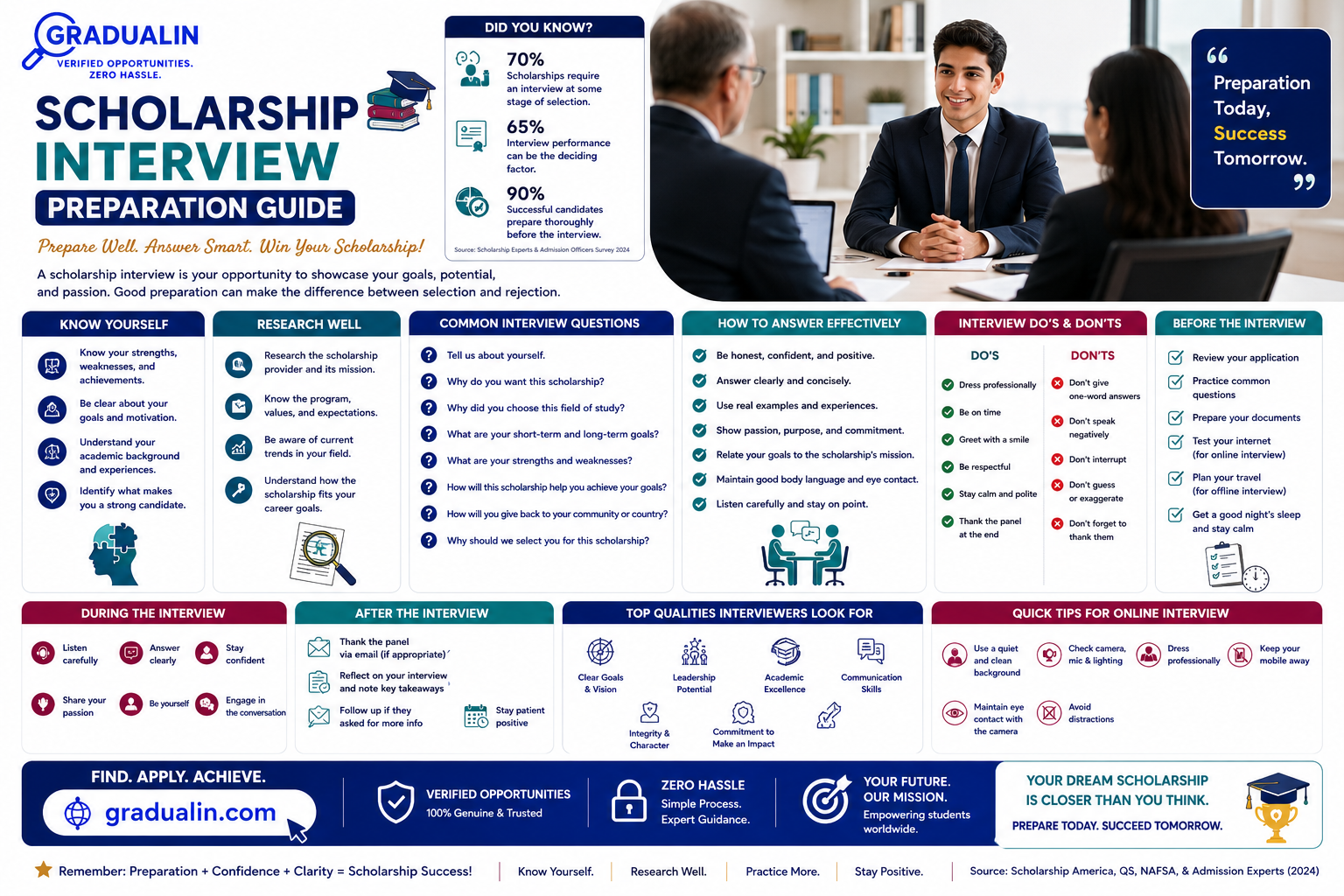
You made it. Out of thousands of applicants, a scholarship committee looked at your documents and said — we want to meet this person. That is a huge deal. Getting invited to a scholarship interview means your application already impressed them. Now the only thing standing between you and life-changing funding is a conversation.
But here is the truth: most candidates lose scholarships not because they are unqualified — they lose because they are unprepared. They freeze on simple questions, give vague answers, or fail to connect their story to the scholarship’s mission. This complete Gradualin guide will make sure that does not happen to you. From the most common questions to body language, dress code, and the one thing interviewers are really looking for — everything is here.
📋 Quick Overview
| Detail | Information |
| Guide Type | Scholarship Interview Preparation |
| Who It’s For | All international students applying for scholarships |
| Applies To | Chevening, Fulbright, Erasmus, DAAD, Gates, and all major scholarships |
| Difficulty | Moderate — fully manageable with the right preparation |
| Time to Prepare | Minimum 1–2 weeks before your interview date |
| Category | 📚 Guidelines & Resources |
📚 Why Scholarship Interviews Matter More Than You Think
A scholarship interview is not a formality. It is the final filter — and for many prestigious scholarships like Chevening, Fulbright, Gates Cambridge, or DAAD, the interview carries enormous weight in the final decision.
Think about it from the committee’s perspective. They have read hundreds of personal statements that all sound polished and impressive on paper. The interview is their chance to meet the real person behind the documents. They want to know:
- Can this person represent our scholarship well?
- Are their goals genuine and realistic?
- Will they actually use this opportunity to make a difference?
The good news is that scholarship interviewers are not trying to trick you or make you fail. They are genuinely hoping you give them a reason to fund you. Your job is simply to show them — clearly, confidently, and authentically — that you are exactly who they are looking for.
📚 How to Research Before Your Interview
Preparation starts long before the day of the interview. Here is what you need to research thoroughly:
1. Know the Scholarship Inside Out
- Read the scholarship’s official website from top to bottom
- Understand its mission, values, and selection criteria
- Know its history — when was it founded, who funds it, how many scholars does it produce each year?
- Read about past scholars and what they went on to achieve
2. Know Your Own Application
- Re-read your personal statement and motivation letter — word for word
- Every claim you made in your application is fair game for the interview
- Be ready to expand on anything you wrote with specific examples
3. Know Your Field and Goals
- Be able to speak clearly about why you chose your field of study
- Know current trends, challenges, and opportunities in your area
- Be specific about what you want to do after the scholarship — vague answers kill applications
4. Know the Country and University
- If studying abroad, research the country’s education system, culture, and your target university
- Be able to explain why that specific university and why that specific country
📚 The Most Common Scholarship Interview Questions (With How to Answer Them)
These are the questions that appear — in some form — in almost every scholarship interview in the world. Master these and you will walk in ready for anything.
🔹 “Tell me about yourself.”
This is almost always the first question — and most candidates waste it by reciting their CV. Don’t do that. The committee already read your CV.
Instead, tell a compelling 60–90 second story that connects:
- Where you come from (briefly)
- What shaped your passion for your field
- Where you are headed
Example structure: “I grew up in [country/city], where I saw [problem/challenge] firsthand. That experience drove me to study [field], and over the past [X] years I’ve [key achievement]. This scholarship is the next step in my plan to [specific goal].”
🔹 “Why do you deserve this scholarship?”
This is not the time for false modesty. Frame your answer around merit and impact — not need.
Talk about:
- Your academic and professional achievements
- What makes your goals uniquely aligned with the scholarship’s mission
- How you will give back or contribute after graduation
What to avoid: Saying “I need the money” or “I’ve always wanted to study abroad.” These answers focus on what you want — not what you will contribute.
🔹 “Why this scholarship specifically?”
This is a loyalty test. The committee wants to know that you chose them intentionally — not just because they are funded.
Show that you understand:
- The scholarship’s values and how they match yours
- Specific past scholars or alumni who inspire you
- What the scholarship offers that others don’t
🔹 “What are your career goals?”
Be specific. “I want to make a difference” is not a goal — it is a wish. A strong answer sounds like:
“Within five years of completing my Master’s in [field], I plan to [specific role or initiative]. Within ten years, I aim to [broader impact]. I chose [scholarship] because its focus on [theme] directly supports this path.”
🔹 “What is your biggest weakness?”
Don’t say “I work too hard” — interviewers have heard it a thousand times. Pick a genuine but manageable weakness, and follow it immediately with what you are doing to address it.
Example: “I used to struggle with public speaking, which held me back in my first year. I joined a debate club, took a communication workshop, and now I actively seek out speaking opportunities. It is still something I work on, but I have seen real improvement.”
🔹 “How will you contribute to your home country after graduation?”
This question is critical for scholarships focused on development and leadership (Chevening, Fulbright, DAAD, etc.). They are investing in you to create change — not just to give you a degree.
Be specific about:
- The problem you want to solve in your country or community
- The role your degree will play in solving it
- How you plan to use your international experience when you return
🔹 “Where else have you applied?”
Be honest. Saying you are only applying to one scholarship can actually seem less credible. The better answer is:
“I have applied to [1–2 others], but [this scholarship] is my first choice because of [specific reason]. The values and network align most closely with what I want to achieve.”
🔹 “Do you have any questions for us?”
Always say yes — and always have a thoughtful question ready. This shows genuine interest and intellectual engagement.
Good questions include:
- “What qualities do you see in scholars who make the most of this programme?”
- “How does the scholarship support alumni in the long term?”
- “What does the selection committee value most in this round?”
Never ask: Questions that are already answered on the website. It signals you did not prepare.
📚 Before the Interview — A Preparation Checklist
Use this checklist in the week leading up to your interview:
Academic & Research Prep:
- ✅ Re-read your personal statement, CV, and all submitted documents
- ✅ Research the scholarship’s history, mission, and past scholars
- ✅ Research your target university and country (if applicable)
- ✅ Prepare 3–4 specific examples of your achievements using the STAR method (Situation, Task, Action, Result)
- ✅ Know current events or trends in your field of study
Practical Prep:
- ✅ Confirm the interview format — in-person, video call, or panel
- ✅ If video: test your camera, microphone, internet connection, and background at least 48 hours before
- ✅ If in-person: plan your route and arrive 15–20 minutes early
- ✅ Prepare your outfit the night before
- ✅ Print or save copies of your application documents for reference
Mental Prep:
- ✅ Practice answering out loud — not just in your head
- ✅ Record yourself and review your tone, pace, and body language
- ✅ Do a mock interview with a friend, mentor, or Gradualin community member
- ✅ Get a full night’s sleep before the interview
📚 What to Wear to a Scholarship Interview
First impressions are made in the first seven seconds — long before you say a word. Dressing appropriately shows respect for the opportunity and signals professionalism.
General rule: Dress one level above what you think is required.
For formal scholarships (Chevening, Fulbright, Gates Cambridge, DAAD, government scholarships):
- Men: Dark suit or smart blazer with dress trousers, collared shirt, tie optional but recommended
- Women: Formal dress, blazer with trousers or skirt, or a professional suit — keep it clean and conservative
For semi-formal scholarships (university-specific, research grants):
- Smart casual — clean, pressed, professional. No jeans, no sneakers.
For video interviews:
- Dress as if it were in-person — the whole outfit, not just the top half
- Choose solid colours over busy patterns — they look cleaner on camera
- Avoid very bright whites or reds, which can distort on screen
- Check your background: neutral, tidy, well-lit
What to avoid:
- ❌ Overly casual clothing (jeans, t-shirts, hoodies)
- ❌ Strong perfume or cologne — distracting in close spaces
- ❌ Excessive accessories or jewellery
- ❌ Clothes you have never worn before on the interview day
📚 Body Language — The Silent Part of Your Interview
You could give the perfect verbal answer and still lose points if your body language says otherwise. Here is what the committee is watching:
✅ Do:
- Maintain natural, comfortable eye contact — especially when answering key questions
- Sit up straight with shoulders relaxed — not stiff, not slouched
- Nod gently when listening to show engagement
- Use calm, controlled hand gestures to emphasise points
- Smile genuinely when appropriate — especially during greetings and closing
- Pause for a second before answering difficult questions — it shows thoughtfulness, not confusion
❌ Don’t:
- Avoid crossing your arms — it looks defensive and closed off
- Don’t fidget with your hands, pen, or clothing — it signals nervousness
- Avoid looking down or away when answering — it reduces perceived confidence
- Don’t rush your answers — slow down and breathe
- Avoid filler words like “um”, “like”, “you know” — practice eliminating them
📚 The STAR Method — Your Secret Weapon for Every Behavioural Question
Many scholarship interviews include behavioural questions that start with “Tell me about a time when…” or “Give me an example of…”. The STAR method is the cleanest way to answer them:
- S — Situation: Set the scene briefly. Where were you? What was the context?
- T — Task: What was your role or responsibility?
- A — Action: What specific steps did you take? (This is the most important part — be detailed here)
- R — Result: What happened as a result of your actions? Use numbers or specifics where possible.
Example question: “Tell me about a time you showed leadership.”
STAR answer: “During my final year at university (Situation), our research group had a project stall because two members disagreed on methodology (Task). I organised a structured meeting, created a comparison framework for both approaches, and facilitated a vote (Action). We completed the project two weeks ahead of schedule and it was selected for our faculty’s annual showcase (Result).”
Short, specific, impactful. That is what wins scholarship interviews.
📚 Common Mistakes That Cost Candidates the Scholarship
These are the errors that interviewers see again and again — and that you can easily avoid:
- ❌ Memorising answers word-for-word: It sounds robotic. Know your key points, not a script
- ❌ Being vague about goals: “I want to help my community” is not a plan. Give specifics
- ❌ Not researching the scholarship: Nothing signals disinterest faster than asking a question that is answered on the website
- ❌ Talking too much: Concise, focused answers are always better than long, wandering ones. Aim for 90 seconds per answer
- ❌ Not preparing questions: Saying “no, I don’t have any questions” makes you seem unengaged
- ❌ Criticising your home country or previous institutions: Stay positive and solution-focused
- ❌ Arriving late or unprepared for tech issues: For virtual interviews especially, test everything in advance
- ❌ Forgetting to follow up: A short, professional thank-you email within 24 hours of the interview leaves a lasting positive impression
📚 After the Interview — What to Do Next
The interview does not end when you walk out the door. Here is what to do immediately after:
- Write down every question you were asked — while it is fresh in your memory. This is invaluable for future interviews
- Note what went well and what you want to improve — be honest with yourself
- Send a thank-you email within 24 hours — keep it brief, warm, and professional. Thank them for their time and reaffirm your enthusiasm for the scholarship
- Do not follow up repeatedly — one thank-you email is professional; multiple follow-ups become annoying
- Keep applying — do not put all your eggs in one basket. Use the experience to get better for the next opportunity
📚 Frequently Asked Questions (FAQ)
Q: How long does a scholarship interview usually last? A: Most scholarship interviews last between 20 and 45 minutes. Panel interviews for major scholarships like Chevening or Fulbright tend to run 30–45 minutes. University-level scholarship interviews may be shorter at 15–20 minutes. Prepare enough material for a full 45-minute conversation, even if yours is shorter.
Q: How many interviewers will be on the panel? A: Most scholarship panels have 2–4 interviewers. Some may have just one. You will typically receive this information in your interview invitation — if not, it is completely acceptable to email and ask in advance.
Q: Should I memorise my answers? A: No. Memorised answers sound rehearsed and unnatural. Instead, memorise your key points, specific examples, and the core narrative of your story. Let the exact words come naturally in the moment.
Q: What if I do not know the answer to a question? A: Do not panic — and do not make something up. It is far better to say: “That is a great question. I don’t have a precise answer ready, but based on what I know about [related topic], I would say…”. Intellectual honesty is a quality scholarship committees respect.
Q: Can I ask for the question to be repeated? A: Absolutely. If you do not understand a question, it is perfectly professional to say: “Could you please clarify what you mean by…?” or “I want to make sure I answer this correctly — are you asking about…?”. This shows attentiveness, not weakness.
Q: Is it okay to be nervous? A: Yes — and most interviewers expect it. A little nervousness is normal and even signals that you care. The goal is not to eliminate nerves but to manage them. Deep breathing, thorough preparation, and mock interviews are the best tools for this.
📚 Final Thought — What Interviewers Are Really Looking For
Here is what every experienced scholarship interviewer will tell you: they are not just looking for the smartest candidate. They are looking for the most genuine, prepared, and purposeful one.
They want to fund someone who:
- Knows exactly what they want and why
- Has a realistic, well-thought-out plan
- Will represent the scholarship’s values in the world
- Will come back and make a real impact — not just a career
Walk into that room as yourself — prepared, confident, and clear about your purpose. That combination is more powerful than any memorised answer.
You already earned the interview. Now go earn the scholarship.
🔗 Explore More on Gradualin
Browse by Category:
Top Scholarship Opportunities:
- 🎓 Top 10 Fully Funded Scholarships in the World 2026–2027
- 🎓 Fully Funded Scholarships USA 2026 — International Students
- 🎓 Fully Funded PhD Scholarships UK 2026 — International Students
- 🎓 Finland Scholarships 2026 — International Students & Tuition Waivers
- 🎓 Fully Funded Scholarships Australia 2026 — International Students
- 🎓 Top 10 Fully Funded Scholarships Asia 2027 — International Students
Related Guidelines:
- https://gradualin.com/how-to-write-recommendation-letter-scholarship-guide-samples/
- https://gradualin.com/how-to-write-cold-email-to-professor-tips-format-sample/
- https://gradualin.com/how-to-make-cv-scholarship-application-2026-guide-template/
- https://gradualin.com/how-to-write-statement-of-purpose-sop-scholarship-2026-guide-sample/
Stay updated with the latest scholarships, jobs, and opportunities at Gradualin.com — your trusted guide to studying abroad for free.