
A scholarship application without a strong recommendation letter is like a CV without work experience — it is technically complete, but it leaves the committee unconvinced. In fact, for many of the world’s most competitive scholarships — Fulbright, Chevening, DAAD, Erasmus, and hundreds of university-specific awards — the recommendation letter can be the single deciding factor between a funded offer and a rejection.
The problem? Most applicants have no idea what makes a recommendation letter truly powerful. And most recommenders — professors, supervisors, managers — are busy people who appreciate clear guidance on what to write.
This Gradualin complete guide covers everything: what a scholarship recommendation letter is, what it must contain, how to ask for one professionally, a step-by-step writing guide for recommenders, three ready-to-use samples, and the most common mistakes that get applications rejected. Whether you are the applicant asking someone to write for you, or the recommender sitting down to write, this guide has you covered.
📚 Quick Info Box
| Detail | Information |
| Document Type | Recommendation / Reference Letter |
| Used For | Scholarship applications, graduate admissions, fellowships |
| Written By | Professor, supervisor, employer, or academic advisor |
| Requested By | The scholarship applicant |
| Typical Length | 300–600 words (1 page, maximum 1.5 pages) |
| Format | Formal letter on official letterhead |
| Tone | Professional, specific, evidence-based |
| Number Required | Usually 2–3 letters per application |
📚 What Is a Scholarship Recommendation Letter?
A recommendation letter for a scholarship (also called a reference letter or support letter) is a formal document written by someone who knows the applicant professionally or academically. It provides the scholarship committee with a third-party, credible assessment of the applicant’s:
- Academic or professional capabilities
- Character and personal qualities
- Suitability for the specific scholarship or program
- Potential for future impact and success
Think of it this way: your CV tells the committee what you have done. Your personal statement tells them who you are. The recommendation letter tells them how others see you — and that outside perspective carries enormous weight.
What makes this document so important is that it is the only part of your application written by someone other than you. A strong, specific, enthusiastic letter from the right person can tip a borderline application into an acceptance. A generic, vague letter from the wrong person can sink an otherwise strong application.
📚 Who Should Write Your Recommendation Letter?
Choosing the right recommender is just as important as the content of the letter itself. Here is how to think about it:
✅ Ideal recommenders:
- A professor or academic supervisor who has directly taught or supervised your research
- A PhD supervisor or thesis advisor who can speak to your research skills in depth
- A direct line manager or employer who can confirm your professional capabilities and work ethic
- A principal investigator (PI) if you have worked in a lab or research setting
- An academic advisor who knows your trajectory and goals
❌ Avoid these recommenders:
- Family members or personal friends (never appropriate)
- Professors who only knew you as one of 200 students in a large lecture course
- Supervisors you worked with only briefly or who barely know your work
- People with impressive titles but little direct knowledge of you
- Anyone who seems hesitant or unenthusiastic when you ask
The golden rule: choose someone who can write about specific examples of your work, abilities, and character — not someone who will write a generic paragraph about your good grades.
📚 How to Ask for a Recommendation Letter (The Right Way)
Most applicants feel awkward asking for a recommendation letter. Here is how to do it professionally and make the process easy for your recommender — which also increases the quality of the letter they write.
Step 1: Ask early Give your recommender at least 4–6 weeks before the deadline. Asking at the last minute is disrespectful and produces rushed, weak letters.
Step 2: Ask in person or via a thoughtful email Do not send a casual text. Request a brief meeting or write a formal, respectful email explaining:
- Which scholarship you are applying for
- Why you chose them as a recommender
- What the deadline is
- What the scholarship values (so they can tailor their letter)
Step 3: Provide a complete information pack Make their job easy by sending:
- Your CV
- Your personal statement or SOP
- A brief summary of your academic or professional highlights they might reference
- The scholarship requirements and values
- The exact deadline and submission instructions
- A sample structure or guidance on what the committee is looking for (you can share this guide)
Step 4: Follow up politely One week before the deadline, send a gentle reminder. Never assume it has been submitted until you receive confirmation.
Step 5: Always say thank you After the process — regardless of outcome — send a sincere thank-you note. This is basic professional courtesy and builds a long-term relationship.
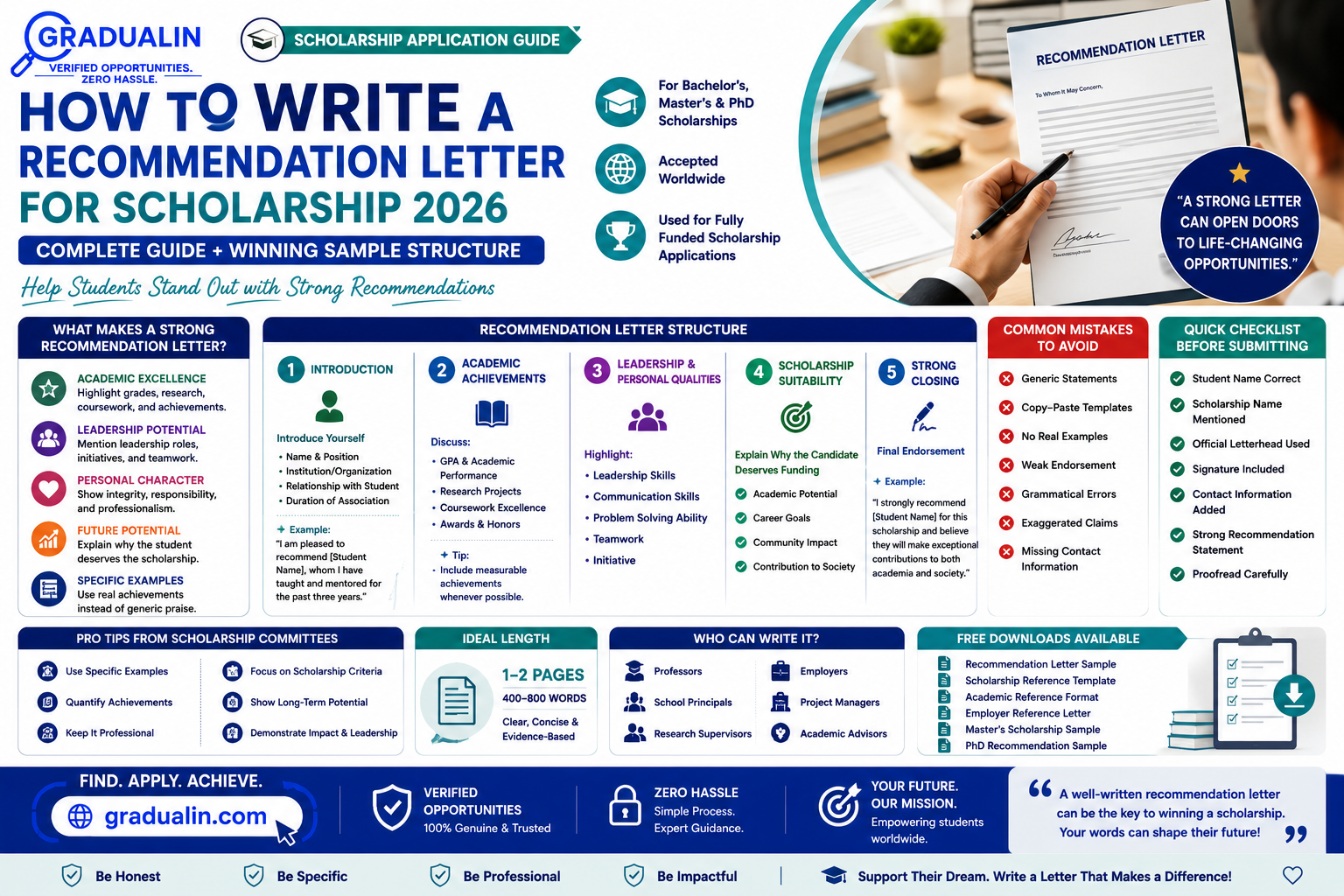
📚 Structure of a Strong Recommendation Letter
Every powerful scholarship recommendation letter follows a clear structure. Here it is, section by section:
1. Opening Paragraph — Who the recommender is and their relationship to the applicant The recommender introduces themselves, their position, institution, and how long and in what capacity they have known the applicant. This establishes their credibility.
2. Second Paragraph — Academic or professional assessment Specific evidence of the applicant’s abilities. This is where grades, research contributions, project leadership, publications, or professional achievements are mentioned with concrete examples.
3. Third Paragraph — Personal qualities and character What makes this person stand out as a human being? Intellectual curiosity, resilience, leadership, teamwork, initiative — illustrated with a real story or specific instance, not vague adjectives.
4. Fourth Paragraph — Why this scholarship is the right fit The recommender explains why this applicant is specifically suited for this scholarship, program, or opportunity. The best letters reference the scholarship by name and values.
5. Closing Paragraph — Unequivocal endorsement A clear, confident statement of recommendation — not “I believe she would do well” but “I recommend her without reservation as one of the most capable students I have supervised in 15 years.”
6. Signature Block Full name, title, institution, email address, phone number, and date. On official letterhead if possible.
📚 Three Ready-to-Use Recommendation Letter Samples
Sample 1 — Academic Recommendation Letter (Professor for Master’s Scholarship)
[University Letterhead]
Date: [Date]
To the Scholarship Committee,
It is my great pleasure to recommend [Applicant Name] for the [Scholarship Name]. I am an Associate Professor of Environmental Sciences at [University Name], where I have known [Applicant Name] for three years — first as a student in my Advanced Research Methods course, and subsequently as a supervised research assistant on my funded project on water quality in urban ecosystems.
[Applicant Name] consistently demonstrated exceptional analytical ability and intellectual depth. During her time on my research project, she independently identified a methodological gap in our data collection approach that had been overlooked by the broader team. Her subsequent recommendations improved the accuracy of our results, and her contribution was formally acknowledged in our published paper in [Journal Name, Year].
Beyond her technical capabilities, [Applicant Name] brings a rare combination of curiosity and professional maturity. During a particularly challenging phase of the project, she took on additional responsibilities without being asked, mentored two junior research assistants, and delivered a progress presentation to our external funders with remarkable confidence and clarity.
The [Scholarship Name]’s focus on [key value, e.g., “environmental sustainability and global impact”] aligns precisely with [Applicant Name]’s stated research goals and demonstrated track record. I believe she will represent this scholarship with distinction.
I recommend [Applicant Name] without reservation and am confident she will make a meaningful contribution to your program. Please do not hesitate to contact me at [email] if further information would be helpful.
Sincerely, [Full Name] [Title], [Department] [University Name] [Email] | [Phone]
Sample 2 — Professional/Employer Recommendation Letter (For a Career-Based Scholarship)
[Company Letterhead]
Date: [Date]
To the Scholarship Selection Committee,
I am writing in strong support of [Applicant Name]‘s application for the [Scholarship Name]. I am the [Job Title] at [Company/Organization Name] and have worked directly with [Applicant Name] for [X years] as their line manager.
During this time, [Applicant Name] has been one of the most driven and capable professionals on my team. In [Year], they led the restructuring of our [specific project or department], delivering the project three weeks ahead of schedule and under budget — a first for our division. Their ability to manage cross-functional teams, communicate with senior stakeholders, and maintain quality under pressure is exceptional for someone at their career stage.
What distinguishes [Applicant Name] from peers is their long-term vision. They consistently connect their daily work to broader organizational and societal goals — a quality I believe will serve them exceptionally well in an advanced academic program. I have watched them invest personal time in learning [relevant skills], demonstrating a commitment to growth that goes well beyond job requirements.
The [Scholarship Name] will provide [Applicant Name] with the academic foundation to amplify the impact they are already making professionally. I wholeheartedly endorse their application.
Yours sincerely, [Full Name] [Title], [Company Name] [Email] | [Phone]
Sample 3 — Short & Powerful Recommendation Letter (PhD Fellowship)
[Institution Letterhead]
Date: [Date]
To the Fellowship Committee,
In my 20 years of supervising doctoral candidates, I have recommended fewer than ten students “without reservation.” [Applicant Name] is one of them.
I supervised [Applicant Name]’s Master’s thesis on [topic] at [University]. Their research demonstrated both methodological rigor and creative thinking — a combination that is genuinely rare at the postgraduate level. One chapter of their thesis has since been revised and accepted for publication in [Journal Name].
[Applicant Name] is intellectually fearless. They challenge assumptions — including mine — in ways that elevate the entire research process. They are also an outstanding collaborator: respected, dependable, and generous with their expertise.
The [Fellowship Name] would be in exceptional hands with [Applicant Name]. I recommend them with complete confidence.
Professor [Full Name] [Department], [University] [Email]
📚 Common Mistakes That Weaken Recommendation Letters
Knowing what not to do is just as important as the guidance above. Share this section with your recommender:
- ❌ Being vague — “She is a hardworking student” tells the committee nothing. “She submitted her thesis two months early and asked for more work” tells them everything.
- ❌ Repeating the CV — Do not simply list the applicant’s achievements. Add color, context, and personal observation.
- ❌ Lukewarm language — “I think she would do reasonably well” signals doubt. Use confident, affirmative language.
- ❌ Too short — A recommendation letter under 250 words looks like it was written in five minutes. Aim for 350–550 words.
- ❌ Generic opening — “I am pleased to recommend [Name] for this scholarship” is used by everyone. Open with something specific and memorable.
- ❌ No specific examples — Every positive claim must be backed by a real example. Adjectives without evidence carry no weight.
- ❌ Wrong tone — Overly casual or overly stiff letters both undermine credibility. Aim for warm professionalism.
- ❌ Missing contact details — The committee may want to follow up. Always include a working email and phone number.
📚 Recommendation Letter Checklist
Before submitting, confirm the letter includes:
- ✅ Official letterhead of the recommender’s institution or organization
- ✅ Date and address block
- ✅ Clear statement of the recommender’s relationship to the applicant and duration
- ✅ At least 2–3 specific examples of the applicant’s abilities or achievements
- ✅ Commentary on personal character and soft skills
- ✅ Direct reference to the scholarship by name
- ✅ Unambiguous, enthusiastic endorsement in the closing
- ✅ Full name, title, institution, email, and phone number
- ✅ Signature (physical or digital)
- ✅ Length between 350–600 words
📚 Frequently Asked Questions (FAQs)
Q: How many recommendation letters do I need for a scholarship? A: Most scholarships require 2–3 letters. Always check the specific requirements of each scholarship. For PhD programs and fellowships, 3 letters is the standard. For undergraduate scholarships, 1–2 is typical.
Q: Can I write a draft for my recommender to edit? A: Yes — and many recommenders actually appreciate this. It is not dishonest; it is efficient. Write the draft in their voice, based on experiences they shared with you. Ask them to edit, add their own perspective, and sign it as their own. Always make clear it is a starting draft for their input, not a final letter.
Q: What if my recommender is from a non-English-speaking country? A: The letter must be in English (for English-medium scholarships). Your recommender may write it in their language and have it professionally translated, or write it directly in English if they are proficient. Some scholarship portals accept translated letters with a signed declaration.
Q: How far in advance should I request a recommendation letter? A: Minimum 4 weeks before the deadline. 6–8 weeks is strongly preferred, especially if your recommender is a busy academic or senior professional. The more time they have, the better the letter.
Q: What if my recommender says no? A: Accept it gracefully and thank them. A reluctant recommender writes a weak letter. Ask someone else who is genuinely enthusiastic about supporting you — that enthusiasm shows in the writing.
Q: Should the recommendation letter be submitted by me or directly by the recommender? A: Most scholarships require letters to be submitted directly by the recommender — either via an online portal (where a link is sent to them) or by email to the committee. Never submit your own recommendation letter unless explicitly permitted.
📚 Official Application Resources
Use these Gradualin resources to complete your full scholarship application package:
- 📄 How to Write a Motivation Letter for Scholarship — Complete Guide
- 📄 How to Write a Statement of Purpose (SOP) — Step-by-Step with Sample
- 📄 How to Make a CV for Scholarship Application — Guide with Template
- 📄 How to Write a Cold Email to a Professor
🔗 Explore More on Gradualin
Browse by Category:
Top Scholarship Opportunities:
- 🔗 Top 10 Fully Funded Scholarships in the World 2026–2027
- 🔗 Fully Funded Scholarships in Australia 2026
- 🔗 Fully Funded PhD Scholarships UK 2026
- 🔗 Fully Funded Scholarships USA 2026
- 🔗 Study Abroad Without IELTS 2026 — Complete Guide
- 🔗 10 Cheapest Countries to Study Abroad 2026
Stay updated with the latest scholarships, jobs, and opportunities at Gradualin.com — your trusted guide to studying abroad for free.