
Canada Graduate Research Scholarship Doctoral 2026 — $40,000/Year for PhD Students
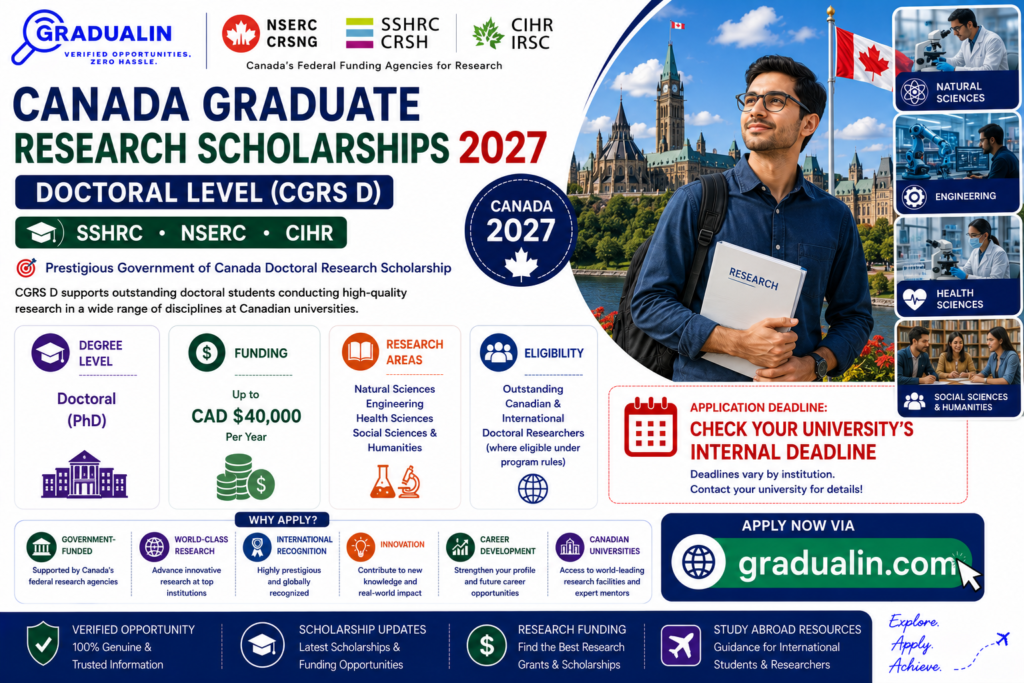
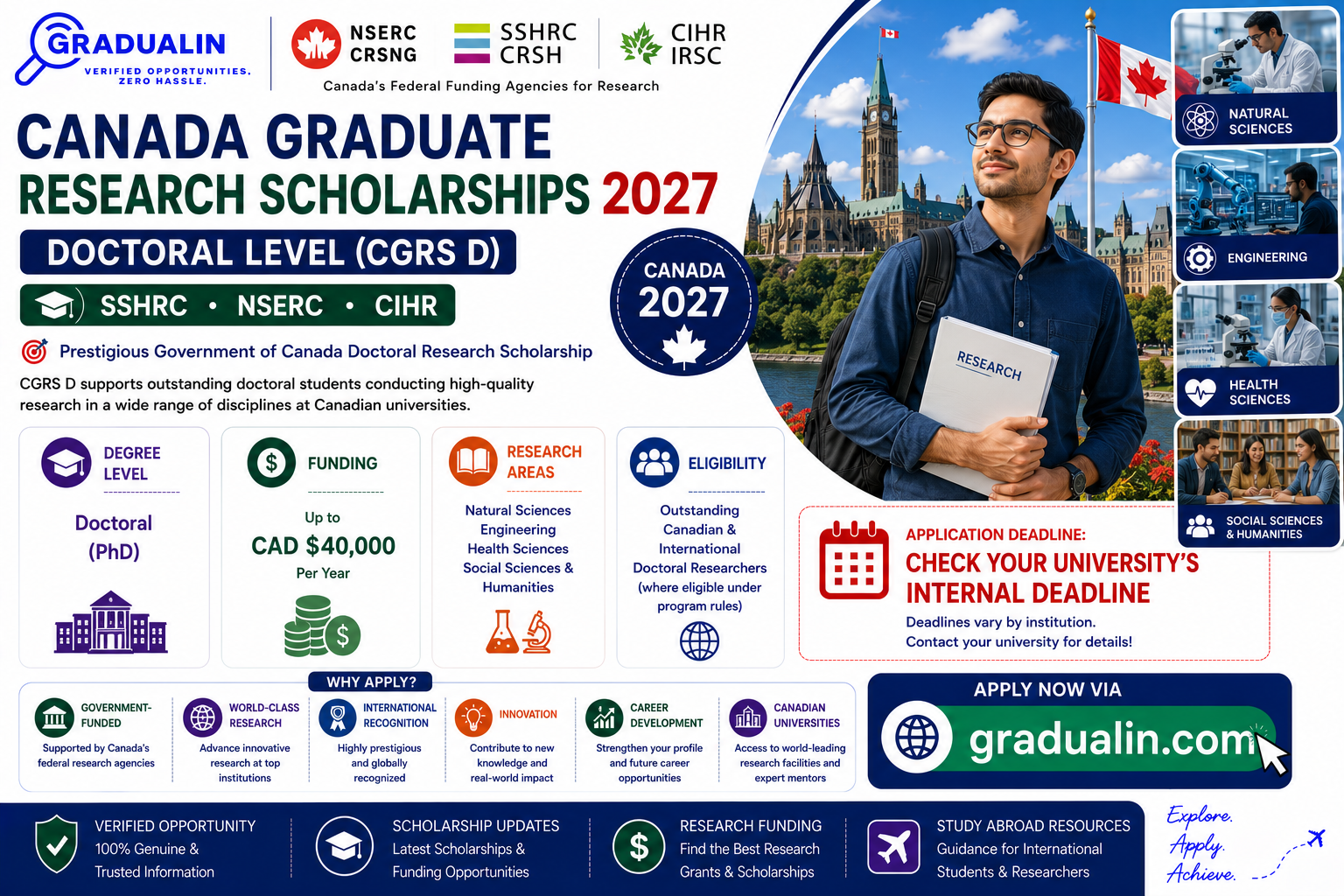
The Government of Canada is offering one of the most prestigious doctoral awards in the world — the Canada Graduate Research Scholarship – Doctoral (CGRS-D) 2026 — worth CAD $40,000 per year for up to three years. Administered jointly by CIHR, NSERC, and SSHRC, this scholarship supports outstanding PhD students across every academic discipline: health sciences, natural sciences, engineering, social sciences, and the humanities. Both Canadian citizens and international students enrolled in Canadian doctoral programs are eligible. In this guide, you’ll find everything you need — eligibility rules, application steps, deadlines, and insider tips — to put your strongest application forward before institutional windows start closing in September 2026.
Quick Info Box
| Detail | Information |
| Awarding Body | Government of Canada — CIHR, NSERC & SSHRC (Tri-Agency) |
| Country | Canada |
| Degree Level | Doctoral (PhD) |
| Funding | CAD $40,000 per year |
| Duration | Up to 36 months (3 years) |
| Deadline (Agency) | 17 October 2026 at 8:00 PM ET — institutional deadlines are earlier |
| Open To | Canadian citizens, permanent residents, and international students enrolled at a Canadian institution |
| Fields | All disciplines — Health (CIHR), Sciences & Engineering (NSERC), Social Sciences & Humanities (SSHRC) |
| Official Link | CGRS-D Official Page |
🎓 About the Canada Graduate Research Scholarship — Doctoral
The CGRS-D — also widely known by its former name, the CGS-D — is the flagship doctoral training award of the Canadian federal government. It sits within the Canada Research Training Awards Suite (CRTAS), a tri-agency initiative run by three of Canada’s most respected research councils: the Canadian Institutes of Health Research (CIHR), the Natural Sciences and Engineering Research Council (NSERC), and the Social Sciences and Humanities Research Council (SSHRC).
What makes the CGRS-D distinct is its scope. Unlike awards tied to a single university or department, this is a national competition that accepts doctoral students from virtually every academic field. The goal is straightforward: give exceptional researchers the financial freedom to focus on their PhD without worrying about how to pay their rent.
This is also one of the few doctoral awards where international students can compete on the same national platform as Canadian citizens — up to 15% of total awards are reserved for international applicants. And with the Vanier Canada Graduate Scholarship now discontinued, the CGRS-D has effectively become the most important doctoral scholarship the Government of Canada offers.
🎓 Benefits & Funding
Here’s exactly what CGRS-D award holders receive:
- CAD $40,000 per year stipend for living and research expenses
- Up to 36 months (3 years) of funding — enough to cover the core of most PhD programs
- Freedom to hold the award at any eligible Canadian institution, or at select institutions abroad (Canadian citizens/PRs only)
- Priority research domains — applicants whose research aligns with government-designated priority areas (AI, clean tech, health, climate, food security, etc.) may be eligible for additional awards on top of the standard competition
- Indigenous scholars supplement: self-identified Indigenous scholars may receive an additional CAD $5,000 supplement for one year (verify on official website)
- Black scholars initiative: each agency may award up to 10 additional CGRS-D awards specifically for self-identified Black doctoral researchers
- Part-time holding option is available in certain circumstances (verify with your agency)
Note: this award is a stipend/fellowship — it does not guarantee tuition coverage. Check with your institution about whether additional tuition support is provided alongside the award.
🎓 Eligibility Criteria
To qualify for the CGRS-D 2026, you must meet all of the following conditions:
- Citizenship/Status: Canadian citizen, permanent resident, protected person under the Immigration and Refugee Protection Act — OR an international student currently enrolled in a doctoral program at an eligible Canadian institution
- Program stage: You must have completed no more than 36 months of full-time equivalent doctoral study by 31 December 2026
- Program type: Your doctoral program must include a significant research component leading to a thesis, major research project, scholarly publication, or equivalent output evaluated by a faculty committee
- No prior doctoral award: You must NOT have previously received a doctoral-level scholarship from CIHR, NSERC, or SSHRC — including the Vanier CGS
- Faculty restriction: You cannot hold a tenure-track faculty appointment at the same time as the award (for CIHR and NSERC applicants)
- Application limit: You can submit only one CRTAS application per academic year; no more than three CGRS-D applications total over your studies
- English language: No specific English test (IELTS, TOEFL) is required by the CGRS-D program itself — language requirements are set by your host Canadian institution. Check directly with your university
Joint programs (MA/PhD, MSc/PhD, MD/PhD, etc.) are eligible — month counting rules differ by program type. See the official page for your specific situation.
🎓 Who Should Apply — and Who Shouldn’t
✅ Strong candidates:
- PhD students within their first 36 months of doctoral study in any discipline
- International students already enrolled at a Canadian university — this is one of the rare government awards accessible to you
- Researchers whose work touches priority areas like AI, climate resilience, health, or food security — extra awards exist for you
- Students who have NOT previously received a doctoral fellowship from the tri-agencies
- Applicants with a strong publication record, conference presentations, or community research engagement
❌ Not eligible:
- Students beyond 36 months of full-time doctoral study by December 2026
- Applicants who have already received a CGS-D, CGRS-D, or Vanier scholarship
- International students NOT currently enrolled at a Canadian institution — you must be registered at a qualifying Canadian university
- Those holding a tenure-track faculty position simultaneously (for CIHR and NSERC awards)
🎓 Eligible Fields & Which Agency to Apply To
The CGRS-D covers all academic disciplines, but you must apply to the agency that best matches your research area. Choose carefully — the wrong agency means your application is evaluated by reviewers outside your field.
- CIHR — Health sciences, including biomedical, clinical, and population health research; some interdisciplinary health topics
- NSERC — Natural sciences, mathematics, computer science, and engineering; check NSERC’s health addendum if your research bridges health and engineering
- SSHRC — Social sciences, humanities, arts-based research, education, law, management, and related interdisciplinary work
If you’re unsure which agency fits your research, use the Selecting the Appropriate Federal Granting Agency guide or contact the agencies directly before submitting.
🎓 Priority Research Domains — Extra Awards Available
The 2024 federal budget unlocked additional CGRS-D awards for applicants whose research aligns with the following national priority areas. If your PhD touches one of these, flag it clearly in your application:
- Advanced digital technologies (including AI, quantum, and cybersecurity)
- Health, including biotechnology
- Clean technology and resource value chains
- Environment, climate resilience, and the Arctic
- Food and water security
- Democratic and community resilience
- Advanced manufacturing and materials
- Defence and dual-use technologies
These are not separate competitions — they’re additional awards layered on top of the main CGRS-D competition for meritorious applicants whose work fits.
🎓 Required Documents
Document requirements vary slightly by agency, but expect to prepare:
1. Online application form — completed through CIHR’s ResearchNet, NSERC’s Online System, or SSHRC’s registration portal
2. Canadian Common CV (CCV) — mandatory; each agency may require additional CV sections
3. Research proposal — includes research questions, methodology, expected contributions; page limits differ by agency — follow instructions exactly
4. Official transcripts — for all post-secondary studies completed; requests often due before the main deadline (e.g., 10–15 September at some universities)
5. Reference/support letters — submitted by referees directly through the agency’s online system; confirm their deadline with them early
6. Proof of enrolment or citizenship status if requested by your agency or institution
7. Equity, diversity and inclusion statement — optional self-identification data; may make you eligible for targeted supplements
Check your specific agency’s application instructions for exact page limits, formatting requirements, and additional components.
🎓 Step-by-Step Application Process
1. Choose your agency: CIHR, NSERC, or SSHRC — based on your research field. This is the most critical first step.
2. Confirm your submission route: Are you enrolled at a Canadian institution with a doctoral quota for your agency? Apply through your institution. If not, apply directly to the agency.
3. Contact your graduate office: Find your institutional deadline immediately — it can be 4–6 weeks before the agency deadline. Some universities close as early as 11 September 2026.
4. Request transcripts early: Many universities require a separate transcript request form submitted by early September. Don’t leave this until the last week.
5. Alert your referees now: Referees submit their letters directly to the agency system. Give them at least 6 weeks’ notice.
6. Build your Canadian Common CV (CCV): Log in at the CCV portal and fill out all sections relevant to your agency’s requirements.
7. Write your research proposal: Follow the agency’s page limit exactly. Reviewers are strict about formatting — a proposal that exceeds the limit may be disqualified.
8. Flag priority research areas: If your research fits one of the eight national priority domains, indicate this clearly where the application asks.
9. Submit via the agency portal:
10. Track your results: Results are announced by 30 April of the following year.
Pro tip: The biggest mistake applicants make is underestimating how long the Canadian Common CV takes. Start it the moment you decide to apply — it can take 8–10 hours to complete properly.
🎓 Important Dates
| Event | Date |
| CIHR application goes offline for applicants | 30 September 2026 (11:59 PM) |
| Typical institutional deadline range | September 11–26, 2026 (varies by university) |
| Agency deadline (direct applicants) | 17 October 2026, 8:00 PM ET |
| Results announced | By 30 April 2027 |
⚠️ Institutional deadlines are significantly earlier than the agency deadline. Contact your graduate office today. Bookmark this page and check back for updates.
🎓 Why the CGRS-D — and Why Canada
Canada consistently ranks among the top destinations for doctoral research. Its universities hold strong positions in global rankings, its research infrastructure is world-class, and its multicultural cities make international students genuinely welcome. Toronto, Montreal, Vancouver, and Ottawa are home to major research hubs — and doctoral students at Canadian universities benefit from access to national labs, research hospitals, and industry partnerships that few countries can match.
The CGRS-D specifically gives you something money can’t always buy: independence. At $40,000/year, the award is competitive enough to let you focus on your research rather than scrambling for teaching assistantships or additional part-time work. Award holders are recognized as some of Canada’s most promising researchers — a credential that carries weight in academia and industry alike.
And here’s what makes this different from most government scholarships: the CGRS-D is not tied to a single university. You can hold it at any eligible Canadian institution — meaning you can choose your supervisor and your research environment first, then bring your funding with you.
🎓 Frequently Asked Questions
Can international students apply for the CGRS-D?
Yes — international students can apply, but they must be enrolled in a doctoral program at an eligible Canadian institution at the time of application. Up to 15% of total awards are reserved for international applicants. International students cannot apply if they are not registered at a Canadian university.
Is this scholarship fully funded?
The CGRS-D provides a stipend of CAD $40,000 per year for up to three years. It is not automatically tied to tuition coverage — that depends on your university’s own policies and any additional awards. For many students, the stipend covers both tuition and living costs depending on program fees and city of study.
What is the difference between CGRS-D and the old CGS-D?
The CGRS-D is the renamed and harmonized successor to the CGS-D (Canada Graduate Scholarships – Doctoral). The program has been unified across CIHR, NSERC, and SSHRC under a single set of rules and the same $40,000 annual value. The Vanier CGS has been discontinued and those candidates are now directed to CGRS-D.
How competitive is the CGRS-D?
Highly competitive. Applications are evaluated on two equally weighted criteria: Research Potential (50%) and Relevant Experience and Achievements (50%). A strong research proposal, a compelling CV, and excellent reference letters are all essential. Applicants whose work aligns with national priority research areas have access to additional awards beyond the main competition pool.
Can I apply if I am already in the second or third year of my PhD?
Yes — as long as you have completed no more than 36 months of full-time equivalent doctoral study by 31 December 2026. Students past that 36-month threshold are not eligible. You may submit up to three CGRS-D applications over the course of your studies.
What if I don’t know whether to apply through my institution or directly to the agency?
Check whether your Canadian institution has a doctoral award quota from your chosen agency (CIHR, NSERC, or SSHRC). If it does, and you are currently enrolled there, you apply through the institution. If your university has no quota, or you are not enrolled at a Canadian institution, you apply directly to the agency. Your graduate office can confirm this.
🎓 Official Source & Contact
- CGRS-D Official Program Page (NSERC)
- CIHR contact: support-soutien@cihr-irsc.gc.ca
- NSERC contact: nsercscholarships-boursescrsng@nserc-crsng.gc.ca
- SSHRC contact: fellowships@sshrc-crsh.gc.ca
- Selecting the Right Federal Granting Agency
🎓 Summary Table
| Detail | Information |
| Awarding Body | Government of Canada — CIHR, NSERC & SSHRC |
| Country | Canada |
| Degree Level | Doctoral (PhD) |
| Annual Value | CAD $40,000/year |
| Duration | Up to 36 months |
| Disciplines | All — Health, Sciences & Engineering, Social Sciences & Humanities |
| Open to Internationals | Yes — must be enrolled at an eligible Canadian institution (up to 15% of awards) |
| Agency Deadline | 17 October 2026 — institutional deadlines from September 2026 |
| IELTS/Language Test | Not required by the program — set by your host institution |
| Apply Through | Official CGRS-D Portal |
🔗 Explore More on Gradualin
Standing Cluster Links:
- Fully Funded Scholarships in Australia 2026
- Fully Funded PhD Scholarships in the UK 2026
- Fully Funded Scholarships in the USA 2026
- Study in Italy 2026 — Guide for International Students
- Finland Scholarships 2026 — Tuition Waivers for International Students
- Top 10 Fully Funded Scholarships in Asia 2027
- Fully Funded PhD Positions in Switzerland 2026
- Top Fully Funded Scholarships in Saudi Arabia 2026
- Study in Turkey 2026 — Guide for International Students
- Study in Netherlands 2026 — Guide for International Students
- Study in Germany 2026 — Guide for International Students
- Study in Norway 2026 — Guide for International Students
- Study in Canada 2026 — Guide for International Students
Related Posts:
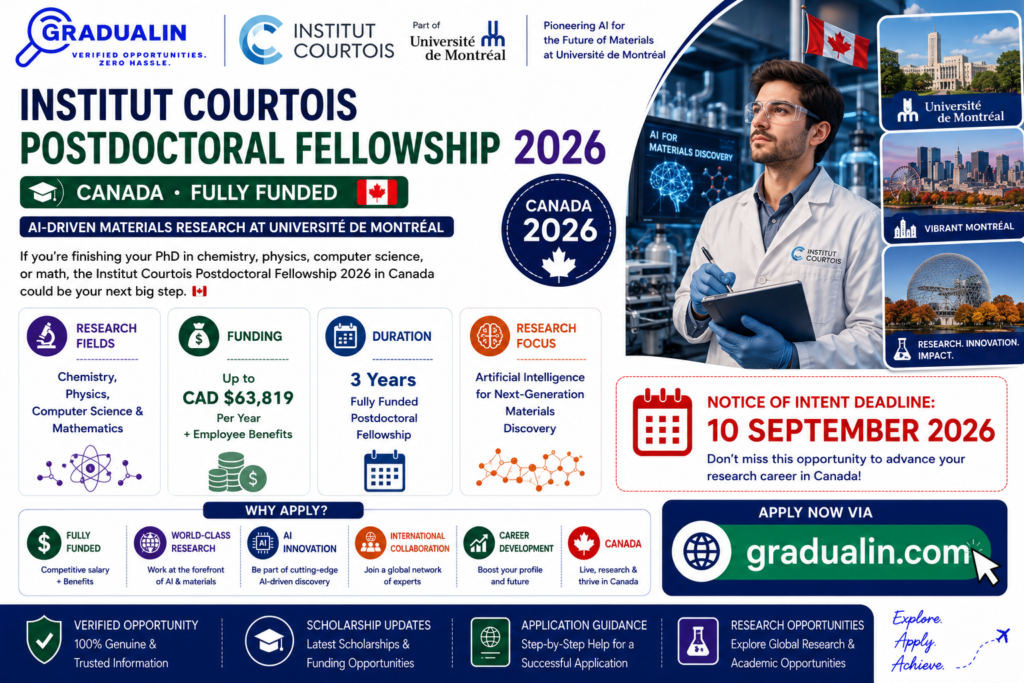
- Institut Courtois Postdoctoral Fellowship 2026 — CAD $63,819/Year in Canada
- Study in Canada 2026 — Guide for International Students
- Fully Funded PhD Positions in Switzerland 2026
Stay updated with the latest scholarships, jobs, and opportunities at Gradualin.com — your trusted guide to studying abroad for free.