
Complete Guide to Study in Germany 2026 — Free Tuition, Visas & Top Universities
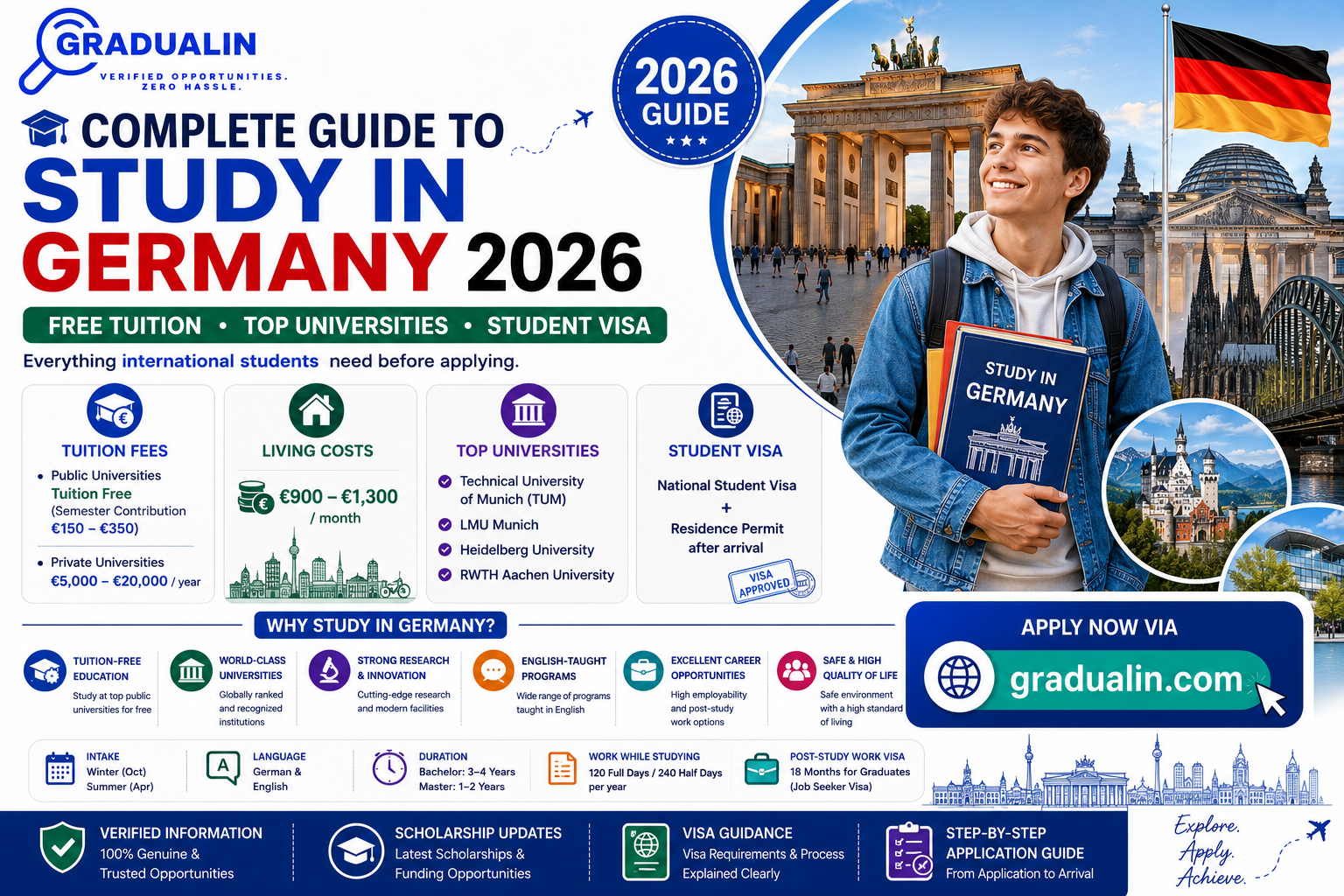
Germany has quietly become one of the world’s most popular study destinations — and the numbers prove it. Over 400,000 international students are currently enrolled at German universities, drawn by something almost unheard of in higher education: world-class degrees that cost close to nothing in tuition. Whether you are aiming for a master’s in engineering, a PhD in the sciences, or a business programme in the heart of Europe, Germany in 2026 offers a clear, structured, and genuinely affordable path. This guide covers everything you need to know — top universities, tuition costs, the blocked account, visa requirements, scholarships, English-taught options, and the step-by-step application process.
| Detail | Information |
| Country | Germany 🇩🇪 |
| System | Federal (16 states, 400+ universities) |
| Tuition at Public Universities | Free for most states; semester fee €100–€400 |
| Minimum Blocked Account (2026) | €11,904 (€992/month) |
| Living Costs | €850–€1,200/month depending on city |
| Language of Instruction | German or English (2,000+ English programmes) |
| Academic Year | Winter Semester (Oct) & Summer Semester (Apr) |
| Post-Study Work Visa | 18 months |
| Official Portal | Study in Germany (DAAD) |
📚 Why Germany? The Case for Studying Here in 2026
Germany sits at a very rare intersection: it is home to globally ranked universities and it charges almost no tuition fees. Since 2014, public universities across most of Germany’s 16 federal states have offered free education to both domestic and international students. That policy holds in 2026.
What makes this different from other “affordable” destinations is that Germany is not cutting corners on quality to keep costs down. TU Munich ranks among the global top 40 universities. RWTH Aachen is one of the world’s premier engineering institutions. Heidelberg University — founded in 1386 — is Germany’s oldest and has produced half of the country’s Nobel Prize winners.
Here’s the best part: a German degree carries significant weight in the European and global job market. After graduating, international students receive an 18-month job-seeker visa to find qualified employment — with no employer sponsorship needed during that search period. Average starting salaries for graduates sit between €45,000 and €55,000 per year across STEM and business fields.
Over 450,000 international students have discovered this. In 2026, it remains one of the smartest moves a student can make.
📚 Understanding the German University System
Germany separates its universities into two main types:
Public Universities (Universität / Technische Universität) These are research-intensive institutions funded by the German federal government and state governments. They offer undergraduate, master’s, and doctoral programmes across virtually every discipline. Tuition is zero at public universities in most states — you only pay a semester contribution (Semesterbeitrag) of roughly €100 to €400, which typically includes a public transport pass for the city.
Universities of Applied Sciences (Fachhochschulen / HAW) These offer more practice-oriented programmes with closer links to industry. They are an excellent choice for students in business, technology, social work, design, and applied sciences. Many offer English-taught programmes and are increasingly popular with international students.
One Important Exception: Baden-Württemberg The southwestern state of Baden-Württemberg — which includes the University of Heidelberg, Karlsruhe Institute of Technology (KIT), and the University of Freiburg — charges non-EU international students an additional €1,500 per semester. That still works out to far less than tuition in the UK, USA, or Australia, but it is worth factoring into your planning. All other states currently do not charge this differential fee.
📚 Top Universities in Germany for International Students 2026
These are the institutions most commonly sought out by international students, combining global rankings, English-taught programmes, and strong post-graduation career networks:
1. Technical University of Munich (TUM) Germany’s highest-ranked university in most global indices, with over 50 English-taught master’s programmes spanning engineering, natural sciences, life sciences, and management. Around 40% of TUM’s students are international. Munich is an expensive city (budget at least €1,000/month), but TUM’s industry links — with BMW, Siemens, and global tech companies — make the investment worthwhile. Note: TUM has recently introduced differential fees for some programmes; verify on the official website.
2. Ludwig Maximilian University of Munich (LMU Munich) The second major Munich institution and a QS top-55 university globally. LMU excels in medicine, humanities, economics, and neuroscience. Seven billion-dollar startups in Germany have been founded by LMU graduates. No tuition for non-EU students — only the standard semester contribution.
3. Heidelberg University Germany’s oldest university (1386) and one of the most prestigious research environments in Europe. It is especially strong in medicine, life sciences, molecular biology, and physics. The campus sits in a scenic university town on the Neckar River. Non-EU students pay €1,500/semester (Baden-Württemberg policy), but research access — including several Max Planck Institutes — is hard to match anywhere.
4. RWTH Aachen University Germany’s largest technical university and the first choice for engineering students worldwide. RWTH offers around 30 English-medium programmes, particularly in mechanical and electrical engineering, and has partnerships with over 200 companies. The city of Aachen borders Belgium and the Netherlands, offering a uniquely European setting at lower living costs than Munich or Berlin. No tuition for non-EU students.
5. Humboldt University of Berlin (HU Berlin) Founded in 1810, HU Berlin is a historic research institution strong in humanities, law, social sciences, and natural sciences. Berlin as a city is culturally diverse, relatively affordable for a European capital, and home to one of Europe’s most dynamic startup ecosystems. Zero tuition for undergraduates and most master’s programmes.
6. Free University of Berlin (FU Berlin) Over 23% of FU Berlin’s students are international — one of the highest shares in Germany. The university offers more than 150 programmes and ranks among the global top 100. Strong in political science, humanities, and social sciences. No tuition fees beyond the semester contribution.
7. Karlsruhe Institute of Technology (KIT) The result of a merger between a university and a national research centre, KIT has an unusually large research budget and is outstanding in engineering, informatics, and physics. Karlsruhe costs significantly less to live in than Munich or Berlin. Non-EU students pay €1,500/semester (Baden-Württemberg).
📚 Tuition Fees and True Cost Breakdown for 2026
The short version: most public universities charge zero tuition. Here is what you will actually pay:
- Semester contribution (Semesterbeitrag): €100–€400 per semester. Often includes a public transport pass, student services, and admin costs.
- Baden-Württemberg universities: Additional €1,500/semester for non-EU students.
- Private universities: €5,000–€20,000+ per year. Specialized MBAs can reach €65,000 total.
Monthly Living Cost Estimates (2026) Costs vary significantly by city. Munich and Frankfurt are the most expensive; Leipzig, Dresden, and smaller university towns cost considerably less.
- Accommodation: €300–€700/month (student dorm or shared flat)
- Food and groceries: €180–€250/month
- Public transport: Often covered by your semester fee; otherwise ~€63/month
- Health insurance: Required — approximately €120–€150/month for international students
- Study materials: €50–€200/semester
- Miscellaneous (phone, leisure, travel): €100–€200/month
Realistic annual budget: €11,000–€15,000, depending on the city and lifestyle.
📚 The German Student Visa and Blocked Account (Sperrkonto)
This is the most critical financial requirement before arriving in Germany. To obtain a German student visa, you must prove you can support yourself financially for one year.
The 2026 blocked account requirement is €11,904 (€992 per month).
Here is how it works:
- You open a blocked account (Sperrkonto) with a provider such as Fintiba, Expatrio, or Coracle before your visa appointment.
- You deposit the full €11,904 upfront.
- After arriving in Germany, you can withdraw €992 per month — no more, no less.
- The bank sends you a confirmation letter (Sperrbestätigung) for the German embassy.
This account is not optional. German immigration authorities require it before your visa interview. The process to open one takes 3–7 business days online, so start at least three months before your visa appointment.
Other visa requirements typically include:
- University admission letter (Zulassungsbescheid)
- Valid passport
- Completed visa application form
- Biometric passport photographs
- Proof of accommodation in Germany (or declaration that you are seeking it)
- Health insurance confirmation
- Proof of language proficiency (German or English, depending on programme)
- APS certificate (required for students from India, China, and Vietnam — allow 6–9 months for processing)
📚 Language Requirements: Do You Need German?
Not necessarily. Germany now hosts over 2,000 English-taught programmes at the master’s level and approximately 200 at the bachelor’s level. Here is how language requirements actually work:
For English-taught programmes: You need proof of English proficiency. Most universities accept:
- IELTS Academic: 6.0–6.5 (top-tier programmes may require 6.5+)
- TOEFL iBT: 80–90 (competitive programmes may require 90+)
- Equivalent certificates (PTE, Cambridge, Duolingo in some cases — verify per programme)
For German-taught programmes: You need one of the following:
- TestDaF: Level 4 in all four components (TDN 4)
- DSH-2: Deutsche Sprachprüfung für den Hochschulzugang, level 2
Practical note: Even if your programme is in English, learning basic German (A1–A2) makes daily life significantly smoother — navigating the Ausländerbehörde (immigration office), signing a rental contract, grocery shopping, and building a social life all benefit from it. Most German universities offer free or subsidised German language courses to enrolled students.
📚 Scholarships to Study in Germany in 2026
Germany offers some of the most generous scholarship programmes in the world. Here are the main options:
DAAD Scholarships (Deutscher Akademischer Austauschdienst) The DAAD is the world’s largest funding organisation for international academic exchange and Germany’s primary scholarship body. It offers over 100 scholarship programmes covering master’s, doctoral, and research levels. Key benefits under flagship programmes include:
- Monthly stipend: €934 for master’s students; €1,200–€1,400 for doctoral candidates; €1,407 for postdocs (2026 rates)
- Travel allowance
- Health, accident, and personal liability insurance
- Study and research allowances (programme-dependent)
- German language course funding (pre-arrival)
DAAD scholarships do not need to be repaid. Applications for the 2026–27 academic year typically open August–September 2026, with most deadlines falling October–November 2026. Allow 12–18 months of preparation time for a competitive application.
Deutschlandstipendium (Germany Scholarship) A merit-based scholarship available to both German and international students at German universities. Provides €300 per month and is noteworthy because it can be combined with DAAD funding. Available through individual universities — apply directly through your institution.
Heinrich Böll Foundation Foundation scholarships for undergraduate and master’s students: up to €812/month with additional allowances up to €992. PhD students can receive up to €1,450/month plus a €100 research allowance. Emphasises political engagement, sustainability, and social responsibility.
Konrad Adenauer Foundation, Friedrich Ebert Foundation, Hanns Seidel Foundation Germany’s major political foundations all offer scholarships to international students, typically at the master’s and doctoral levels. Each has its own values alignment and application process. Worth exploring if you have a clear civic or research profile.
Erasmus+ Scholarships For students from eligible countries (EU and partner states), Erasmus+ covers tuition fees and a monthly living stipend for exchange periods at German universities.
📚 How to Apply to a German University — Step by Step
Step 1: Research and choose your programme Use the DAAD’s international programme database at daad.de to search over 8,000 programmes. Filter by language of instruction, degree level, and discipline. Shortlist 4–6 programmes.
Step 2: Check your academic qualifications (HZB) Germany requires a university entrance qualification called the Hochschulzugangsberechtigung (HZB). Check whether your qualifications are equivalent using the Anabin database. If your credentials are not directly recognised, you may need to complete a Studienkolleg (foundation year) first.
Step 3: Apply through Uni-Assist (if applicable) Many German universities outsource application processing for international applicants to Uni-Assist. Upload translated and notarised transcripts. The first application costs approximately €75; each additional application costs €30. Allow 8 weeks for processing.
Step 4: Apply to the university directly Some universities manage their own international applications. Always check the specific university portal for deadlines and requirements. Typical deadlines:
- Winter Semester (October start): Applications usually January–July (varies widely by programme)
- Summer Semester (April start): Applications usually October–January
Step 5: Receive your admission letter (Zulassungsbescheid) This document is essential for your visa application. Do not proceed without it.
Step 6: Open your blocked account (Sperrkonto) Open your Sperrkonto with Fintiba, Expatrio, or Coracle as soon as you have your admission letter. This takes 3–7 days online. You will need the Sperrbestätigung for the embassy.
Step 7: Apply for your student visa Apply at the German embassy or consulate in your country at least 8–12 weeks before your travel date. Gather all documents: admission letter, blocked account confirmation, health insurance, passport, visa form, photos, and proof of language proficiency.
Step 8: Enrol, register with the city, and open a bank account Upon arrival, register your address at the local registration office (Einwohnermeldeamt) within 14 days. Enrol at the university. Apply for your residence permit (Aufenthaltserlaubnis) at the Ausländerbehörde (costs ~€110). Open a regular German bank account for your monthly withdrawals.
Pro tip: Start your APS certificate process (required for Indian, Chinese, and Vietnamese students) 6–9 months before you plan to apply to universities. APS interview slots at German embassies book up weeks in advance.
📚 Important Dates — 2026 Academic Calendar
| Milestone | Typical Timeframe |
| DAAD 2026–27 applications open | August–September 2026 |
| Most DAAD master’s deadlines | October–November 2026 |
| Winter Semester 2026 start | October 2026 |
| Applications for Summer Semester 2027 | September 2026–January 2027 |
| Applications for Winter Semester 2027 | January–July 2027 |
| Open blocked account | At least 3 months before visa appointment |
| Apply for student visa | 8–12 weeks before travel date |
Bookmark this page and check back for updates. Application windows vary by university and programme — always verify on the official university portal.
📚 Working While You Study in Germany
International students in Germany are permitted to work 120 full days or 240 half days per year (equivalent to about 20 hours/week on a consistent basis). The minimum wage in 2026 is €12.82/hour, meaning most students can realistically earn €450–€700/month through part-time work.
Common student roles include research assistantships, library and admin positions at the university, cafes, retail, and tutoring. Campus Hiwi (student assistant) jobs are especially popular — they pay well and look excellent on a CV.
This part-time income can significantly reduce the financial pressure of studying in Germany, but should be treated as a supplement to your blocked account, not a replacement for it.
📚 After Graduation — The 18-Month Job-Seeker Visa
This is one of Germany’s most generous offerings for international graduates. Once you complete your degree, you are automatically eligible to apply for an 18-month job-seeker visa under §20 AufenthG. During this period:
- You can stay in Germany and search for qualified employment
- No employer sponsorship is required
- You can work in any role while you search (to cover living costs)
Once you secure a qualified job, you can convert to a work permit or EU Blue Card. The EU Blue Card threshold in 2026 is a salary of €45,300 annually (or €41,042 for shortage occupations including IT and engineering). Germany is actively competing for international talent through this pathway — it is not a bureaucratic obstacle but a genuine opportunity.
📚 Who Should Apply — Who Shouldn’t
✅ Germany is the right choice if you:
- Want a globally respected degree without taking on significant debt
- Are targeting engineering, STEM, medicine, humanities, or business
- Can commit to 12–18 months of advance planning for scholarship applications
- Are comfortable navigating bureaucracy with patience and preparation
- Want a clear post-study work pathway in Europe
❌ Germany may not be the right fit if you:
- Need a degree within 2–3 months (German admissions have fixed intake windows)
- Are not prepared to manage the blocked account and visa documentation process
- Expect an entirely English-speaking daily environment (outside the classroom, German is essential for daily life)
- Cannot meet the financial requirement of €11,904 upfront, even temporarily
📚 FAQ — Study in Germany 2026
Q1: Are public universities in Germany really free for international students in 2026? Yes — in most of Germany’s 16 states. You pay only a semester contribution of €100–€400. The exception is Baden-Württemberg, where non-EU students pay an additional €1,500 per semester at universities such as Heidelberg, KIT, and Freiburg. Always verify the current fee structure on the specific university’s website before applying.
Q2: How much money do I need per month to study in Germany? The German Academic Exchange Service (DAAD) sets the baseline at €992/month for the blocked account requirement. In practice, most students budget €850–€1,200/month depending on the city. Munich and Frankfurt are on the higher end; Leipzig, Dortmund, and smaller cities are considerably more affordable.
Q3: Can I study in Germany in English without knowing German? Yes. There are over 2,000 English-taught programmes across German universities. For these, you need IELTS 6.0–6.5 or TOEFL iBT 80–90, not German language certification. However, knowing basic German (A1–A2) improves your daily life and post-graduation job prospects significantly.
Q4: What is the DAAD and how competitive is it? The DAAD (Deutscher Akademischer Austauschdienst) is Germany’s primary scholarship body and the world’s largest international academic exchange organisation. It funds over 100,000 scholars annually across 100+ countries. The acceptance rate for flagship master’s programmes is approximately 10–15%, making it competitive but genuinely achievable with a strong profile and early preparation.
Q5: What is the blocked account (Sperrkonto) and do I really need it? Yes, it is mandatory for a German student visa. You deposit €11,904 into a special restricted bank account before your visa appointment. German immigration authorities require the confirmation letter from this account as proof of financial stability. After arriving, you withdraw €992/month. Providers include Fintiba, Expatrio, and Coracle — all available online.
Q6: When should I start applying? Start 12–18 months before your intended programme start. DAAD scholarship deadlines are typically October–November for the following year’s intake. University application deadlines for Winter 2027 (October start) fall mainly January–July 2027. For students requiring an APS certificate (India, China, Vietnam), add another 6–9 months to that timeline.
📚 Official Sources and Resources
- DAAD — Scholarships for International Students
- Study in Germany Programme Database
- Anabin — Qualification Recognition Database
- Uni-Assist — International Application Platform
- Fintiba — Blocked Account Provider
- DAAD General Contact
📚 Summary Table
| Detail | Information |
| Country | Germany 🇩🇪 |
| Public University Tuition | Free (most states); semester fee €100–€400 |
| Baden-Württemberg Fee | +€1,500/semester for non-EU students |
| Blocked Account Requirement | €11,904 (€992/month) — mandatory for visa |
| Monthly Living Cost | €850–€1,200 depending on city |
| English Programmes Available | 2,000+ at master’s level |
| English Proficiency (English programmes) | IELTS 6.0–6.5 / TOEFL iBT 80–90 |
| German Proficiency (German programmes) | TestDaF level 4 or DSH-2 required |
| Top Universities | TUM, LMU, Heidelberg, RWTH Aachen, HU Berlin |
| DAAD Monthly Stipend (Master’s) | €934 (2026 rate) |
| DAAD Monthly Stipend (PhD) | €1,200–€1,400 (2026 rate) |
| Part-time Work Allowed | 120 full days / 240 half days per year |
| Post-Study Work Visa | 18 months (job-seeker visa) |
| Official Portal | daad.de |
📚 Browse by Category:
Standing Cluster Links:
Fully Funded Scholarships in Australia 2026
Fully Funded PhD Scholarships in the UK 2026
Fully Funded Scholarships in the USA 2026
Study in Italy 2026 — Guide for International Students
Finland Scholarships 2026 — Tuition Waivers for International Students
Top 10 Fully Funded Scholarships in Asia 2027
Fully Funded PhD Positions in Switzerland 2026
Top Fully Funded Scholarships in Saudi Arabia 2026
Study in Turkey 2026 — Guide for International Students
Study in Netherlands 2026 — Guide for International Students
Related Posts:
🎓 Fully Funded DAAD Master’s Scholarship 2027 — Study in Germany Across All Disciplines
🎓 HTW Berlin MIDE Master 2027 — Complete Application Guide
🎓 Fully Funded RIFS Fellow Programme 2027 — Apply Now
Stay updated with the latest scholarships, jobs, and opportunities at Gradualin.com — your trusted guide to studying abroad for free.
12 Responses