
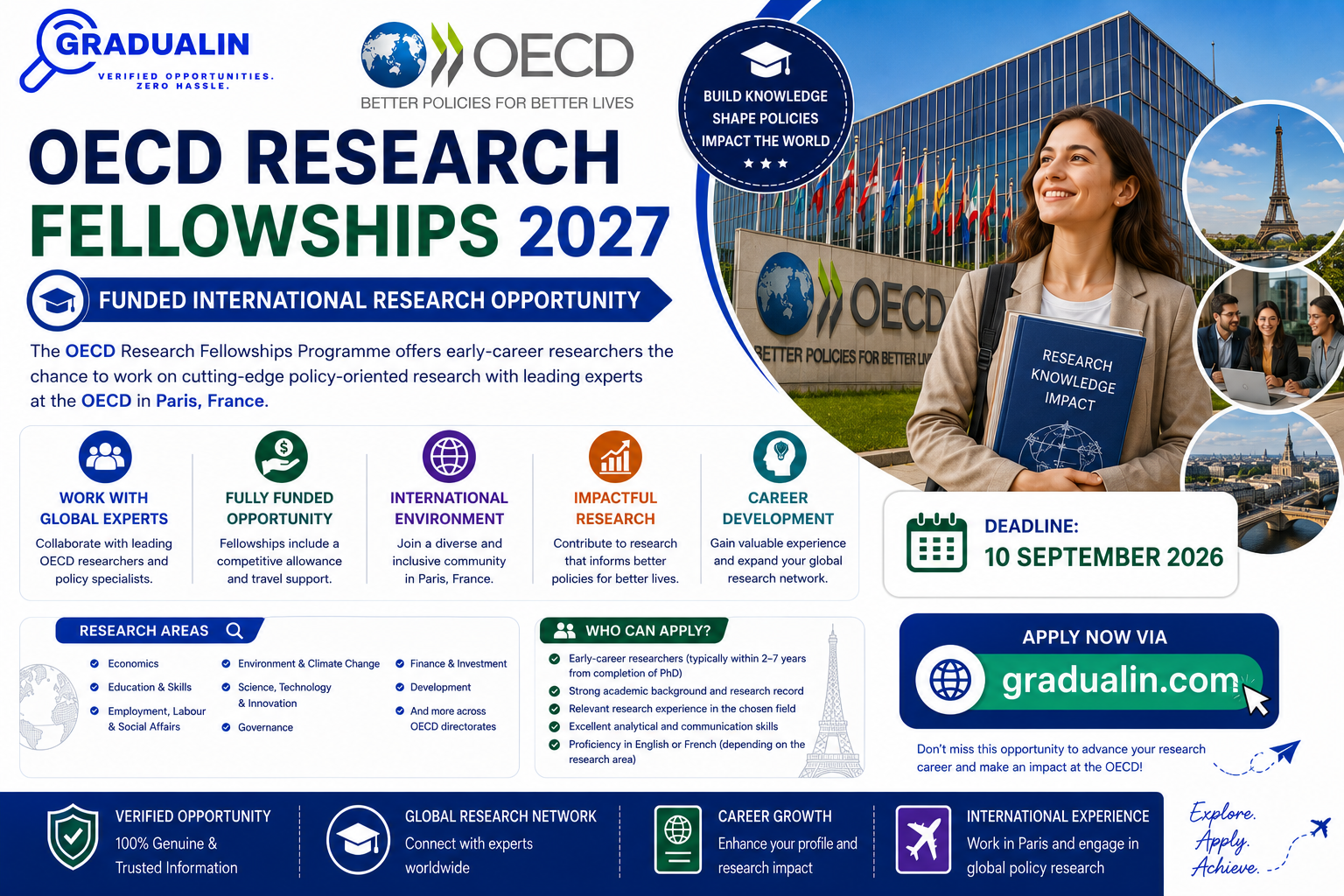
Funded OECD CRP Research Fellowship 2027 — Apply by Sept 2026
The OECD Co-operative Research Programme (CRP) has officially opened its call for Research Fellowship applications for 2027 — and this is one of the most credible, internationally recognized funded fellowship opportunities available to scientists working in agriculture, forestry, and fisheries. The fellowship covers travel costs and a weekly subsistence allowance for research stays of 6 to 26 weeks at an institution in another participating CRP country. If you are a postdoctoral researcher or established scientist in any of these fields and want to spend weeks or months collaborating with a world-class institution abroad, this guide covers every detail you need to apply with confidence. The deadline is 10 September 2026, midnight Paris time — and applications are already open right now.
| Detail | Information |
| Organisation | OECD Co-operative Research Programme (CRP) |
| Country | OECD member countries (32 participating nations) |
| Level / Type | Postdoctoral / Established Scientist Research Fellowship |
| Funding Type | Travel grant + weekly subsistence allowance + terminal allowance |
| Fellowship Duration | 6 to 26 weeks |
| Deadline | 10 September 2026, midnight (Paris time) |
| Open To | Researchers resident in CRP participating countries |
| Official Link | OECD CRP Fellowship Applications |
🎓 About the OECD Co-operative Research Programme
The Organisation for Economic Co-operation and Development (OECD) is one of the world’s most influential intergovernmental organisations, bringing together 38 member countries to promote policies that improve economic and social well-being. Within this larger framework, the Co-operative Research Programme: Sustainable Agricultural and Food Systems — known simply as the CRP — has been funding international scientific exchange and collaboration for decades.
The CRP’s mission is to strengthen scientific knowledge in food, agriculture, forestry, and fisheries — fields that are more interconnected with global policy challenges than ever before. Climate change, food insecurity, biodiversity loss, and environmental degradation are reshaping how the world thinks about farming, fishing, and land management. The CRP is designed to be part of the solution: by funding researchers to cross borders, share knowledge, and build new collaborations, it generates findings that directly inform policy decisions worldwide.
What makes this programme distinct from a typical research grant is its person-centred model. The CRP funds individual scientists, not large institutions or multi-year projects. You design the research. You choose the host country. You spend weeks immersed in a world-class scientific environment abroad — and you bring that knowledge home. In 2026 alone, 21 international research fellowships were awarded under this programme, covering projects ranging from climate-smart agriculture to fisheries systems.
Brazil joined as the 32nd participating country on 1 July 2026, making this the most internationally inclusive the programme has ever been.
🎓 Fellowship Funding — What Does the OECD CRP Cover?
The CRP Research Fellowship is a travel and subsistence grant, not a full salary replacement. Here is exactly what the funding package covers:
- Return economy class airfare — a travel lump sum is calculated based on the distance between your home laboratory and the host institution (verify exact amount on the official website)
- Weekly subsistence allowance of approximately €600–€650 to cover living costs at the host location (verify on official website)
- Terminal allowance of approximately €165 — a one-time payment (verify on official website)
- Fellowship periods run from a minimum of 6 weeks to a maximum of 26 weeks
- Fellowships funded in 2027 must begin no later than 1 November 2026, with departure possible up to 15 December 2026 at the latest
Important: The CRP travel grant covers one return trip to and from the host laboratory. Fellows are not insured by the CRP or the OECD during the fellowship period — you will need to arrange your own insurance. The grant does not cover visa costs, personal travel, or dependant expenses.
This is one of the few international research fellowship programmes that is genuinely discipline-flexible within its sector — covering the full breadth of agriculture, forestry, fisheries, and food systems science.
🎓 Eligibility Criteria
Before applying, check every item below carefully. The CRP has specific requirements that differ from standard scholarship programmes:
- Institutional location: You must be working at an institution in a CRP participating country — and your host institution must also be in a different participating country
- Postdoctoral experience: Applicants should have at least 4 years of postdoctoral training. This programme is not targeted at PhD students
- In exceptional circumstances, applicants without a PhD may be considered if they have equivalent scientific expertise and an extensive publication record
- Employment contract: You must have a contract with your current employer that ensures continued employment after completing the fellowship. If your contract is shorter than 3 years, your institution must certify continued scientific affiliation
- English proficiency: Applications must be submitted in English. No specific IELTS/TOEFL score is stated; your ability to write a detailed scientific proposal in English is the practical requirement (verify on the official website)
- Previous fellows: If you have already received a CRP fellowship, you may apply again — but only 5 years after the year of your first award
- New collaborations are treated preferentially to existing ones — this is a crucial selection factor
⚠️ Country updates for 2027: Brazil is now eligible (joined 1 July 2026). Türkiye’s membership ends 24 December 2026 — it will not participate in 2027 fellowship funding. Ukraine is in accession status — contact the CRP Secretariat at TAD.Prog@oecd.org for confirmation.
🎓 Who Should Apply — and Who Shouldn’t
✅ This fellowship is for you if:
- You hold a PhD and have at least 4 years of postdoctoral experience in agriculture, forestry, or fisheries
- You are employed at an institution in a CRP member country and have a stable contract
- You want to initiate a new international collaboration with a researcher or lab in another CRP country
- Your research aligns with sustainable food systems, climate resilience, biodiversity, or land/water resource management
- You can commit to a 6–26 week research stay starting before 1 November 2026
❌ This fellowship is not right for you if:
- You are a current PhD student or early-career researcher without postdoctoral experience
- Your home country or target host country is not among the 32 CRP participating nations
- You are looking for a full salary replacement — the CRP covers travel and subsistence, not your home salary
- Your research falls entirely outside agriculture, forestry, fisheries, or related food and environmental sciences
🎓 Research Priority Areas
The CRP is not open to just any topic within agriculture. Research proposals must align with at least one of the programme’s defined priority areas. These include:
- Sustainable and resilient productivity growth and food security and nutrition
- Climate risks and emissions reduction in agriculture and food systems, and carbon sequestration in agriculture, forestry and land use
- Halting and reversing forest loss and land degradation
- Reducing negative environmental impacts of livestock production, and exploring the positive contributions livestock can make to soil health, biodiversity, and rural livelihoods
- Biodiversity and enhancing ecosystem services
- Improving soil health, water quality, and air quality, including through agro-ecological and innovative, context-specific approaches
- Innovations in agricultural knowledge transfer, including Indigenous and traditional knowledge systems
- Fisheries and aquaculture productivity, sustainability, and resilience
Here’s what makes this different: the CRP explicitly values multidisciplinary approaches. If your project crosses two or more of these areas — say, combining fisheries sustainability with Indigenous knowledge systems — that is a strength, not a complication.
🎓 Required Documents
Applications must be submitted in English using the online CRP application form. Prepare the following before you begin:
- Completed online application form — note that the form only supports plain text; no formatting, bullet points, or tables inside the form itself
- Your CV — this is passed directly to the Scientific Advisory Body for review; make it thorough and research-focused
- List of publications from the last five years
- Letter of acceptance from the host institution — the host must confirm their willingness to receive you if successful; this is mandatory and must be attached at submission
- If tables or formatted content are essential to your proposal, upload them separately through the form or email them to TAD.Prog@oecd.org
🎓 Step-by-Step Application Process
- Confirm your eligibility — check that both your home institution and target host institution are in different CRP member countries
- Identify your host researcher and institution — new collaborations are prioritised; approach a researcher whose work genuinely complements yours
- Secure a letter of acceptance from your intended host institution before submitting — without this, your application is incomplete
- Review the CRP Research Themes — align your proposal clearly with at least one priority area; vague alignment is a common reason for rejection
- Prepare your research proposal — write it in plain English with clear goals, feasibility, dissemination plans, and expected impact
- Gather your CV and publications list — the Scientific Advisory Body reviews these directly; make sure your last five years of output are fully listed
- Submit via the official online application portal at oecd.org/en/about/programmes/co-operative-research-programme/crp-applications-for-fellowships.html
- Await confirmation — the system automatically confirms receipt of your submission
Practical tip: Contact your target host researcher well before the September deadline and get the acceptance letter secured early. The CRP’s own guidelines note that securing host agreement takes time — do not leave it to the last week.
Bookmark this page and check back for updates.
🎓 Important Dates
| Milestone | Date |
| Application portal opens | Now open (as of July 2026) |
| Application deadline | 10 September 2026, midnight (Paris time) |
| Fellowship start (latest) | 1 November 2026 |
| Latest possible departure | 15 December 2026 |
| Fellowship year funded | 2027 cycle |
🎓 Why Apply — Why the OECD CRP
Here’s the best part about this fellowship: the OECD name carries enormous international weight. A CRP fellowship on your CV signals to institutions, funding bodies, and governments worldwide that your research was selected by a body of eminent scientists — not through a university’s internal process, but through genuine peer competition.
The CRP’s Governing Body includes representatives from 32 countries. The Scientific Advisory Body — which selects fellowship recipients — is composed of six leading agricultural research scientists. Past fellows have described the experience as transformative: not just for the science they produced, but for the networks they built. Testimonials from UK fellows who researched in Japan, Australian fellows who worked in Spain, and US labs hosting Hungarian scientists all describe the same thing — unexpected collaborations, new funding leverage, and research directions that wouldn’t have happened otherwise.
The CRP is also one of the few science mobility programmes that actively and explicitly prioritises new partnerships over existing ones. If you have been working with the same international collaborator for years, that is a disadvantage here. The programme wants to spark new connections — which is exactly why it has been generating global scientific value for so long.
🎓 Frequently Asked Questions
Q: Can I apply if I am still finishing my PhD? A: No. The CRP Research Fellowship requires at least 4 years of postdoctoral experience. PhD students are explicitly outside the target group. In rare exceptions, non-PhD scientists with equivalent expertise and a strong publication record may be considered.
Q: Do I need to be a citizen of a CRP member country? A: You need to be resident in and working at an institution in a CRP member country. Citizenship is not the determining factor — your institutional affiliation and country of residence are.
Q: My target host country is Türkiye — can I still apply for 2027? A: No. Türkiye’s CRP membership ends on 24 December 2026, so it is not participating in fellowship funding for the 2027 cycle. Choose a different host country from the current 32-member list.
Q: Can I apply if I already received a CRP fellowship before? A: Yes — but only if at least 5 years have passed since the year of your first CRP award.
Q: Is IELTS required? A: No specific IELTS or TOEFL band is stated in the CRP guidelines. However, all applications must be submitted in English, and your scientific proposal needs to be detailed and clearly written. If English is not your first language, strong written proficiency is essential. Verify any institutional language requirements with your target host (verify on official website).
Q: How competitive is this fellowship? A: In 2026, 21 fellowships were awarded globally. The number of applicants is not publicly disclosed, but competition comes from researchers across 32 countries. The CRP’s own guidelines emphasise scientific quality, relevance to research themes, new collaboration potential, and feasibility as the four main selection factors.
🎓 Official Source and Contact
Application Portal: OECD CRP Fellowship Applications
Full Programme Page: OECD Co-operative Research Programme: Sustainable Agricultural and Food Systems
Secretariat Contact: TAD.Prog@oecd.org
CRP Fellowship Guidelines PDF (download directly from OECD): Guidelines and Conditions for CRP Research Fellowship Awards
🎓 Summary Table
| Detail | Information |
| Organisation | OECD Co-operative Research Programme (CRP) |
| Programme Name | CRP Research Fellowship 2027 |
| Fields | Agriculture, Forestry, Fisheries, Food Systems |
| Fellowship Duration | 6–26 weeks |
| Funding | Travel grant (economy return airfare) + ~€600–€650/week subsistence + ~€165 terminal allowance |
| Eligibility | Postdoc with 4+ years experience; resident in CRP member country |
| Participating Countries | 32 (Australia, Canada, USA, UK, Germany, France, Japan, Brazil + more) |
| Application Language | English only |
| Deadline | 10 September 2026, midnight Paris time |
| Start Date | No later than 1 November 2026 (latest departure 15 Dec 2026) |
| Official Contact | TAD.Prog@oecd.org |
| Application Link | Apply Here |
Explore More Categories:
Standing Cluster Links:
Fully Funded Scholarships in Australia 2026
Fully Funded PhD Scholarships in the UK 2026
Fully Funded Scholarships in the USA 2026
Study in Italy 2026 — Guide for International Students
Finland Scholarships 2026 — Tuition Waivers for International Students
Top 10 Fully Funded Scholarships in Asia 2027
Fully Funded PhD Positions in Switzerland 2026
Top Fully Funded Scholarships in Saudi Arabia 2026
Study in Turkey 2026 — Guide for International Students
Study in Netherlands 2026 — Guide for International Students
Study in Germany 2026 — Guide for International Students
Study in Norway 2026 — Guide for International Students
Related Posts:
Fully Funded JSPS Postdoctoral Fellowship Japan 2026
Fully Funded UNESCO Global Fellowship 2026
Stay updated with the latest scholarships, jobs, and opportunities at Gradualin.com — your trusted guide to studying abroad for free.