
📅 Last Updated: 28 October 2026
Exeter EPSRC DLA PhD 2027 — 16 Fully Funded Studentships
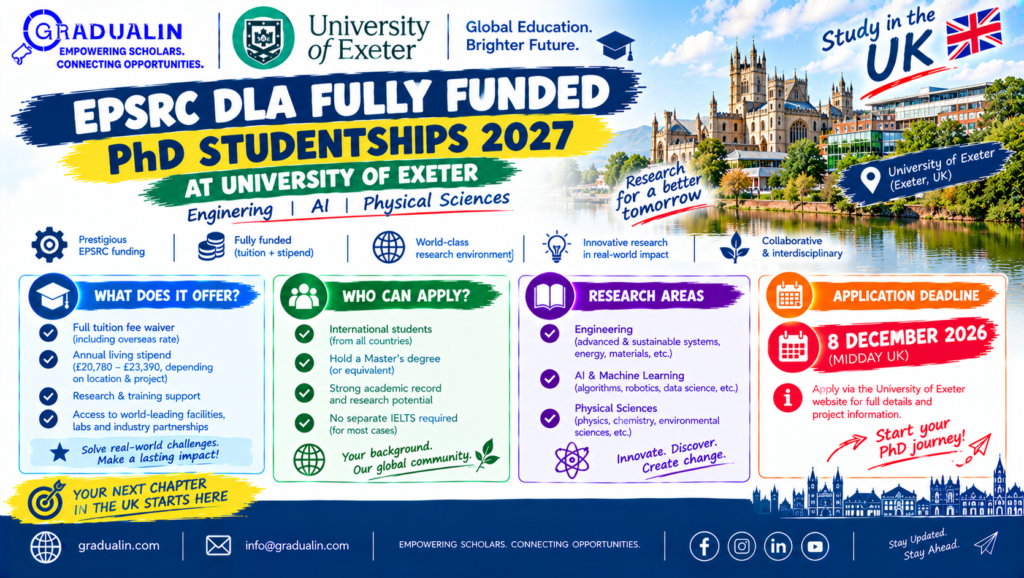
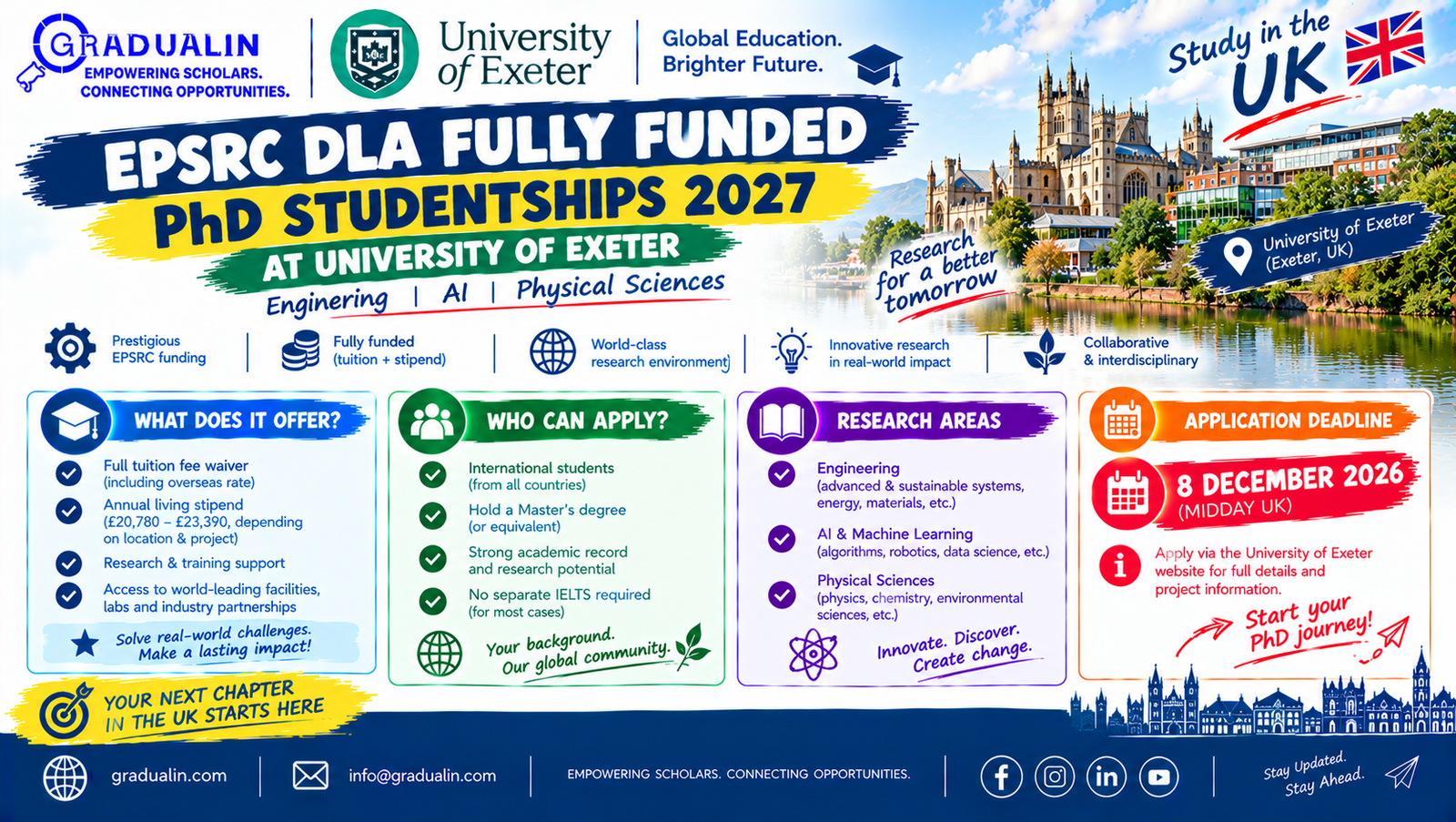
The University of Exeter, a Russell Group university in South West England, has opened its EPSRC Doctoral Landscape Award (DLA) competition for September 2027. There are up to 16 fully funded PhD studentships across 49 projects in 14 departments, covering AI and computer science, engineering, physics, mathematics, earth sciences, health data science and more. Each award pays tuition fees, a stipend of £21,805 a year (2026/27 rate, index-linked) for up to 3.5 years, and a £5,000 research training grant. International students can apply for up to 30% of the places, and successful international applicants have their full tuition fees covered. You can apply to up to 3 projects by midday on 8 December 2026.
| 🏛️ University | University of Exeter, UK (Russell Group) |
| 🎓 Scheme | EPSRC Doctoral Landscape Award (DLA) studentships |
| 🔢 Places | Up to 16 (up to 30% for international students) |
| 📚 Projects | 49 projects in 14 departments |
| 💷 Fees | Tuition fees paid; international winners have full fees covered (confirm with PGR Admissions) |
| 💰 Stipend | £21,805/year (2026/27 rate, index-linked), up to 3.5 years |
| 🔬 Research Grant | £5,000 Research Training Support Grant over 3.5 years |
| 🎓 Requirement | First or 2:1 (or equivalent) in science, engineering or technology; a 2:2 plus a master’s is considered |
| 🗣️ English | Exeter’s English requirements apply if English isn’t your first language |
| 📅 Deadline | Midday, 8 December 2026 (UK time) |
| 🗓️ Interviews / Offers | About 15–24 February 2027 / early March 2027 |
| 🇵🇰 Pakistani Students Eligible | Yes, for the international places (up to about 30% of the cohort) |
| 🔗 Official Page | Exeter EPSRC DLA Studentships |
About the Exeter EPSRC DLA
The Engineering and Physical Sciences Research Council (EPSRC) is the UK’s main funder of research in engineering, the physical sciences, mathematics and digital technologies. Through its Doctoral Landscape Awards, it gives universities block funding to recruit PhD students into “EPSRC-facing” projects. At Exeter, these span digital technologies, clean energy, manufacturing, mathematics, advanced materials, chemistry and their applications in health, climate and the environment.
How it’s structured: this is a project-led competition. You don’t propose your own topic. Instead you choose from 49 advertised projects, each with a named lead supervisor, and apply separately to up to three.
How it compares: unlike Warwick’s university-wide Chancellors scholarships, where you bring your own project, Exeter’s DLA attaches funding to specific projects. That makes it ideal if one of the topics matches your background closely. It’s also much smaller: 16 awards, with roughly 4–5 international places. Our EPSRC funding guide explains how DLAs fit into UK research funding.
💰 What the Studentship Covers
- ✅ Tuition fees paid. Exeter states that successful international applicants have their full tuition fees covered for the duration of the programme (confirm with PGR Admissions)
- ✅ Stipend: £21,805 a year (2026/27 rate), index-linked, so it’s expected to rise for 2027/28
- ✅ Research Training Support Grant: £5,000 over 3.5 years, for conferences, training and research costs
- ✅ Up to 3.5 years of full-time funding
In PKR: £21,805 is roughly PKR 75–80 lakh a year (about PKR 6–6.5 lakh a month, tax-free). That’s comfortable in Exeter, which is cheaper than London. Not covered: the visa application fee, the Immigration Health Surcharge and flights. Budget for these yourself (verify on official website).
📋 Eligibility
- Academic: a First or Upper Second Class (2:1) UK honours degree or equivalent in an appropriate science, engineering or technology subject
- 2:2 holders: considered if they also have a master’s or significant relevant non-academic experience
- Home applicants: UK nationals meeting residency rules, or those with settled, pre-settled or indefinite leave status
- International applicants: eligible for limited places, up to 30% of the cohort
- English: you must meet Exeter’s English language requirements before starting if English isn’t your first language
- Some projects have extra specific requirements, so check each project PDF
🇵🇰 Pakistani students: eligible for the international places. A Pakistani BS or MS with a CGPA of about 3.0–3.3 or higher is often treated as roughly a UK 2:1, but Exeter decides equivalence itself (verify on official website). Strong fits are graduates in CS and AI, electrical, mechanical or chemical engineering, physics, mathematics, environmental science and biomedical engineering from NUST, LUMS, FAST, GIKI, PIEAS, UET, COMSATS and QAU. Most Exeter PhDs ask Pakistani applicants for IELTS (typically 6.5 or above, depending on the department), so book early (verify on official website).
✅ Apply if you…
- Have a strong STEM degree (2:1 equivalent or above), or a 2:2 plus a master’s
- Find 1–3 projects that closely match your skills
- Can write a project-specific personal statement
- Have two academic referees ready by 15 February 2027
- Can meet Exeter’s English requirements before starting
❌ Skip it if you…
- Want to propose your own topic (this is project-led)
- Have no background related to any of the 49 projects
- Can’t apply by midday UK time on 8 December
- Expect visa and health surcharge costs to be covered
- Want to apply to more than 3 projects (the maximum is 3)
🔬 The 49 Projects (by Department)
Computer Science (6): End-to-End Verification of Security Protocols in Isabelle · Extensible Programming Languages for Data Structures in Monoidal Categories · Explainable AI for Early Dementia Detection and Deployment · Uncertainty-Aware Synchronisation for Sustainable Data Centre Digital Twins · R2T2-Med: Resource-Aware AI for Scalable Medical Image Analysis · Sovereign Agentic AI: Distilling Small Language Model Agents for Local Deployment
Engineering (6): Ceramic Powder Feedstocks for Additive Manufacturing (Extreme Environments) · Catalyst-Layer Microenvironments for Acidic CO₂ Electrolysis · Scientific ML Digital Twins for High-Torque Electric Propulsion · Physics-Aware Graph Neural Networks for Visibility Forecasting · 3D-Printed Adaptive Interfaces for Bone Screw Fixation · Electrochemical Lithium Extraction
Physics and Astronomy (6): All-Optical Magnetic Switching for Deterministic Recording · Quantum Information with Mechanical Systems (Optomechanics) · Polarisation-Resolved Nonlinear Microscope · Relativistic Effects in Metamaterials with Quantum Graph Theory · Structured Food Products for Flavour and Nutrition · Quantification in Deep Raman Spectroscopy
Mathematics and Statistics (6): The Khintchine-Groshev Theorem · Uncertainty Quantification for Healthcare Models · Multi-Symplectic Methods for Ocean Wave Forecasting · Arithmetic Moments and Random Matrix Statistics over Function Fields · Virtual Brain Networks for Deep Brain Stimulation in Childhood Epilepsy · Cut-and-Project Schemes in Hyperbolic Space (Acoustic Metamaterials)
Geography (3): Compounding Climate Risk to UK Infrastructure · Physics-Informed AI for Ocean Mixing · Forest Microclimate Dynamics in Amazonia
Earth and Environmental Sciences (3): Ocean Observation Through Surfing · Digital Twinning for Post-Mining Environments · Satellite Radar for Arctic Permafrost Monitoring
Living Systems Institute (3): In-Silico Directed Evolution of Biological Qubits · Coevolution in Flow-Shaped Aquatic Environments · AI-Enabled Smart Spectroscopy Pixels for Antibiotic Responses
Public Health and Sport Sciences (3): Musculoskeletal and Finite Element Modelling of Osteogenic Potential · Computer Vision to Predict Falls in Older Adults · Digital Movement Biomarkers of Mood and Fatigue
Business School (3): Responsible Innovation in Metamaterials for a Circular Economy · De-Risking AI Scale-Up in Circular Supply Chains · SCALE-Decode: Growth Workflows in UK SMEs
Psychology (3): Active Matter and Bee Nests · Graph Kernels for ADHD on UK Biobank Data · The Emotional Basis of Behaviour
Ecology and Conservation (2): ML with One Health for Disease Transmission · Technology to Record Wild Animal Behaviour
Clinical and Biomedical Sciences (2): Improving AI through Neuroscience · AI Smart Cameras for Diabetic Retinopathy
Biosciences (2): Bioinspired Fluidic Metamaterials · Raman Spectroscopy for Kidney Stone Disease in Farmed Fish
Health and Community Sciences (1): Predicting Hospital-Acquired Acute Kidney Injury from Data
See each project’s PDF (with supervisor details and the application link) on the official project list.
📄 Required Documents
- Personal statement naming the project you’re applying for, and why you fit it
- CV
- Transcript(s) with full details of subjects and grades
- Two references. Referees submit by 15 February 2027 (email PGRApplicants@exeter.ac.uk)
- English language evidence, if applicable
HEC note for Pakistani applicants: upload clear transcripts with your university’s grading-scale explanation. Start HEC attestation now for the visa (CAS) stage. If you have no IELTS score yet, book IELTS UKVI or Academic for November or December.
🪜 Step-by-Step: How to Apply
- Browse all 49 projects and shortlist up to 3 that match your degree and skills.
- Email each lead supervisor (contact details are in the project PDF) with your CV and a short note on why you fit.
- Write a separate personal statement for each project. Generic statements lose marks.
- Apply using the link at the bottom of each project PDF. Applications through other routes won’t be considered.
- Submit by midday (UK) on 8 December 2026 (17:00 PKT).
- Make sure your two referees submit by 15 February 2027.
- Interviews around 15–24 February 2027. Offers in early March 2027.
- If selected: accept, get your CAS, and apply for a UK Student visa. Start in September 2027.
📅 Important Dates
| Milestone | Date |
|---|---|
| Applications open | 26 October 2026 |
| Application deadline | Midday, Tuesday 8 December 2026 (UK) |
| Reference deadline | 15 February 2027 |
| Interviews | About 15–24 February 2027 (verify on official website) |
| Offers | Early March 2027 |
| PhD start | September 2027 |
🌍 Why Apply
Exeter is a top-15 UK research university, with strengths in climate and environmental science, AI, physics, mathematics and health data. The DLA projects are highly applied, including digital twins, medical imaging AI, clean energy, and ocean and climate modelling, which leads to strong career paths in industry, government science and academia. A funded EPSRC PhD on your CV carries weight with UK and international employers.
❓ Frequently Asked Questions
Can Pakistani students apply for the Exeter EPSRC DLA studentships?
Yes. International applicants are eligible for limited places, up to 30% of the cohort. Exeter says successful international applicants have their full tuition fees covered, plus the stipend and research grant.
How much is the stipend?
£21,805 a year at the 2026/27 rate. It’s index-linked, so it’s expected to rise slightly for 2027/28. There’s also a £5,000 Research Training Support Grant over 3.5 years.
Can I propose my own research topic?
No. This is project-led: you choose from the 49 advertised projects and apply to up to 3, each with its own application.
What degree do I need?
A First or 2:1 UK honours degree or equivalent in a relevant science, engineering or technology subject. Applicants with a 2:2 are considered if they also have a master’s or significant relevant experience.
Do I need IELTS?
If English isn’t your first language, you must meet Exeter’s English requirements before starting. Pakistani applicants are usually asked for IELTS, but check the requirement for your department (verify on official website).
What is the deadline?
Midday UK time on Tuesday 8 December 2026 (17:00 PKT). References are due 15 February 2027, interviews are around 15–24 February, and offers come in early March 2027.
🔗 Official Sources
- Exeter EPSRC DLA Studentships
- Project list (49 projects)
- How to apply and eligibility
- EPSRC (UKRI)
- Contact: PGRApplicants@exeter.ac.uk
📊 Summary Table
| Detail | Information |
|---|---|
| Scheme | Exeter EPSRC Doctoral Landscape Award |
| Places / Projects | Up to 16 / 49 projects |
| International | Up to 30% of the cohort; full fees covered |
| Stipend | £21,805/year (2026/27), up to 3.5 years |
| Research Grant | £5,000 |
| Requirement | First/2:1, or 2:2 plus a master’s |
| Deadline | Midday, 8 December 2026 |
| Start | September 2027 |
| Pakistani Students | Eligible (international places) |
Explore more on Gradualin: Scholarships, Jobs & Internships, Events & Conferences, and Guidelines & Resources.
Stay updated with the latest scholarships, jobs, and opportunities at Gradualin.com — your trusted guide to studying abroad for free.