

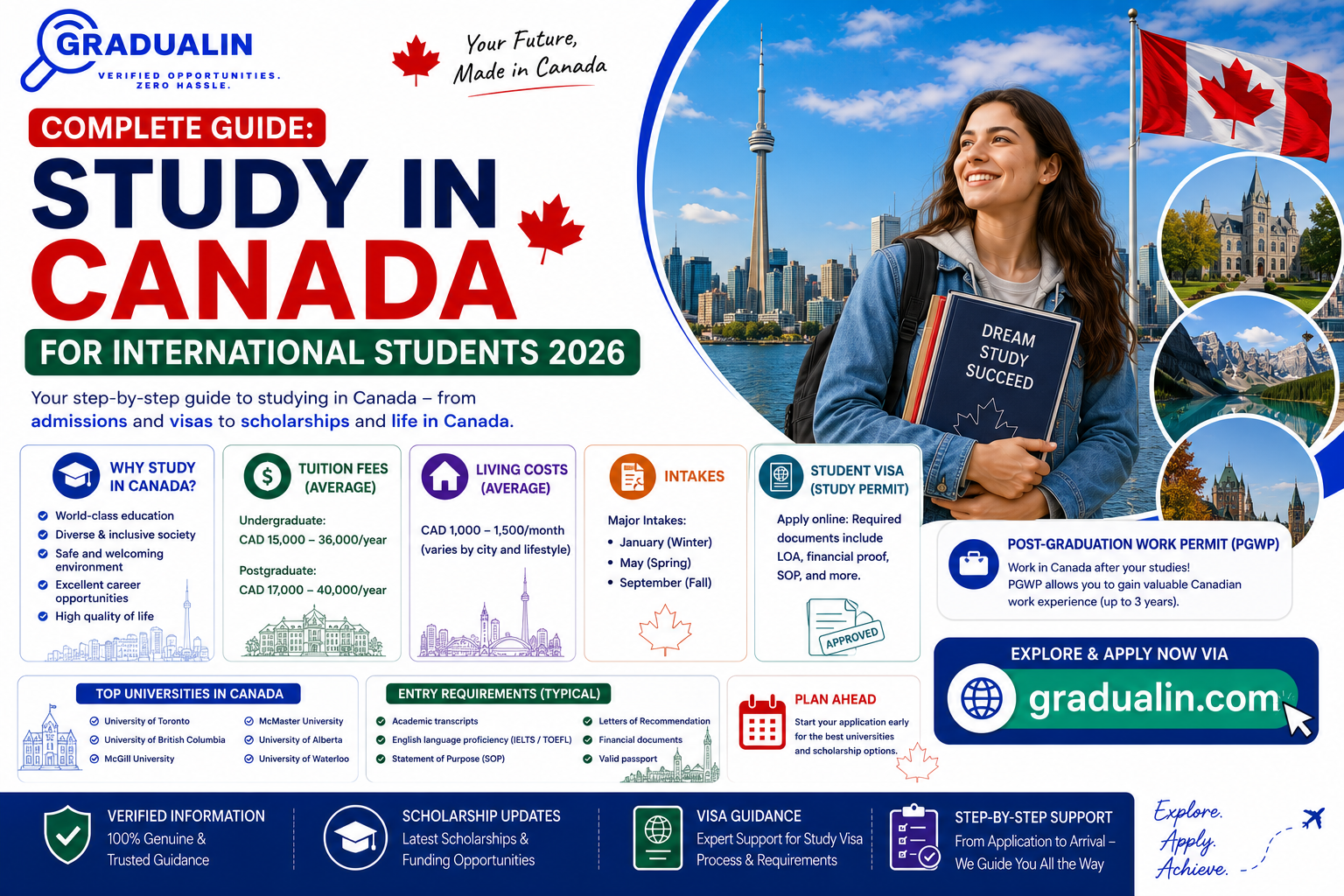
Complete Guide: Study in Canada for International Students 2026
Canada has quietly become one of the smartest study-abroad decisions a student can make right now. World-class universities, a genuine post-study work permit that runs up to three years, and one of the clearest pathways to permanent residency anywhere in the world — all in a country that actively welcomes international students from every background. But the rules have changed significantly since 2024, and if you are working from an outdated guide, you could miss critical requirements before you ever submit an application. This guide covers everything you need to know about studying in Canada in 2026 — study permits, costs, top institutions, scholarships, and what happens after graduation.
| Detail | Information |
| Destination | Canada |
| Degree Levels | Certificate, Diploma, Undergraduate, Master’s, PhD |
| Language of Instruction | English (most programs), French (Quebec and some bilingual programs) |
| Study Permit Required | Yes — for programs longer than 6 months |
| Proof of Funds Required | CAD $22,895 (living expenses) + first-year tuition |
| Off-Campus Work Rights | Up to 24 hours/week during term; full-time during scheduled breaks |
| Post-Study Work Permit | PGWP — up to 3 years |
| Official Immigration Portal | Immigration, Refugees and Citizenship Canada (IRCC) |
📚 Why Canada Remains One of the Best Study Destinations in 2026
Canada is not just a popular choice — it is a strategically strong one. The country welcomes over 800,000 international students annually and consistently ranks among the top three study destinations globally. What sets it apart from the UK or Australia is the combination of quality, affordability, and immigration opportunity in a single package.
McGill University ranks among the global top 30 in QS World University Rankings 2026, while the University of Toronto and UBC appear in the top bracket of Times Higher Education rankings. Beyond rankings, the real draw for most international students is what happens after the degree. All ten of Canada’s top universities are PGWP-eligible, meaning graduates of programs lasting eight months or more receive open work permits that can last up to three years, creating a direct path to skilled Canadian work experience and permanent residency through programs like Express Entry.
Canada is generally 20–30% cheaper than US universities for comparable programs, and it offers a clearer PR pathway than most other destinations. For students who want quality education without spending US tuition prices, Canada makes a strong case.
📚 What Is a Canada Study Permit — and How Is It Different from a Visa?
This is one of the most common points of confusion. A Canada study permit is the official document that authorizes international students to study at a Designated Learning Institution (DLI). It is not the same as a visa — the study permit grants permission to study, while a separate visitor visa or Electronic Travel Authorization (eTA) is needed to enter the country.
International students must apply for a study permit if their program runs longer than six months. If your program is shorter than that, no study permit is needed — though an eTA or visitor visa may still be required for entry depending on your nationality.
Your DLI status matters enormously. Every province maintains its own DLI list, and you can verify your institution on the IRCC website. Choosing a school that is not on the DLI list means you cannot get a study permit — and it means you will not be eligible for the Post-Graduation Work Permit either.
📚 Key 2026 Updates Every International Student Must Know
The Canada student immigration landscape has shifted more in the past two years than in the previous decade. If someone shared a guide with you from early 2024 or before, treat every policy detail in it with caution.
Here are the most important changes currently in effect:
- Student Direct Stream (SDS) is gone. IRCC officially closed the Student Direct Stream on November 8, 2024. In 2026, all international students — regardless of nationality — go through the standard study permit application process.
- Provincial Attestation Letters (PAL) are now required for most applicants. As of January 1, 2026, Master’s and PhD students at public institutions are fully exempt from both the national study permit cap and the PAL requirement, which removes one of the slowest steps in the process for graduate applicants specifically. Undergraduate and college applicants at most public DLIs still need one.
- Financial requirements have increased. From September 1, 2025, applicants must show access to at least CAD $22,895 for one person in addition to first-year tuition as proof of living funds when applying for a study permit.
- Off-campus work is capped at 24 hours per week. International students are allowed to work a maximum of 24 hours per week off-campus during normal academic terms.
- PGWP eligibility has been clarified. IRCC added 119 new PGWP-eligible fields in June 2025, spanning healthcare, skilled trades, and education, bringing the total to 1,107 eligible programs. Master’s graduates can now get a three-year PGWP even if their program is under two years, provided it was at least 8 months long and completed at a DLI.
📚 Canada Study Permit Requirements 2026
To apply for a study permit, you will need:
- Letter of Acceptance from a DLI — This is the most fundamental requirement. You must first apply to and receive an acceptance letter from a school, college, or university that is officially recognized as a DLI by the Canadian government.
- Valid passport — must cover the full duration of your program
- Proof of financial support — CAD $22,895 in living funds + full first-year tuition (verify Ontario-specific requirements separately)
- Provincial Attestation Letter (PAL) — required for most undergraduate applicants at public institutions (exempt for Master’s and PhD students at public DLIs)
- English or French language scores — the most widely recognized English language tests include IELTS Academic (minimum 6.0 for undergraduate programs; 6.5 for postgraduate courses) and TOEFL iBT (minimum scores ranging between 80 to 90 depending on the university). Requirements vary by institution — always check your specific program’s requirement on the official university website.
- Biometrics — fingerprints and a digital photo collected at a visa application centre
- Medical examination — most international students must complete a medical examination before study permit approval, typically costing between CAD $200–$400 depending on location.
- Letter of Explanation (recommended) — a well-written letter of explanation can significantly strengthen your application, addressing why you want to study in Canada, why you chose your specific program and institution, and your genuine intention to return home after your studies.
- Quebec Acceptance Certificate (CAQ) — if you plan to study in Quebec for more than six months, you need a CAQ issued by the Gouvernement du Québec in addition to the federal study permit.
📚 Who Should Apply to Study in Canada — and Who Should Hold Off
✅ Strong candidates:
- Students with strong academics who want a real PR pathway after graduation
- Those interested in STEM, healthcare, engineering, or business — all high-demand sectors with excellent PGWP outcomes
- Students who can demonstrate solid financial proof comfortably above the CAD $22,895 minimum
- Those applying to Master’s or PhD programs at public universities — the PAL exemption makes the process faster and simpler
❌ Who may want to reconsider or prepare more:
- Students with weak financial documentation — this is the number one reason applications fail
- Those targeting private colleges that do not qualify for PGWP (always verify on the IRCC DLI list)
- Students whose home ties (family, employment, property) are not clearly evidenced in the application
- Those applying very late — late applications reduce visa eligibility and competitive programs fill fast, especially at universities like UBC, University of Toronto, and McGill which follow fixed deadlines, not rolling ones.
📚 Cost of Studying in Canada in 2026
Here’s the honest breakdown. Canada is not cheap — but it is significantly more affordable than the US for comparable quality, and the post-study work rights give you a real mechanism to recover costs.
Tuition: International undergraduates in Canada pay an average of CAD $41,746 for the 2025/2026 academic year, up about 2.5%. Ontario is the most expensive province at CAD $49,802 per year; Newfoundland and Labrador is the most affordable at CAD $18,867.
Living expenses: The total cost of studying in Canada ranges from CAD $30,000–$60,000 per year including tuition, living expenses of $15,000–$20,000, and first-year upfront costs of $3,000–$10,000.
How to reduce costs significantly:
- Choose Atlantic provinces (New Brunswick, Nova Scotia, Prince Edward Island, Newfoundland) or Manitoba, where tuition is substantially lower than Ontario or British Columbia
- Memorial University holds international tuition at CAD $11,000–$22,000, and Newfoundland’s lower cost of living means housing and food are more affordable than major cities like Toronto or Vancouver.
- McGill, for non-medical and non-dental programs, is the cheapest of Canada’s globally top-30 universities because of Quebec’s tuition framework, with international undergraduate tuition for arts, science, education, and engineering running CAD $22,000–$30,000 per year — about half of comparable Ontario schools.
Proof of funds required for study permit (as of September 2025):
| Applicant | Required Proof |
| Single student (outside Quebec) | CAD $22,895 + first-year tuition |
| With spouse | Add CAD $4,000 |
| Each dependent child | Add CAD $3,000 |
| Quebec students | Slightly higher threshold — verify on IRCC website |
📚 Top Universities in Canada for International Students 2026
Canada’s university system offers genuine options across every budget level. All institutions below are PGWP-eligible public DLIs.
Globally Ranked (higher tuition, stronger brand):
- University of Toronto — ranked in the global top 20 on Times Higher Education; strong across virtually every field
- McGill University — ranked #27 in QS World University Rankings 2026, Canada’s highest, with strong scores in sustainability, employment outcomes, and academic reputation
- University of British Columbia (UBC) — consistently in the global top 40; strongest in forestry, mining, and life sciences
- University of Waterloo — renowned for engineering and computer science, with a massive co-op program and strong employer recognition in tech and finance
Strong, affordable mid-tier options:
- University of Calgary — ranked #211 in QS World University Rankings 2026, known for science and business programs with approximately 94% of graduates finding employment after finishing
- Dalhousie University (Halifax, Nova Scotia) — strong for health sciences and engineering; Atlantic Canada location keeps living costs low
- University of Manitoba / Brandon University (Winnipeg) — Manitoba is the overall winner for affordability, with Brandon University at CAD $8,000/year combined with Winnipeg’s living costs of CAD $950–$1,350/month
The smart approach for most students: weigh the tuition savings against the brand recognition based on your career goals. In many fields — especially STEM and healthcare — a degree from a solid, PGWP-eligible Canadian university in an affordable province outperforms a prestigious brand with crippling debt.
📚 Scholarships in Canada for International Students 2026
Canada offers substantial scholarship funding, though the most competitive awards require serious preparation well in advance.
Top scholarships to know:
Vanier Canada Graduate Scholarships (PhD) The Vanier award provides CAD $50,000 annually for up to three years of doctoral study. It is open to both Canadian and international students and is one of the most prestigious government scholarships available in Canada. Students must be nominated by a Canadian university. Deadline: typically November 1.
Lester B. Pearson International Scholarship (Undergraduate — University of Toronto) The Pearson is Canada’s most valuable undergraduate scholarship, covering tuition, books, incidental fees, and full residence support for four years — worth over CAD $280,000 total. Requires high school nomination and exceptional academics plus community leadership.
Pierre Elliott Trudeau Foundation (PhD) The Trudeau Foundation rewards up to 15 outstanding doctoral candidates annually in social sciences and humanities, with an annual value of up to CAD $60,000 per scholar for up to four years.
Canada Graduate Scholarships — Master’s (CGS-M) The CGS-M provides CAD $17,500 for one year to master’s students, with about 3,000 awards given nationally. International students are eligible at participating universities.
University-level entrance scholarships Most major Canadian universities offer merit-based entrance awards ranging from CAD $500 to CAD $60,000. Scholarship holders often graduate with less debt, more work-integrated learning opportunities, and stronger reference networks — all of which improve eligibility under Express Entry, the PGWP, and provincial nominee programs.
Browse the official Canadian government scholarship listings at EduCanada International Scholarships and the Government of Canada Scholarships page.
📚 Step-by-Step Application Process
- Research your program and institution — Confirm the university is a DLI and that your specific program is PGWP-eligible. Use the IRCC DLI list to verify.
- Apply for university admission — Most major universities (UBC, U of T, McGill) have fixed deadlines in January–February for September intake. Do not miss these.
- Receive your Letter of Acceptance — This is your anchor document. Nothing moves without it.
- Obtain your Provincial Attestation Letter (PAL) — If required (undergraduate/college applicants at most public DLIs). Your institution will guide this process. Master’s and PhD students at public DLIs are exempt.
- Gather your financial documents — Bank statements from the last 4–6 months, Guaranteed Investment Certificate (GIC), or scholarship letter showing funds above the CAD $22,895 threshold plus first-year tuition.
- Complete your medical examination — Check the IRCC website to confirm whether your country requires this upfront.
- Apply for your study permit online — Submit through the official IRCC portal. Online is faster and allows you to track your application status.
- Pay the application fee and submit biometrics — The study permit application fee is CAD $150. Biometrics cost CAD $85, valid for 10 years.
- Wait for a decision — Processing times in 2026 range from four weeks to four months depending on where you apply from. Apply as early as possible.
- Prepare for departure — Secure housing before arrival, especially in competitive cities like Toronto and Vancouver where housing markets are tight.
Practical tip: Write your Letter of Explanation like an immigration document, not a school essay. Name your institution, your program, your exact funding sources, and — critically — your concrete plan to return home or your intention to pursue Canadian PR legitimately. Visa officers act on specifics, not generic statements of ambition.
📚 Important Dates and Deadlines
| Milestone | Typical Timing |
| University application deadlines (September intake) | January–February |
| Scholarship research and preparation should begin | 12–18 months before intended start |
| PAL obtained from institution | As early as possible after acceptance |
| Study permit application submission | At minimum 4–6 months before program start |
| Biometrics appointment | Immediately after submitting study permit |
| Vanier CGS deadline (PhD) | November 1 annually |
| Pearson Scholarship deadline (UofT UG) | November 7 (for September start) |
| CGS-M deadline (Master’s) | Typically December 1 |
Bookmark this page and check back for updates — Canadian immigration policy updates frequently, and Gradualin keeps this guide current.
📚 Life After Graduation — PGWP and the PR Pathway
This is where Canada genuinely stands apart. Most countries end the relationship when your student visa expires. Canada gives you a structured pathway to stay.
The standard PR sequence is: study permit → PGWP-eligible degree → PGWP → 1 year of skilled Canadian work experience → Express Entry Canadian Experience Class or Provincial Nominee Program (PNP).
Master’s graduates can now receive a three-year PGWP even if their program is under two years, provided it was at least 8 months long and completed at a DLI. For PhD graduates, the PGWP is typically capped at three years.
The PNP streams in smaller provinces — Saskatchewan, Manitoba, Nova Scotia, New Brunswick — often have shorter queues than Ontario, which is another reason choosing an Atlantic province or Prairie province university can be smarter than defaulting to Toronto.
📚 FAQ
Q: Do I need IELTS to study in Canada? A: Most Canadian universities require proof of English proficiency. The most widely recognized tests include IELTS Academic (minimum 6.0–6.5 depending on program level) and TOEFL iBT (80–90 minimum depending on the institution). Some universities exempt students who completed previous degrees in English — check your specific institution’s policy directly.
Q: Can I work while studying in Canada in 2026? A: Yes. International students are allowed to work a maximum of 24 hours per week off-campus during normal academic terms. Full-time work is permitted during scheduled breaks like summer and winter holidays.
Q: What is a Designated Learning Institution (DLI) and why does it matter? A: A DLI is a school, college, or university officially recognized by the Canadian government to host international students. You must hold an acceptance letter from a DLI to apply for a study permit. Your DLI status also determines your PGWP eligibility after graduation.
Q: Is the Student Direct Stream still available in 2026? A: No. IRCC officially closed the Student Direct Stream on November 8, 2024. In 2026, all international students go through the standard study permit application process.
Q: What happens if my province runs out of PAL allocations? A: Each province receives a fixed allocation of PALs under the federal cap on new international students. Once a province exhausts its allocation, no more letters issue until the next intake year. In 2025, several smaller provinces hit their cap by March, leaving late applicants without a path forward. This is why applying early is not optional — it is strategic.
Q: What is the cheapest province to study in Canada? A: Ontario is the most expensive province for international undergraduates at about CAD $49,802 per year, while Newfoundland and Labrador is the most affordable at about CAD $18,867. Manitoba, New Brunswick, and Quebec (for non-Quebec-specific programs at McGill) also offer significantly lower costs than Ontario or BC.
📚 Official Sources
- Immigration, Refugees and Citizenship Canada — Study in Canada
- EduCanada — International Scholarships
- Government of Canada Scholarship Listings
- Contact the IRCC for application queries via the IRCC web form
📚 Summary Table
| Detail | Information |
| Destination | Canada |
| Study Permit | Required for programs over 6 months |
| Proof of Living Funds | CAD $22,895 (outside Quebec) + first-year tuition |
| PAL Required | Yes (most undergrad); No (Master’s and PhD at public DLIs) |
| Work Rights During Study | 24 hrs/week off-campus |
| Post-Study Work Permit | PGWP — up to 3 years |
| Average UG Tuition (international) | CAD $41,746/year (national average 2025/26) |
| Most Affordable Province | Newfoundland and Labrador (avg CAD $18,867/year) |
| PR Pathway | Study → PGWP → Work → Express Entry / PNP |
| Language Requirement | IELTS 6.0–6.5 / TOEFL 80–90 (varies by institution) |
| SDS Still Available | No — discontinued November 2024 |
| Official Portal | canada.ca/study |
📚 Explore More on Gradualin
Standing Cluster Links:
Fully Funded Scholarships in Australia 2026
Fully Funded PhD Scholarships in the UK 2026
Fully Funded Scholarships in the USA 2026
Study in Italy 2026 — Guide for International Students
Finland Scholarships 2026 — Tuition Waivers for International Students
Top 10 Fully Funded Scholarships in Asia 2027
Fully Funded PhD Positions in Switzerland 2026
Top Fully Funded Scholarships in Saudi Arabia 2026
Study in Turkey 2026 — Guide for International Students
Study in Netherlands 2026 — Guide for International Students
Study in Germany 2026 — Guide for International Students
Study in Norway 2026 — Guide for International Students
Related Posts:
Fully Funded Scholarships in the USA 2026
Fully Funded PhD Scholarships in the UK 2026
Fully Funded Scholarships in Australia 2026
Stay updated with the latest scholarships, jobs, and opportunities at Gradualin.com — your trusted guide to studying abroad for free.
11 Responses