
Gulbenkian Institute Fellowship 2027 — Research in Lisbon
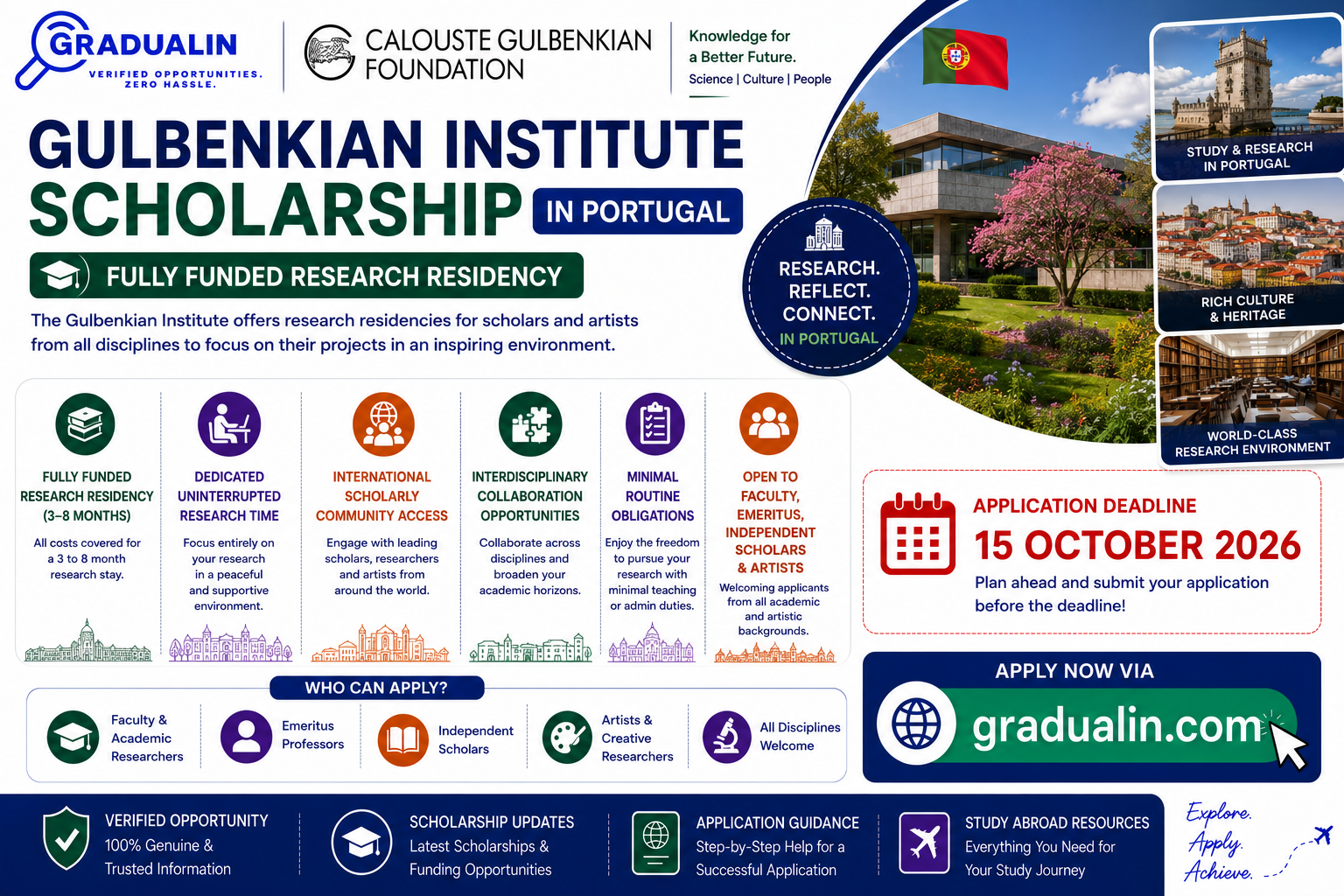
Portugal is quietly emerging as one of Europe’s most exciting destinations for world-class researchers — and the brand-new Gulbenkian Institute for Advanced Study is leading that charge. Established in 2025 by the legendary Calouste Gulbenkian Foundation, GIAS has just opened applications for its 2027/28 Fellowship Programme, inviting outstanding scholars, independent researchers, artists, and academics from every field and every country to spend three to eight months doing exactly what they love most — deep, uninterrupted research. The application window is open right now, from 1 July to 15 October 2026, and no specific language proficiency test, nationality restriction, or field limitation applies. If you have been searching for a prestigious, funded research residency in Europe, this one deserves your full attention.
| Detail | Information |
| Institution | Gulbenkian Institute for Advanced Study (GIAS) |
| Country | Portugal 🇵🇹 |
| Level | Research Fellowship (Postdoctoral, Academic, Independent Scholar) |
| Funding Type | Funded — stipend, travel, health insurance, housing allowance |
| Fellowship Duration | 3 to 8 months (academic year: September 15 – May 15) |
| Application Open | 1 July 2026 |
| Deadline | 15 October 2026 |
| Open To | All nationalities, all fields (no language requirement) |
| Official Link | Apply at Gulbenkian |
🎓 About the Gulbenkian Institute for Advanced Study
The Gulbenkian Institute for Advanced Study — known as GIAS — is an independent institute established in 2025 by the Calouste Gulbenkian Foundation, one of the most respected philanthropic organisations in the world. Its founding mission is beautifully simple: give world-class scholars the time, the space, and the peace of mind to do their best thinking.
GIAS is currently located in Lisbon’s iconic Gulbenkian Foundation main building — a Portuguese national monument — before moving to a permanent headquarters in Oeiras, just 10 miles west of Lisbon and a half-mile from the Atlantic Ocean, by 2029. That permanent home is a restored 18th-century palace surrounded by historic gardens — which tells you something about the level of environment GIAS is building.
What makes this programme genuinely different from most research fellowships is its philosophy. GIAS does not dictate research topics, does not push collaborative agendas, and does not overload fellows with obligations. It trusts that the best intellectual communities emerge when talented, curious people are simply put in the same room with enough freedom to think. Stanford’s Humanities Center has already highlighted GIAS as one of the largest institutes for advanced study in Europe — and this is only its second cohort.
The 2027/28 call welcomes up to 15 fellows across all disciplines for the academic year, making selection genuinely competitive and the community genuinely intimate.
🎓 Fellowship Benefits
GIAS fellows receive a funded package designed to remove every practical barrier to deep research. Here is what the fellowship includes:
- Monthly stipend — amount determined individually based on fellow circumstances (verify exact figure on official website)
- Travel expenses — covered for the residency period
- Family health insurance — included for the entire stay
- Partial housing allowance — GIAS also offers guidance on finding suitable accommodation in Lisbon
- Individual private office on campus
- Access to seminar rooms, a fellows’ lounge, and a reference library with electronic resources
- Borrowing privileges from university libraries across the Lisbon area and the Gulbenkian Art Library
- Visa support letter issued by GIAS for immigration purposes
- Access to campus restaurants on weekdays
- Option to organise seminars, workshops, and public lectures if desired — but never required
The fellowship is awarded as a grant, not as employment income, and is not subject to Portuguese tax withholding. Fellows should independently confirm any tax implications in their home country.
🎓 Eligibility Criteria
GIAS keeps its eligibility requirements deliberately broad — one of the rare fellowships that genuinely means “open to everyone.”
- Nationality: No restrictions. Scholars from any country worldwide may apply
- Career stage: Primarily active academics, but emeriti professors, independent scholars, and practicing artists are all explicitly welcome
- Academic degree: A PhD is the typical profile but is not a formal requirement
- Language requirement: No Portuguese or English language test is required — no IELTS, no TOEFL, no minimum score
- Field of study: All disciplines considered — humanities, social sciences, natural sciences, arts. The only exception: projects requiring laboratory/experimental facilities or that are primarily practice- or application-oriented
- Exclusion: Candidates who have held a GIAS Fellowship within the previous five years are not eligible to reapply
🎓 Who Should Apply — Who Shouldn’t
✅ This fellowship is for you if:
- You are an established or emerging academic who wants uninterrupted time for an independent research project
- You work in the humanities, social sciences, arts, or interdisciplinary fields without heavy lab requirements
- You are an independent scholar, artist, or emeritus professor looking for a prestigious institutional home
- You want a funded European research residency without nationality or language barriers
- You value intellectual community built on voluntary exchange rather than imposed collaboration
❌ This fellowship may not fit if:
- Your research requires lab space, experimental equipment, or clinical facilities — GIAS cannot provide these
- You are an undergraduate or Master’s student — the profile is overwhelmingly postdoctoral and academic
- You need guaranteed full-year funding from day one — GIAS also awards shorter 3-month or 4-month fellowships, but full-year preference exists
- You want a fellowship at a specific university department with faculty supervision — GIAS is an independent institute, not a university faculty
🎓 Research Fields Considered
GIAS has no field restrictions, which is genuinely rare. Fellows are encouraged to pursue projects of their own choosing. Fields that fit well include:
- Humanities — history, philosophy, literature, linguistics, art history, cultural studies
- Social sciences — sociology, political science, economics, anthropology, legal theory
- Interdisciplinary research — any project bridging two or more established fields
- Arts — practising artists with a research component to their work
- Law, ethics, and governance — projects on policy, rights, or institutional theory
- Natural sciences — theoretical or computational work that does not require laboratory equipment
Here’s the key principle from the Institute itself: GIAS gives special attention to innovative and unusual proposals — including those whose unconventional nature may have prevented their authors from getting funded elsewhere. If your research idea is bold and original, that is an advantage here, not a risk.
🎓 Required Documents
Applications are submitted through the MyGulbenkian portal. You will need:
- Curriculum Vitae — full academic and professional record
- Research Proposal — maximum three pages, covering: main themes, scholarly context, originality of the project, and specific objectives for the GIAS stay
- Names of two referees — referees are contacted directly by GIAS and submit letters via the MyGulbenkian platform (letters sent by email are not accepted)
- MyGulbenkian account — free to create at the application portal; required before you can submit
Important: No automatic confirmation email is sent after submission. Once you submit, verify your application is visible in the “Applications” section of your MyGulbenkian account.
🎓 Step-by-Step Application Process
- Create a free MyGulbenkian account at gulbenkian.pt if you do not already have one
- Prepare your research proposal — three pages maximum; be specific about what you will do during the residency, not just your broader academic agenda
- Write your CV — include publications, institutional affiliations, previous fellowships, and any relevant recognition
- Select two referees and inform them in advance — GIAS will contact them directly, so make sure your referees are expecting that request
- Log in to MyGulbenkian and complete the online application form
- Upload all required documents through the portal
- Submit before 15 October 2026 at 15:00 Lisbon time — this is a hard deadline with no late submissions
- Check your MyGulbenkian account to confirm the application is visible under “Applications”
Practical tip: Write your three-page proposal specifically for GIAS’s spirit — emphasise originality, intellectual curiosity, and how the Lisbon environment and the fellow community will benefit your thinking. GIAS explicitly favours bold, unconventional proposals over safe, conventional ones.
🎓 Important Dates
| Milestone | Date |
| Application Window Opens | 1 July 2026 |
| Application Deadline | 15 October 2026 — 15:00 Lisbon time |
| Applicants notified of outcome | Early February 2027 |
| Final list of fellows announced | By 15 April 2027 |
| Fellowship residency begins | September 15, 2027 |
| Fellowship residency ends (full year) | May 15, 2028 |
Bookmark this page and check back for updates.
🎓 Why Apply — Why Lisbon and Why GIAS
Lisbon is one of Europe’s most liveable, affordable, and intellectually vibrant cities. It sits at the intersection of Atlantic, Mediterranean, and global influences, with a research and arts scene that punches well above its size. The cost of living is significantly lower than London, Paris, or Zürich — which means your housing allowance stretches further and your months in residence actually feel comfortable, not financially stressful.
The Gulbenkian Foundation itself is one of the world’s great cultural institutions — home to an extraordinary museum, a world-class music programme, and decades of international grant-making. Being affiliated with GIAS places you inside that ecosystem.
What makes GIAS stand out among institutes for advanced study is its founding philosophy. Unlike programmes that group fellows around a theme or impose a scholarly agenda, GIAS deliberately mixes scholars from radically different fields and lets the community form organically. That is where the best intellectual surprises happen — the historian who talks to the economist, the artist who challenges the legal theorist. It is one of the few research fellowship programmes in Europe where an independent scholar or practicing artist holds exactly the same standing as a tenured full professor.
🎓 Frequently Asked Questions
Q: Do I need to know Portuguese to apply or live at GIAS? No. There is no language requirement of any kind — neither for the application nor for the residency. Lisbon is an English-friendly city, and GIAS operates internationally.
Q: Can I apply if I am not affiliated with a university? Yes. GIAS explicitly welcomes independent scholars, practicing artists, and emeriti alongside active academics. A PhD is not even a formal requirement.
Q: Can I split my residency across two visits? No. GIAS requires continuous residency for the agreed period. Short absences may be allowed in exceptional circumstances, but the fellowship cannot be split into separate visits.
Q: How many fellowships are awarded each year? Up to 15 fellowships per academic year. The exact number depends on the duration mix of individual awards — a cohort of full-year fellows will be smaller than one with several three-month fellows.
Q: Is the fellowship renewable? No. GIAS fellowships are not renewable. Former fellows must wait at least five years before reapplying.
Q: What happens after I submit — will I get a confirmation email? No automatic confirmation is sent. Log in to your MyGulbenkian account and check that your application appears in the “Applications” section. That is your confirmation.
🎓 Official Source
- Application Portal: Apply for the GIAS Fellowship
- GIAS Website: gulbenkian.pt/gias
- FAQ Page: Frequently Asked Questions — GIAS
- Call Conditions PDF: Available on the application page
🎓 Summary Table
| Detail | Information |
| Institution | Gulbenkian Institute for Advanced Study (GIAS) |
| Country | Portugal 🇵🇹 |
| City | Lisbon |
| Level | Research Fellowship |
| Open To | All nationalities, all fields |
| Language Requirement | None — no IELTS, no TOEFL |
| Fellowship Duration | 3–8 months (full year preferred) |
| Benefits | Stipend + travel + health insurance + housing allowance |
| Number of Awards | Up to 15 per year |
| Application Deadline | 15 October 2026 — 15:00 Lisbon time |
| Results Announced | Early February 2027 |
| Residency Starts | September 15, 2027 |
| Official Link | Apply Here |
Explore more opportunities on Gradualin:
Standing Cluster Links:
Fully Funded Scholarships in Australia 2026
Fully Funded PhD Scholarships in the UK 2026
Fully Funded Scholarships in the USA 2026
Study in Italy 2026 — Guide for International Students
Finland Scholarships 2026 — Tuition Waivers for International Students
Top 10 Fully Funded Scholarships in Asia 2027
Fully Funded PhD Positions in Switzerland 2026
Top Fully Funded Scholarships in Saudi Arabia 2026
Study in Turkey 2026 — Guide for International Students
Study in Netherlands 2026 — Guide for International Students
Study in Germany 2026 — Guide for International Students
Study in Norway 2026 — Guide for International Students
Study in Canada 2026 — Guide for International Students
Related Posts:
Fully Funded UNESCO Global Fellowship 2026 — Apply Now
Fully Funded JSPS Postdoctoral Fellowship Japan 2026
Complete Guide to EPSRC Funding UK 2026
Stay updated with the latest scholarships, jobs, and opportunities at Gradualin.com — your trusted guide to studying abroad for free.