
📅 Last Updated: September 2026
Fully Funded RIT PhD in Computing and Information Sciences 2027 — Complete Guide for International Students
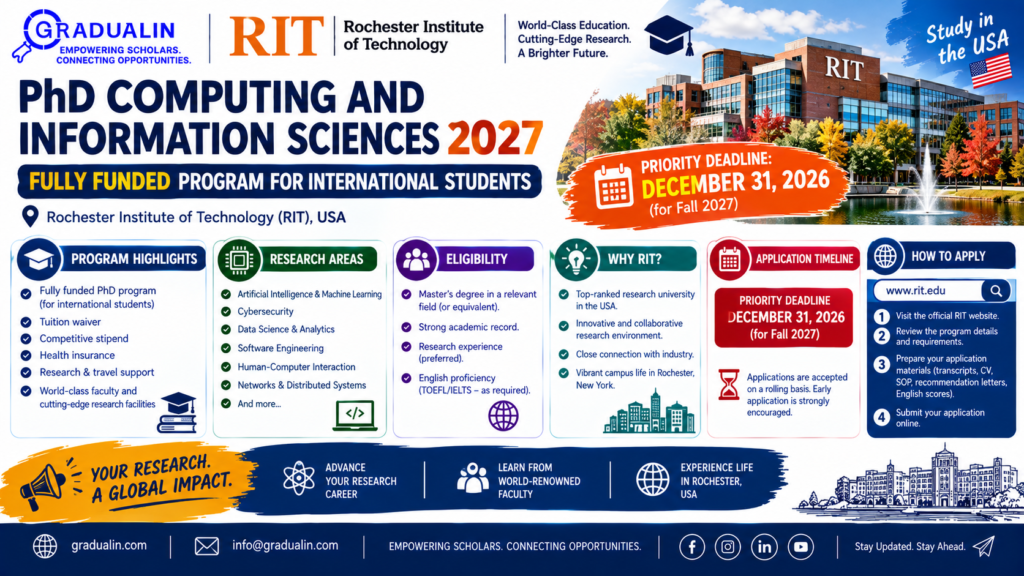
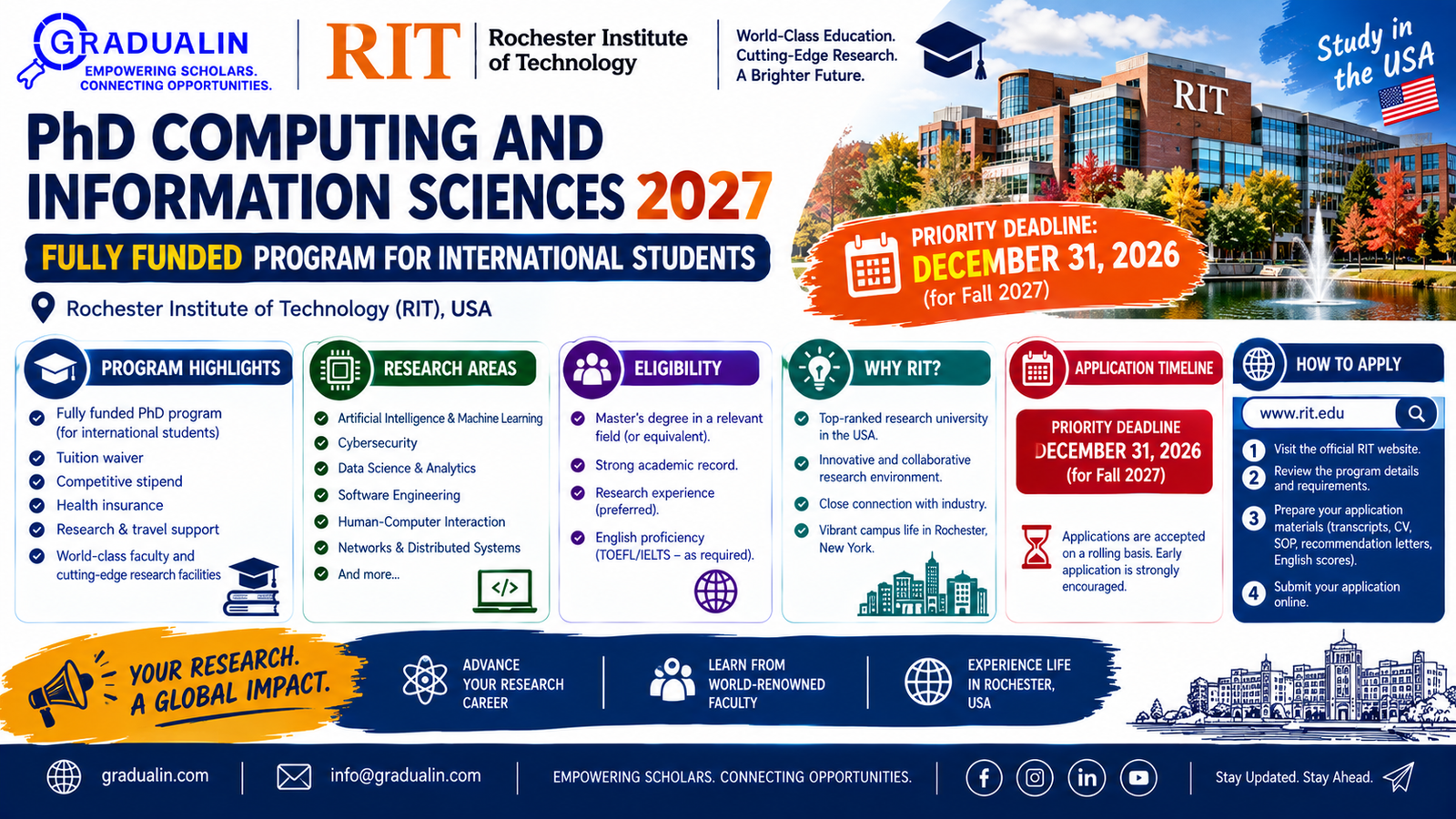
Every admitted student to RIT’s PhD in Computing and Information Sciences receives full tuition coverage plus a monthly stipend — not as a competitive scholarship, but as a standard part of the offer. That 100% funding rate, confirmed directly by the Golisano College, makes this one of the most financially secure routes into a computing PhD in the United States. For Pakistani and South Asian CS graduates ready to pursue doctoral research in Artificial Intelligence, Cybersecurity, Data Science, or Software Engineering, RIT sits at a realistic and rewarding entry point — ranked #68 nationally among all computing PhD programs by US News & World Report, with a 100% placement rate for graduates. This guide covers everything beyond the official page: what the funding actually looks like, how the faculty-matching process works (the part most applicants miss), and what makes a competitive profile for Fall 2027.
| University | Rochester Institute of Technology (RIT) |
| College | Golisano College of Computing and Information Sciences |
| Country | 🇺🇸 United States of America |
| Degree Level | Doctor of Philosophy (PhD) |
| Field | Computing and Information Sciences |
| Funding Type | Fully Funded — Tuition Waiver + Stipend (Graduate Assistantship) |
| Credit Hours | Minimum 60 credit hours beyond bachelor’s |
| Study Mode | On-campus only (full-time) |
| Admit Term | Fall only |
| Priority Deadline | December 31, 2026 (rolling after) |
| Open To | International Students Worldwide |
| Pakistani Students Eligible | ✅ Yes |
| IELTS Required | 6.5 (waiver possible for some applicants) |
| Official Link | Apply Here |
🎓 About RIT and the Golisano College
Rochester Institute of Technology is a private research university in upstate New York with over 19,000 students and a decades-long reputation for producing industry-ready graduates. Its Golisano College of Computing and Information Sciences is one of the largest computing colleges in the United States, spanning five departments: Computer Science, Cybersecurity, the School of Information, the School of Interactive Games and Media, and Software Engineering.
The PhD program was built specifically around the concept of cyberinfrastructure — the integration of hardware, networks, data systems, and software services to solve real-world problems across multiple domains. This is meaningfully different from a traditional computer science PhD, which typically stays within a single narrow specialization. RIT’s approach produces researchers who can work at the intersection of computing and fields like biomedicine, education, social computing, and AI.
For comparison, programs like Carnegie Mellon’s School of Computer Science or Georgia Tech’s Computing PhD are more prestigious on paper but far more competitive and have higher GPA and GRE cutoffs. RIT’s program ranks #68 nationally — a meaningful research university ranking, not a regional one — while remaining genuinely accessible to international applicants with strong research potential. It occupies a productive middle ground between elite selectivity and strong research output.
RIT distributes more than $37 million in merit scholarships and assistantships to graduate students annually, with PhD candidates in computing among the primary beneficiaries.
🎓 Funding Package — What You Actually Receive
- ✅ Full tuition waiver — 100% of tuition covered for all admitted PhD students in good standing
- ✅ Graduate Research Assistantship (GRA) or Teaching Assistantship (GTA) — paid stipend for working with a faculty supervisor or teaching undergraduate courses
- ✅ Stipend range: STEM computing PhD stipends at RIT typically fall between $12,000–$16,000 annually (verify exact amount in your offer letter — verify on official website for updated figures)
- ✅ Semi-monthly payments — stipend paid twice per month throughout the academic year
- ✅ Summer funding — some programs offer additional stipend support during summer months, depending on your advisor and available grants
- ✅ External fellowship support — many RIT computing PhD students hold additional NSF, Microsoft Research, or government fellowships on top of the base package
- ✅ STEM-OPT visa eligible — international graduates can extend post-graduation work authorization in the USA for up to 3 years
- ⚠️ Student activity and health services fees ($235 + $315 per semester) are the student’s responsibility — budget accordingly
🎓 Eligibility Criteria
- Hold a bachelor’s degree (or US equivalent) from an accredited institution — students with backgrounds in engineering, science, humanities, fine arts, or business with sufficient computing experience are all encouraged to apply
- Minimum cumulative GPA of 3.0 (or equivalent) — recommended, not a hard cutoff
- At least one full year of programming and computing coursework
- Strong mathematical background in discrete mathematics, probability, and statistics
- Research aptitude, vision, and any prior experience in computing-related work
- GRE required — no official minimum published; strong scores improve your profile significantly
- English language requirements: TOEFL 88, IELTS 6.5, PTE Academic 60, Duolingo 130, LanguageCert Academic 74. An English test waiver is possible for some applicants — check RIT’s waiver criteria
- Pakistani students: ✅ Fully eligible — no nationality restrictions. International students must study full-time on campus and hold an appropriate US student visa (F-1)
✅ Strong Candidates
- CS, IT, Software Engineering, or related bachelor’s or master’s graduates with a research interest
- Students with prior publications, conference papers, or thesis research
- Applicants who have already identified 1–2 RIT faculty whose research aligns with their goals
- Strong math background with programming skills in Python, C++, or similar
- Pakistani students from NUST, FAST, LUMS, GIKI, UET — where strong CS foundations are built
- Students with IELTS 6.5+ or TOEFL 88+
❌ Not the Right Fit If
- You want a taught or coursework-only degree — this is a research doctorate requiring original dissertation work
- You have no interest in academic or R&D industry careers
- You cannot commit to full-time on-campus study in Rochester, NY
- Your GPA is below 2.8 with no compensating research experience
- You have not yet identified any potential research area — vague statements of purpose are screened out early
🎓 Research Areas — What You Can Study
The PhD brings together faculty from five departments, giving students unusually broad research options. The seven formal research clusters are:
Artificial Intelligence — machine learning, computer vision, natural language processing, pattern recognition, neural-symbolic systems, and AI safety. This is RIT’s fastest-growing research area, with recent NSF CAREER Awards to faculty working on adversarial robustness and AI security.
Data Science — algorithms for large-scale data, knowledge discovery, visualization, and informatics. Particularly strong for students interested in healthcare data and biomedical computing.
HCI and Accessibility — human-computer interaction, accessible technology design, and computing for users with disabilities. RIT’s co-location with the National Technical Institute for the Deaf (NTID) makes its accessibility research internationally recognized.
Security and Privacy — the ESL Global Cybersecurity Institute at RIT is one of the few university-affiliated cybersecurity research centers in the USA. Work here includes network security, privacy-preserving AI, and critical infrastructure protection.
Software Engineering — software design, productivity, product-line architectures, and the intersection of SE with AI tools. Browse Guidelines & Resources on Gradualin for tips on building a strong SE research portfolio.
Systems — hardware-software integration, networking, IoT, and mobile computing.
Theory — algorithms, complexity theory, cryptography, and formal methods.
Beyond these, the program explicitly supports interdisciplinary domain research — computing applied to medicine, education, gaming, geographic information systems, social computing, and computational sustainability.
🎓 Required Documents
- Online application via RIT’s graduate admissions portal
- Official transcripts (in English) of all undergraduate and graduate coursework — Pakistani students need HEC-attested transcripts and degree certificates; contact your university’s controller office early as attestation can take 4–6 weeks
- Statement of Purpose — a research-focused document (not a personal statement). See the dedicated section below
- Two letters of recommendation — ideally from academic supervisors or professors who can speak to your research ability
- Current CV or résumé — include any publications, projects, GPA, GRE, and English test scores prominently
- GRE scores — no official minimum, but competitive applicants typically score well in the Quantitative section
- English test scores — TOEFL, IELTS, PTE, Duolingo, or LanguageCert (see requirements above)
- Research background documentation — any prior papers, thesis chapters, or project work that demonstrates research experience
⚠️ For Pakistani applicants: degree equivalence verification is not typically required by RIT at the application stage, but your I-20 and visa process will require HEC-attested documents. Prepare these in parallel with your application — do not wait until after admission.
🎓 Step-by-Step Application Process
- Identify faculty first. Before writing a single word of your application, spend serious time on RIT’s Funded PhD Studentship page — it lists faculty actively recruiting students for the next cycle. This is the single most important step most applicants skip. The PhD director matches qualified applicants to faculty, and applications with no clear faculty alignment receive far less attention
- Email your target faculty. Write a concise, professional email (not a template) explaining your research interest, mentioning 1–2 of their specific papers, and attaching your CV. Use the subject format: [Your Name — Prospective PhD Fall 2027]. Some faculty will respond with encouragement to apply formally; this materially improves your odds
- Complete the online application at join.rit.edu/apply — submit all materials through this portal
- Submit before December 31, 2026 for priority consideration. Applications received after this date are reviewed on a rolling basis but receive weaker attention as offers go out progressively
- Prepare for a phone/video interview. All candidates for the second stage are interviewed. Expect questions about your research experience, your proposed research direction, and why RIT specifically
- Faculty-director matching. From November through April, the PhD director works with faculty and the admissions committee to find the best matches. You may be asked to contact specific faculty during this phase — respond promptly
- Receive and review your offer. Confirm your stipend amount and tuition remission percentage in writing before accepting. Do not rely on verbal assurances
💡 Practical tip for Pakistani applicants: Begin your US student visa process immediately after receiving your admission letter and I-20. F-1 visa appointment wait times from Pakistan can range from a few weeks to several months depending on the consulate. Start early.
| Milestone | Date / Detail |
|---|---|
| Fall 2027 Admissions Open | Expected: late 2026 (Fall 2026 is now closed) |
| Priority Application Deadline | December 31, 2026 |
| Rolling Admissions (after priority) | January 2027 onwards — until cohort is full |
| Faculty Matching Period | November 2026 – April 2027 |
| Interview Stage | Rolling, following application review |
| Offer Letters Issued | Typically March–April 2027 |
| Program Start | August/September 2027 (Fall semester) |
📌 Bookmark this page — we update deadlines as soon as changes are announced.
🎓 Why Apply — And What the Numbers Actually Mean
The headline statistics are genuinely impressive: 100% of full-time PhD students are fully supported, and the program claims 100% job placement by graduation — in faculty positions at universities worldwide and in industry R&D. These are not aspirational numbers; they are published by the Golisano College directly.
What makes RIT’s PhD particularly compelling for international students is the STEM-OPT pathway. After graduating, international students can work in the USA for up to 3 years on Optional Practical Training (OPT) — which, combined with the research credentials from a ranked US PhD, creates a strong foundation for either an academic career or a transition to tech industry roles at companies that regularly recruit from RIT: Google, Microsoft, IBM, Apple, and others.
The program’s interdisciplinary scope also matters. A Pakistani student with a background in biomedical engineering who wants to apply AI to healthcare can find a genuine home here — something few narrowly-defined CS programs accommodate.
🎓 Frequently Asked Questions
These questions are based on what students most commonly search about this program.
Q: Are Pakistani students eligible for the RIT PhD in Computing?
Yes — Pakistani students are fully eligible and there are no nationality restrictions. International students must study on campus full-time and hold an F-1 student visa. RIT has a well-established international student community and an International Students Office (ISS) that provides dedicated support. Pakistani applicants should note that US F-1 visa processing from Pakistan can take time — start the visa process as soon as you receive your I-20.
Q: Is the RIT Computing PhD fully funded, and is the funding guaranteed?
Yes — all admitted full-time PhD students in computing receive full tuition coverage and a graduate assistantship (stipend). The Golisano College confirms 100% of full-time students are fully supported. Funding continues as long as you maintain satisfactory academic and research progress. You should request written confirmation of your exact stipend amount and tuition remission percentage before accepting your offer — verbal assurances are not binding.
Q: Is GRE required, and what score is competitive?
GRE is required for this program. RIT does not publish a minimum GRE cutoff, but for a computing PhD, a strong Quantitative score (160+) meaningfully strengthens your application. Verbal and Analytical Writing sections matter less in computing but should not be neglected. If your GRE score is weak, a strong research background and faculty relationship can help compensate.
Q: How important is finding a faculty advisor before applying?
Extremely important — arguably more important than your GPA or GRE. The RIT Computing PhD admission process is faculty-driven. The PhD director matches applicants to faculty based on research fit. Applicants who have already identified and contacted specific faculty — and whose statement of purpose clearly addresses that faculty member’s research — receive priority attention. Check the Funded PhD Studentship page regularly as it lists faculty actively recruiting for the next cycle.
Q: Can I apply for a Spring semester intake?
No — the RIT PhD in Computing and Information Sciences admits students for Fall only. There is no Spring intake. Plan your application for the December 31 priority deadline for Fall 2027 enrollment.
Q: What happens if my IELTS or TOEFL score is below the minimum?
Students below the minimum English language requirement may be considered for conditional admission, which typically involves completing English language preparation coursework before or alongside beginning PhD courses. Check RIT’s English test requirement waiver criteria — some international applicants from English-medium universities may qualify for a waiver. Contact Admissions at mskecr@rit.edu to confirm your eligibility before applying.
🎓 Official Source
All information in this guide is sourced from official RIT pages. Always verify current details directly:
- RIT PhD in Computing and Information Sciences — Official Program Page
- Golisano College — PhD Department Page
- Funded PhD Studentship — Faculty Recruiting for Next Cycle
- RIT Doctoral Program Application Guide
For questions: contact Mandie Klingelhoffer, Senior Assistant Director of Graduate Admissions at mskecr@rit.edu or 585-475-5526.
| Field | Details |
|---|---|
| University | Rochester Institute of Technology (RIT) |
| Country | 🇺🇸 USA |
| Degree | PhD — Computing and Information Sciences |
| Funding | Fully Funded (Tuition + Stipend) |
| Study Mode | Full-time, On-campus only |
| Intake | Fall only |
| Priority Deadline | December 31, 2026 |
| IELTS Required | 6.5 (waiver possible) |
| GRE Required | Yes |
| Pakistani Students Eligible | ✅ Yes |
| STEM-OPT Eligible | ✅ Yes — up to 3 years post-graduation |
| Placement Rate | 100% by graduation |
| US News Ranking | #68 nationally — Computing PhD programs |
Stay updated with the latest scholarships, jobs, and opportunities at Gradualin.com — your trusted guide to studying abroad for free.