
📅 Last Updated: September 2026
Fully Funded Australia Awards Scholarship 2028 Pakistan — Complete Guide
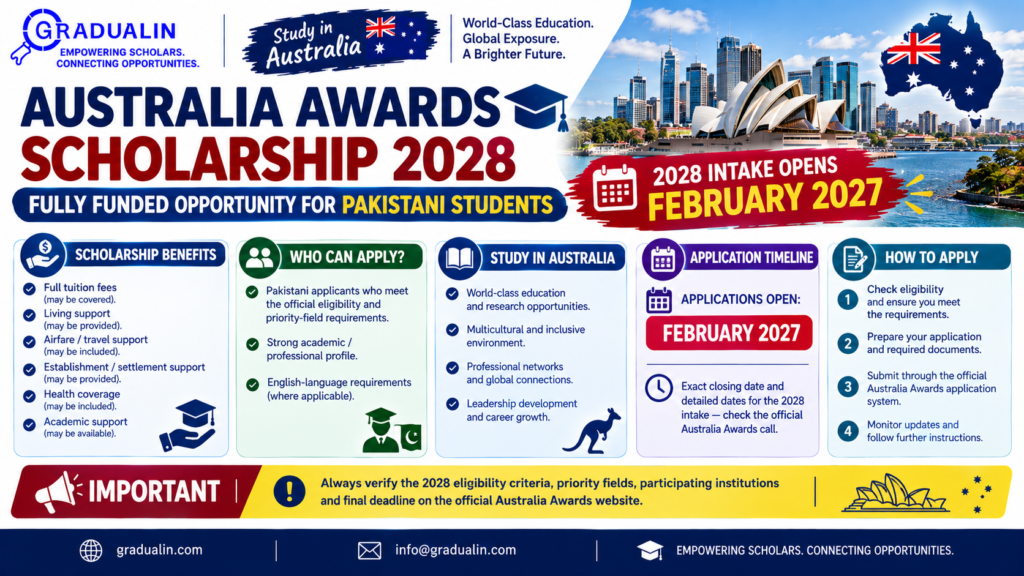
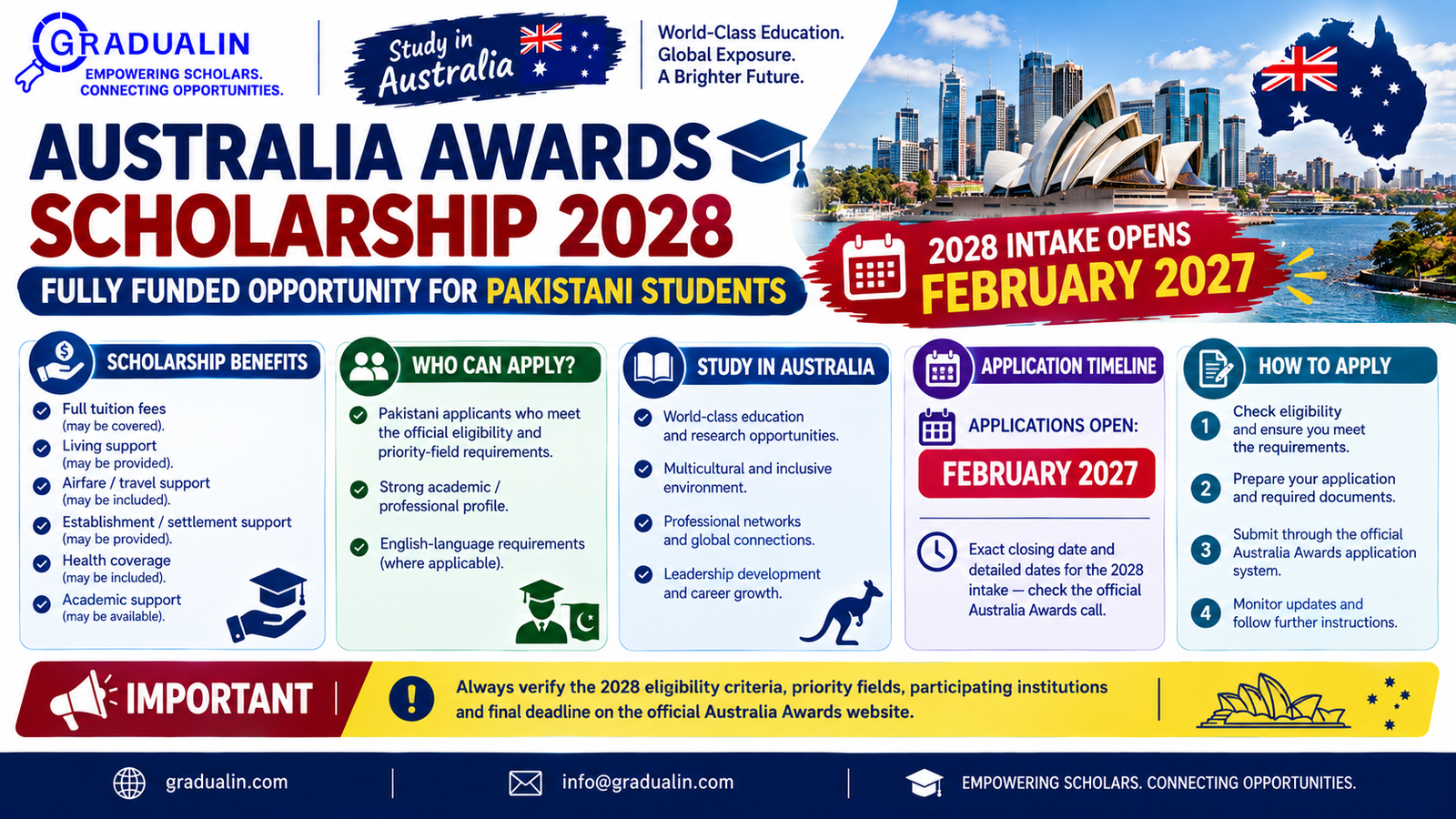
The Australia Awards Scholarship is one of the most generous government-funded scholarships available to Pakistani professionals — and it has been running in Pakistan for over 25 years. Funded by Australia’s Department of Foreign Affairs and Trade (DFAT), it covers the full cost of a Master’s degree at a top Australian university: tuition, airfare, monthly living stipend, and health insurance. Nothing comes out of your pocket. The 2028 intake applications open in February 2027 — which means now is exactly the right time for Pakistani and South Asian students to understand the process, prepare the critical Development Impact and Linkages Plan (DILP), and get their IELTS sorted. This guide covers everything the official page does not: how competitive you really are, what the DILP actually requires, and which priority sectors give Pakistani applicants the strongest shot.
| Funded By | Australian Government (DFAT) |
| Country | Australia |
| Degree Level | Master’s Degree (Coursework or Research) |
| Funding Type | Fully Funded |
| Next Application Window | February – April 30, 2027 (2028 intake) |
| Open To | Pakistani Citizens (residing in Pakistan) |
| Pakistani Students Eligible | Yes — Priority Country for 25+ Years |
| IELTS Required | Yes — 6.5 Academic (no band below 6.0) |
| Work Experience Required | Yes — minimum 5 years |
| Age Limit | Maximum 45 years at time of application |
| Official Link | australiaawardspakistan.org |
🎓 About the Australia Awards Scholarship
The Australia Awards are Australia’s flagship international scholarship program, managed globally by DFAT and administered in South Asia and Mongolia by Palladium. Since 1955, the program has supported over 100,000 scholars worldwide — and Pakistan has been a consistent priority partner for more than two and a half decades.
Unlike university-run scholarships, this is a government-to-government investment. The Australian Government specifically selects fields of study that align with Pakistan’s national development priorities — water security, energy, health, education, governance, and women’s empowerment. That mission-driven design is what makes it different from a standard merit scholarship: your potential to drive change in Pakistan matters as much as your academic record.
For the 2028 intake, the Pakistan program offers Master’s level scholarships only — no undergraduate or PhD pathways through this route. (Pakistani students interested in PhDs should look at Australia’s Research Training Program (RTP), which operates separately through individual universities.) University placement is handled by DFAT, not the applicant — you are matched to an institution based on your field and academic profile, which means top universities like the University of Melbourne, ANU, University of Sydney, Monash, UNSW, and UQ are all possible placements.
Compared to the Chevening Scholarship (UK), which targets similar leadership profiles, Australia Awards offers a longer degree duration and a notably more structured return obligation — but the funding package is broader and includes establishment costs that Chevening does not cover. Both are highly competitive; applicants from strong development-sector backgrounds are genuinely competitive for both.
🎓 What the Scholarship Covers
- ✅ Full tuition fees — paid directly to your Australian university for the entire duration of your degree
- ✅ Return economy airfare — Pakistan to Australia at start, Australia to Pakistan at end
- ✅ Contribution to Living Expenses (CLE) — a fortnightly stipend (approximately AUD 2,000–2,200 per month, verify on official website) to cover accommodation, food, and personal costs
- ✅ Establishment allowance — a one-time payment on arrival in Australia to cover initial setup, textbooks, and study materials
- ✅ Overseas Student Health Cover (OSHC) — full medical insurance for the duration of your scholarship
- ✅ Introductory Academic Program (IAP) — orientation to Australian academic and cultural life before studies begin
- ✅ Pre-Course English (PCE) — English language training if your score meets the minimum but the university requires higher
- ✅ Supplementary academic support — tutoring or academic assistance if needed during your studies
- ✅ Fieldwork allowance — for research students and coursework Master’s programs with a compulsory fieldwork component
- ✅ Australia Global Alumni network membership — lifelong access to a global network of development leaders and further professional development opportunities
Note: The scholarship covers the scholar only. Dependant family expenses are not covered, though dependants may accompany you at your own cost.
🎓 Eligibility Criteria
All of the following must be met at the time of application:
- Be a Pakistani citizen currently residing in Pakistan
- Not hold, or be applying for, Australian or New Zealand citizenship or permanent residency
- Not be married to, engaged to, or in a relationship with an Australian or New Zealand citizen or permanent resident
- Not be a serving military officer (former military who have transitioned to civilian roles are eligible)
- Have completed at least 16 years of education (a Bachelor’s degree is the minimum; an existing Master’s is common among successful applicants)
- Have a minimum of 5 years of relevant full-time work experience in Pakistan
- Be no older than 45 years of age at the time of submitting your application
- English language requirement: IELTS Academic 6.5 or above (no individual band below 6.0), OR TOEFL iBT 84+, OR PTE Academic 58+. Results must remain valid as of 1 January 2028 (i.e., test taken after 1 January 2026 at the latest)
- Not have previously received an Australia Awards scholarship without completing the mandatory two-year return obligation
- Not currently be enrolled in an Australian institution or hold an Australian student visa
Pakistani students: Pakistan is one of the most active participating countries and has been a priority partner for over 25 years. Pakistani applicants are fully eligible — and women, people with disability, and individuals from underrepresented regions are strongly encouraged to apply, as DFAT places active emphasis on inclusive selection.
✅ Strong Candidates
- Mid-career Pakistani professionals (5–15 years experience) in government, NGOs, or development sectors
- Applicants working in water, energy, health, education, governance, or women’s empowerment
- Women applicants — actively encouraged and often given weight in selection
- Professionals with a clear, credible plan to return to Pakistan and apply their degree to national development
- Applicants who can write a compelling, specific DILP with named organisations and measurable outcomes
- Former military personnel now working in civilian development roles
- People from underrepresented provinces or regions (Balochistan, KP, AJK, Gilgit-Baltistan)
❌ Not the Right Fit If
- You are a fresh graduate with fewer than 5 years of work experience
- You want to pursue a PhD — the Pakistan program offers Master’s only
- You are currently married to or in a relationship with an Australian or New Zealand citizen/permanent resident
- You are a serving military officer
- You already hold Australian permanent residency or citizenship
- Your proposed field of study has no clear connection to Pakistan’s development challenges
- You are over 45 at the time of application
🎓 Priority Fields for Pakistani Applicants
The Australia Awards Pakistan program does not publish a rigid approved-courses list, but DFAT consistently prioritises fields aligned with Pakistan’s Sustainable Development Goal priorities. For the 2028 intake, the following areas represent the strongest alignment:
- Water security, WASH, and irrigation management
- Renewable energy and energy policy
- Agriculture, food security, and rural development
- Public health, health systems management, and epidemiology
- Education policy and management
- Governance, public administration, and policy development
- Gender equality, women’s empowerment, and social inclusion
- Infrastructure, urban planning, and climate resilience
- Inclusive economic development and microfinance
Your field does not need to be an exact match — but your DILP must convincingly explain how your chosen degree connects to one or more of these areas. An MBA applicant, for example, can qualify if the application clearly argues how the qualification will improve governance or inclusive economic development in Pakistan. Download the official priority sectors PDF from australiaawardspakistan.org when the 2028 application window opens, as the list is updated annually.
🎓 Required Documents
- Online application — submitted via the OASIS portal (Online Australia Awards Scholarships Information System) at oasis.dfat.gov.au
- Development Impact and Linkages Plan (DILP) — the most critical document; use the official template available on australiaawardspakistan.org during the application window. This is where most Pakistani applications succeed or fail
- Curriculum Vitae (CV) — use the DFAT-provided template, not your standard resume
- Bachelor’s degree certificate and transcript — both sides of all certificates must be copied. Pakistani applicants: ensure HEC attestation of your degrees before the deadline — allow 4–6 weeks for the process
- Master’s degree certificate and transcript (if applicable) — both sides, HEC attested
- IELTS / TOEFL / PTE result — must remain valid as of 1 January 2028
- Passport copy — must cover the full study period
- Academic referee report(s) — one report for Master’s by Coursework applicants; two for Master’s by Research applicants. Use official templates
- Employment referee report — from a supervisor or senior colleague, confirming your role and experience
- No Objection Certificate (NOC) — required for applicants working in the public sector. Obtain from your department well in advance
- Police character certificate — required for the visa stage; obtain from NADRA or your local police station (allow 3–4 weeks processing)
All documents must be uploaded as single PDFs. Scanned documents must be clear and complete — blurry or incomplete scans are a common reason for rejection at the document check stage.
🎓 Step-by-Step Application Process
- Check eligibility — use the self-assessment tool on australiaawardspakistan.org before investing time in the application
- Book your IELTS test now — IELTS centres in Lahore, Karachi, Islamabad, and Peshawar typically have 6–8 week waiting lists during application season. Book 4–6 months before the April 2027 deadline. If your score needs improving, plan time for a resit. TOEFL and PTE are accepted alternatives
- Get your degrees HEC attested — submit to the Higher Education Commission for attestation well in advance. Public university degrees usually take 3–4 weeks; private degrees may take longer
- Download the DILP template — available on the Pakistan country page when applications open in February 2027. Begin drafting early; strong DILPs go through multiple revisions
- Prepare your CV using the official DFAT template — highlight leadership roles, community impact, and development-sector work
- Secure your referee reports — contact referees early; they must use official templates and many busy professionals need significant lead time
- Register on OASIS — at oasis.dfat.gov.au. You will receive a unique registration number. Save it carefully
- Complete and submit your application — upload all documents as single PDFs. The system closes automatically at 14:00 AEST on April 30, 2027. No extensions are given under any circumstances
- Wait for shortlisting — shortlisted candidates are contacted for in-country interviews at the Australian High Commission in Islamabad
- Attend interview — focus areas: your DILP, your return plan, and how your qualification addresses Pakistan’s development challenges
- Outcome notification — final results typically announced between October and December 2027
💡 Practical tip: Attend any virtual information sessions or webinars listed on the Australia Awards Pakistan website during the application window. These sessions explain exactly what assessors look for in the DILP — the single most common failure point — and are free to attend.
For Public Sector applicants, your No Objection Certificate must be obtained from your department before submitting the application, not after. This is a common delay that causes last-minute problems. Start this process in January 2027.
📅 Important Dates — 2028 Intake
| Milestone | Date |
|---|---|
| Application window opens | February 2027 (exact date TBC) |
| DILP template available | February 2027 |
| Application deadline | April 30, 2027 at 14:00 AEST (9:00 AM Pakistan time) |
| Shortlisting period | May – August 2027 |
| In-country interviews | Mid-2027 (varies) |
| Outcome notification | October – December 2027 |
| Scholarship commencement | Early 2028 |
📌 Bookmark this page — we update deadlines as soon as changes are announced.
🎓 Why Apply for the Australia Awards Scholarship?
The financial case is straightforward: a fully funded Master’s at a Group of Eight Australian university — with tuition, airfare, living costs, and health cover all included — represents a financial package worth AUD 80,000–150,000+ depending on your degree and city of study (verify exact figures on official website). But the non-financial value may be even more significant.
Australia Awards scholars return to Pakistan with international credentials, a global alumni network of development leaders across South Asia, and a direct link to the Australian Government’s development programs. Many alumni move into senior government roles, leadership positions in major NGOs, or advisory roles with international organisations. The two-year return obligation, often seen as a constraint, is actually a feature — it ensures your investment lands where it matters most.
The honest caveat: this scholarship is competitive. Pakistan receives a limited number of awards each cycle, and the selection panel explicitly prioritises development impact and leadership potential over academic grades alone. A 4.0 GPA with no clear development angle will lose to a 3.2 GPA with a specific, credible DILP. You also must have IELTS — there is no waiver for this requirement, unlike some other government scholarships. If your score is below 6.5, this window of time before February 2027 is your opportunity to prepare.
🎓 Frequently Asked Questions
These questions are based on what Pakistani students most commonly search about this program.
Can Pakistani students apply for Australia Awards — and is there a quota?
Yes, Pakistani students are fully eligible. Pakistan is one of the most active participating countries in the Australia Awards program — it has been a priority partner for over 25 years. While the exact number of awards per cycle is not publicly disclosed, Pakistan consistently receives among the highest allocations in the South Asia and Mongolia region. There is no separate quota for different provinces or universities; applications are assessed on individual merit and development impact potential.
Is IELTS mandatory, or is there a waiver option?
IELTS (or an equivalent TOEFL or PTE score) is mandatory for Pakistani applicants. There is no waiver. The minimum is IELTS Academic 6.5 with no individual band below 6.0 — TOEFL iBT 84 or PTE Academic 58 are accepted alternatives. Your test result must remain valid as of 1 January 2028, meaning it must have been taken after 1 January 2026. Women, people with disability, and applicants from traditionally marginalised groups may apply with a reduced score (IELTS 6.0, no band below 5.5) but will still need to meet their university’s full requirement before commencing study. Book your IELTS early — test centres in Lahore, Karachi, and Islamabad are heavily booked during application season.
What exactly is the DILP and why does it matter so much?
The DILP — Development Impact and Linkages Plan — is a written document explaining why you want to study in Australia, what you will study, and most importantly, how your qualification will contribute to Pakistan’s development after you return. It is the centrepiece of your application and carries more weight than your academic transcript or work record. A strong DILP names the specific problem you will address, your current and future role in addressing it, the organisations you will work with, and the measurable outcomes you expect to achieve. Vague statements like “I will improve health outcomes in Pakistan” consistently fail. Specific statements — naming your employer, your target community, your planned intervention, and your timeline — consistently score higher. The official DILP template is available on australiaawardspakistan.org when applications open.
Do I get to choose which Australian university I attend?
No — university placement is managed by DFAT, not the applicant. You are matched to a university based on your proposed field of study, your academic profile, and available places. This means world-class universities like the University of Melbourne, ANU, University of Sydney, Monash, UNSW, and UQ are all realistic placements depending on your field. The upside is that you don’t need to navigate individual university admissions processes — DFAT handles placement on your behalf once you are selected.
I work in the private sector. Can I still apply?
Yes. While Australia Awards Pakistan historically skewed toward government and NGO professionals, the program is open to private sector applicants as long as your DILP convincingly connects your proposed study to Pakistan’s development priorities. The key is demonstrating development impact — whether you work in a government ministry, an international NGO, or a private company doesn’t matter as much as whether your work and your plans address national development challenges. That said, public sector applicants must submit a No Objection Certificate (NOC) from their department.
What happens after I finish my degree — do I have to return to Pakistan?
Yes. Returning to Pakistan is a legally binding condition of the award. You must return to Pakistan and reside there for a minimum of two continuous years after completing your scholarship before you can apply for any other Australian visa. This condition is formally attached to your student visa and monitored by DFAT. Failure to comply results in a debt to the Commonwealth for the full cost of your scholarship. This is different from university research scholarships like the RTP, which carry no return obligation. If you are considering working in Australia after your degree, Australia Awards is not the right scholarship for you.
🎓 Official Sources
Always verify current deadlines, priority fields, and document requirements directly from official sources before submitting your application:
- Australia Awards Pakistan — australiaawardspakistan.org (country-specific requirements, DILP template, application portal link)
- Australia Awards South Asia & Mongolia — Scholarships (regional scholarship overview)
- OASIS Portal — official online application system
- Australia Awards Short Courses — shorter training programs also open to Pakistani nationals
| Detail | Information |
|---|---|
| Funded By | Australian Government (DFAT) |
| Host Country | Australia |
| Degree Level | Master’s Degree (Coursework or Research) |
| Funding | Fully Funded |
| Application Opens | February 2027 (2028 intake) |
| Application Deadline | April 30, 2027 at 14:00 AEST |
| IELTS Required | Yes — 6.5 Academic (no band below 6.0) |
| Work Experience | 5 years minimum |
| Age Limit | 45 years maximum |
| Pakistani Students Eligible | Yes — Priority Country |
| Return Obligation | 2 years in Pakistan after graduation |
| Official Website | australiaawardspakistan.org |
Stay updated with the latest Scholarships, Jobs & Internships, Events & Conferences, and Guidelines & Resources at Gradualin.com — your trusted guide to studying abroad for free.