
Institut Courtois Postdoctoral Fellowship 2026 — CAD $63,819/Year Funded Research in Canada
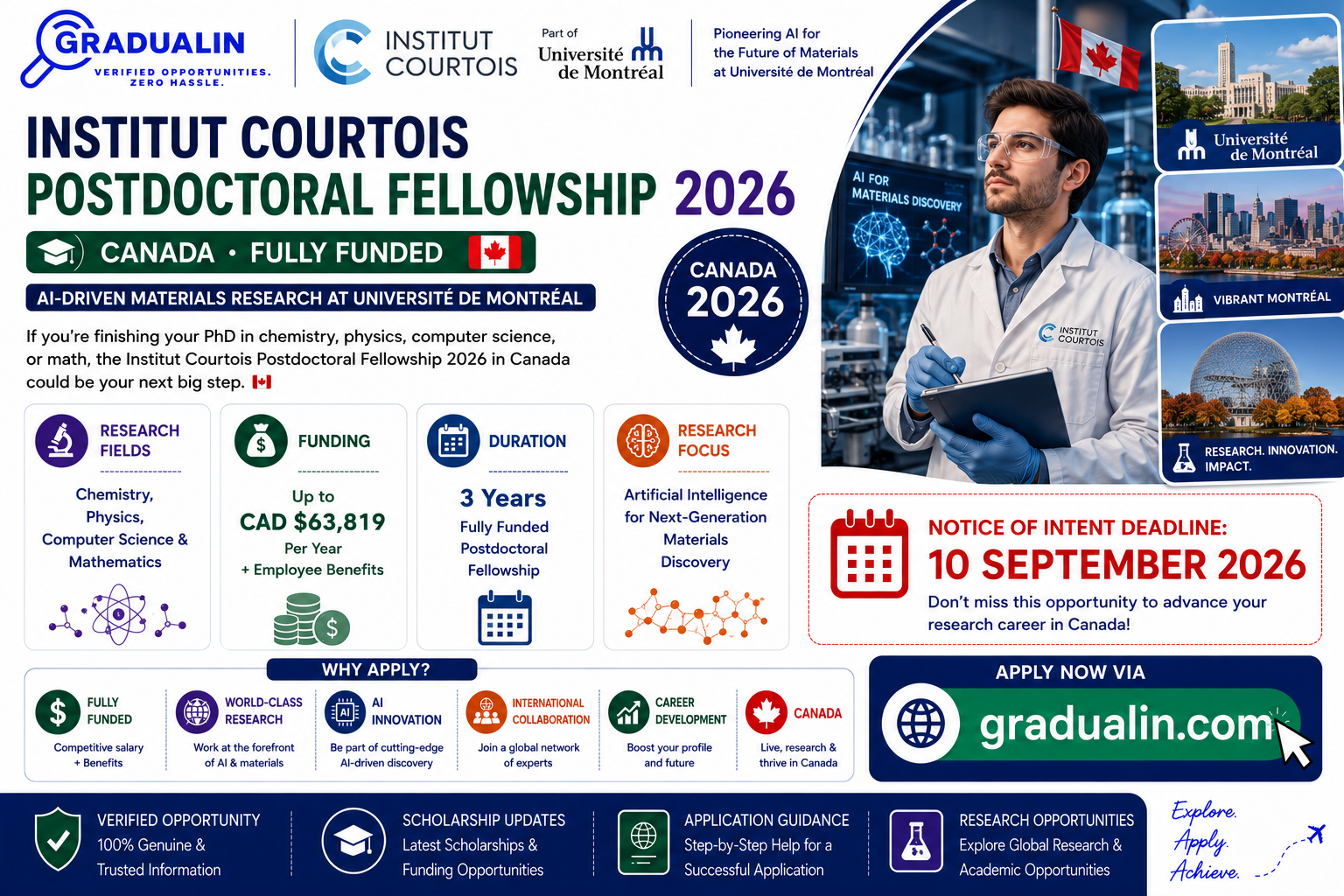
If you just completed your PhD — or are about to — and your work sits anywhere near materials science, quantum physics, chemistry, computer science, or artificial intelligence, this is one of the most valuable postdoctoral opportunities available in Canada right now. The Institut Courtois Postdoctoral Fellowship 2026, hosted at the Université de Montréal, offers a three-year funded position with a salary of CAD $63,819 per year (approximately CAD $76,000 including benefits), plus up to CAD $30,000 per year in dedicated research funding. The notice of intent deadline is September 10, 2026, and the full application closes September 28, 2026. This guide covers everything you need — what the Institut Courtois is, what the fellowship funds, who qualifies, and exactly how to put together a competitive file.
| Detail | Information |
| Institution | Institut Courtois, Université de Montréal |
| Country | Canada |
| Level | Postdoctoral Fellowship |
| Annual Salary | CAD $63,819 (~CAD $76,000 with benefits) |
| Research Funding | Up to CAD $30,000/year (if justified) |
| Duration | 3 years |
| Notice of Intent Deadline | September 10, 2026 |
| Full Application Deadline | September 28, 2026 |
| Results Announced | January 2027 |
| Official Link | Institut Courtois Postdoctoral Fellowship 2026 |
🎓 About Institut Courtois
The Institut Courtois is a research institute within the Faculty of Arts and Sciences at the Université de Montréal — one of Canada’s leading research-intensive universities. Situated at the MIL campus in the heart of Montréal, the Institute was created with a specific mission: to bring together experimental and theoretical researchers in chemistry, physics, computer science, and mathematics, and to harness the power of artificial intelligence to accelerate the discovery of new materials.
What makes Institut Courtois genuinely distinctive is the nature of the research environment it has built. Rather than prioritizing short-term results, the Institute’s more open approach to scientific progress leaves researchers free to devote time to innovative thinking. That philosophy is rare in competitive academic environments and is exactly what makes a postdoctoral fellowship here different from a standard industry-adjacent position.
The Institute counts among its affiliated researchers some of the most prominent names in Canadian science — including Yoshua Bengio (Turing Award laureate and pioneer of deep learning) and Gilles Brassard (co-inventor of quantum cryptography). The director, Carlos Silva, holds the Canada Excellence Research Chair in Light-Matter Interactions and is a globally recognized figure in ultrafast spectroscopy and quantum materials. This is a research community operating at the absolute frontier.
🎓 Research Areas — What You Would Work On
The Institut Courtois organizes its research around four main scientific thrusts, each addressing major challenges where new materials play a transformative role:
- Materials for the Quantum Revolution — Development of quantum materials and systems supporting the emergence of quantum technologies, including superconductors and quantum computing architectures
- Materials for the Energy Transition — Research on energy production, storage, and conversion; think next-generation batteries, photovoltaics, and fuel cells
- Materials for a Sustainable Environment — Design of material solutions that promote sustainability and environmental resilience
- Materials for a Smart Society — Development of materials supporting advanced information technologies and intelligent systems
Running through all four thrusts are two cross-cutting axes that define the Institute’s methodological identity:
- Modeling, theory, materials simulation, and AI — accelerating predictive approaches and the discovery of complex systems through bidirectional interactions between AI specialists and materials researchers
- Automation, robotization, and AI applied to experimental data — high-throughput experimentation, autonomous discovery platforms, and advanced data analysis pipelines
Here’s the best part about this fellowship specifically: you are not being hired to execute someone else’s agenda. The program explicitly asks applicants to propose an original research program — one that integrates into the Institute’s axes but is genuinely your own intellectual contribution. That level of scientific autonomy at the postdoctoral stage is uncommon.
🎓 Fellowship Benefits — What Is Funded
- Salary: CAD $63,819 per year
- Total compensation (including benefits): approximately CAD $76,000 per year
- Research funding: up to CAD $30,000 per year, subject to justification in your budget submission
- Duration: 3 years of continuous funding
- Visa support: The Institut Courtois will assist selected candidates with their work permit and visa application process
To put the salary figure in context: this is a competitive rate for a postdoctoral position in Canada, and the addition of a separate research budget — covering equipment, conference travel, consumables, and collaborations — means fellows can pursue genuinely ambitious work without being constrained by their supervisor’s existing grant structure.
Note that the final allocation of the fellowship is conditional on obtaining the required Canadian work permit for international candidates.
🎓 Eligibility Criteria
To be eligible for the Institut Courtois Postdoctoral Fellowship 2026, you must:
- Be enrolled in, or plan to enroll in, a postdoctoral program at the Université de Montréal
- Have obtained your doctoral degree within the three years prior to the start of funding — or plan to obtain it before the start of the fellowship (expected between March and September 2027)
- Propose an original research program aligned with the expertise of Institut Courtois members and the Institute’s four research thrusts
- Be legally entitled to work in Canada — through Canadian citizenship, permanent residence, or commitment to obtaining a work permit (the Institute will support this process)
- Candidates who can justify career breaks or special circumstances (such as maternity leave or serious illness) may have obtained their doctorate less than four years before the fellowship start date
The Institut Courtois is strongly committed to equity, diversity, and inclusion. Applications from candidates belonging to traditionally underrepresented groups are explicitly encouraged, regardless of ethnic origin, nationality, sexual orientation, or social status.
🎓 Who Should Apply / Who Shouldn’t
✅ This fellowship is the right fit if you:
- Hold a PhD (or will hold one before mid-2027) in chemistry, physics, computer science, mathematics, or a closely related field
- Have an original research idea that fits one of the Institute’s four thrusts and can be articulated as an independent project
- Are looking for a postdoctoral environment that values exploratory, long-horizon research over immediate deliverables
- Want to work alongside world-class researchers in quantum materials, AI, and materials discovery in one of the world’s great research cities
- Are international and need institutional support navigating Canadian work authorization
❌ This may not be the right fit if you:
- Are completing a bachelor’s or master’s degree — this fellowship is strictly for PhD holders or near-completers
- Work in fields unrelated to materials science, quantum physics, chemistry, computer science, or mathematics
- Are not in a position to enroll at or affiliate with the Université de Montréal
- Are looking for an industry-facing role — this is fundamental and exploratory research
🎓 Required Documents
The application is submitted as a single PDF file by email. Here is exactly what must be included:
- Research project (maximum 6 pages) — must cover: the research problem, objectives, literature review, methodology, justification for the choice of Institut Courtois mentor, and justification for integration into the Institute’s research axes
- Budget using the Excel template provided by the Institute, plus a budget justification (maximum 1 page)
- Bibliographic references (maximum 1 page)
- Official doctoral transcripts — non-Canadian universities must include the grading scale
- Curriculum vitae including a full list of publications
- Letter of support from your Institut Courtois mentor, co-signed if applicable — this letter must propose three evaluator suggestions and clearly describe the innovation and added value of your project relative to the mentor’s existing research group
Additionally, three letters of recommendation must be sent directly by referees to institut-courtois@umontreal.ca — they are not included in your application file.
Formatting requirements: Single line spacing, Times New Roman 12pt font, 1-inch (2.54 cm) margins. Applications may be written in either English or French.
🎓 Step-by-Step Application Process
- Identify a mentor — Before anything else, browse the Institut Courtois team page and identify one or more researchers whose work aligns with your proposed project. You cannot proceed without a mentor willing to co-sign your application
- Develop your research project — Use the Heilmeier Catechism (available at darpa.mil/work-with-us/heilmeier-catechism) as a structuring framework — the Institut Courtois explicitly recommends it
- Submit your Notice of Intent by September 10, 2026 — Complete the online form at the Microsoft Forms portal. Include: your name, project title, 10 keywords, your PhD institution and year of completion, names of three referees, and names and emails of your mentor and co-mentor
- Request your three letters of recommendation — Referees must send letters directly to institut-courtois@umontreal.ca with the subject line: ICPDF2026 – letter for LAST NAME First name and filename: Rec-letter NAME of XXX.pdf
- Assemble your full application file as a single PDF named: NOM_Prénom_FellowpostdocIC2026
- Submit the full application by September 28, 2026 (11:59 PM ET) by email to institut-courtois@umontreal.ca with subject line: ICPDF2026 – LAST NAME First name
- Await results — announced January 2027; funding begins between March and September 2027
Practical tip: The evaluation committee includes members from computer science, chemistry, physics, and mathematics — so your research project must be written accessibly for a multidisciplinary scientific audience. Avoid jargon that only specialists in your sub-field would recognize. The clearest application, not the most technically dense one, tends to win.
🎓 Important Dates
| Milestone | Date |
| Competition Launch | May 4, 2026 |
| Notice of Intent Deadline | September 10, 2026 at 11:59 PM (EST) |
| Full Application Deadline | September 28, 2026 at 11:59 PM (ET) |
| Results Announced | January 2027 |
| Funding Start | Between March and September 2027 |
Bookmark this page and check back for updates — Institut Courtois may publish additional guidance or clarifications on its official programs page.
🎓 Why This Fellowship — Why Montréal
There are postdoctoral fellowships, and then there are the ones that genuinely change career trajectories. The Institut Courtois falls into the second category, for a few reasons that matter at the postdoctoral stage.
First, the three-year duration is significant. Most postdoctoral positions run for one to two years — barely enough time to establish a research identity, let alone complete a project of real depth. Three years of continuous funding at Institut Courtois gives you the runway to pursue a genuinely ambitious question.
Second, the research budget — up to CAD $30,000 per year in addition to your salary — is a meaningful differentiator. In most postdoctoral arrangements, research spending comes entirely out of the supervisor’s grant, which creates dependency and limits scope. A dedicated, applicant-justified research allocation changes that dynamic entirely.
Third, the scientific community assembled at the Institute is remarkable. Its innovation ecosystem embraces both distinguished and promising young researchers who have come together at the University of Montreal’s MIL campus to push back the limits of knowledge. Working alongside researchers of the calibre affiliated with Institut Courtois — in an environment explicitly designed for open, exploratory science — provides career capital that is difficult to replicate elsewhere.
Montréal itself deserves a mention. It is consistently ranked among the world’s most liveable cities, with a dynamic bilingual culture, a thriving tech and AI ecosystem, and a cost of living that is far lower than comparable research hubs like Toronto, San Francisco, or London. For an international researcher navigating a new country, it is an excellent city to land in.
This is one of the few postdoctoral programs in Canada that combines a competitive salary, a dedicated research fund, multi-year security, and genuine intellectual freedom — all at a single institution.
🎓 Evaluation Criteria
Applications are assessed across three dimensions:
Excellence of the Candidate
- Academic track record and merit
- Scientific publications and conference presentations
- Evidence of scientific leadership
Excellence of the Project
- Originality and innovative character of the proposed research
- Feasibility within the fellowship period
- Added value to the mentor’s scientific program
Integration at Institut Courtois
- Alignment with the Institute’s four research thrusts
- Potential for collaboration with existing Institute members
- Planned use of the Institute’s infrastructure, laboratories, and computing resources
🎓 Frequently Asked Questions
Q: Do I need to have my PhD in hand when I apply? A: No. You may apply if you plan to obtain your doctorate before the fellowship start date (between March and September 2027). However, the final award is conditional on degree completion.
Q: Can I apply without already having a mentor at Institut Courtois? A: Not effectively — a letter of support from an Institut Courtois mentor is a required document, and the mentor must co-sign the application. Identifying and contacting a potential mentor is the essential first step. Browse the Institut Courtois team page and reach out early — well before the September deadline.
Q: Is the fellowship open to international applicants? A: Yes. The competition is open internationally. Non-Canadian applicants must be legally entitled to work in Canada or commit to obtaining a work permit — the Institut Courtois will provide support with the visa and permit process. The final fellowship award is conditional on obtaining the required authorization.
Q: Can the application be submitted in French? A: Yes. Applications may be written in either English or French.
Q: What is the Heilmeier Catechism and why does it matter? A: The Heilmeier Catechism is a set of questions developed at DARPA to test whether a research proposal is genuinely well-conceived — covering what you are trying to do, why it matters, what is new, what success looks like, and what it will cost. Institut Courtois explicitly recommends using it to structure your 6-page research project. Applicants who ignore this recommendation are at a disadvantage.
Q: Are career break candidates eligible? A: Yes. Individuals who can justify career breaks or special circumstances — including maternity or parental leave, illness, or other significant interruptions — may have obtained their doctorate within a broader window. Contact the Institute directly to confirm your eligibility.
🎓 Official Source and Contact
- Fellowship Page: institut-courtois.umontreal.ca/en/postdoctoral-fellowship-2026
- Notice of Intent Form: Online Form (Microsoft Forms)
- Application & Recommendation Letters Email: institut-courtois@umontreal.ca
- Institut Courtois Team Page: institut-courtois.umontreal.ca/en/our-team
- Address: Complexe des sciences, Université de Montréal, 1375 Ave. Thérèse-Lavoie-Roux, Montréal, QC H2V 0B3, Canada
🎓 Summary Table
| Detail | Information |
| Institution | Institut Courtois, Université de Montréal |
| Country | Canada (Montréal, Québec) |
| Level | Postdoctoral Fellowship |
| Fields | Chemistry, Physics, Computer Science, Mathematics, Materials Science, AI |
| Annual Salary | CAD $63,819 (~CAD $76,000 with benefits) |
| Research Budget | Up to CAD $30,000/year |
| Duration | 3 years |
| Open To | International applicants (work authorization required) |
| Notice of Intent Deadline | September 10, 2026 |
| Full Application Deadline | September 28, 2026 |
| Results | January 2027 |
| Fellowship Start | March–September 2027 |
| Official Page | View Fellowship |
Explore More Categories:
Top Standing Posts:
Fully Funded Scholarships in Canada 2026 — Guide for International Students
Fully Funded PhD Scholarships in the UK 2026
Fully Funded PhD Positions in Switzerland 2026
Top 10 Fully Funded Scholarships in Asia 2027
Fully Funded Scholarships in the USA 2026
Fully Funded PhD Scholarships in Australia 2026
Fully Funded PhD Positions in Switzerland 2026
Top Fully Funded Scholarships in Saudi Arabia 2026
Study in Turkey 2026 — Guide for International Students
Study in Netherlands 2026 — Guide for International Students
Study in Germany 2026 — Guide for International Students
Study in Norway 2026 — Guide for International Students
Study in Italy 2026 — Guide for International Students
Related Posts:
Study in Canada 2026 — Guide for International Students
Fully Funded PhD Positions in Switzerland 2026
Stay updated with the latest scholarships, jobs, and opportunities at Gradualin.com — your trusted guide to studying abroad for free.