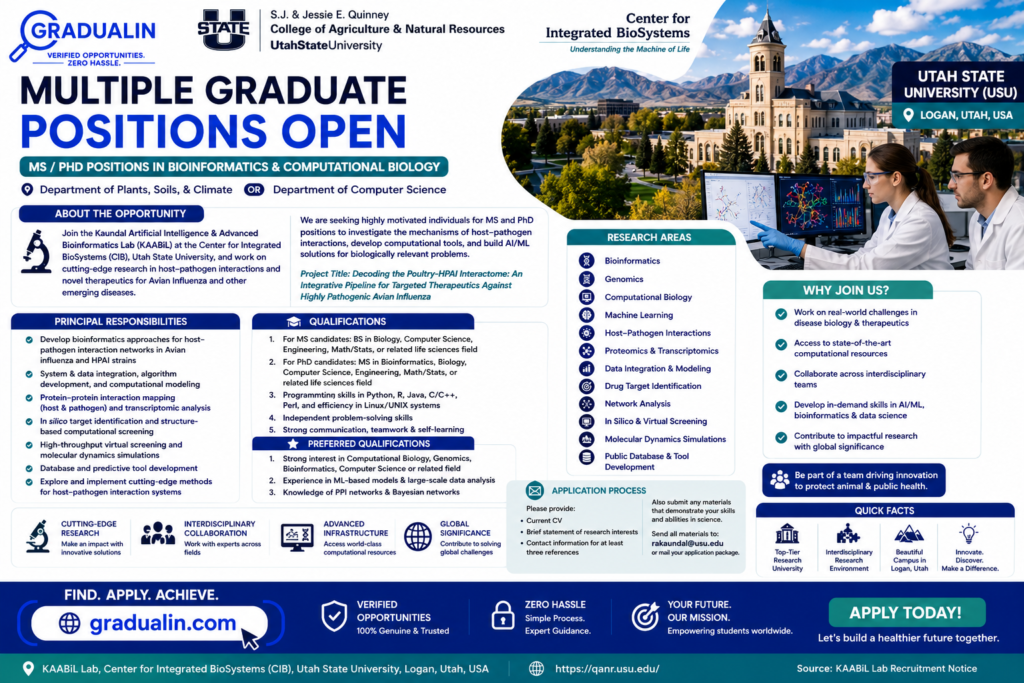

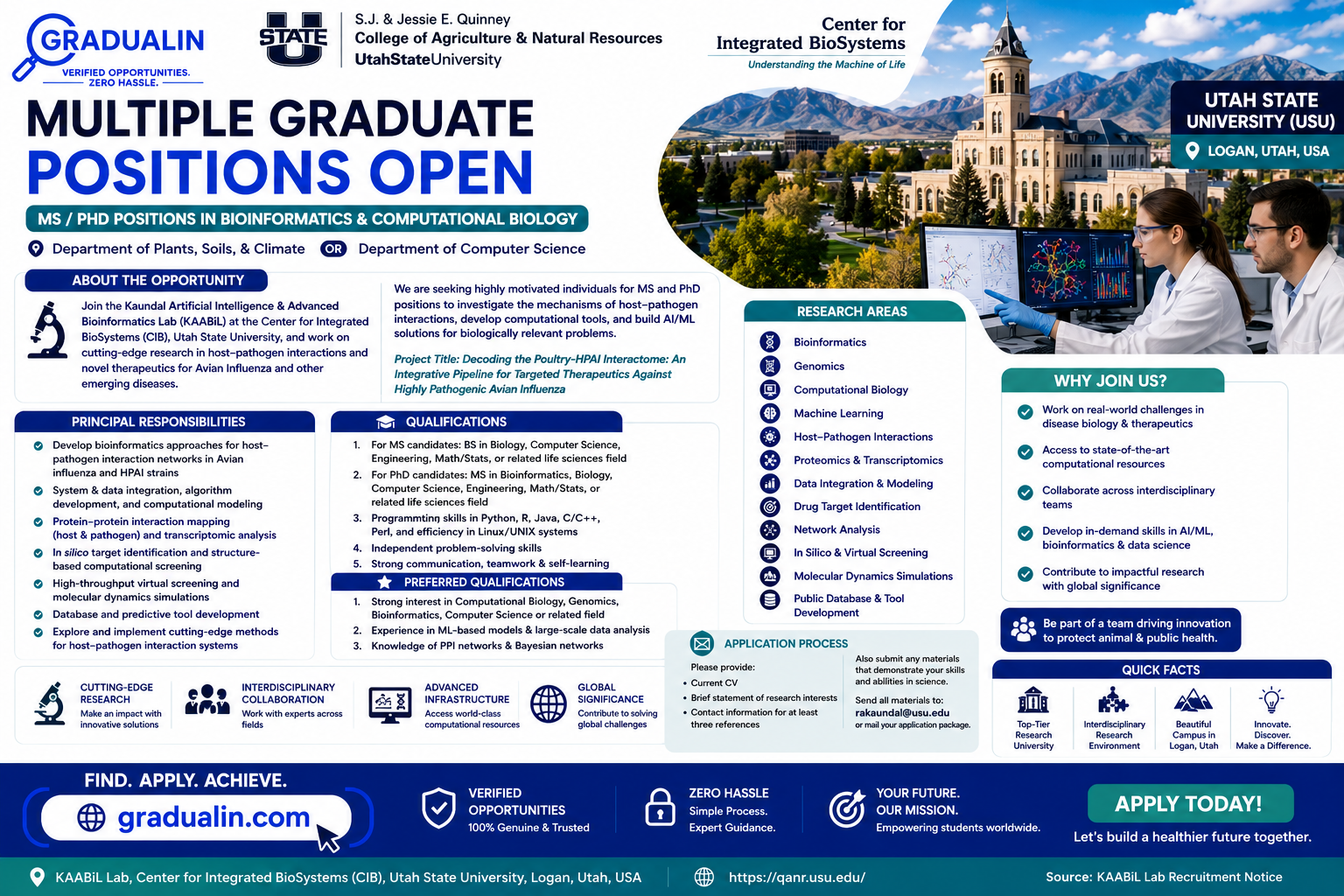
One of the most exciting research-funded graduate opportunities in the United States just opened its doors — and it sits at the crossroads of Artificial Intelligence, Genomics, and life-saving science. Utah State University’s KAABiL Lab is actively recruiting multiple MS and PhD students in Bioinformatics and Computational Biology for 2026, backed by a $1.9 million USDA federal grant. This is not just a degree — it is a chance to work on cutting-edge AI-driven research to combat Highly Pathogenic Avian Influenza (HPAI), one of the biggest biosecurity threats facing the world today. If you have a passion for bioinformatics, machine learning, or computational biology, this opportunity was built for someone like you. At Gradualin, we have broken down everything you need to know — from eligibility and funding to the step-by-step application process.
📋 Quick Overview
| Detail | Information |
| University | Utah State University (USU) |
| Lab | KAABiL — Kaundal AI & Advanced Bioinformatics Lab |
| Country | United States 🇺🇸 |
| Degree Level | MS and PhD |
| Field | Bioinformatics, Computational Biology, Computer Science |
| Funding Type | Research Assistantship (Fully Funded) |
| Deadline | Open — Apply as Soon as Possible |
| Open To | International & Domestic Students |
| PI Contact | rkaundal@usu.edu |
| Official Website | https://kaabil.net |
🎓 Opportunity Overview
Utah State University (USU), located in Logan, Utah, is a leading public research university and a top-tier institution for agricultural, biological, and computational sciences. The S.J. & Jessie E. Quinney College of Agriculture and Natural Resources is home to the Center for Integrated BioSystems (CIB) — a world-class research hub where biology meets technology.
At the center of this exciting opportunity is the KAABiL Lab — the Kaundal Artificial Intelligence and Advanced Bioinformatics Laboratory — led by Associate Professor Dr. Rakesh Kaundal. The lab sits jointly within the Department of Plants, Soils & Climate and the Department of Computer Science at USU.
Here is what makes this truly remarkable: the U.S. Department of Agriculture’s Animal and Plant Health Inspection Service selected KAABiL’s project as one of only 58 out of 417 proposals to receive funding — and it was the only Utah project selected — receiving a $1.9 million federal grant to develop novel treatments, drugs, and therapies for avian influenza using AI and machine learning.
This is not a small lab posting a generic assistantship. This is a federally funded, globally relevant research initiative — and you can be part of it.
🎓 Benefits and Funding
Being accepted into the KAABiL Lab as an MS or PhD student comes with a comprehensive support package. Here is what you can typically expect from a federally funded research assistantship at USU (verify exact amounts on the official website):
- ✅ Full Tuition Waiver — Tuition covered through the research assistantship
- ✅ Monthly Stipend — Approximately $1,800–$2,500/month for MS students; $2,200–$3,000/month for PhD students (verify on official website)
- ✅ Health Insurance — Subsidized or fully covered health benefits
- ✅ Research Funding — Access to lab resources, computing infrastructure, and conference travel
- ✅ State-of-the-Art Facilities — The grant supports building and expanding advanced computational facilities, creating a durable AI and big data ecosystem within the Quinney College of Agriculture and Natural Resources
- ✅ Career Development — Graduate students, postdoctoral researchers, and faculty will receive hands-on experience with AI-based biological modeling, reproducible data science, and real-world agricultural biosecurity problems
The combined value of tuition + stipend at a US university of this caliber is easily worth $40,000–$60,000+ per year — making this one of the most valuable funded opportunities available for bioinformatics students in 2026.
🎓 Eligibility Criteria
Before applying, make sure you meet the following requirements:
For MS Candidates:
- ✅ A Bachelor’s degree in Biology, Computer Science, Engineering, Mathematics/Statistics, or a closely related life sciences field
For PhD Candidates:
- ✅ A Master’s degree in Bioinformatics, Biology, Computer Science, Engineering, Mathematics/Statistics, or a related life sciences field
Additional Requirements for Both:
- ✅ Programming skills in Python, R, Java, C/C++, or Perl
- ✅ Proficiency in Linux/UNIX operating systems
- ✅ Strong independent problem-solving skills
- ✅ Good communication skills, teamwork spirit, and self-learning ability
- ✅ Open to international and domestic students
- ⚠️ Note on English Proficiency: No specific IELTS/TOEFL score is mentioned in the lab posting itself — however, USU graduate admissions typically require TOEFL (iBT 79+) or IELTS (6.0+) for international students. Check the official USU Graduate School page for exact requirements. (verify on official website)
🎓 Who Should Apply — And Who Should Not
✅ Apply if you…
- Have a background in bioinformatics, genomics, or computational biology
- Can code in Python, R, or C++
- Are excited about AI and machine learning applied to real biological problems
- Want to work on federally funded, globally impactful research
- Are motivated, self-driven, and ready to join an active research lab immediately
❌ Don’t apply if you…
- Have no programming experience or are not willing to learn quickly
- Are looking for a coursework-only master’s degree without research
- Have no background in biology, life sciences, or computer science
- Are not comfortable working in a data-intensive, deadline-driven research environment
🎓 Research Areas and Available Programs
The KAABiL Lab offers positions under the following areas of focus. All research connects to the funded project on Host-Pathogen Interaction Networks:
Core Research Themes:
- 🧬 Computational mapping of Avian-HPAI host-pathogen interactions — proteomics and transcriptomics approaches
- 💊 In silico drug target identification — structure-based computational screening, molecular docking, and high-throughput virtual screening
- 🔬 Molecular Dynamics (MD) simulations for therapeutic candidate screening
- 🗄️ Public database and predictive tool development — building intuitive UI for hypothesis testing
- 🤖 Machine Learning models for deciphering host-pathogen interaction networks
- 📊 Systems bioinformatics across diverse Avian and HPAI strains
The lab’s broader research interests also span systems biology, metagenomics, regulatory mechanisms of gene expression, genome-wide host-pathogen interaction networks, and genome annotation for functional studies. KAABiL is actively developing novel computational tools and algorithms for pathogen detection and discrimination, identification of species-specific signatures, and using AI to predict biochemical pathways.
Both MS and PhD positions are available within the Department of Plants, Soils & Climate and/or the Department of Computer Science at USU.
🎓 Required Documents
Prepare the following materials before reaching out or applying:
- Updated CV/Resume — Include academic background, programming skills, and research experience
- Brief Statement of Research Interests — Explain your background and why you want to join KAABiL
- Contact Information for at Least 3 References — Individuals who can speak to your skills and abilities in science
- Academic Transcripts — Unofficial copies are acceptable for initial contact
- Proof of English Proficiency (TOEFL/IELTS) — Required for international applicants through USU admissions (verify on official website)
- Programming Portfolio or Code Samples — Optional but strongly recommended
- Publications or Research Reports — Include if available
🎓 Step-by-Step Application Process
Follow these steps to give yourself the best chance of joining KAABiL in 2026:
- Prepare Your Documents — Update your CV, write a strong research interest statement, and collect your reference contacts
- Email the Principal Investigator Directly — Send your full application package to Dr. Rakesh Kaundal at rkaundal@usu.edu with a clear subject line such as: “Application for Graduate Position — [Your Name] — MS/PhD Bioinformatics 2026”
- Visit the KAABiL Lab Website — Familiarize yourself with current research projects at https://kaabil.net before writing your email
- Apply to USU Graduate School — Once contacted by Dr. Kaundal, formally apply through USU’s Graduate Admissions portal at https://www.usu.edu/apply/
- Submit All Required USU Application Materials — Including transcripts, English proficiency scores, and statement of purpose through the official portal
- Follow Up Politely — If you do not hear back within 2–3 weeks, send one polite follow-up email
💡 Pro Tip: In your research interest statement, specifically mention the HPAI project and explain how your programming skills (Python, R, etc.) connect to the lab’s goals. Tailored applications receive significantly more attention.
🎓 Important Dates and Deadlines
| Event | Date |
| Positions Posted | Early 2026 (Active Now) |
| Application Deadline | Open — Apply As Soon As Possible |
| Preferred Start | Fall 2026 Semester |
| USU Graduate School Deadline | Typically March–June for Fall admission (verify on official website) |
📌 Bookmark this page and check back for updates. Positions may close once filled.
🎓 Why USU — Why This Research Matters
Logan, Utah is a beautiful university town nestled in Cache Valley — clean, safe, affordable, and surrounded by stunning mountain landscapes. The cost of living is significantly lower than most US coastal cities, making your stipend go much further.
But beyond lifestyle, here is the bigger picture: this project does not simply fund a single experiment — it establishes a durable AI and big data ecosystem within the Quinney College of Agriculture and Natural Resources, positioning USU at the forefront of applying artificial intelligence and bioinformatics to real-world agricultural problems, moving discoveries from abstract computation to practical tools that protect producers and consumers.
Related research in areas such as crop disease forecasting, climate-resilient agriculture, soil microbiome analysis, and precision livestock management all stand to benefit from the technologies and expertise developed through the work on HPAI.
When you graduate from KAABiL, you will leave with hands-on experience in AI-driven biological modeling, a track record of publications in top journals, and connections to USDA labs across the country. That is the kind of graduate experience that opens doors to careers in academia, government research, biotech, and pharmaceutical industries globally.
KAABiL’s research has appeared in high-impact journals including Briefings in Bioinformatics, Plant Physiology, Proteomics, and AoB Plants — meaning your work will have real scientific visibility from day one.
🎓 Frequently Asked Questions (FAQ)
Q: Is this position open to international students? A: Yes. The KAABiL Lab explicitly welcomes motivated international candidates. You will need to meet USU’s graduate admissions English proficiency requirements (TOEFL/IELTS) as part of the formal university application process.
Q: Is the position fully funded? A: Yes — these are research assistantship positions, meaning tuition is typically waived and a monthly stipend is provided in exchange for working on the funded research project. (Verify exact amounts with Dr. Kaundal directly.)
Q: Can I apply for the MS position even if I want to do a PhD later? A: Absolutely. Many students join at the MS level and transition to a PhD track, especially if their research aligns well with ongoing projects. Discuss this directly with Dr. Kaundal during your initial contact.
Q: What programming language should I know to be competitive? A: Python and R are the most commonly used tools in bioinformatics. The lab posting also mentions Java, C/C++, and Perl. Knowing at least one of these at a functional level — and being able to demonstrate it — will significantly strengthen your application.
Q: Is IELTS required? A: The KAABiL Lab posting does not specify IELTS/TOEFL. However, USU’s Graduate School typically requires English proficiency scores from international applicants. Check the official USU Graduate School admissions page or contact Dr. Kaundal to confirm your specific case.
Q: What is the HPAI project about? A: The project, entitled “Decoding the Poultry-HPAI Interactome: An Integrative Pipeline for Targeted Therapeutics Against Highly Pathogenic Avian Influenza,” addresses the mechanisms of pathogenesis and aims to develop novel therapeutics to control HPAI in poultry using AI and machine learning-based approaches.
🎓 Official Sources and Contact
- 🌐 KAABiL Lab Website: https://kaabil.net
- 🌐 USU Bioinformatics Facility: https://bioinfocore.usu.edu
- 🌐 Department of Plants, Soils & Climate: https://qanr.usu.edu/psc/index.php
- 🌐 USU Graduate Admissions: https://www.usu.edu/apply/
- 📧 Principal Investigator: Dr. Rakesh Kaundal — rkaundal@usu.edu
- 📞 Phone: (435) 797-4117 | Fax: (435) 797-2766
- 📍 Address: PSC Department, 4820 Old Main Hill; Center for Integrated BioSystems, 4700 Old Main Hill, Utah State University, Logan, UT 84322
📋 Complete Summary Table
| Detail | Information |
| University | Utah State University (USU) |
| Lab | KAABiL — Kaundal AI & Advanced Bioinformatics Lab |
| PI | Dr. Rakesh Kaundal |
| Country | United States 🇺🇸 |
| City | Logan, Utah |
| Degree Level | MS and PhD |
| Department | Plants, Soils & Climate / Computer Science |
| Field | Bioinformatics, Computational Biology, Genomics, CS |
| Funding | Research Assistantship — Tuition + Stipend |
| Grant Amount | $1.9 Million (USDA / APHIS) |
| Open To | International & Domestic Students |
| Programming Required | Python, R, Java, C/C++, Perl, Linux |
| Deadline | Open — Apply ASAP |
| PI Email | rkaundal@usu.edu |
| Lab Website | https://kaabil.net |
🔗 Explore More Opportunities on Gradualin
Browse All Categories:
Top Funded Opportunities for International Students:
- 🎓 Fully Funded Scholarships in Australia 2026
- 🎓 Fully Funded PhD Scholarships in the UK 2026
- 🎓 Fully Funded Scholarships in the USA 2026
- 🎓 Study in Italy 2026 — Complete Guide
- 🎓 Finland Scholarships 2026 — Tuition Waivers
- 🎓 Top 10 Fully Funded Scholarships in Asia 2027
Related Posts You Should Read:
Stay updated with the latest scholarships, jobs, and opportunities at Gradualin.com — your trusted guide to studying abroad for free.