
Merit Scholarships Georgetown GHD Program 2027 — Apply Now
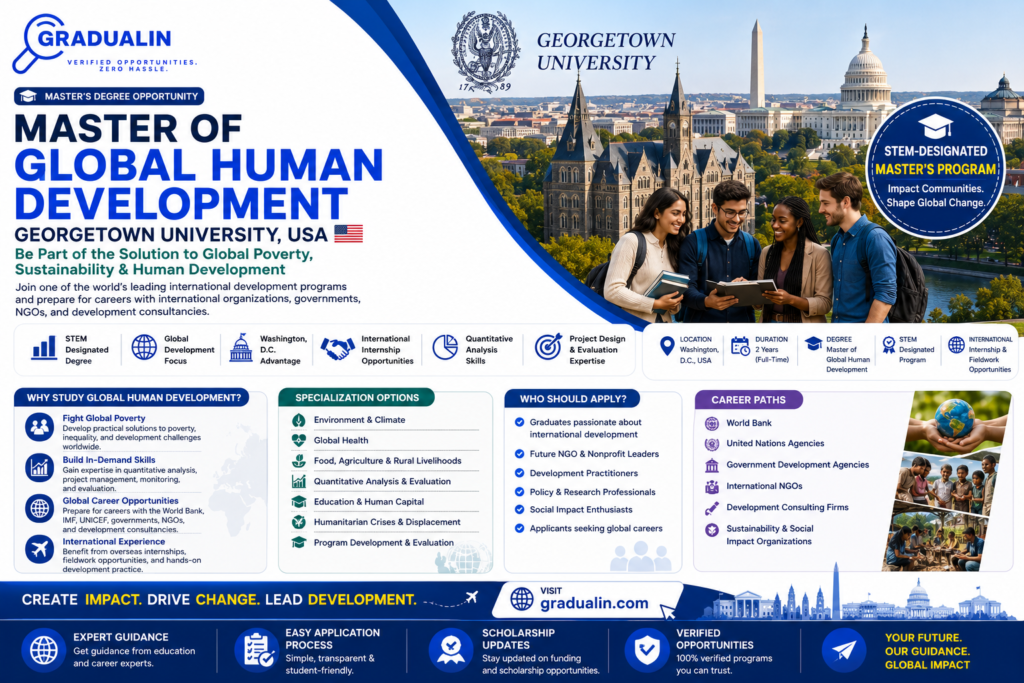
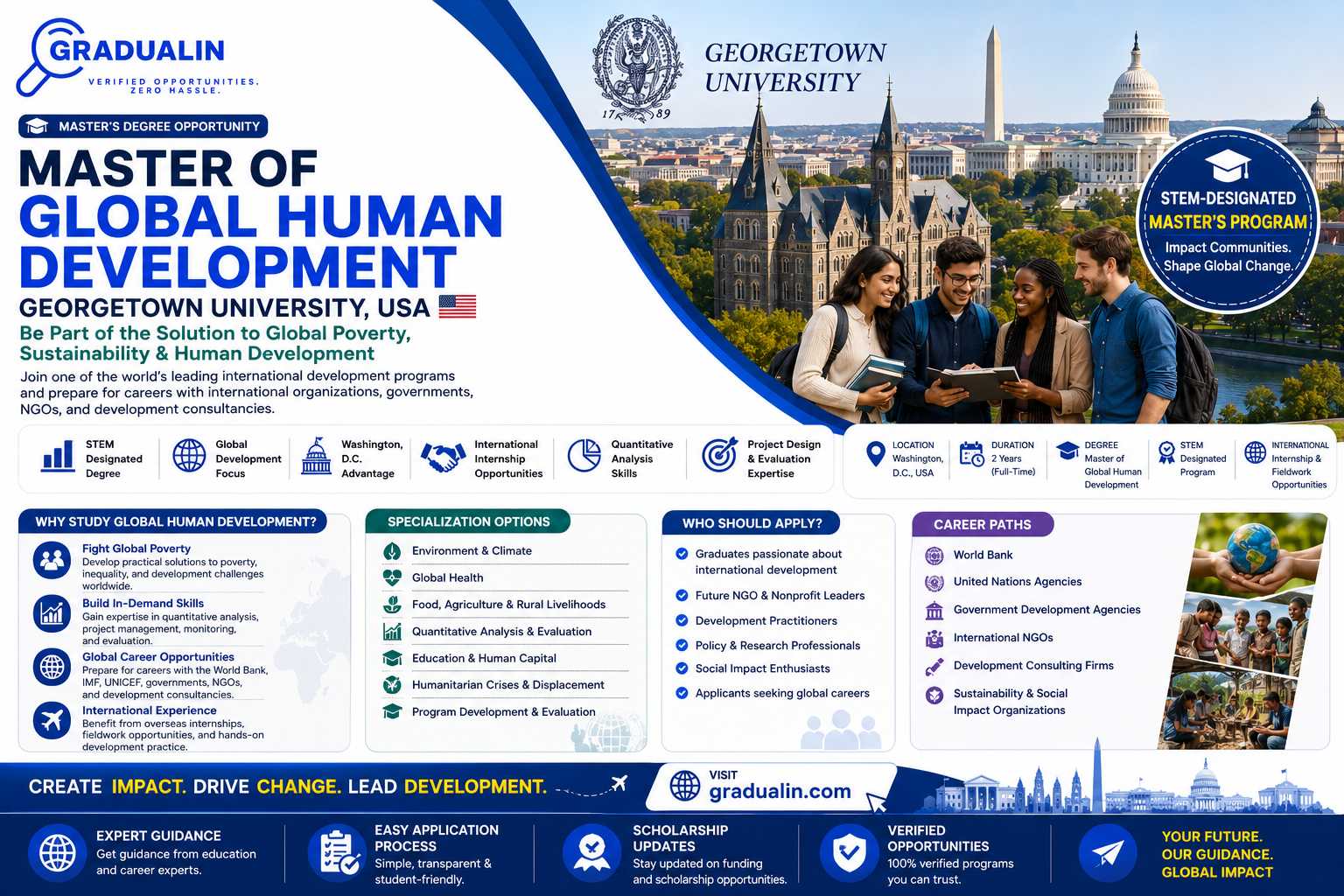
Georgetown University sits just two miles from the World Bank, the IMF, and the U.S. State Department — and its Master of Global Human Development (GHD) program was built to put you inside those doors. This is a STEM-designated, two-year master’s degree from one of the world’s most respected schools of foreign service, designed specifically for people who want to fight poverty, design development programs, and shape global policy. If that sounds like you, this guide covers everything: the program, the scholarships available for international students, the exact deadlines, the application process, and whether this opportunity is right where you are in your career.
| Detail | Information |
| University | Georgetown University (School of Foreign Service) |
| Country | United States |
| Degree / Level | Master of Arts (MA) — 2 years, full-time |
| Funding Type | Merit-based scholarships (full and partial tuition); not a fully funded stipend program |
| Priority Deadline | January 15, 2027 (for scholarship consideration) |
| Final Deadline | April 1, 2027 |
| Open To | All nationalities (specific regional scholarships available) |
| Official Link | GHD Program — Georgetown SFS |
🎓 About the Georgetown GHD Program
Georgetown University’s School of Foreign Service (SFS) has been training diplomats, development professionals, and global policymakers since 1919. The Master of Global Human Development sits within this tradition — but with a sharp, practical focus on one of the world’s most pressing challenges: ending extreme poverty.
What makes this program stand out from similar master’s degrees in international development is its STEM designation. That matters for international students specifically, because it opens the door to extended Optional Practical Training (OPT) in the United States — giving graduates more time to work and build their careers on American soil after graduation.
The program accepts a small, selective cohort of 25 to 30 students per year. That’s intentional. Every student gets close access to faculty who are active practitioners, not just academics. The curriculum blends quantitative analysis, project management, and program design and evaluation — the technical skills that development employers actually hire for.
Georgetown’s location in Washington, DC, gives students direct access to institutions like the World Bank, UNICEF, the Inter-American Development Bank, the Peace Corps, and dozens of the world’s leading development organizations. Many of these employ Georgetown GHD alumni — and some serve as practitioner fellows who teach directly in the program.
Foreign Policy Magazine ranked Georgetown’s SFS #1 in the world for international relations master’s programs in 2024. And the Class of 2023 recorded a 100% employment rate within six months of graduation. Those are numbers worth taking seriously.
🎓 Scholarships and Funding
The GHD program offers merit-based scholarships to both domestic and international students. These come in the form of full or partial tuition remission — not a living stipend. Here is what is available:
- Sub-Saharan Africa: At least one full-tuition scholarship is awarded each year, alongside several partial scholarships, made possible through named family endowments. This is one of the most competitive and generous regional awards in the program.
- The Philippines: The Father Bienvenido Nebres, S.J. Scholarship covers full tuition for one student from the Philippines each year.
- Asia: A student from Asia is eligible for a partial tuition scholarship.
- Latin America: The Beeck Latin America Endowed Scholarship covers 50% of tuition for a student from Latin America.
- The Middle East: Students from this region may receive a partial tuition scholarship.
- Coverdell Fellowship (Returned Peace Corps Volunteers): Volunteers admitted with at least a 33% tuition scholarship may qualify as Coverdell Fellows, with eligibility for additional merit-based aid based on application strength.
- Federal Government Employees: Georgetown offers a 10% scholarship on base tuition plus an application fee waiver for current or recently separated federal civil servants.
- General Merit Aid: Open to all nationalities — submit your application by the January 15 priority deadline and check the merit aid box on your application form.
Important: Scholarship amounts and availability vary each cycle. Always verify current figures and availability at the official financial aid page. First-year scholarships are renewable for the second year, contingent on meeting academic standards.
Tuition costs are not listed here as they are subject to annual updates — check Georgetown’s tuition and aid page for current figures before applying.
🎓 Eligibility Criteria
To be eligible for the GHD program, you must meet the following requirements:
- A bachelor’s degree from an accredited institution
- Completed coursework in introductory macroeconomics, microeconomics, and statistics with a grade of B or better
- Ability to communicate effectively in English and at least one other language
- International applicants must demonstrate English proficiency via TOEFL iBT minimum score of 100 (new scale: 5 from January 21, 2026) or IELTS Academic minimum score of 7.0 — unless your bachelor’s degree was from an institution where English is the sole language of instruction
- At least 1–2 years of full-time work experience after completing your undergraduate degree (strongly recommended)
- Experience living, studying, or working outside your home country (strongly recommended, not mandatory)
Note on the language requirement: before graduation, all admitted students must pass an oral proficiency exam in a second language. This is a graduation requirement, not an admissions test — but factor it into your preparation timeline.
🎓 Who Should Apply — and Who Shouldn’t
✅ Strong candidates for this program:
- Professionals from any background who want to shift into international development, global policy, or development consulting
- Returned Peace Corps Volunteers or AmeriCorps alumni looking to formalise their experience
- Students from sub-Saharan Africa, the Philippines, Latin America, the Middle East, or Asia who want to compete for the regional scholarships — these are among the most accessible full or partial funding opportunities for international students in a US master’s program
- Anyone who has completed the economics and statistics prerequisites and can demonstrate meaningful work or volunteer experience in development-adjacent fields
- Candidates with strong applications who can submit by January 15 to maximize scholarship chances
❌ This program may not be the right fit if:
- You are looking for a fully funded program that covers tuition, living costs, and a stipend — this program offers tuition-based scholarships only
- You have not completed the prerequisite economics and statistics coursework (though you can complete these before enrolling)
- You need TOEFL/IELTS waiver — this program requires demonstrated English proficiency for non-native speakers unless your bachelor’s degree was from an English-medium institution
- You are seeking a research-focused PhD track rather than a practitioner-oriented master’s degree
🎓 Curriculum and Specializations
The GHD program is structured around 48 total credits over two years:
- 27 core credits covering quantitative analysis, project management, program design and evaluation, and a capstone project
- 3 STEM-related credits
- 18 elective and specialization credits, which students can direct toward themes such as:
- Food, agriculture, and rural livelihoods
- Environment and climate
- Social innovation
- Regional area studies
Beyond coursework, the program builds a professional portfolio through:
- A DC internship with a development organization in Washington
- An overseas summer internship abroad with a development organization
- A client-based capstone project solving real development challenges
- An ethics retreat
- Skills workshops and language proficiency development
This combination of classroom training and hands-on placement is genuinely rare at the master’s level and is one of the most frequently cited reasons alumni chose GHD over competing programs. Visit the official curriculum page for full course listings.
🎓 Required Application Documents
- Completed online application form via the Georgetown graduate application portal
- Resume or CV (work experience, academic history, publications, honors)
- Statement of purpose (500 words max) — address where you see yourself in 2030 and what motivates you to work in development
- Official academic transcripts from all institutions attended (non-US transcripts: WES credential evaluation strongly recommended)
- Demonstration of English proficiency: TOEFL iBT (min. 100) or IELTS Academic (min. 7.0) — where applicable
- Three letters of recommendation (mix of professional and academic references recommended)
- Optional: additional personal statement (500 words max)
- Optional: GRE or GMAT scores (recommended if undergraduate GPA or prerequisites are not strong)
- Application fee: $90 USD (non-refundable)
Fee waivers are available for Returned Peace Corps Volunteers, Fulbright Scholars, McNair Scholars, applicants from Sub-Saharan Africa, Truman Scholars, Teach For All alumni, and others — email ghdinfo@georgetown.edu at least one week before submitting.
🎓 Step-by-Step Application Process
- Review the eligibility checklist — confirm your prerequisites, work experience, and language requirement are in order.
- Request your transcripts — if you studied outside the US, contact WES for credential evaluation early; this process can take several weeks.
- Prepare your statement of purpose — keep it under 500 words; focus on your 2030 vision and your development motivation.
- Request your three recommendation letters — give your referees at least four weeks’ notice; professional references carry particular weight for this practitioner-oriented program.
- Submit your TOEFL or IELTS scores — send official scores directly from ETS (institution code: 5244) or IELTS to Georgetown’s Graduate School of Arts & Sciences.
- Request a fee waiver if eligible — email ghdinfo@georgetown.edu with documentation at least one week before submitting.
- Submit your application at the online portal by January 15, 2027 for scholarship consideration.
- Check the merit aid box on your application form if you want to be considered for scholarships — this is not automatic.
Pro tip: The statement of purpose is only 500 words, which means every sentence must carry weight. Avoid vague motivations — name a specific development challenge you want to address and tie it directly to your past experience.
🎓 Important Dates
| Deadline | Date |
| Fee Waiver Deadline | December 1, 2026 |
| Priority Deadline (Scholarship Consideration) | January 15, 2027 |
| Final Application Deadline | April 1, 2027 |
Missing the January 15 priority deadline means losing consideration for merit-based scholarships. If funding matters to you — and it likely does — treat January 15 as your hard deadline, not the April 1 safety net. Bookmark this page and check back for any updates.
🎓 Why Georgetown — Why Washington, DC
Here’s the thing about studying international development in Washington, DC: the city is the industry. The World Bank, the IMF, the U.S. State Department, USAID, the Inter-American Development Bank, IFPRI, and the Peace Corps are all a short Metro ride from Georgetown’s campus. GHD alumni work at all of these institutions.
Georgetown’s practitioner faculty model means you’re learning from people who have actively designed and evaluated the kinds of programs you want to work on — not just academics who study them from a distance. Faculty like Steven Radelet, the Donald F. McHenry Chair in Global Human Development and a former Chief Economist at USAID, bring genuine field experience to every seminar.
For international students, DC also offers one of the most diverse and globally connected professional ecosystems anywhere in the United States. The STEM designation extends your post-graduation OPT work authorization, giving you more runway to build a career in the US development sector before transitioning to your longer-term path — whether that’s multilateral organizations, the nonprofit sector, or government.
This is one of the very few master’s programs where graduates can plausibly be working at the World Bank or UNICEF within a year of finishing their degree — and the alumni network makes that trajectory real rather than aspirational.
🎓 Frequently Asked Questions
Q: Is the Georgetown GHD program fully funded? A: No. The program offers merit-based tuition scholarships — full or partial — to competitive applicants. It does not provide a living stipend or full cost-of-attendance funding. Plan for living expenses in Washington, DC, separately from any tuition scholarship you receive.
Q: Do international students need IELTS to apply? A: Yes, in most cases. International applicants whose bachelor’s degree was not from an English-medium institution must submit a TOEFL iBT score of at least 100 or an IELTS Academic score of at least 7.0. There is no blanket IELTS waiver for this program.
Q: Is GRE required for the Georgetown GHD application? A: No, GRE and GMAT are optional. However, Georgetown recommends submitting scores if your undergraduate GPA is weak, your prerequisites are incomplete or dated, or you want to strengthen an area of your application.
Q: Can I apply without economics and statistics prerequisites completed? A: Yes — incomplete prerequisites do not disadvantage you during the admissions review, as Georgetown evaluates holistically. However, all prerequisites must be completed before you enroll.
Q: When should I apply for scholarships? A: Submit your application by January 15, 2027 and check the merit aid box on the form. Also research and apply for external scholarships simultaneously — many external fellowships have deadlines earlier than the GHD priority deadline.
Q: What is the Coverdell Fellowship? A: Returned Peace Corps Volunteers admitted with at least a 33% tuition scholarship qualify as Coverdell Fellows and are eligible for additional merit-based aid. Fellows complete internships in underserved American communities as part of the program. Georgetown also waives the application fee for all returned Peace Corps Volunteers.
🎓 Official Source and Contact
- Program page: Master of Global Human Development — Georgetown SFS
- Scholarships and aid: Financial Aid, Scholarships and Stipends
- How to apply: Application guide
- Application portal: Apply online
- Email: ghdinfo@georgetown.edu
- Phone: 202-687-5696
- Address: 301 Intercultural Center, 37th & O Streets NW, Washington, DC 20057
🎓 Summary Table
| Detail | Information |
| University | Georgetown University — School of Foreign Service |
| Country | United States (Washington, DC) |
| Degree | MA in Global Human Development |
| Duration | 2 years, full-time |
| STEM Designated | Yes |
| Cohort Size | 25–30 students |
| Funding | Merit scholarships (full or partial tuition); no living stipend |
| Regional Scholarships | Sub-Saharan Africa (full tuition available), Philippines (full tuition), Latin America (50%), Asia (partial), Middle East (partial) |
| IELTS Requirement | IELTS Academic 7.0 minimum (or TOEFL iBT 100) — required for most international students |
| Priority Deadline | January 15, 2027 |
| Final Deadline | April 1, 2027 |
| Fee Waiver Deadline | December 1, 2026 |
| Application Fee | $90 USD (waivers available for multiple categories) |
| Official Link | sfs.georgetown.edu/ma-global-human-development |
Explore more opportunities by category:
Scholarships | Jobs & Internships | Events & Conferences | Guidelines & Resources
Standing related opportunities:
- Fully Funded Scholarships in the USA 2026
- Fully Funded PhD Scholarships in the UK 2026
- Top 10 Fully Funded Scholarships in Asia 2027
- Fully Funded PhD Positions in Switzerland 2026
- Fully Funded Scholarships in Australia 2026
- Fully Funded PhD Scholarships in the UK 2026
- Finland Scholarships 2026 — Tuition Waivers for International Students
Related posts from Gradualin:
- Complete Guide to Financial Planning for Studying Abroad 2026
- Funded PhD Positions at University of South Carolina 2027 — Human Factors
Stay updated with the latest scholarships, jobs, and opportunities at Gradualin.com — your trusted guide to studying abroad for free.