
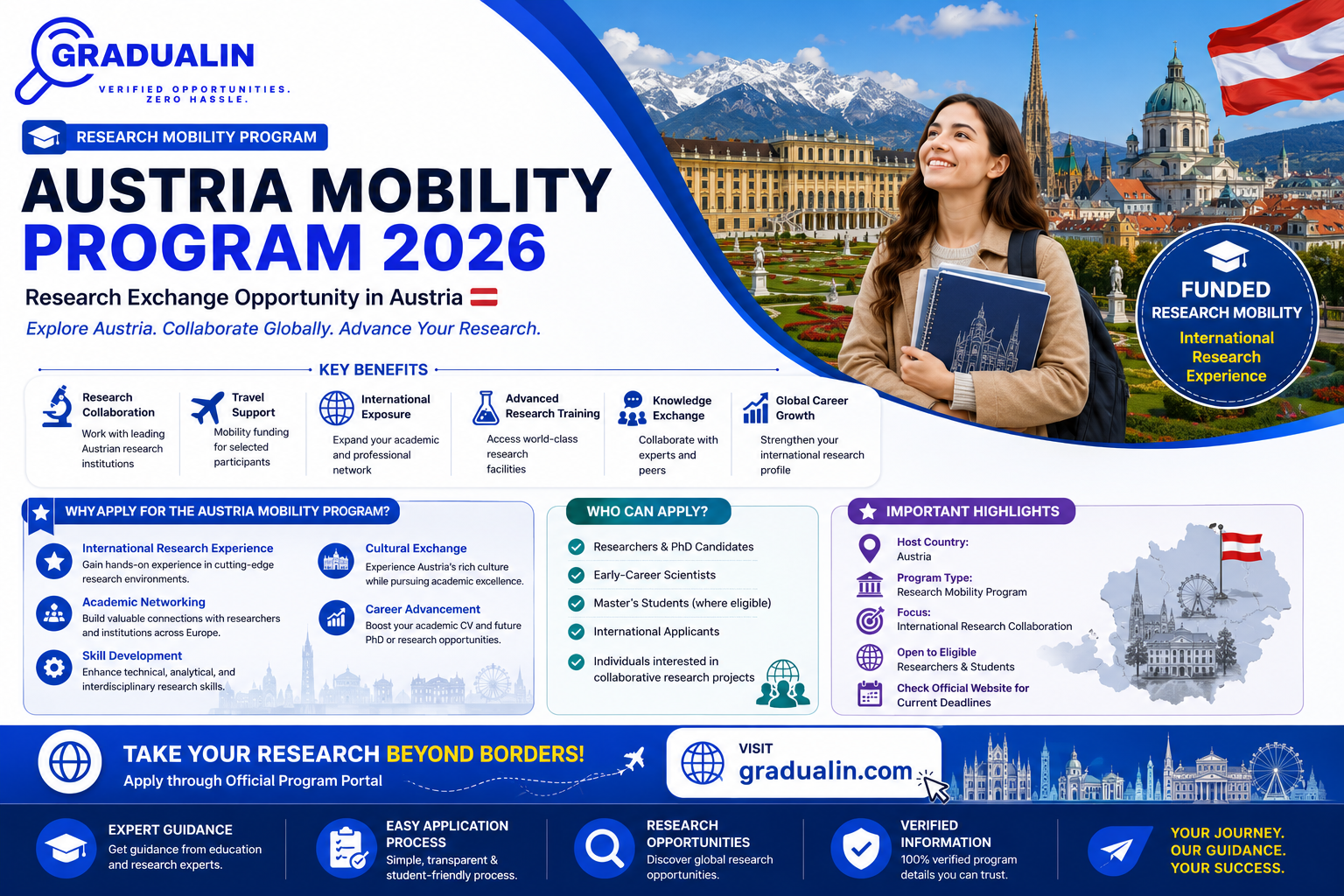
HIDA Austria Mobility Program 2026 — Research Stay in Vienna Guide
If you are a researcher employed at a Helmholtz Centre in Germany, the HIDA Austria Mobility Program is one of the most direct pathways to spending up to three months doing funded, collaborative research at one of Europe’s most exciting data science hubs — the Complexity Science Hub (CSH) in Vienna. HIDA covers travel and accommodation costs of up to €2,000 per month, meaning your research stay comes with genuine financial backing, not just academic permission. This guide breaks down exactly how the program works, who it is for, what the CSH offers, and how to apply step by step.
| Detail | Information |
| Organization | Helmholtz Information & Data Science Academy (HIDA) |
| Country | Austria (Vienna) |
| Stay Duration | Up to 3 months |
| Funding | Up to €2,000/month (travel and accommodation) |
| Host Institution | Complexity Science Hub (CSH) Vienna |
| Open To | Employees of Helmholtz Centres in Germany |
| Deadline | Rolling — apply through HIDA portal |
| Official Link | HIDA Austria Mobility Program |
🌍 About This Opportunity
The Helmholtz Information & Data Science Academy (HIDA) is the training and networking arm of the Helmholtz Association — Germany’s largest scientific organization, comprising 18 research centres working across energy, earth and environment, health, aeronautics, space, matter, and information. HIDA was established specifically to strengthen data science and AI competencies across this ecosystem.
The Austria Mobility Program is one of HIDA’s international mobility tracks, sitting alongside similar programs for Canada, Norway, South Korea, and internal Helmholtz mobility. What makes Austria distinct is the partnership with the Complexity Science Hub (CSH) Vienna — an independent, internationally connected research institution that takes a systems-level view of the most pressing societal questions of our time.
This is not a scholarship and it is not open to the general public. It is a professional research mobility grant for scientists already working within the Helmholtz system who want to deepen their data science toolkit, forge new collaborations, and bring fresh methodological perspectives back to their home centre. The program’s logic is simple: great data science happens faster when researchers move between environments and share methods.
🌍 Benefits and Funding
HIDA’s financial support for the Austria Mobility Program is structured as follows:
- Up to €2,000 per month to cover travel and accommodation costs
- Maximum stay duration of three months — meaning the total potential support reaches up to €6,000
- Costs are settled through your home Helmholtz Centre, with HIDA reimbursing up to the stated ceiling
- The research stay is formally classified as an extended business trip under your existing employment contract
- You retain your salary and employment status at your home centre throughout the stay
- Access to the CSH’s proprietary real-world datasets and its internationally connected research community
- Potential for co-authored publications, new grant applications, and long-term research partnerships with Austrian institutions
What makes this stand out among researcher mobility programs is the combination of institutional backing (Helmholtz and HIDA together carry serious weight in European research) and the genuine scientific environment you step into at the CSH. This is not a visit to give a seminar — it is three months of collaborative, hands-on research.
(Verify all specific funding amounts and reimbursement procedures with your home centre’s program representative before applying.)
🌍 Eligibility Criteria
The Austria Mobility Program has a clear and narrow target group. Before applying, confirm you meet these conditions:
- You are currently employed at a Helmholtz Centre in Germany (any of the 18 member centres)
- You work in a field relevant to data science, AI, computational research, or complex systems — or you are looking to incorporate these methods into your existing research
- You have the support of your home supervisor at your Helmholtz Centre (their sign-off is required as part of the application)
- You are able to develop a concrete joint research project with a researcher at the Complexity Science Hub Vienna before applying
- Your research interests align with one or more of the CSH’s active areas: supply chain dynamics, social polarization and opinion dynamics, healthcare systems, digital market behavior, urban development, or labor market transformations
- You can coordinate your stay within your centre’s business travel regulations
Important: This program is not open to PhD students, master’s students, postdocs without Helmholtz Centre affiliation, or external researchers from outside the Helmholtz Association. If you do not hold a current employment contract with a Helmholtz Centre, this particular program is not the right fit for you.
🌍 Who Should Apply / Who Shouldn’t
✅ This is a strong match if you:
- Are a researcher, postdoc, or data scientist employed at a Helmholtz Centre
- Work with large, complex datasets and want to deepen your analytical methods
- Are interested in network science, agent-based modeling, economic complexity, or digital twins
- Have a specific research question that could benefit from the CSH’s interdisciplinary environment
- Want to establish a lasting collaboration with Austrian academia or industry
❌ This is not the right opportunity if you:
- Are a university student, independent researcher, or external applicant without Helmholtz Centre employment
- Are looking for a funded master’s or PhD program
- Cannot obtain your home supervisor’s approval for an extended research trip
- Are looking for a grant that pays a living stipend on top of your existing salary (funding here covers travel and accommodation, not a new income stream)
🌍 About the Host — Complexity Science Hub Vienna
Here is what makes the CSH genuinely different from a standard university research department. The Complexity Science Hub Vienna describes itself as a place where researchers from physics, computer science, economics, and social sciences work side by side — without disciplinary silos.
The CSH takes what it calls a “complex systems lens” on the world: viewing societies, economies, and ecosystems as interconnected, dynamic, co-evolving networks. Its researchers do not just study these systems in abstract — they use massive real-world datasets to extract meaning from how these systems actually behave, combining data-driven discovery with rigorous theoretical modeling.
Some of the active research domains at CSH include:
- Supply chain dynamics — modeling vulnerabilities and disruptions in global trade networks
- Social polarization and opinion dynamics — understanding how information spreads and divides
- National health insurance data — longitudinal analysis to find new co-morbidity pathways and early warning signals for disease
- Digital market behavior — studying how platforms and consumers co-evolve
- Urban development — data-driven approaches to city planning and spatial systems
- Labor market transformations — tracking how automation and globalization reshape employment patterns
What the CSH offers that few institutions can match is access to proprietary, bespoke real-world datasets — some of which come from long-standing government and industry partnerships that would be difficult for an individual researcher to negotiate independently. For a Helmholtz researcher working on health, energy, environmental, or social systems, this access is a meaningful research accelerator.
The CSH also has over 140 external faculty worldwide, which means your time in Vienna is a point of entry into a genuinely global network.
🌍 Research Areas and Fields Supported
The Austria Mobility Program is well suited for Helmholtz researchers working in or moving toward:
- Data science and AI at scale — particularly predictive AI combined with complex systems theory
- Network science — multilayer networks, diffusion processes, cascade effects
- Agent-based modeling and simulation
- Statistical physics applied to social and economic systems
- Digital twins for complex infrastructure
- Computational social science and economic complexity
- Health data analytics and epidemiological modeling
The CSH’s interdisciplinary approach means that even researchers from traditionally non-computational fields can find a productive entry point — the key requirement is a genuine research question that benefits from data-driven systems analysis.
🌍 Required Documents and Preparation
Before and during the application process, you will need to prepare and coordinate the following:
- Concrete project idea — developed jointly with your intended CSH host researcher (this must happen before you formally apply)
- Home supervisor agreement — your direct supervisor at your Helmholtz Centre must formally support the stay
- Timeline and scope — a clear outline of the research period (up to 3 months), what you plan to achieve, and how it connects to your ongoing work at your home centre
- Application through the HIDA portal — submitted formally by your centre (see Step 3 in the process below), not by you personally
- Business travel documentation — your centre’s business travel regulations will apply; coordinate with your HR or administration team early
- Final report — required upon return; HIDA provides guidelines on format and content
🌍 Step-by-Step Application Process
Step 1: Identify a CSH researcher and develop your project. Visit the Complexity Science Hub website and explore current research groups and faculty. Identify a researcher whose work connects with yours, and reach out directly to discuss the possibility of a joint research stay. This first conversation is informal — its purpose is to establish mutual interest and begin shaping a shared project idea.
Step 2: Develop the project plan. Work with your CSH contact to define the scope of the research, the timeline, and the expected outputs. At the same time, coordinate with your home supervisor at your Helmholtz Centre to get their support and clarify how the stay fits within your current contract and workload.
Step 3: Submit your application through the HIDA portal. The formal applicant is your Helmholtz Centre — not you individually. You are responsible for drafting the application and coordinating inputs from your home supervisor and your CSH host. Navigate to the Austria Mobility Program application page and follow the application assistant. It will guide all parties through the process.
Step 4: Await the selection committee decision. Applications are reviewed by a HIDA selection committee. You and your centre will be notified of the outcome shortly after review. There is no single fixed deadline — applications are processed on a rolling basis, so applying early is advantageous.
Step 5: Organize your trip. Once approved, submit the business travel request at your home centre, arrange accommodation in Vienna, and coordinate with your CSH host on logistics and workspace arrangements.
Step 6: Complete the stay and submit your final report. After your research stay, you will need to submit a final report to HIDA documenting what you achieved, what new collaborations were established, and what knowledge you are bringing back to your home centre.
💡 Pro tip: Step 1 — contacting the CSH researcher directly — is the most important step and should happen well before you initiate the formal HIDA application. A warm introduction from a CSH researcher you have already spoken with will substantially strengthen your application file.
🌍 Important Dates
| Event | Date |
| Application cycle | Rolling — no fixed annual deadline |
| Maximum stay duration | Up to 3 months |
| Funding ceiling | Up to €2,000/month |
| Maximum total support | Up to €6,000 per researcher |
Bookmark this page and check back for updates. HIDA may update program guidelines and available funding pools; confirm current terms directly with HIDA before applying.
🌍 Why Apply — Why Vienna and the CSH
Vienna consistently ranks among the top cities globally for quality of life, and it is home to a dense cluster of scientific institutions that rarely gets the same international attention as London or Zurich — but arguably punches above its weight in research output per capita. For a researcher coming from a Helmholtz Centre in Germany, Austria offers a close cultural and linguistic environment with serious scientific depth.
Here is the bigger picture: the CSH is one of the few research institutions in Europe where complexity science, AI, and policy-relevant data analysis genuinely converge. Most universities do one of these things well. The CSH does all three simultaneously, with access to datasets that academic researchers elsewhere spend years trying to obtain through formal data-sharing agreements.
For a Helmholtz researcher, the return on this three-month investment is not just the immediate research output. It is the methodology transfer — bringing back new techniques in network analysis, agent-based simulation, or health data analytics that can reshape how you approach your work at home. It is also the network: the CSH’s external faculty base spans institutions across North America, Europe, and Asia, and spending three months inside that community puts you on the map in ways that conference attendance simply cannot replicate.
One of the few funded researcher mobility programs of its kind in Europe — the Austria Mobility Program is worth serious consideration for any Helmholtz data scientist looking to expand their methodological toolkit while building durable international partnerships.
🌍 FAQ
Q: Is this program open to PhD students or master’s students? No. The Austria Mobility Program is exclusively for employees of Helmholtz Centres in Germany. PhD students enrolled in a university program but not formally employed at a Helmholtz Centre are not eligible. Check with your centre’s program representative if you are unsure of your status.
Q: Does the €2,000/month cover my full living costs in Vienna? The €2,000/month is intended to cover travel and accommodation costs. It does not replace your existing salary, which continues from your Helmholtz Centre. Whether €2,000 covers full accommodation costs in Vienna will depend on your specific housing arrangements — verify on official website and discuss with your centre’s travel office.
Q: Do I need to speak German to participate? No. The CSH operates in English and its research community is internationally diverse. The scientific work and collaboration will be conducted in English. German is not a requirement.
Q: Can I propose my own research topic, or must I follow CSH’s existing projects? The project is developed jointly between you and your CSH host. It should align with the CSH’s research areas, but there is space for you to bring your own questions and data. The expectation is genuine co-creation, not simply being hosted.
Q: How long does the application review take? The source does not state a precise review timeline, but notes that you will be notified “shortly” after the committee reviews your file. Plan for several weeks between submission and decision — coordinate your timeline with your centre’s travel planning accordingly.
Q: What happens after the research stay? You return to your home Helmholtz Centre and submit a final report to HIDA. The program explicitly expects knowledge transfer — you are meant to bring new methods, perspectives, and connections back into the Helmholtz ecosystem.
🌍 Official Sources
- Austria Mobility Program: HIDA Austria Mobility Program
- Complexity Science Hub Vienna: csh.ac.at
- Application Portal: Apply via HIDA Application Assistant
- Application Process Details: HIDA Application Process Page
- Program Guidelines: HIDA Mobility Guidelines
- Program Contact: hida.mobility@helmholtz.de
- Phone: +49 30 206329-122
- Address: Helmholtz Association, Anna-Louisa-Karsch-Straße 2, D-10178 Berlin
🌍 Summary Table
| Detail | Information |
| Program Name | HIDA Austria Mobility Program |
| Organizer | Helmholtz Information & Data Science Academy (HIDA) |
| Host Institution | Complexity Science Hub (CSH), Vienna, Austria |
| Stay Duration | Up to 3 months |
| Funding | Up to €2,000/month (travel & accommodation) |
| Max Total Support | Up to €6,000 |
| Eligible Applicants | Employees of Helmholtz Centres in Germany |
| Research Fields | Data science, AI, complex systems, network science |
| Language | English |
| Application Deadline | Rolling |
| Application Route | Via HIDA portal (formal applicant = your centre) |
| Official Link | helmholtz-hida.de |
Browse by Category:
Scholarships | Jobs & Internships | Events & Conferences | Guidelines & Resources
Standing Cluster Links:
- Fully Funded Scholarships in Australia 2026
- Fully Funded PhD Scholarships in the UK 2026
- Fully Funded Scholarships in the USA 2026
- Study in Italy 2026 — Guide for International Students
- Finland Scholarships 2026 — Tuition Waivers for International Students
- Top 10 Fully Funded Scholarships in Asia 2027
- Fully Funded PhD Positions in Switzerland 2026
Related Posts:
- Fully Funded PhD Positions in Switzerland 2026 — strong thematic match for European research mobility
- Study in Italy 2026 — Guide for International Students — cross-link as a complementary European academic opportunity
Stay updated with the latest scholarships, jobs, and opportunities at Gradualin.com — your trusted guide to studying abroad for free.