
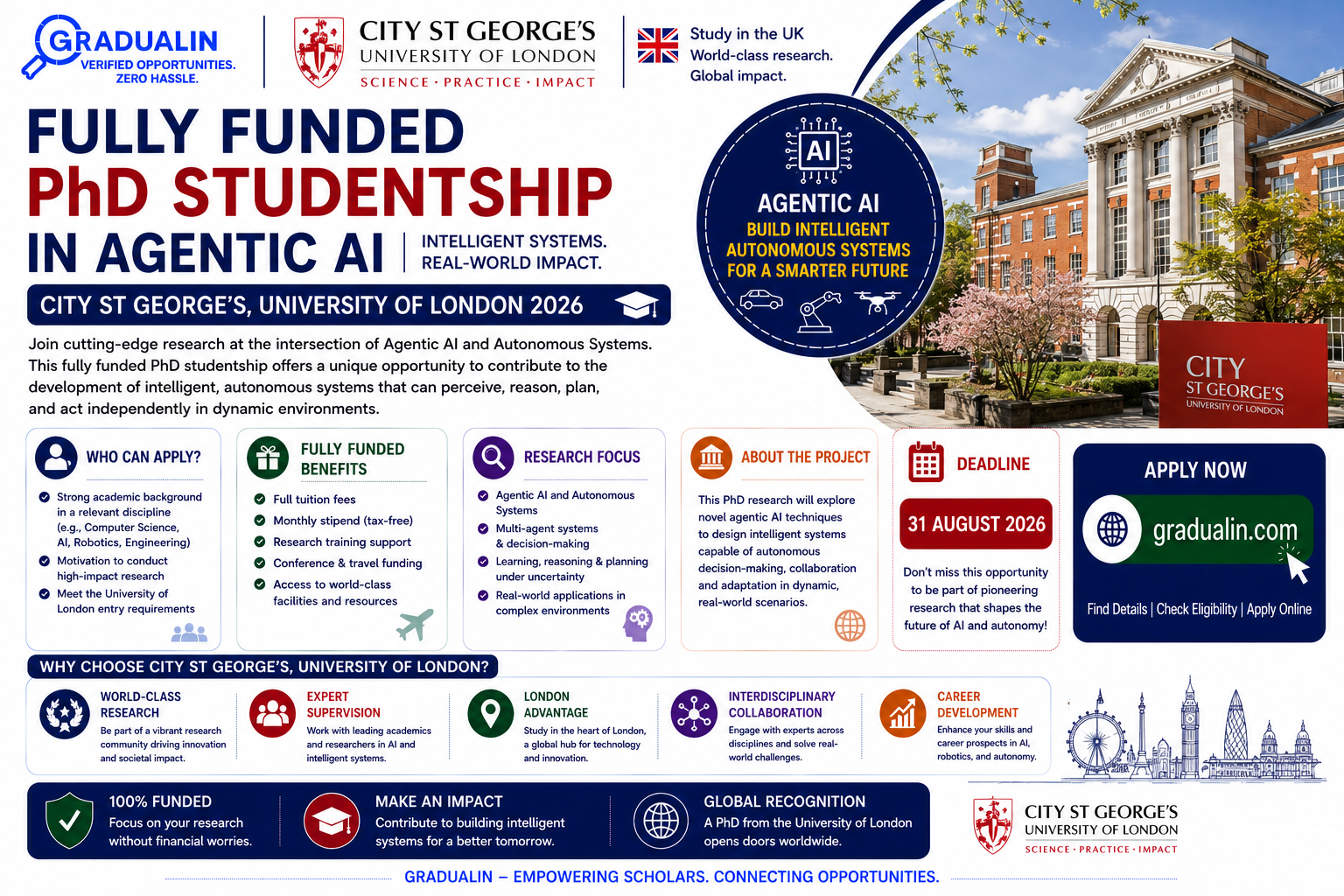
Fully Funded PhD Studentship in Agentic AI — City St George’s, University of London 2026
City St George’s, University of London is offering a fully funded three-year PhD studentship in one of the most strategically important research areas of this decade: Agentic AI and Intelligent Autonomous Systems. The studentship covers full tuition fees and provides a tax-free annual stipend of £23,805, increasing each year in line with UKRI rates. It is open to UK, EU, and international students alike, with a start date of 1 October 2026.
This is not a generic AI PhD. The research sits at the frontier of how AI systems plan, reason, and act autonomously — a field that is moving fast and producing graduates with rare, in-demand expertise. The deadline is 31 August 2026, leaving a narrow application window.
| Detail | Information |
| University | City St George’s, University of London |
| Department | Computer Science |
| Location | Clerkenwell, London, UK |
| Degree Level | PhD (3 years, Full Time) |
| Funding Type | Fully Funded — Fees + Stipend |
| Annual Stipend | £23,805 (UKRI rate, tax-free, increases annually) |
| Deadline | 31 August 2026 |
| Start Date | 1 October 2026 |
| Open To | UK, EU, and International Students |
| Official Link | Apply Here |
🎓 About This Opportunity
City St George’s, University of London — formed through the merger of City, University of London and St George’s, University of London — is a research-focused institution in the heart of London with a long track record in computer science, engineering, and applied technology. The Department of Computer Science hosts active research groups working on AI, federated learning, blockchain, and intelligent systems, which is precisely the research ecosystem this studentship sits within.
What makes this PhD distinctive compared to most funded AI studentships in the UK is its explicit focus on agentic AI — not just machine learning or deep learning in the conventional sense, but the emerging paradigm of AI systems that can plan, make autonomous decisions, use tools, and coordinate with other agents. This is the architecture underlying systems like AutoGPT, LangChain agents, and enterprise AI workflows, and it is significantly underrepresented in formal PhD research pipelines.
By contrast, comparable funded PhDs in the UK — such as those offered through the EPSRC Doctoral Training Partnerships or the Alan Turing Institute’s PhD programme — tend to focus on narrower sub-problems: model optimisation, computer vision, or specific NLP benchmarks. This studentship is explicitly positioned at the intersection of cognitive architecture, multi-agent systems, and real-world decision-making, which is a rarer and more forward-looking research remit.
The studentship is also industry-partnered, which typically means the research has a defined real-world application pathway — and that the student may have access to industry data, mentorship, or co-authorship opportunities beyond the academic department alone.
This position is supervised within a research group that specialises in AI, blockchain, federated learning, and trust frameworks — making it especially relevant for candidates who want to work on trustworthy and privacy-preserving AI, not just high-performing AI.
🎓 Benefits and Funding
- Annual tax-free stipend: £23,805 — increases each year in line with the UKRI rate
- Full tuition fee coverage for the duration of the programme (3 years)
- Industry partnership — structured engagement with an external partner (verify specific partner on official page)
- Research environment — active group in AI, blockchain, federated learning, and intelligent systems
- London location — access to the UK’s largest tech and AI industry cluster
The £23,805 annual stipend sits at the standard UKRI doctoral rate for 2026. While it is not lavish for London living costs, it is tax-free and covers full fees on top — making the total package meaningfully more valuable than the stipend figure alone suggests. Candidates comparing this to industry salaries should factor in the three-year access to a cutting-edge research environment, publication record, and post-PhD positioning in AI roles. (Verify any additional bursaries or conference travel funding with the department.)
🎓 Eligibility Criteria
- Degree requirement: First or upper second-class BEng/MEng (or equivalent or higher) in Computer Science or a related discipline
- Programming: Strong foundation in Python — this is explicitly required
- Deep learning frameworks: Hands-on experience with TensorFlow or PyTorch
- NLP background: Applicants with experience in NLP model development, fine-tuning, or evaluation receive special consideration
- Preferred (not mandatory): Research experience in AI, ML, or NLP; published work in conferences or journals; outstanding academic performance in relevant modules
- Critical note: The listing explicitly states — “Applicants without prior experience in Conversational AI are unlikely to be considered.” This is a hard filter, not a soft preference.
- Open to: UK, EU, and international students
- English language: Not explicitly stated on the listing — contact the department to confirm requirements for international applicants (verify on official website)
🎓 Who Should Apply — and Who Probably Shouldn’t
✅ Strong fit if you:
- Hold a BEng/MEng or MSc in Computer Science, AI, or a closely related field with strong grades
- Have worked on chatbots, voice AI, conversational agents, or LLM-based systems — even as a project or internship
- Can demonstrate Python proficiency and have used PyTorch or TensorFlow in real projects
- Have published or presented research at any level — even undergraduate conferences count
- Are genuinely interested in how AI systems reason and act autonomously, not just in building classifiers
❌ Poor fit if you:
- Have a background in mathematics or data science alone, with no experience in NLP or conversational AI specifically
- Are a recent bachelor’s graduate without hands-on deep learning project work
- Have a computer science degree but no research experience and no published or submitted work
- Are looking for a broad AI PhD with open topic choice — this is a defined research scope with a specific supervisor
🎓 Research Areas and Programme Scope
The successful candidate will work on one or more of the following research directions:
- Autonomous multi-agent systems for real-world decision-making — how groups of AI agents coordinate, negotiate, and act without human oversight
- Agentic LLMs — large language models extended with planning, tool use, and self-evaluation capabilities (think: AI that checks its own work and revises it)
- Cognitive architectures for self-reflective, self-improving AI — systems that can update their own strategies based on experience
- Data-driven agents for reasoning, forecasting, and knowledge integration — connecting AI agents to external data sources and knowledge bases
- Safe, transparent, and privacy-preserving agent-based AI — building systems that are not just capable but auditable and trustworthy
The research group’s existing work in federated learning and blockchain-based trust frameworks suggests the supervisory team has a particular interest in how agentic systems operate securely across distributed environments — a niche that intersects with enterprise AI deployment, healthcare AI, and financial AI applications.
For related UK PhD opportunities in AI and computer science, see Fully Funded PhD Scholarships in the UK 2026.
🎓 Required Documents
- CV — this is the primary selection document; it must clearly demonstrate:
- How your background, qualifications, and experience align with the Agentic AI research scope
- Relevant experience in Conversational AI (voice-based AI, chatbots, conversational agents, or related technologies)
- Academic transcripts (implied — verify on the official application portal)
- No research proposal required — the listing explicitly confirms this
- No prior supervisor approval required — you apply directly without needing to contact the supervisor first (though informal enquiries are welcome)
Note: A research proposal is not required, which lowers the barrier to entry compared to most UK PhD positions. However, this also means your CV must do more heavy lifting — it needs to show research fit without a dedicated document to argue it.
🎓 Step-by-Step Application Process
- Review the research scope — read the full listing carefully and confirm you have genuine experience in Conversational AI. If you are unsure, email Dr. Sujit Biswas at sujit.biswas@citystgeorges.ac.uk for an informal conversation before applying.
- Prepare your CV — this is the central document. Tailor it specifically to this role: lead with Conversational AI and NLP experience, list relevant projects with tools used (Python, PyTorch, TensorFlow), and include any publications, conference papers, or significant coursework in AI.
- Gather supporting materials — transcripts, degree certificates, and any proof of English language proficiency if you are an international applicant (confirm requirements with the department before applying).
- Submit via the official portal — use the Apply Here link on the listing. No supervisor sign-off is needed before you apply.
- Wait for shortlisting — only shortlisted candidates will be contacted. If you have not heard back within two to three weeks of the deadline, follow up with pgr.sst.enquire@citystgeorges.ac.uk.
Practical tip: Because no research proposal is required, your CV’s project descriptions need to be specific and technical. Vague lines like “worked on AI projects” will not pass the initial screen. Instead, write: “Fine-tuned GPT-2 on customer service dialogues using PyTorch, achieving X% improvement on BLEU score.” Concrete outputs, named tools, measurable results.
🎓 Important Dates
| Event | Date |
| Listing Published | 10 August 2026 |
| Application Deadline | 31 August 2026 |
| Expected Start Date | 1 October 2026 |
The window between listing and deadline is just three weeks — this is an unusually tight timeline. Do not delay. Bookmark this page and check back for any updates.
🎓 Why Apply — and Why London
City St George’s sits in Clerkenwell, London, one of the most technically active areas of the city — minutes from the tech clusters of Old Street and Shoreditch, and close to major financial services firms in the City of London. For an AI PhD focused on intelligent autonomous systems, this geography matters: London has the highest concentration of AI startups, enterprise AI deployments, and AI research labs in Europe.
The university itself has been navigating an ambitious post-merger identity, and the Computer Science department is clearly investing in AI research as a growth area. Being an early PhD researcher in that environment carries some real upside — you are not lost in a cohort of 40 PhD students competing for the same supervisor’s attention.
Beyond the university: a funded PhD in Agentic AI positions you for roles that barely existed five years ago — AI systems architect, agent framework engineer, autonomous systems researcher — in a hiring market that is increasingly willing to pay for people who can think about AI at the architecture level, not just the model level.
Gradualin Editor’s Note: This is a competitive studentship, but the selection signals are unusually specific. The explicit requirement for Conversational AI experience means the pool of eligible candidates is genuinely smaller than a typical AI PhD call. If you have that background — even from strong coursework or a final-year project — you are more competitive here than you might assume. The tight deadline (three weeks from posting) will eliminate most procrastinators. For strong candidates who are ready to move quickly, this is a realistic target.
For more funded PhD opportunities in the UK, browse our Fully Funded PhD Scholarships in the UK 2026 guide. If Switzerland is also on your radar, see Fully Funded PhD Positions in Switzerland 2026.
🎓 Frequently Asked Questions
These questions are based on what students most commonly search about this programme.
Is this PhD open to international students? Yes. The listing explicitly states the studentship is open to UK, EU, and international students. The funding covers tuition fees regardless of your fee status, and the stipend applies to all candidates. International applicants should contact the department to confirm English language requirements before applying, as these are not specified on the listing.
Do I need to contact the supervisor before applying? No. The listing states that no formal supervisor approval is required prior to applying. You can — and are encouraged to — submit your application directly if you meet the essential criteria. Informal enquiries to Dr. Sujit Biswas at sujit.biswas@citystgeorges.ac.uk are welcome but not a prerequisite.
Do I need to submit a research proposal? No. A research proposal is explicitly not required for this application. Your CV is the primary selection document, and it must demonstrate alignment with the Agentic AI research scope and experience in Conversational AI.
What does “Conversational AI experience” mean in practice? The listing uses the phrase to describe voice-based AI systems, chatbots, conversational agents, or related technologies. In practice, this includes: building or fine-tuning chatbots, working with LLMs (GPT, LLaMA, etc.) for dialogue tasks, developing voice assistants, or evaluating conversational system outputs as part of a research or industry project.
What is the UKRI stipend rate and will it change? The current stipend is £23,805 per year, which is the 2026 UKRI doctoral stipend rate. It increases annually in line with the UKRI uplift — typically between 3–5% per year, though this is set by UKRI, not the university, and is subject to change. Verify the exact increase schedule with the department.
Can I apply if I have a master’s degree in a related field but not Computer Science specifically? Possibly. The listing says “Computer Science or a related discipline,” which leaves room for degrees in Data Science, Electrical Engineering, Cognitive Science, or similar fields. What matters more is demonstrable experience in Python, deep learning frameworks, and Conversational AI. If your degree is adjacent, lead your CV with project experience rather than formal qualification titles.
🎓 Official Source and Contact
- Apply Here: PhD Studentship Application Portal
- Research Enquiries: sujit.biswas@citystgeorges.ac.uk
- Application Process Queries: pgr.sst.enquire@citystgeorges.ac.uk
- Original Listing: jobs.ac.uk — PhD Studentship: Agentic AI and Intelligent Autonomous Systems
- University Address: Northampton Square, London, EC1V 0HB, UK
🎓 Summary Table
| Detail | Information |
| University | City St George’s, University of London |
| Department | Computer Science |
| Location | Clerkenwell, London, UK |
| Degree Level | PhD (3 years, Full Time) |
| Funding Type | Fully Funded — Fees + Stipend |
| Annual Stipend | £23,805 (UKRI rate, tax-free, increases annually) |
| Deadline | 31 August 2026 |
| Start Date | 1 October 2026 |
| Open To | UK, EU, and International Students |
| Research Proposal Required | No |
| Supervisor Approval Required | No |
| Official Link | Apply Here |
Related Opportunities on Gradualin
- Fully Funded PhD Scholarships in the UK 2026
- Fully Funded PhD Positions in Switzerland 2026
- Top 10 Fully Funded Scholarships in Asia 2027
Explore more opportunities across all categories: Scholarships | Jobs & Internships | Events & Conferences | Guidelines & Resources
Stay updated with the latest scholarships, jobs, and opportunities at Gradualin.com — your trusted guide to studying abroad for free.
Author: Faseeh Sultan — MSIT, PhD Scholar | 7 Years in Education