

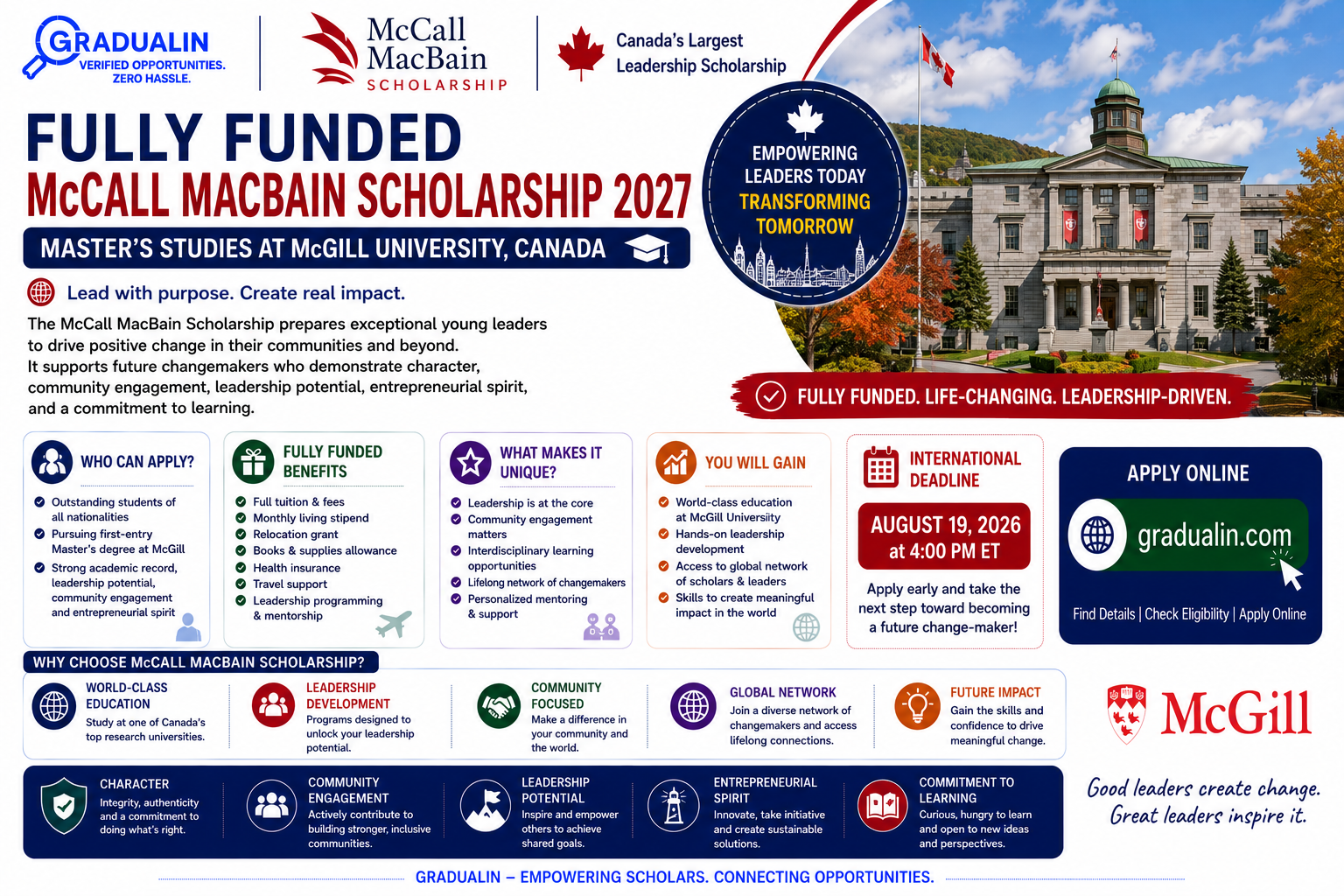
Fully Funded McCall MacBain Scholarship 2027 — Canada’s Largest Leadership Scholarship for Master’s Studies at McGill
Canada’s most prestigious leadership-based graduate scholarship just opened applications for its 2027 cohort. The McCall MacBain Scholarship offers up to 30 fully funded master’s or professional degree places at McGill University — one of the world’s top 30 universities — along with a living stipend of CAD $2,300 per month, a relocation grant, mentorship, and an interdisciplinary leadership curriculum. Unlike most graduate scholarships that reward academic achievement alone, this one is explicitly designed for people who want to lead — in any sector, from healthcare and engineering to law, social work, and public policy.
Applications are open now for Summer/Fall 2027 entry. The deadline for international students (outside Canada and the US) is August 19, 2026. Canadian and US applicants have until September 23, 2026.
| Detail | Information |
| University | McGill University, Montreal, Canada |
| Country | Canada |
| Degree Level | Master’s or Second-Entry Professional Undergraduate |
| Fields | 150+ programs across all disciplines |
| Funding Type | Fully Funded |
| Monthly Stipend | CAD $2,300 per month (during academic terms) |
| Full Scholarships Available | Up to 30 (20 Canadian, 10 international) |
| Total Awards Available | Up to 130 (scholarships + finalist + regional awards) |
| International Deadline | August 19, 2026 at 4:00 PM ET |
| Canada/US Deadline | September 23, 2026 at 4:00 PM ET |
| Open To | Canadian and international students worldwide |
| Official Link | Apply Here |
🎓 About the McCall MacBain Scholarship
Established in 2019 by Canadian philanthropists John and Marcy McCall MacBain, this program holds an important distinction: it is described as Canada’s first comprehensive leadership-driven scholarship for master’s and professional studies, and the largest of its kind in the country. McGill is ranked #1 in Canada and #30 globally in the 2027 QS World University Rankings — and the McCall MacBain Scholarship is the most competitive route to study there at no cost.
What separates this program from comparable flagship scholarships is its breadth. The Rhodes Scholarship is restricted to Oxford and to certain fields; the Chevening is open only to UK study; Commonwealth scholarships are limited to specific country partnerships. The McCall MacBain Scholarship covers over 150 master’s programs at a single institution — from Architecture, Business, and Engineering to Social Work, Urban Planning, and Medicine — and it selects scholars based on character, leadership, and community engagement, not just academic scores.
Each year, 30 scholars are selected: 20 Canadian and 10 international. Beyond the full scholarships, up to 100 additional finalist and regional awards are available, meaning the total awards pool is 130 for the 2027 cohort. Even candidates who reach the regional interview stage but are not selected as finalists can receive a Regional Award worth CAD $5,000 (Canadian applicants) or CAD $10,000 (international applicants) — usable at any public university in Canada.
The program has now produced six cohorts. The 2026 cohort press release confirms that 30 scholars were selected from a pool of applicants across fields as varied as AI, bioengineering, cosmology, rehabilitation, robotics, and urban planning — a useful signal of the program’s genuine disciplinary breadth.
🎓 Benefits and Funding
The McCall MacBain Scholarship is fully funded with several components:
- Full tuition and fees for the complete normal duration of the eligible master’s or professional program at McGill
- Living stipend of CAD $2,300 per month during academic terms
- One-time relocation grant to cover moving costs to Montreal
- Optional summer funding of up to CAD $5,000 for scholars not enrolled full-time during summer, to support meaningful research or impact work
- Leadership development curriculum — included as part of the program, not an add-on; spans bi-weekly seminars, annual summer intensives, field trips, and place-based learning in a different Canadian city in the scholar’s second year
- Personal mentor matched to each scholar’s field and goals, plus an executive coach and advisors
- McCall MacBain House — a dedicated space on McGill’s downtown campus for scholar community, study, and workshops
- Travel costs covered for scholars invited to final interviews in Montreal
Scholars may also accept up to CAD $10,000 per year in additional merit-based funding from other sources. There is no cap on additional funding received based on financial need.
The Finalist Award — for those who reach final interviews but are not selected as McCall MacBain Scholars — is CAD $10,000 (Canadian) or CAD $20,000 per year for up to 2 years (international), tenable at eligible McGill programs.
The Regional Award — for those who distinguish themselves at regional interviews but are not invited to finals — is CAD $5,000 (Canadian) or CAD $10,000 (international), usable at any public university in Canada.
🎓 Eligibility Criteria
The McCall MacBain Scholarship is open to both Canadian and international students. To be eligible for the 2027 cohort, you must meet one of the following:
- You are a current student on track to earn your first bachelor’s degree by August 2027
- You earned your first bachelor’s degree within the last five years (January 2021 or later)
- You earned your first bachelor’s degree more than five years ago and were 30 years or younger on January 1st, 2026
Beyond graduation timing:
- You must meet McGill’s minimum degree and language proficiency requirements for your chosen master’s program. English proficiency documentation (IELTS, TOEFL, etc.) is not required at the scholarship application stage but will be required by McGill when you apply to your program.
- You must apply to and be admitted to an eligible full-time program at McGill of 45 credits or more, separately from the scholarship application.
- No specific GPA cutoff is stated for the scholarship itself, but academic strength is one of five selection criteria — and you must meet your chosen McGill program’s own admission GPA requirements.
- No age restriction in most cases. The bachelor’s-timing criteria above effectively govern eligibility without imposing a hard age limit.
- Applicants currently in a graduate program may apply, provided they intend to start a new eligible program at McGill in the following year.
- Applicants who already hold a graduate degree are also eligible, provided the above conditions are met.
One thing worth flagging about re-application: applicants may apply a maximum of twice in total. Those who accepted a Regional Award or were invited to final interviews in a previous year may not re-apply.
🎓 Who Should Apply — and Who Probably Shouldn’t
✅ Strong fits:
- A final-year undergraduate student or recent graduate with clear evidence of leadership through community, sports, politics, social enterprise, or professional roles — not just academic achievement
- Someone with a genuine vision for how a master’s degree at McGill connects to a specific impact goal, communicated convincingly through their application
- International students from one of the ~90 outreach partner universities across 30 countries — particularly South Asia, Africa, Latin America, and East Asia — where the program actively recruits
- Applicants who want leadership training layered on top of their academic program, not just funding; the mandatory leadership curriculum requires real participation
- Canadians or internationals interested in any of McGill’s 150+ eligible programs — the breadth here is exceptional and covers medicine, law, architecture, engineering, education, and beyond
❌ Poor fits:
- Applicants interested only in a PhD — doctoral programs are explicitly excluded
- Those seeking an executive master’s (EMBA, IMHL, IMPM), part-time program, or joint degree — none of these are covered
- Applicants who have already used both of their lifetime application attempts to this program
- Those who received and accepted a Regional Award or attended final interviews in a previous year — re-application is not permitted
- Students who want funding but cannot commit to full-time enrolment and full participation in the leadership curriculum alongside their academic program — these are non-negotiable requirements
- Applicants without a clear or compelling leadership story; this program is not a pure academic merit award and reviewers actively look for community impact and leadership character
🎓 Eligible Programs and Fields of Study
The scholarship covers more than 150 full-time master’s programs at McGill’s downtown and Macdonald campuses, including:
MA (Arts), MArch (Architecture), MBA, MEd (Education), MEng (Engineering), MISt (Information Studies), MM (Management Analytics, Finance, Retail), MMus (Music), MPP (Public Policy), MSc (Science), MScA (Applied Science), MScAPT (Physical Therapy), MScAOT (Occupational Therapy), MSW (Social Work), MUP (Urban Planning), LLM (Law), STM (Sacred Theology)
Also covered: three second-entry professional undergraduate programs — BCL/JD (Law), DMD (Dentistry), and MDCM (Medicine).
Programs not covered include: PhDs, graduate certificates, executive master’s programs (EMBA, IMHL, IMPM), part-time programs, and joint degree programs.
To browse the full list of eligible McGill master’s programs, visit McGill’s graduate programs page. Each program has its own admission requirements and GPA standards — review these early and apply to programs by their stated deadlines. Finalists will be required to apply to McGill in December regardless of whether their program’s deadline is later.
🎓 Required Documents
The McCall MacBain Scholarship application requires the following:
- Online application form — submitted through the McCall MacBain application portal; applications open in June 2026
- One academic reference — typically a professor or someone who knows your academic work directly
- One community reference — someone who knows your involvement outside the classroom: a volunteer coordinator, employer, coach, or campus supervisor
- Unofficial transcript(s) — official transcripts are not required at the scholarship application stage; unofficial versions from your student portal are accepted
- University endorsement (where required — see below) — current students and many recent international graduates require formal endorsement from a senior university administrator
A note on the endorsement: whether you need one depends on your citizenship and graduation year. Canadian applicants who graduated in 2023 or earlier apply directly without endorsement. International applicants from participating universities graduating in 2023 or earlier also apply directly. All others generally require endorsement — verify your specific situation in the application portal. Applicants from the five Pakistani outreach partner universities (IBA Karachi, LUMS, NUST, Quaid-i-Azam University, and University of Karachi) are eligible for nomination endorsement through their institutions.
No standardized test scores (GRE, GMAT, LSAT, MCAT) are required for the scholarship application, though your chosen McGill program may require them for its own admissions process.
🎓 Step-by-Step Application Process
- Check your eligibility — use the criteria above and the interactive deadline checker at mccallmacbainscholars.org/apply to confirm your situation.
- Attend an information session — the program runs regular online sessions through the events portal. These are free and strongly recommended before submitting; they clarify the endorsement process and application expectations.
- Identify your McGill program early — you need not be admitted to McGill before applying for the scholarship, but you should know which program(s) you’re targeting. Review the eligible programs list and each program’s own admission requirements well in advance.
- Start your scholarship application in June 2026 — the portal opens in June. Arrange your reference writers early: both forms must be submitted by the application deadline, not after. Send reference requests as soon as you start the application.
- Submit by your deadline — August 19, 2026 (international, 4:00 PM ET) or September 23, 2026 (Canada/US, 4:00 PM ET). The program recommends applying early; do not wait until the final days.
- Apply to McGill programs (October–December 2026) — McGill admissions generally open in September. Finalists will be required to apply by December even if their program’s stated deadline is later.
- Attend regional interviews if invited (October–December 2026) — more than 250 semi-finalists globally are invited to regional interviews with leaders from varied disciplines and backgrounds. Shortlisted candidates are notified approximately two weeks before their interview date.
- Attend final interviews in Montreal if invited (March 2027) — approximately 85 finalists are brought to Montreal for final interviews. Travel costs are covered by the scholarship. Finalists are eligible for either the full scholarship or a Finalist Award.
- Receive results (April–May 2027) — the 2026 cohort announcement was made on May 6, 2026, suggesting a similar timeline for 2027.
- Arrive at McGill, September 2027 — up to 30 scholars begin their programs.
One practical tip that genuinely matters: the community reference form carries more weight than most applicants assume. Reviewers are assessing your character and engagement outside the classroom — choose a reference who can speak with specificity and warmth to the impact you have had in a community, not just a supervisor who can confirm your role.
🎓 Important Dates
| Milestone | Date |
| Application portal opens | June 2026 |
| International application deadline | August 19, 2026, 4:00 PM ET |
| Canada/US application deadline | September 23, 2026, 4:00 PM ET |
| McGill program applications open | Mid-September 2026 |
| Regional interviews | October–December 2026 |
| Finalist McGill application deadline | December 2026 |
| Final interviews in Montreal | March 2027 |
| Scholars announced | ~May 2027 |
| Studies begin at McGill | September 2027 |
Bookmark this page and check back for updates — specific regional interview dates are published separately at mccallmacbainscholars.org/regional-interviews.
🎓 Why Apply — McGill, Montreal, and the Leadership Difference
McGill is not simply a host institution for this scholarship — it is the reason the experience works. Ranked #1 in Canada and #30 globally, the university offers a research environment, faculty calibre, and international student body that few institutions on the continent match. Graduate students at McGill regularly work alongside faculty whose names appear in the journals shaping their fields. The campus sits in the heart of Montréal, consistently ranked among the world’s top student cities for affordability, cultural depth, and quality of life — with 130+ direct international flight connections and bilingual urban energy that is genuinely unlike anywhere else in North America.
The leadership program layered on top of the academic degree is the element that most distinguishes McCall MacBain from other funding schemes. Over the course of their studies, scholars engage with a curriculum spanning six competency areas: foundational context (including Indigenous worldviews), leadership skills, managing change, building systems knowledge, risk-taking and resilience, and personal reflection. Second-year scholars take a place-based learning trip to another Canadian city — recent destinations include Vancouver, Winnipeg, Halifax, and Quebec City. Mentors are matched from distinguished careers in business, law, health, academia, social finance, and international development; over 100 have served the program since 2021.
The network effect compounds over time. McCall MacBain Scholars who graduate carry connections to cohorts before and after them, to over 100 mentors, and to the interdisciplinary community the program deliberately cultivates. For an international student, that is a Canadian professional network built from day one.
Gradualin Editor’s Note: The McCall MacBain Scholarship is genuinely one of the best graduate funding opportunities available to international students anywhere in the world — the combination of stipend, full tuition coverage, mentorship, and the McGill credential is difficult to match. That said, it is competitive in a particular way: this is not a scholarship you win by being the highest GPA in the room. It rewards applicants who can demonstrate real leadership through concrete examples, articulate a vision for their impact, and show up as a full, engaged participant in a demanding program. Average academics with extraordinary community records have won it; exceptional academics with thin leadership stories have not. Realistic self-assessment matters here.
🎓 FAQ
These questions are based on what students most commonly search about this program.
Is the McCall MacBain Scholarship open to international students? Yes — 10 of the 30 full scholarships are reserved for international applicants. The international application deadline is August 19, 2026 — nearly five weeks earlier than the Canadian deadline. International applicants from one of the ~90 outreach partner universities across 30 countries benefit from a formal nomination pathway through their institution. Countries represented include India, Pakistan (five partner universities), Ghana, Nigeria, South Africa, Kenya, and many others.
Do I need to be admitted to McGill before applying for the scholarship? No. The scholarship application (June–August/September 2026) runs on a different and earlier timeline than McGill’s own admissions process (October–December 2026). Most applicants apply for the scholarship first, then apply to McGill programs afterward. If selected as a finalist, you will need to apply to McGill by December regardless of program deadlines.
What is the monthly stipend and what does it actually cover? The scholarship provides CAD $2,300 per month during academic terms. Montreal is significantly more affordable than Toronto or Vancouver — based on typical student living costs in Montreal, this stipend covers rent, food, and day-to-day expenses for most scholars without requiring additional income. Scholars may also apply for up to CAD $5,000 in summer funding for research or impact work.
Can I apply if I already have a master’s degree? Yes — provided you are applying to start a new eligible master’s program at McGill in the following year and meet the bachelor’s degree timing criteria. Having a prior graduate degree does not disqualify you; you will simply need to show clearly how this new program serves your goals.
What happens if I reach the final interview stage but am not selected as a Scholar? Finalists who attend the Montreal interviews but are not selected as McCall MacBain Scholars receive a Finalist Award — CAD $10,000 for Canadian applicants, or CAD $20,000 per year for up to two years for international applicants. These awards are tenable at eligible McGill programs. This is a meaningful consolation that many Finalist Award recipients have used to pursue their McGill studies. Note: accepting a Finalist Award or attending final interviews permanently closes the door to re-applying in future years.
Can I apply more than once? Yes, but with firm limits. Applicants may apply a maximum of twice in total. Those who accepted a Regional Award or accepted an invitation to final interviews in a previous year may not re-apply.
🎓 Official Sources
- Program Overview: McCall MacBain Scholars — Program
- Application Portal: Apply Now
- Application Criteria and Deadlines: Apply Page
- FAQ: McCall MacBain FAQ
- Regional Interview Dates: Regional Interviews
- Information Sessions: Events Portal
- McGill Eligible Programs: Graduate Programs
- Address: 772 Sherbrooke St W, 4th Floor, Montreal, QC H3A 1G1, Canada
🎓 Summary Table
| Detail | Information |
| University | McGill University, Montreal, Canada |
| Country | Canada |
| Degree Level | Master’s or Second-Entry Professional Undergraduate |
| Fields | 150+ programs across all disciplines |
| Funding Type | Fully Funded |
| Monthly Stipend | CAD $2,300/month (academic terms) |
| Relocation Grant | One-time (amount not specified on website) |
| Full Scholarships | Up to 30 (20 Canadian, 10 international) |
| Total Awards (incl. Finalist & Regional) | Up to 130 |
| Finalist Award | CAD $10,000 (Canadian) / CAD $20,000/year up to 2 years (international) |
| Regional Award | CAD $5,000 (Canadian) / CAD $10,000 (international) |
| International Deadline | August 19, 2026 at 4:00 PM ET |
| Canada/US Deadline | September 23, 2026 at 4:00 PM ET |
| Maximum Applications | 2 lifetime attempts |
| Official Link | Apply Here |
Related Opportunities on Gradualin:
- Fully Funded Scholarships in Canada 2026 — Guide for International Students
- Fully Funded Scholarships in the USA 2026
- Fully Funded PhD Scholarships in the UK 2026
- Top 10 Fully Funded Scholarships in Asia 2027
Explore more on Gradualin: Browse the latest Scholarships, Jobs & Internships, Events & Conferences, and Guidelines & Resources.
Stay updated with the latest scholarships, jobs, and opportunities at Gradualin.com — your trusted guide to studying abroad for free.
Author: Faseeh Sultan — MSIT, PhD Scholar; 7 Years in Education


2 Responses
Hey there I am so happy I found your webpage, I really found you by
error, while I was browsing on Google for something else, Anyhow I am here now and would just like
to say thanks for a incredible post and a all round entertaining blog (I
also love the theme/design), I don’t have time to read
through it all at the moment but I have book-marked it and
also included your RSS feeds, so when I have time I will
be back to read more, Please do keep up the superb work.
Thank you so much for the kind words and for bookmarking the blog! I am thrilled that you stumbled upon the page and love the design.