
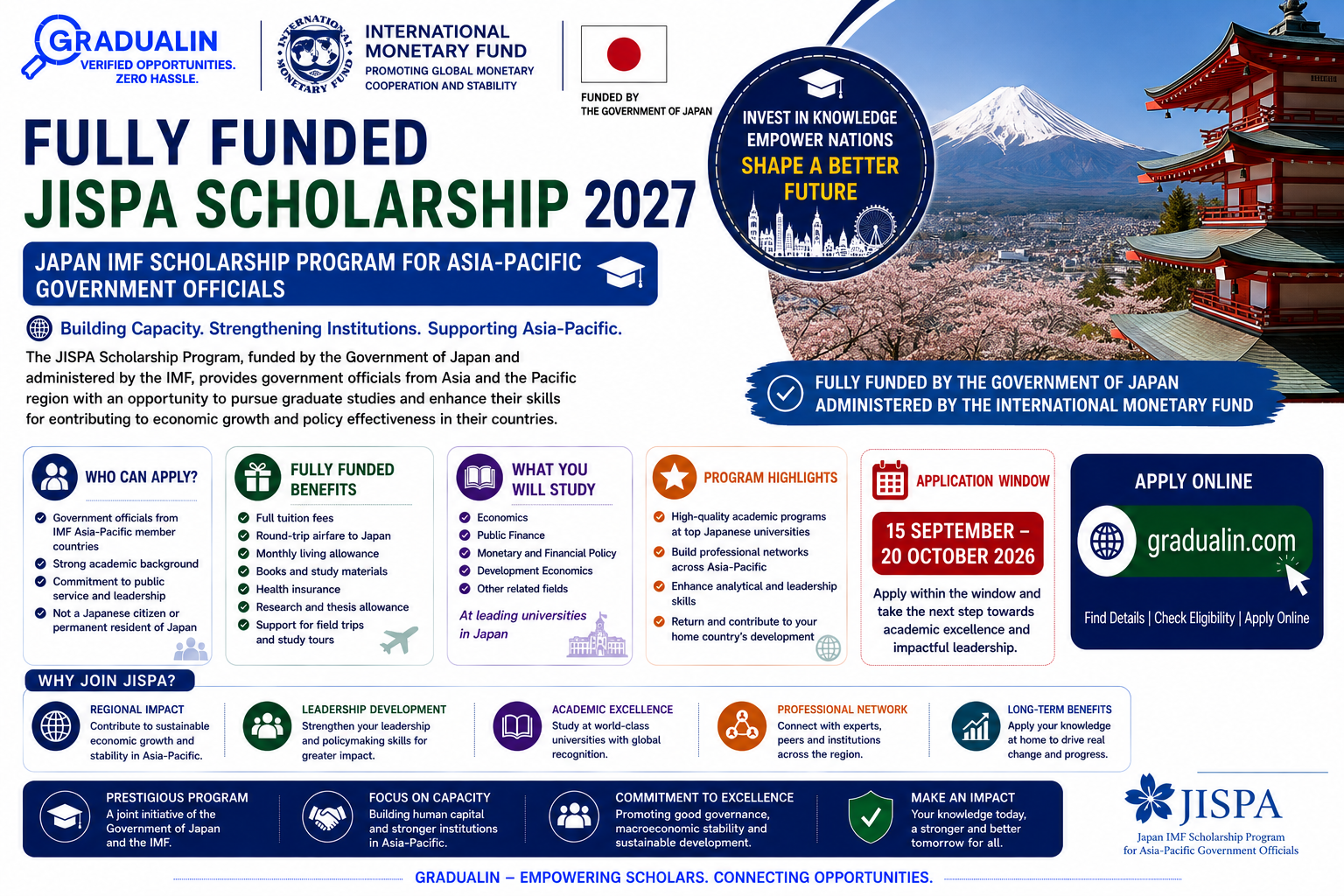
Fully Funded JISPA Scholarship 2027 — Japan IMF Scholarship Program for Asia-Pacific Government Officials
If you work in a central bank, ministry of finance, or a macroeconomic policy agency in Asia or the Pacific, the Japan-IMF Scholarship Program for Asia (JISPA) is one of the most valuable fully funded opportunities you will find anywhere. This is not a generic graduate scholarship — it is a highly selective, boutique program that has been running since 1993, has produced over 1,000 alumni now holding senior roles in governments across more than 20 countries, and is backed by the Government of Japan and administered by the International Monetary Fund. The AY2027-28 Master’s Track application window opens September 15, 2026, and closes on October 20, 2026. This guide covers everything — funding, eligibility, partner universities, the application process, and honest guidance on who should and shouldn’t apply.
| Detail | Information |
| Program | Japan-IMF Scholarship Program for Asia (JISPA) |
| Funding Body | Government of Japan |
| Administering Body | IMF Regional Office for Asia and the Pacific (OAP) |
| Host Country | Japan |
| Degree Level | Master’s (1-year and 2-year programs) |
| Fields | Economics, Public Policy, Public Economics |
| Funding Type | Fully Funded |
| Application Window | September 15 – October 20, 2026 |
| Open To | Junior government officials from 22 eligible Asia-Pacific countries |
| Official Link | Apply Here |
🎓 What Is JISPA and Why It Matters
Established in 1993, JISPA is an IMF-backed investment in the economic capacity of the Asia-Pacific region. Unlike broad international scholarship programs such as the Chevening or Fulbright — which are open to a wide range of applicants across many disciplines and career stages — JISPA is deliberately narrow in its target: junior government officials with direct involvement in macroeconomic policy formulation. That specificity is exactly what makes it powerful.
The program has awarded over 1,000 scholarships across its three-decade history and today runs with an annual intake of around 35 scholars, maintaining the “boutique” character its administrators deliberately protect. The cohort size is a feature, not a limitation — scholars engage directly with IMF economists, senior management (including the Managing Director), Japanese ministry officials, and the Bank of Japan in ways that simply aren’t possible in larger, more anonymous programs.
The IMF’s Regional Office for Asia and the Pacific (OAP), based in Tokyo, administers the program directly. Scholars become part of a JISPA alumni network that spans central banks, finance ministries, and international organizations across more than 20 countries. That alumni network is a career asset that persists long after graduation, reinforced through a Continuing Education program that brings alumni back to Japan for further training.
🎓 Benefits and Funding
JISPA is fully funded. Every confirmed cost associated with studying in Japan under the program is covered:
- Full tuition and admission fees at the partner university
- Orientation Program fees (the pre-study intensive at International University of Japan, Niigata)
- Monthly stipend for living expenses during the program (verify exact amount on official website)
- Round-trip economy airfare allowance for one trip between the scholar’s home country and Japan
- Pre-arrival allowance covering visa fees and the mandatory medical examination
- Settling-in allowance upon arrival in Japan
- Field trip fees organized by the partner university
The partner universities additionally provide assistance with visa applications, dormitory accommodation, and an insurance package. Note that the monthly insurance premium is paid from the scholar’s stipend.
Two firm restrictions to be aware of: the scholarship covers the scholar only — no financial or logistical support is extended to accompanying family members. Scholars are also not permitted to hold any other concurrent scholarship while receiving JISPA funding.
🎓 Eligibility Criteria
JISPA eligibility is specific and non-negotiable on several points. Read these carefully before investing time in an application.
- Nationality: Must be a citizen of one of 22 eligible countries: Bangladesh, Bhutan, Cambodia, India, Indonesia, Kazakhstan, Kyrgyz Republic, Lao P.D.R., Malaysia, Maldives, Mongolia, Nepal, Pacific Island Countries, Papua New Guinea, Philippines, Sri Lanka, Tajikistan, Thailand, Timor-Leste, Turkmenistan, Uzbekistan, or Vietnam.
- Age: Must be under 36 years old at the time of application.
- Education: Must hold a Bachelor’s degree with 16 years of formal education.
- No prior overseas Master’s degree: Applicants who have already earned a Master’s degree from outside their own country are not eligible.
- Work experience: Must have a minimum of 2 years of work experience in the public sector.
- Employer: Must be employed by a central bank, ministry of economy, ministry of finance, ministry of planning/development, ministry of trade/commerce, tax administration, national statistics bureau, financial regulatory agency, or a similar government body. Officials from other government areas significantly involved in macroeconomic policy may also be considered.
- Agency endorsement: A formal nomination and certification from the applicant’s government agency is mandatory — the agency must confirm its support and guarantee reinstatement upon the scholar’s return.
- English proficiency: TOEFL iBT 79–80 or IELTS Overall 6.0 is required, with proof submitted. Applicants from India, Philippines, and select Pacific Island Countries are exempt from submitting proof of English language ability.
- Commitment to return: Selected scholars must return to their home agency upon graduation and apply the knowledge gained to their country’s development.
🎓 Who Should Apply — and Who Probably Shouldn’t
✅ Strong fits:
- A junior economist at a central bank with 2–5 years of hands-on policy experience and a clear research question connected to your country’s fiscal or monetary challenges
- A staff member at a ministry of finance who has never studied outside their home country and is seeking structured exposure to Japanese academic and policy environments
- Someone whose government agency actively supports their development and will back their application with a strong institutional nomination
- Applicants from countries where the IMF has a resident representative (Bangladesh, Cambodia, Indonesia, India, Philippines, Vietnam, and others listed in the brochure) — local IMF contacts can often provide useful guidance on the application
- Officials aiming for senior leadership in their agencies who would benefit from both the academic training and the JISPA alumni network
❌ Poor fits:
- Private sector employees or those working outside government macroeconomic policy — the program does not consider these applicants
- Anyone who has already earned a Master’s degree abroad — this is a disqualifying condition, not a preference
- Applicants who are 36 or older at time of application — no exceptions are noted
- Those seeking a program in a field unrelated to economics, finance, or public policy — the four partner universities all deliver specialized policy economics, not general social science
- Applicants who cannot commit to returning to their home agency after graduation — the return obligation is a formal requirement, not optional
🎓 Partner Universities and Programs
Applicants must specify their preferred university at the time of application, and the IMF strongly encourages careful review of each program before choosing. The four partner institutions each have distinct strengths:
National Graduate Institute for Policy Studies (GRIPS) — Tokyo Offers both a one-year and a two-year Macroeconomic Policy Program. The one-year track (MPP or MPuE) is designed for applicants with strong quantitative competency who can handle an intensive pace. The two-year track (MA in Public Economics) suits those who want more time for thesis development. GRIPS is ranked 11th among public policy schools globally by research output (RePEcdata, June 2024) and 2nd in Japan — exceptional for a relatively compact institution. Located in Roppongi, Tokyo.
Hitotsubashi University (HIT) — Tokyo area Two-year Asian Public Policy Program (MPP in Public Economics). Class sizes are very small — around 15 per intake — with roughly 4 students per supervising faculty member. This is the best option for applicants who want close academic mentorship and are considering doctoral studies after JISPA. Strong focus on fiscal policy, tax policy, and public economics.
International University of Japan (IUJ) — Niigata Two-year Macroeconomic Policy Program (MA in Economics). IUJ hosts the JISPA Orientation Program, so new scholars spend their first weeks on this campus before dispersing to their chosen universities. Strong curriculum emphasis on monetary policy, public finance, and financial market policy. Rural campus environment is quieter than Tokyo — worth considering for applicants who prefer focus over urban energy.
The University of Tokyo (UTokyo) — Tokyo Two-year Master of Public Policy, International Program (MPP/IP). JISPA scholars enroll in the Economic Policy, Finance and Development (EPFD) stream. UTokyo is one of the world’s top-ranked research universities and GraSPP graduates are represented in government institutions in Japan and internationally. The broader academic environment and faculty diversity here are arguably the strongest of the four options, though the program expects a foundational understanding of law, politics, and economics at entry.
All four programs are taught entirely in English.
🎓 Required Documents
The following materials are required for a complete JISPA application:
- Online application form (completed through the JISPA portal)
- Nomination and Certification Form from the applicant’s government agency — signed, confirming the agency’s support and commitment to reinstate the applicant upon return
- Statement of Purpose and Research Proposal
- Official transcripts and certified copies of diplomas or degree certificates
- Two letters of reference (submission deadline: November 1, 2026 — five days after the application window closes)
- TOEFL or IELTS certificate (if applicable — exempt applicants from India, Philippines, and select Pacific Island Countries do not need to submit this)
A note on the Math Test: all eligible applicants who pass document screening are invited to take a Math Test on December 3, 2026, as part of the selection process. Review quantitative methods — the test assesses the analytical readiness JISPA expects of incoming scholars.
🎓 Step-by-Step Application Process
- Confirm your eligibility — work through every criterion above before starting. The agency endorsement requirement is often the first stumbling block: begin internal conversations with your supervisor early, since the nomination form requires institutional signatures that can take weeks to arrange.
- Choose your preferred partner university — download the “Skills to be Attained” document for each university from the JISPA partner universities page and match it against your professional goals. University choice is part of your application, not a decision made after selection.
- Draft your Statement of Purpose and Research Proposal — this is where most applications are decided. Successful SOPs are specific: they connect a concrete policy challenge in your home country to the academic training you will receive, and they demonstrate awareness of how your research interests align with the strengths of your chosen university.
- Arrange your two reference letters — references from senior government or academic supervisors who can speak directly to your policy analysis work carry the most weight. Inform referees early; letters are due November 1, 2026.
- Submit the online application through the JISPA application portal between September 15 and October 20, 2026.
- Prepare for the Math Test — administered December 3, 2026, to all eligible applicants.
- Attend interviews if shortlisted — interviews take place between late January and late February 2027.
- Await results — notifications to selected and reserve candidates are issued on March 11, 2027.
🎓 Important Dates
| Milestone | Date |
| Application window opens | September 15, 2026 |
| Application window closes | October 20, 2026 |
| Reference letters deadline | November 1, 2026 |
| Math Test | December 3, 2026 |
| Interviews | Late January – Late February, 2027 |
| Selection notifications | March 11, 2027 |
| Acceptance deadline | March 18, 2027 |
| Reserve candidates called | March 19, 2027 |
| Visa application process | March – June, 2027 |
| JISPA program commences | July 2027 |
| Arrive in Japan for Orientation Program | July 7–8, 2027 |
| Orientation Program at IUJ, Niigata | July 9 – September 22, 2027 |
| Master’s programs begin | September–October 2027 (varies by university) |
Bookmark this page and check back for updates — dates noted as “indicative” on the official site may be adjusted.
🎓 Why Apply — Japan, the IMF, and Your Career Trajectory
Japan is an exceptional environment for macroeconomic policy education. The country’s own policy history — navigating decades of low growth, monetary experimentation, fiscal management challenges, and now structural reform — makes it a living case study that no textbook replicates. Scholars gain field trip access to the Bank of Japan and the Ministry of Finance, and direct policy dialogue with Japanese policymakers is a structured part of the JISPA experience, not an add-on.
Beyond Japan, the IMF connection is a genuine career accelerant. JISPA scholars are invited to townhall meetings with IMF leadership (recent cohorts have met with Managing Director Kristalina Georgieva and Deputy Managing Director Nigel Clarke), attend IMF economists’ seminars, and participate in a Summer Workshop on IMF analytical frameworks at the end of their first year. For a junior government official, sustained access at that level is rare.
The alumni outcome speaks for itself: JISPA’s over 1,000 graduates now hold senior positions in central banks, finance ministries, and key institutions across Asia and the Pacific, with career progression tracked through an active alumni network and regular Continuing Education events held in Japan.
JISPA also offers something that is increasingly uncommon in international scholarship design: time and community. With only around 35 scholars per year, the cohort is small enough to form lasting professional relationships — what the program itself calls the “JISPA family.” These peer connections across 22 Asia-Pacific economies are a career network that compounds over decades.
Gradualin Editor’s Note: JISPA is a genuinely excellent opportunity — but it has a very narrow target. If you work in government macroeconomic policy in one of the 22 eligible countries, are under 36, and have not already obtained an overseas Master’s degree, you should take this seriously. The return-to-agency obligation is a real constraint: this program is not for those who are planning a career transition out of government. For strong applicants who meet every criterion, the combination of full funding, IMF exposure, Japanese university credentials, and a regional alumni network is difficult to match anywhere in the Asia-Pacific space. For average applicants — those with weak quantitative backgrounds, thin government policy experience, or unlikely institutional endorsement — the Math Test and interview rounds are genuine filters that matter.
🎓 FAQ
These questions are based on what students most commonly search about this program.
Can I apply to JISPA if I already have a Master’s degree from my home country? Yes — the restriction is on Master’s degrees obtained outside your home country. If you earned your Master’s degree domestically, you remain eligible, provided you meet all other criteria.
Does JISPA require IELTS or TOEFL? TOEFL iBT 79–80 or IELTS Overall 6.0 is required for most applicants. However, applicants from India, the Philippines, and select Pacific Island Countries are exempt from submitting proof of English language ability. Check the official application guidelines to confirm whether your specific country qualifies for the exemption.
Can I choose any university in Japan? No. JISPA places scholars exclusively at four partner universities: GRIPS, Hitotsubashi University, International University of Japan, and the University of Tokyo. You must specify your preferred institution in your application, and placement depends on both your preference and your academic profile.
What happens if I don’t return to my agency after graduation? The return obligation is a formal condition of the scholarship, confirmed by your agency in the nomination form. Scholars are expected to return to their government agency and apply the skills gained. The brochure states that post-graduation return is a requirement, not a guideline. Failure to comply would be a breach of scholarship conduct.
Is the scholarship available to people from Pakistan or other South Asian countries not on the list? No. Eligibility is strictly limited to the 22 countries named in the brochure. Pakistan is not on the eligible countries list. Only Bangladesh, Bhutan, Cambodia, India, Indonesia, Kazakhstan, Kyrgyz Republic, Lao P.D.R., Malaysia, Maldives, Mongolia, Nepal, Pacific Island Countries, Papua New Guinea, Philippines, Sri Lanka, Tajikistan, Thailand, Timor-Leste, Turkmenistan, Uzbekistan, and Vietnam are eligible.
What is the Math Test and how should I prepare? The Math Test is administered on December 3, 2026 to all applicants who pass the initial document screening. JISPA does not publish a formal syllabus, but based on the curriculum taught at all four partner universities, you can expect questions covering calculus, statistics, linear algebra, and basic econometrics. Refreshing your undergraduate quantitative methods before the application window closes is a practical preparation step.
🎓 Official Sources
- JISPA Home Page: IMF — JISPA Program
- Master’s Track Overview: Master’s Track
- Application Portal: JISPA Applications
- Funding and Benefits: Funding Details
- Partner Universities: Partner Universities
- JISPA e-Brochure (PDF): Download Brochure
- JISPA Secretariat Email: jispa@imf.org
- IMF Regional Office for Asia and the Pacific: 21F, Fukoku Seimei Bldg., 2-2-2 Uchisaiwai-cho, Chiyoda-ku, Tokyo 100-0011, Japan
🎓 Summary Table
| Detail | Information |
| Program | Japan-IMF Scholarship Program for Asia (JISPA) |
| Funding Body | Government of Japan |
| Administering Body | IMF Regional Office for Asia and the Pacific (OAP) |
| Host Country | Japan |
| Degree Level | Master’s (1-year and 2-year programs) |
| Fields | Economics, Public Policy, Public Economics |
| Funding Type | Fully Funded |
| Partner Universities | GRIPS, Hitotsubashi, IUJ, University of Tokyo |
| Annual Cohort Size | ~35 scholars |
| Eligible Countries | 22 Asia-Pacific countries (see eligibility section) |
| Age Limit | Under 36 years old |
| English Requirement | TOEFL iBT 79–80 or IELTS 6.0 (exemptions apply) |
| Application Window | September 15 – October 20, 2026 |
| Reference Letters Due | November 1, 2026 |
| Official Link | Apply Here |
Related Opportunities on Gradualin:
- Top 10 Fully Funded Scholarships in Asia 2027
- Fully Funded PhD Scholarships in the UK 2026
- Fully Funded PhD Positions in Switzerland 2026
Explore more on Gradualin: Browse the latest Scholarships, Jobs & Internships, Events & Conferences, and Guidelines & Resources.
Stay updated with the latest scholarships, jobs, and opportunities at Gradualin.com — your trusted guide to studying abroad for free.
Author: Faseeh Sultan — MSIT, PhD Scholar; 7 Years in Education