
📅 Last Updated: October 2026
Clarendon Scholarship 2027 — Fully Funded at Oxford
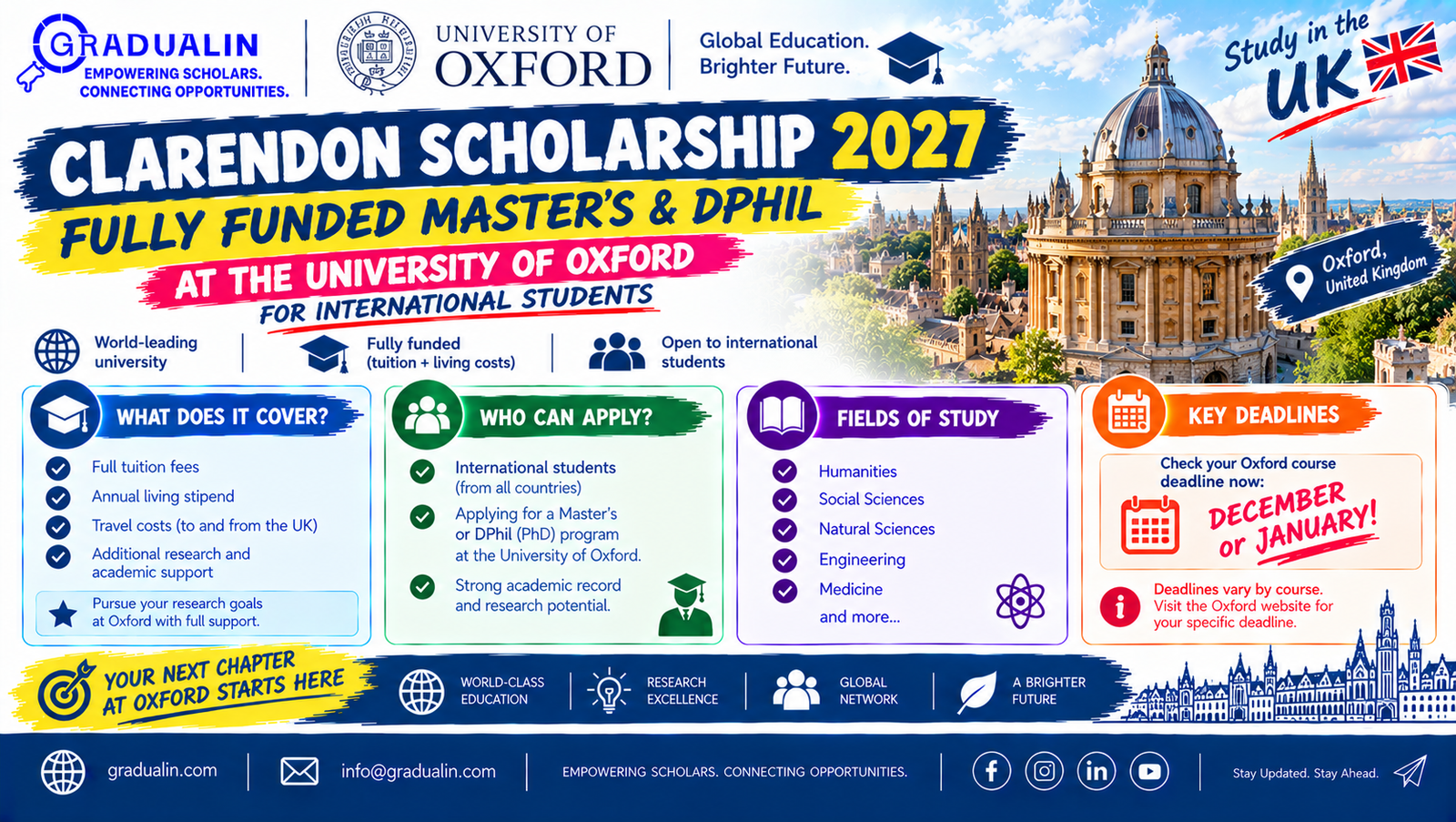
Every year, the University of Oxford awards more than 200 fully funded Clarendon Scholarships to new Master’s and DPhil students. Each one pays full course fees and a living grant of at least the UK’s national doctoral stipend. There’s no separate application form: if you apply for an eligible Oxford course by its December or January deadline, you’re automatically considered.
Clarendon has no restrictions on nationality or subject, so Pakistani and South Asian students compete on equal terms. The real question is how to get nominated by your Oxford department. This guide explains what Clarendon pays, how selection actually works, what academic record you need, and the timeline from application to offer.
| University/Organization | University of Oxford: Clarendon Fund |
| Country | United Kingdom |
| Degree/Level | All full-time and part-time Master’s and DPhil courses |
| Funding Type | Fully Funded: full course fees + living grant (at least the UKRI doctoral rate) |
| Deadline | Your Oxford course’s December or January deadline |
| Open To | International Students Worldwide (no nationality restrictions) |
| Pakistani Students Eligible | Yes |
| Official Link | Apply Here |
🎓 About the Clarendon Scholarship 2027
The Clarendon Fund is Oxford’s flagship graduate scholarship scheme. It has funded scholars since 2001 and now supports over 700 current scholars from about 70 countries. Scholars are chosen by academics in their own field for outstanding academic merit and potential, and join an active, multidisciplinary Clarendon community across the university.
Many Clarendon awards are put together as bespoke packages. Once you’re selected, Oxford may combine Clarendon funding with partnership awards from colleges, departments or donors. You don’t apply for those separately either.
How it compares: Cambridge’s Gates Cambridge Scholarship requires you to opt in, answer extra questions and provide a separate reference, and it puts heavy weight on leadership and social commitment. Clarendon has no extra forms and focuses on academic excellence and research potential. Oxford’s Weidenfeld-Hoffmann Scholarship targets future leaders from developing countries with a dedicated leadership programme. Clarendon is far larger, with 200+ awards a year, and open to every country and subject.
💰 Benefits and Funding
- 🎓 Course fees covered in full, for home and overseas fee status alike
- 💷 Living grant for full-time scholars of at least the UKRI minimum doctoral stipend. In 2025–26 that was at least £20,780, and UKRI’s 2026–27 rate is £21,805 (verify the 2027–28 figure in your offer letter)
- 📆 Duration: the full period of fee liability for your course. Some divisions add extra time with a living grant only
- 🧩 Part-time scholars receive a study support grant of one-sixth, one-third or half of the UKRI rate, depending on the course
- 🤝 Membership of the Clarendon community, with events, networks and alumni worldwide
Not covered: continuation charges after fee liability ends, and costs like visa fees, flights and the Immigration Health Surcharge, unless your package states otherwise.
What it’s worth: a living grant of about £21,000–22,000 is roughly PKR 7.6–8.2 million a year (approximate; check today’s rate). Combined with overseas fees, which can be well over £30,000 a year for many Oxford courses, a full DPhil award is worth a very large sum.
✅ Eligibility Criteria
- Nationality and residence: no restrictions
- Subject: no restrictions. All academic divisions take part
- Level: all full-time and part-time Master’s and DPhil courses
- Timing: you must apply for a new Master’s or DPhil by the December or January deadline that applies to your course
- Also eligible: current Oxford Master’s students applying for a DPhil or a second Master’s
- Not eligible: applicants holding a deferred offer, and current students continuing the same degree next year
Selection criteria (Oxford’s guideline):
- Outstanding academic record. Most scholars have at least a first-class degree or equivalent, such as a GPA of 3.7 or above out of 4. An exceptional master’s can make up for a moderate bachelor’s
- Future potential and aptitude, judged through your references and, for research degrees, your research proposal
- Motivation, judged through your personal statement and referees’ reports
English test: Clarendon has no separate English requirement, but you must meet Oxford’s English requirement for your course (standard or higher level). Check the course page for accepted tests and exemptions (verify on official website).
Pakistani students: eligible. Oxford publishes country-specific degree equivalences, so check how your Pakistani CGPA maps to its requirements (verify on official website).
✅ Strong Candidates
- Graduates at the top of their class, typically a CGPA of about 3.7/4 or above, or a first-class equivalent
- Pakistani MS or MPhil holders with an outstanding master’s, including a strong thesis and publications
- DPhil applicants with a sharp research proposal that fits an Oxford supervisor’s work
- Applicants whose referees can describe them as exceptional within their cohort
❌ Not the Right Fit If
- You apply after your course’s December or January deadline
- You already hold a deferred Oxford offer
- Your academic record is good but not outstanding, with no compensating master’s
- You’ll be continuing the same Oxford degree next year
On competitiveness for South Asian applicants: Clarendon is highly competitive, and departments only nominate their strongest applicants. Pakistani candidates stand out through evidence of ranking (class position, gold medals, university prizes), publications, and referees from active researchers who can compare them with other strong students.
📚 Choosing Your Oxford Course
Because Clarendon is linked to your course application, your choice of course matters a lot:
- Find your course on Oxford’s graduate courses pages and note whether its funding deadline is in December or January. Applying by that deadline is what makes you eligible.
- DPhil applicants: identify supervisors whose research matches yours and tailor your proposal to the department’s strengths.
- Taught Master’s applicants: show clearly why this specific course fits your academic path and goals.
- Apply strategically: each course application is assessed separately. Apply only where you’re genuinely competitive and your profile fits well.
Departments consider academic quality and fit when making admissions decisions, and use the same evidence when deciding whom to nominate for Clarendon.
📄 Required Documents
There are no extra Clarendon documents. Everything comes from your Oxford course application, which typically includes:
- Official transcripts for all degrees
- CV or résumé
- Statement of purpose or personal statement (length set by each course)
- Research proposal (for DPhil and some research master’s courses)
- Written work samples, if your course requires them
- Usually three references, mostly academic (check your course)
- English language test results, if required
- Application fee, unless you qualify for a waiver (verify on official website)
Notes for Pakistani applicants: Oxford usually accepts transcripts in English at the application stage. Make sure your class rank or position, any gold medals and university prizes are clearly documented, because they directly support the “outstanding academic record” criterion. HEC attestation isn’t normally needed to apply.
🧭 Step-by-Step: How Clarendon Selection Works
- Apply to your Oxford course by its December or January funding deadline. There’s no scholarship form.
- Academics in your field assess the quality and suitability of your application.
- Your department decides on admission and notifies you separately.
- In parallel, the department nominates its top applicants to the academic division for Clarendon.
- Divisions meet in February or March to rank nominations, and the top-ranked candidates are shortlisted.
- Offers (CB1 letters) are emailed, mostly by the end of April.
- Funding packages (CB2 letters) follow from April into the summer, matching partnership awards and confirming your college.
Practical tip: since Clarendon relies entirely on your course application, put all your effort into that application. A specific statement of purpose, a focused research proposal and detailed references are what lead to a nomination. Brief your referees on your achievements and the course, so their letters include concrete examples.
📅 Important Dates
| Milestone | Date |
|---|---|
| Course application and Clarendon consideration deadline | Your course’s December 2026 or January 2027 deadline (check the course page) |
| Departmental assessment and nominations | Winter 2026–27 |
| Divisional ranking meetings | February–March 2027 |
| Most Clarendon offers (CB1) sent | By the end of April 2027 |
| Funding packages (CB2) and college confirmation | April to summer 2027 |
| No contact by | Mid-June 2027 means you weren’t selected |
📌 Bookmark this page. We update deadlines as soon as changes are announced.
🌟 Why Apply
Clarendon is one of the largest fully funded graduate scholarship schemes at any top-ranked university, with no application form and no nationality limit. For Pakistani students with an outstanding academic record, simply applying to Oxford on time gives you a real chance at full funding.
Apply to Cambridge as well to maximise your chances. See our Gates Cambridge guide, the Weidenfeld-Hoffmann Oxford guide and our UK PhD scholarships guide. You can also browse all Scholarships, research roles in Jobs & Internships, statement-writing guides in Guidelines & Resources, and academic events in Events & Conferences.
❓ Frequently Asked Questions
These questions are based on what students most commonly search about this program.
Q: Can Pakistani students get the Clarendon Scholarship?
Yes. Clarendon has no nationality or subject restrictions. Pakistani applicants are considered automatically when they apply for an eligible Oxford Master’s or DPhil by the course’s December or January deadline.
Q: How do I apply for the Clarendon Scholarship?
You don’t apply separately. Applying for a new Oxford graduate course by its December or January deadline means you’re automatically considered. There are no extra forms or documents.
Q: What does the Clarendon Scholarship cover?
Course fees in full (home or overseas), plus a living grant of at least the UKRI minimum doctoral stipend for full-time scholars (at least £20,780 in 2025–26), for the period of fee liability. Part-time scholars receive a study support grant.
Q: What GPA do I need for Clarendon?
Most scholars have at least a first-class degree or equivalent, for example a GPA of 3.7 or above out of 4. An exceptional master’s degree can make up for a moderate bachelor’s result.
Q: When are Clarendon results announced?
Most offers are emailed by the end of April. If you haven’t heard by mid-June, assume you haven’t been selected.
Q: Can I get Clarendon if I deferred my Oxford offer?
No. Applicants with a deferred graduate offer aren’t eligible.
🔗 Official Source
📊 Summary Table
| Detail | Information |
|---|---|
| Scholarship | Clarendon Scholarship 2027 |
| University | University of Oxford, UK |
| Awards | 200+ new fully funded scholarships a year |
| Courses | All full-time and part-time Master’s and DPhil courses |
| Funding | Full fees + living grant (at least the UKRI rate) |
| How to Apply | Automatic consideration; no separate application |
| Criteria | Outstanding academic record, potential, motivation |
| Deadline | Your course’s December or January deadline |
| Offers | Mostly by the end of April 2027 |
| Pakistani Students Eligible | Yes |
| Official Link | ox.ac.uk |
Stay updated with the latest scholarships, jobs, and opportunities at Gradualin.com — your trusted guide to studying abroad for free.