
Fully Funded Knight-Hennessy Scholars 2027 — Stanford’s Most Prestigious Graduate Fellowship
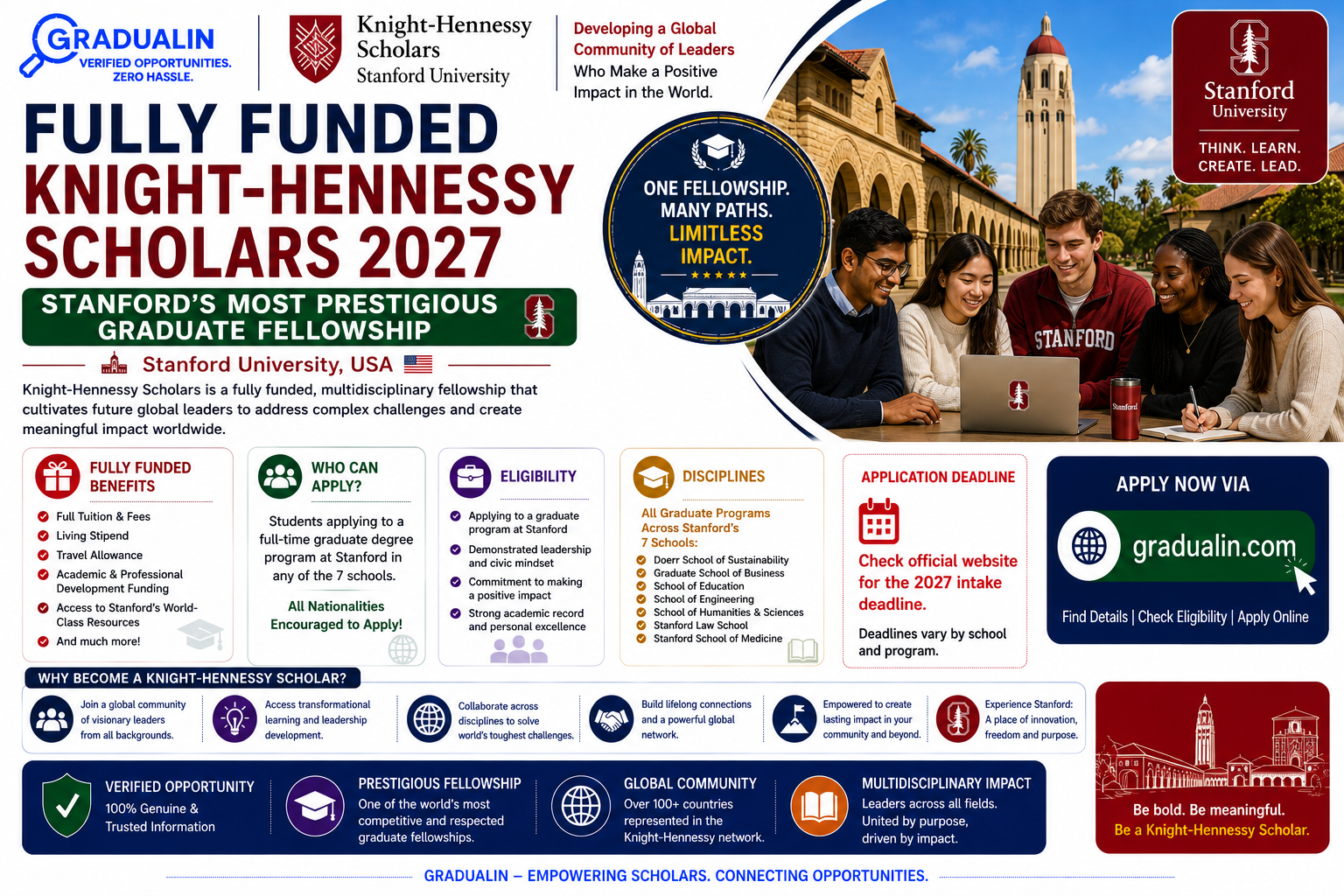
One of the most generous and genuinely multidisciplinary graduate fellowships in the world is now open for the 2027 cohort — and the application deadline is October 6, 2026. The Knight-Hennessy Scholars (KHS) program at Stanford University funds up to three full years of graduate study, covering tuition, a living stipend, and an annual travel allowance for scholars from any country, in any graduate discipline. Unlike most elite scholarships that target a specific degree or field, KHS works across all seven of Stanford’s schools simultaneously — from the School of Medicine to the Graduate School of Business to the School of Engineering.
This guide covers everything a prospective applicant genuinely needs to know: what the funding actually includes, the eligibility rules that trip people up, what reviewers actually look for, and a candid editor’s note on whether this program is a realistic target for you specifically.
| Detail | Information |
| Organization | Knight-Hennessy Scholars Program |
| University | Stanford University |
| Country | United States |
| Level | Graduate (MA, MBA, MFA, JD, MD, MPP, MS, PhD, DMA, and more) |
| Funding Type | Fully Funded — tuition, stipend, travel |
| KHS Deadline | October 6, 2026, 1:00 PM Pacific Time |
| Stanford Program Deadline | Varies by program; no later than December 1, 2026 |
| Open To | Citizens and residents of all countries |
| Official Link | Apply Here |
🎓 About Knight-Hennessy Scholars
Knight-Hennessy Scholars was established through a historic philanthropic gift by Phil Knight and John Hennessy — whose combined investment created one of the largest fully-endowed graduate scholarship programs in the world. It launched with its inaugural cohort in 2018 and has grown into a signature Stanford program, selecting roughly 80–100 scholars per year from a global applicant pool.
The program is rare in one key structural way: it is not attached to a single department, degree, or field. Scholars enroll across all seven of Stanford’s schools — Law, Medicine, Business, Engineering, Education, Humanities and Sciences, and the Doerr School of Sustainability — and pursue different graduate degrees while sharing a common leadership development experience through the KHS program.
This separates KHS from comparable programs in a significant way. The Rhodes Scholarship, for example, funds study at a single institution (Oxford) in a limited set of disciplines, and most other prestigious fellowships (Marshall, Gates Cambridge, Schwarzman) are similarly structured around one institution or one field. KHS offers something fewer programs do: genuine cross-disciplinary community at a top-ranked research university, with full financial support regardless of degree type.
The 2026 cohort — the most recently announced — included 87 new scholars, described by the program as the most globally diverse cohort to date.
🎓 Benefits and Funding
The financial package at KHS is among the most comprehensive of any graduate fellowship globally. During each of the first three years of graduate study, scholars receive:
- Full tuition and associated fees paid directly to Stanford
- A living stipend covering room and board, books, academic supplies, instructional materials, local transportation, and reasonable personal expenses
- An annual travel stipend covering one economy-class round-trip flight to and from Stanford per year
- A one-time relocation stipend for newly enrolling scholars, to offset moving costs and technology purchases
- Supplemental funds in the second and third years, available on application, to support conference attendance and academic enrichment activities
For degree programs longer than three years — such as PhD, MD, or dual-degree programs — KHS covers the first three years, and the remaining years are funded by the relevant Stanford department or school through their standard commitments. PhD students, for example, typically receive department funding from Year 4 onward (verify on official website for your specific program).
Stipends are taxable income. International students from countries with no US tax treaty will have tax withheld. Budget for this — KHS does not reimburse taxes.
🎓 Eligibility Criteria
KHS has notably few restrictions compared to most graduate fellowships. There are no quotas by discipline, region, or nationality.
- Nationality: Open to citizens and residents of all countries
- Age: No age restriction
- Field: No field restriction — any Stanford graduate degree program qualifies (with specific exceptions below)
- Undergraduate degree: Must have earned a first bachelor’s degree (or equivalent from an internationally recognized institution) in January 2020 or later to join the 2027 cohort
- Military service exception: Those who served in the military have an additional two years of eligibility — bachelor’s degree earned January 2018 or later qualifies
- Enrollment condition: You must be admitted to and enrolled in a full-time Stanford graduate degree program at the same time as KHS enrollment — applying to both concurrently is the standard path
- Current Stanford students: First-year PhD students (starting 2026) may apply to KHS for their second year; students already enrolled in a graduate program before 2026 are generally not eligible for their current program
- English proficiency: KHS itself does not specify a standalone English test requirement — English language requirements are set by the individual Stanford graduate programs you apply to; check your target program directly (verify on official website)
Ineligible degree programs (even at Stanford):
- Honors Cooperative Program
- Master of Liberal Arts
- Doctor of Science of Law (JSD) and Master of Legal Studies (MLS)
- Coterminal degrees (unless applying to a new external degree program)
🎓 Who Should Apply — and Who Probably Shouldn’t
✅ Strong fit for KHS if you:
- Have a genuine, demonstrable commitment to leadership in a specific domain — not leadership as a buzzword, but a traceable record of initiative and impact
- Can articulate a coherent long-term goal that a Stanford graduate degree meaningfully advances
- Are applying to a Stanford graduate program concurrently and have a realistic chance of admission to that program
- Earned your undergraduate degree in January 2020 or later (or January 2018 or later with military service)
- Come from any country, field, or background — the diversity of the scholar community is a deliberate feature
❌ KHS is probably not the right target if you:
- Have not yet identified or seriously researched a specific Stanford graduate program — admission to a Stanford degree is a hard prerequisite, and KHS cannot substitute for that
- Earned your bachelor’s degree before January 2020 (or January 2018 for military service veterans)
- Are already enrolled in a Stanford graduate program that started before 2026 — you are ineligible for your current degree program
- Are seeking a purely research fellowship with no interest in a structured leadership development program — KHS involves active participation in programming beyond your degree coursework
- Are applying to one of the ineligible Stanford programs listed above
🎓 Available Programs and Fields
Because KHS funds study across all seven Stanford schools, the list of eligible programs is extensive. Scholars in recent cohorts have pursued degrees including:
- Law (JD) at Stanford Law School
- Business (MBA) at the Stanford Graduate School of Business
- Medicine (MD) at the School of Medicine
- Engineering — MS and PhD programs in Computer Science, Electrical Engineering, Mechanical Engineering, and related fields
- Education — MA and PhD programs at the Graduate School of Education
- Humanities and Sciences — MA, MS, and PhD programs in fields ranging from Political Science to Biology to Sociology
- Sustainability — MS and PhD programs at the Stanford Doerr School of Sustainability
- Dual and joint degrees — such as JD/MBA, MD/PhD (MSTP), and other combined programs
For the full list of Stanford graduate programs, visit Stanford Graduate Admissions. Note that not every Stanford program participates in KHS — always confirm your target degree’s eligibility directly with the program.
🎓 Required Documents
KHS requires both a KHS application and a separate Stanford graduate program application. Documents required for the KHS application specifically include:
- Online KHS application — completed via the KHS portal
- Three short-answer responses — covering your academic and professional goals (250 words), three experiences related to perspective, courage, and falling short of expectations (250 words combined), and eight improbable facts about yourself (150 words combined)
- Personal essay — “Connect the dots: How have the influences in your life shaped you?” (550 word limit)
- Résumé — per KHS résumé guidelines
- Official transcripts — from all institutions attended
- Standardized test scores — as required by your target Stanford graduate program (GRE, GMAT, LSAT, MCAT, as applicable — verify per program)
- Recommendation letters — number and format per KHS guidelines (verify on official website)
- Video statement — invited after initial review; not submitted with the initial application
Your Stanford graduate degree program application is entirely separate and submitted on its own timeline and portal.
🎓 Step-by-Step Application Process
- Identify your Stanford graduate program — Before anything else, confirm you are applying to an eligible full-time Stanford graduate degree program. Research the program’s own admissions requirements, deadline for KHS applicants, and whether it falls within the eligible programs list.
- Register for KHS updates — Sign up at the KHS prospective applicants page to receive admission event invitations and application guidance directly from the program.
- Prepare your KHS application materials — Draft the three short answers and the personal essay well in advance. The “improbable facts” question is deceptively important: reviewers use it to understand personality and character, not achievements. Do not use this as a list of credentials.
- Submit your KHS application — Deadline is October 6, 2026, 1:00 PM Pacific Time, regardless of which Stanford program you are applying to. This deadline is universal.
- Submit your Stanford graduate program application — By the earlier of your program’s KHS-applicant deadline or December 1, 2026. The MBA Round 1 deadline specifically must be met for GSB applicants — no other MBA rounds align with KHS.
- Video statement stage — Shortlisted applicants receive an invitation to submit a video statement. This is not part of the initial submission.
- Finalist experience — A select group of finalists are invited to Stanford for an in-person experience before final decisions.
- Decisions announced — Scholars are notified of selection results in the spring.
Practical tip: The essay prompt — “Connect the dots” — is the single most distinctive element of the KHS application. Reviewers consistently describe the strongest essays as deeply personal and introspective, not career summaries. If your draft reads like a well-organized LinkedIn profile, start again. The 550-word limit is tight; spend the majority of it on who you are, not what you have done.
🎓 Important Dates
| Milestone | Date |
| KHS Application Deadline | October 6, 2026, 1:00 PM Pacific Time |
| Stanford Program Deadline (latest) | December 1, 2026 |
| Stanford MBA Round 1 Deadline | Varies — confirm at GSB MBA deadlines |
| Video Statement (shortlisted only) | After initial review |
| Finalist Experience | Spring |
| Scholar Decisions | Spring 2027 |
| Enrollment Begins | Autumn 2027 |
Bookmark this page and check back for updates as the October deadline approaches.
🎓 Why Apply — Why Stanford
Stanford’s Silicon Valley location is an obvious draw, but the more durable argument for KHS is the cross-disciplinary community it deliberately builds. A cohort of 80–90 scholars from law, medicine, engineering, business, and the humanities, all sharing a common leadership development experience at Denning House, creates a professional network that is genuinely unusual in its range.
The KHS leadership development programming — including the KHeystone Projects (collaborative, real-world problem-solving initiatives) and access to visiting speakers drawn from global government, industry, and civil society — operates in parallel with degree coursework. Scholars are not choosing between their degree and their fellowship; they are doing both simultaneously with full funding.
The Bay Area career environment for Stanford graduates remains among the strongest in the world across technology, law, healthcare, policy, and finance. For international students especially, the combination of a Stanford degree, a KHS fellowship on the résumé, and three years of building in that environment represents a meaningful career acceleration.
Gradualin Editor’s Note: KHS is one of the most legitimate fully-funded opportunities available to international graduate students in the United States — but the prerequisite that trips most applicants up is the concurrent Stanford admission requirement. You cannot apply to KHS without simultaneously pursuing admission to a Stanford graduate program, and Stanford graduate admissions are highly competitive independent of KHS. For applicants with strong academic records and a clear leadership trajectory, this is a program worth serious investment. For applicants still exploring which graduate program to pursue, focus on the Stanford program decision first — the KHS application follows from that foundation, not the other way around.
🎓 FAQ
These questions are based on what students most commonly search about this program.
Can international students apply to Knight-Hennessy Scholars? Yes. KHS explicitly welcomes citizens and residents of all countries. There are no nationality restrictions and no quotas by world region. International applicants must meet the same eligibility requirements as domestic applicants — primarily the bachelor’s degree date window and concurrent Stanford admission. English language requirements are set by your Stanford graduate program, not by KHS directly.
Do I need to get into Stanford first before applying to KHS? Both applications are submitted concurrently, not sequentially. You apply to KHS and your Stanford graduate program at the same time, in the same cycle. However, KHS selection is contingent on being admitted to and enrolling in a Stanford graduate degree program — so if Stanford does not admit you to your degree program, the KHS offer does not stand independently.
Does KHS require GRE or IELTS scores? KHS itself does not set a standalone English test or GRE requirement. The required tests depend entirely on the Stanford graduate program you are applying to. Some Stanford programs require GRE, some accept alternatives, and English proficiency requirements vary — verify directly with your target program.
Can I apply to multiple Stanford programs through KHS? You may apply to KHS while applying to one or more Stanford graduate programs, but your KHS funding will be tied to the degree(s) indicated in your initial KHS admission letter. Scholars who later wish to add an additional graduate program may apply to KHS for additional funding, but this is not guaranteed.
Is Knight-Hennessy a scholarship or a fellowship, and what is the difference in practice? KHS describes itself as a fellowship, reflecting the program’s emphasis on leadership development in addition to financial support. In practical terms, it functions as a fully-funded scholarship — it covers tuition and living expenses — while also requiring active participation in programming, projects, and the broader KHS community beyond academic coursework.
Can I defer my KHS award if I need to delay enrollment? No. KHS does not permit deferral of a scholar offer. If selected and unable to enroll, you must reapply in a future cycle. You can, however, defer admission to a Stanford graduate program and then apply to KHS in the year you intend to enroll, as long as you continue to meet all eligibility requirements.
🎓 Official Sources
- KHS Official Website: knight-hennessy.stanford.edu
- KHS Application Portal: apply.knight-hennessy.stanford.edu
- Eligibility Details: Eligibility Page
- Funding Details: Funding Page
- Application Deadlines: Deadlines Page
- Stanford Graduate Admissions: gradadmissions.stanford.edu
- Campus Contacts: Find a Campus Contact
- Address: Knight-Hennessy Scholars, Denning House, Stanford University, Stanford, CA 94305
🎓 Summary Table
| Detail | Information |
| Organization | Knight-Hennessy Scholars Program |
| University | Stanford University |
| Country | United States |
| Level | Graduate — all disciplines (MA, MBA, MFA, JD, MD, MPP, MS, PhD, DMA, and more) |
| Funding Type | Fully Funded — tuition, stipend, travel, relocation |
| KHS Deadline | October 6, 2026, 1:00 PM Pacific Time |
| Stanford Program Deadline | Varies by program; no later than December 1, 2026 |
| Cohort Size | Approximately 80–100 scholars per year |
| Open To | All nationalities — no age, field, or country restrictions |
| Official Link | Apply Here |
Related Opportunities on Gradualin:
- Fully Funded Scholarships in the USA 2026
- Fully Funded PhD Scholarships in the UK 2026
- Fully Funded PhD Positions in Switzerland 2026
Browse all opportunities by category: Scholarships | Jobs & Internships | Events & Conferences | Guidelines & Resources
Stay updated with the latest scholarships, jobs, and opportunities at Gradualin.com — your trusted guide to studying abroad for free.
Author: Faseeh Sultan — MSIT, PhD Scholar | 7 Years in Education