
OHCHR Indigenous Fellowship Programme 2027 — Fully Funded Training in Geneva
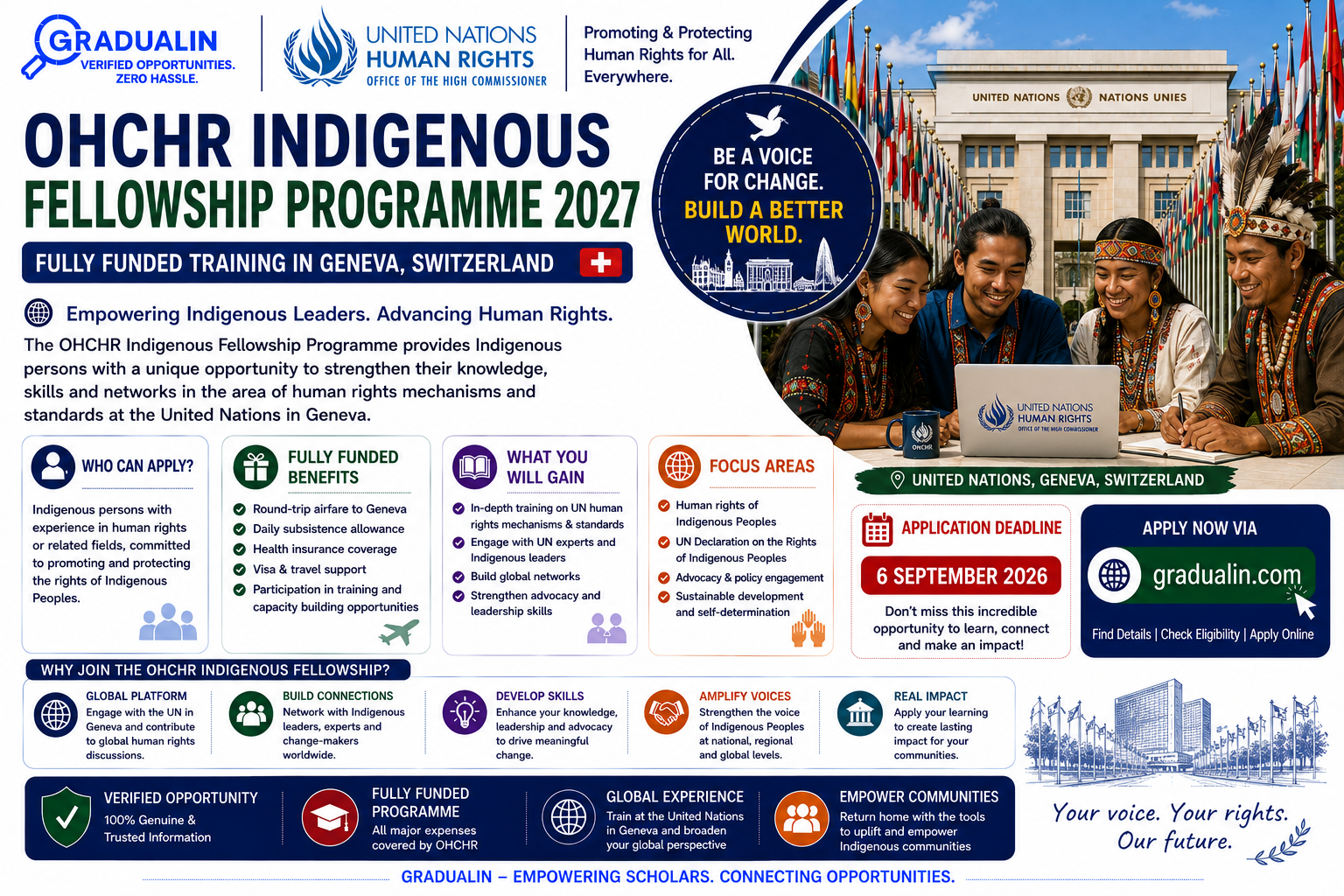
The United Nations runs a lot of fellowship programmes. Most require degrees, professional credentials, and formal institutional affiliations. The OHCHR Indigenous Fellowship Programme is explicitly built to cut through those barriers. Launched in 1997 in the context of the first International Decade of the World’s Indigenous People, the programme exists to give indigenous persons the opportunity to gain knowledge about the UN system and mechanisms dealing with human rights issues in general and indigenous issues in particular. It asks only that you are indigenous, that your community or organisation nominates you, and that you commit to sharing what you learn when you return home. Applications for the 2027 cycle are now open and close at 23:59 Geneva time on 6 September 2026.
| Detail | Information |
| Organising Body | Office of the UN High Commissioner for Human Rights (OHCHR) |
| Location | Geneva, Switzerland |
| Duration | 4 weeks (June/July 2027) |
| Programme Type | Human Rights Training Fellowship |
| Funding | Fully Funded |
| Languages | English, Spanish, French, Portuguese |
| Degree Required | No |
| Application Deadline | 6 September 2026, 23:59 Geneva time |
| Open To | Indigenous persons worldwide |
| Official Link | Apply Here |
🎓 About the Programme
The Indigenous Fellowship Programme was launched in 1997 by the Office of the High Commissioner for Human Rights (OHCHR) in the context of the first International Decade of the World’s Indigenous People. The aim of the programme is to give indigenous persons the opportunity to gain knowledge about the UN system and mechanisms dealing with human rights issues in general and indigenous issues in particular. Trained participants are better equipped to assist their organisations and communities in protecting and promoting their rights.
It is worth situating this programme among its peers. The OHCHR also runs fellowship programmes for people of African descent, minorities, and staff of national human rights institutions. All operate on a similar training model. The Indigenous Fellowship, however, is distinctive in one important respect: it is among the very few UN-affiliated programmes that explicitly rejects formal education as a criterion. The official guidelines state that education should not be a barrier, in direct acknowledgment of the socioeconomic realities many indigenous communities face. This is not a waiver or an exception — it is a design principle.
Compare this to something like the UN Women fellowship or the UNODC fellowship, both of which typically expect postgraduate qualifications and professional credentials in specific technical areas. The OHCHR Indigenous Fellowship Programme is asking a different question: not “what are your qualifications?” but “what will you do with this when you go home?”
That return-commitment is baked into the selection criteria and carries real weight. The programme is not offering a credential. It is building a network of informed advocates embedded in indigenous communities globally.
🎓 What the Fellowship Covers
The fellowship is fully funded by OHCHR. Confirmed benefits include:
- Return flight ticket from your home country to Geneva (economy class)
- Living expenses for the full duration of the four-week programme
- Basic health insurance covering the training period
- Full participation in the four-week intensive training in Geneva
- Simultaneous interpretation across all four language streams — no language barrier between cohort members
- Direct attendance at the annual session of the Expert Mechanism on the Rights of Indigenous Peoples (EMRIP), allowing fellows to observe and engage with international discussions on indigenous rights
There is no tuition fee and no participation cost. The programme covers what it needs to cover so that financial circumstances do not determine who can attend.
One practical note: living expense coverage is described as basic. Geneva is one of the most expensive cities in the world. Fellows should confirm the specific living allowance amount directly with OHCHR before making any personal financial plans for the duration. The return ticket and health insurance, however, are fully covered without ambiguity.
🎓 Eligibility Criteria
The eligibility framework is deliberately simple, and the single non-negotiable criterion is indigeneity.
- Must be indigenous. Non-indigenous persons will not be taken into consideration, even if they have close links with indigenous communities and/or organisations. This is absolute — there are no exceptions.
- No age restriction. Age should not be a limitation to participation in the programme.
- No formal education requirement. Formal education should not be a limitation to participation in the IFP given the socio-economic barriers confronted by many indigenous peoples that limit access to formal educational institutions.
- Must be nominated by an indigenous organisation or community. The candidate should be proposed, and their candidacy supported by their indigenous organisation and/or community. It is desirable that the sponsoring organisation has a firm constituency or membership and that it is representative.
- Must commit to training others on return. Candidates should agree to train other indigenous persons after the return to their respective communities/organisations.
- Must have a working knowledge of the programme language — English, Spanish, French, or Portuguese. No formal English test (IELTS/TOEFL) is required by OHCHR (verify on the official application form).
- Indigenous candidates, including women, LGBTQI+ individuals, and persons with disabilities, are strongly encouraged to apply.
🎓 Who Should Apply — and Who Probably Shouldn’t
✅ Strong-fit applicants:
- Indigenous community leaders or advocates who want to understand how to engage the UN human rights system for their community’s benefit
- Indigenous persons already doing local or national advocacy work who need the international framework and vocabulary to operate at UN level
- People nominated by an established indigenous organisation with genuine community roots — a broad-based, representative body carries more weight than a newly formed or single-person group
- Applicants who can clearly articulate how the training will translate into concrete work when they return home
- First-time applicants from underrepresented geographic regions — the selection process explicitly prioritises regional balance
❌ Poor-fit applicants:
- Non-indigenous persons, regardless of how closely connected they are to indigenous communities or causes — this criterion is absolute and unappealing documentation will not change it
- Applicants without organisational or community nomination — a solo application with no institutional backing will not progress
- Those seeking a professional qualification, academic credit, or a certificate for a CV — the IFP is a capacity-building programme, not a credential
- Applicants who cannot commit to the knowledge-sharing obligation on return — the return commitment is taken seriously in selection
🎓 What the Training Covers
Fellows gain practical knowledge of UN human rights mechanisms, international advocacy strategies, and policy tools to advance indigenous rights upon returning to their home communities.
The fellowship runs for four weeks in Geneva and usually takes place in June/July, aligning with the annual session of the Expert Mechanism on the Rights of Indigenous Peoples (EMRIP). This timing is strategic and practically significant. EMRIP is the UN subsidiary body mandated to study and advise on the rights of indigenous peoples under the Human Rights Council. Attending its annual session means fellows are not just learning in a classroom — they are watching how indigenous rights get discussed, debated, and decided at the highest international level in real time.
Simultaneous interpretation is provided, allowing participants from different language backgrounds to learn together. The four language streams — English, Spanish, French, and Portuguese — are run concurrently, meaning the cohort is genuinely international in composition, not segmented by language.
Training covers: the structure of the UN human rights system, the major international instruments protecting indigenous peoples (including the UN Declaration on the Rights of Indigenous Peoples), treaty body procedures, special procedure mechanisms including the Special Rapporteur on the Rights of Indigenous Peoples, complaint procedures, and how to document and present human rights violations at the international level.
🎓 Required Documents
Both parts of the online application form must be completed in full. Based on confirmed information from the official call, you will need:
- Completed online application form — Parts I and II, submitted via the OHCHR survey portal
- Official recommendation letter from your nominating indigenous organisation or community — this must be uploaded directly within the online application form; it cannot be submitted separately
- Language selection — indicate which language component you are applying to (English, Spanish, French, or Portuguese)
- Details of your indigenous identity and community affiliation — specified within the form
- Statement of commitment to training other indigenous persons after return
There is no requirement for academic transcripts, degree certificates, or standardised test scores. The simplicity of the document list reflects the programme’s access-first design philosophy — but do not underestimate the recommendation letter. A vague or generic letter from a community organisation can undermine an otherwise strong application. It should be specific, describe your role within the community, and confirm the commitment-to-training obligation.
🎓 Step-by-Step Application Process
- Secure your community nomination first — before anything else. The recommendation letter from your indigenous organisation or community is mandatory. Without it, the application is automatically incomplete. Approach your nominating organisation early, brief them on what the IFP is and what is expected, and give them time to write a letter that genuinely represents your role and your community’s support.
- Decide which language component to apply to. Select English, Spanish, French, or Portuguese — whichever you use professionally and with confidence. The training itself is intensive, and following complex legal and human rights content in a second language under time pressure is harder than it sounds. Apply in the language where you can actually participate, not just understand passively.
- Read the full guidelines on the official OHCHR page at ohchr.org before opening the form. The 2027 application is entirely online — there is no postal submission for this cycle (note: the older “about the programme” page still references postal applications; the 2027 call page is the authoritative source and specifies online-only submission).
- Complete both Parts I and II of the application form at survey.ohchr.org. Upload your recommendation letter directly within the form. Incomplete applications are not considered, regardless of their quality on the completed sections.
- Submit well before the deadline. OHCHR explicitly advises submitting early. The deadline is 23:59 Geneva time on 6 September 2026. Geneva time in September is UTC+2. Factor this into your calculation if you are submitting from a different time zone — missing by minutes is still missing.
- If pre-selected, prepare for an interview. The selection process entails interviews of pre-selected candidates who applied to either the English, French, Spanish, or Portuguese language components of the programme. Only pre-selected candidates are contacted — if you do not hear from OHCHR, your application was not shortlisted.
🎓 Important Dates
| Milestone | Date/Detail |
| Applications Open | Now open |
| Application Deadline | 6 September 2026, 23:59 Geneva time (UTC+2) |
| Pre-selection interviews | After deadline (only shortlisted candidates contacted) |
| Fellowship Dates | June/July 2027 (4 weeks, Geneva) |
| EMRIP Session (concurrent) | June/July 2027, Geneva |
Bookmark this page and check back for updates, particularly on the exact training dates once confirmed by OHCHR.
🎓 Why Apply — Geneva, the UN, and What This Actually Opens Up
Geneva is not a symbolic choice for this fellowship. It is where the human rights machinery of the United Nations physically operates — the Human Rights Council, the treaty bodies, the special procedures secretariats, the EMRIP. A four-week placement here, timed to coincide with an actual EMRIP session, gives fellows access to the kind of institutional knowledge and professional networks that cannot be replicated through online training or self-study.
OHCHR has published video testimonies of former attendees of the OHCHR Indigenous Fellowship Programme, showing the impact on their work advocating for the rights of their communities and for the rights of indigenous peoples in general. The programme has been running annually since 1997, meaning there is a substantial global alumni network — former fellows are now operating at community, national, and international levels across every region.
The return-obligation design is also important to understand as a feature, not a constraint. The IFP is not asking you to stay in Geneva or relocate internationally. It is explicitly funding people to go back and be more effective where they already are. That makes it genuinely community-focused in a way that few funded international programmes are.
Gradualin Editor’s Note: This is one of the most genuinely accessible UN fellowships in existence — accessible in the literal sense of having removed educational and professional barriers to entry. For indigenous advocates and community leaders who want to understand the UN system and use it more effectively for their communities, it is the most direct route available. The practical difficulty lies not in the eligibility bar but in the nomination requirement: your application is only as strong as the organisation backing it. Fellows from well-established, representative indigenous organisations with a clear record of advocacy work will be most competitive. First-time applicants from regions that are statistically underrepresented in the EMRIP process may also benefit from the regional balance principle that guides final selection.
🎓 Frequently Asked Questions
These questions are based on what applicants most commonly search about this programme.
Can I apply if I do not have a university degree? Yes — explicitly and by design. Formal education should not be a limitation to participation in the IFP given the socio-economic barriers confronted by many indigenous peoples that limit access to formal educational institutions. There is no minimum educational requirement of any kind.
Can a non-indigenous person apply if they work closely with indigenous communities? No. The candidate must be indigenous. Non-indigenous persons will not be taken into consideration, even if they have close links with indigenous communities and/or organizations. This rule has no exceptions.
How competitive is the programme — and how are finalists chosen? A pre-selection of 15 to 20 candidates per language group is made by previous indigenous fellows. This is unusual and worth noting: it is former fellows — not OHCHR bureaucrats — who make the initial shortlist. Final selection is then reviewed by an advisory group of OHCHR staff. The selection criteria include gender balance, regional balance, and the human rights situation in the applicant’s country or region.
Is an IELTS or TOEFL score required? OHCHR does not require a formal English language test. The requirement is a “good working knowledge” of your chosen programme language — English, French, Spanish, or Portuguese. There is no minimum score or certificate specified (verify on the official application form before submitting).
What happens after the fellowship ends — is there any ongoing support? The formal commitment is the four-week programme in Geneva. Beyond that, there is no structured follow-up programme specified by OHCHR. However, the alumni network of former fellows is active and provides informal peer support. The return commitment — to train other indigenous persons in your community — is the primary expectation on completion.
Can I apply from any country? Yes, as long as you are indigenous and meet the other criteria. The programme is global in scope, with fellows drawn from across Africa, the Americas, Asia-Pacific, and other regions. There is no country exclusion list — the selection process actively seeks regional diversity.
🎓 Official Sources and Contact
- 2027 Application Form: Apply via OHCHR Online Survey
- Programme Information: OHCHR Indigenous Fellowship Programme
- About the Programme (background): ohchr.org/en/about-us/fellowship-programmes/about-programme
- Programme Email: indigenousfellowship@ohchr.org
- Postal Address (for reference): OHCHR Indigenous Peoples and Minorities Section, 48 Avenue Giuseppe-Motta, CH-1211 Geneva 10, Switzerland
🎓 Summary Table
| Detail | Information |
| Organising Body | Office of the UN High Commissioner for Human Rights (OHCHR) |
| Location | Geneva, Switzerland |
| Duration | 4 weeks (June/July 2027) |
| Programme Type | Human Rights Capacity-Building Training |
| Funding | Fully Funded |
| Benefits | Return airfare, living expenses, health insurance, EMRIP attendance |
| Languages Available | English, Spanish, French, Portuguese |
| Degree Required | No |
| Age Limit | None |
| Application Method | Online — both Parts I and II required, plus recommendation letter |
| Application Deadline | 6 September 2026, 23:59 Geneva time |
| Open To | Indigenous persons worldwide |
| Application Portal | Apply Here |
Related Opportunities on Gradualin:
- Fully Funded PhD Scholarships in the UK 2026
- Top 10 Fully Funded Scholarships in Asia 2027
- Top Fully Funded Scholarships in Saudi Arabia 2026
Browse all opportunity categories: Scholarships | Jobs & Internships | Events & Conferences | Guidelines & Resources
Stay updated with the latest scholarships, jobs, and opportunities at Gradualin.com — your trusted guide to studying abroad for free.
Author: Faseeh Sultan — MSIT, PhD Scholar | 7 Years in Education