
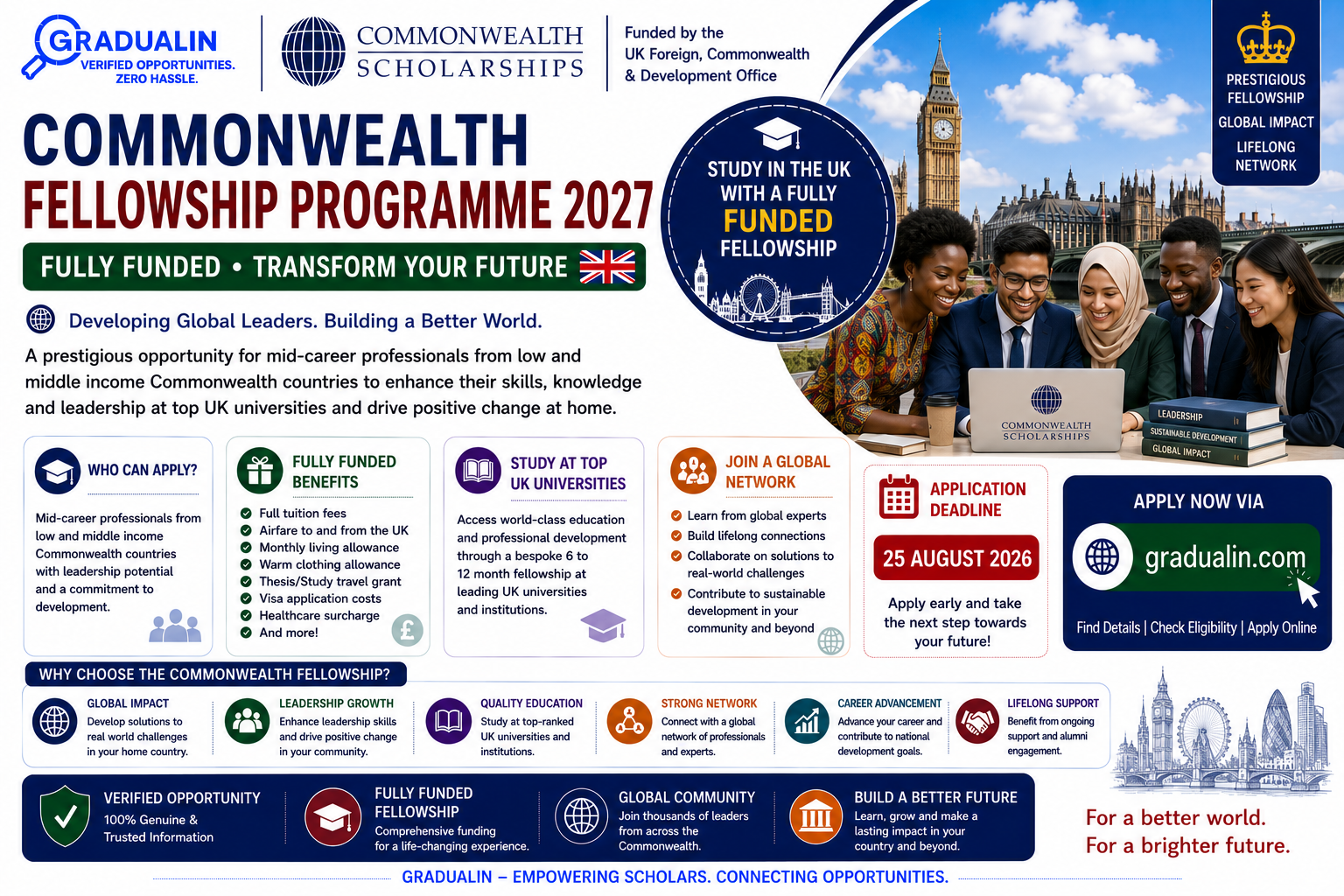
Fully Funded Commonwealth Fellowship Programme 2027 — Apply by August 25
The Commonwealth Scholarship Commission in the UK (CSC) has just opened applications for the Commonwealth Fellowship Programme 2027 — and this cycle marks a significant expansion. For the first time, the programme runs two parallel tracks: the established Professional Fellowship for experienced practitioners, and a brand-new Academic Fellowship for PhD-holding university staff. Both are fully funded by the UK Foreign, Commonwealth and Development Office (FCDO). Applications opened on 28 July 2026 and close at 16:00 BST on 25 August 2026. If you are a mid-career professional or an academic at a Commonwealth university, this is one of the most credible short-term funded programmes currently accepting applications.
| Detail | Information |
| Administering Body | Commonwealth Scholarship Commission in the UK (CSC) |
| Funder | UK Foreign, Commonwealth and Development Office (FCDO) |
| Country of Fellowship | United Kingdom |
| Fellowship Type | Professional Development / Academic Exchange |
| Duration | Six weeks to three months (from February 2027) |
| Funding | Fully Funded |
| Application Deadline | 25 August 2026, 16:00 BST |
| Open To | All Commonwealth countries (except UK) |
| Official Link | Apply Here |
🎓 About the Commonwealth Fellowship Programme
The Commonwealth Scholarship Commission has administered scholarships and fellowships since 1960. In that time, more than 31,000 people have taken up a Commonwealth Scholarship or Fellowship, with alumni including prime ministers, cabinet ministers, Nobel Prize winners, academics, and leaders across NGOs and business. The Fellowship track specifically is shorter and more targeted than the degree-level scholarships: it brings experienced people to the UK for intensive placement periods rather than multi-year study.
From 2026/27, the CSC has launched a new Commonwealth Fellowship Programme featuring two strands — the existing Professional Fellowships alongside a new strand of Academic Fellowships. This is a meaningful structural upgrade. Previously, only professionals could apply to this specific programme; academics had to route their UK engagement through research collaborations or separate CSC award types. The new Academic strand addresses that gap directly.
It is worth comparing this to the Chevening Fellowship offered by the same UK government funding envelope. Chevening Fellowships are thematic, cohort-based, and typically policy-oriented. The Commonwealth Fellowship Programme, by contrast, is placement-based: you join a specific UK host organisation or university and undertake a structured programme tailored to your professional or academic context. The Commonwealth programme is therefore better suited to applicants who want sector-specific, hands-on development rather than a seminar-and-networking model.
Applications will be assessed on the extent to which the proposed fellowship will ensure the transfer of skills relevant to the CSC’s six development themes.
🎓 What the Fellowship Covers
Both strands — Professional and Academic — are fully funded. Confirmed benefits include:
- Return airfare from your home country to the UK (economy class, approved route)
- Visa fee reimbursement — the standard visa application cost is covered in full
- Monthly stipend of £2,218 outside London, or £2,753 within the London metropolitan area (rates at 2025/26 levels — verify current rates on the official page)
- Arrival allowance of up to £1,247.09, which includes a warm clothing element
- Conference and travel funding: up to £1,000 for placements of six weeks to two months, and up to £2,000 for placements of two to three months — paid directly to the host organisation to cover costs of short courses, conferences, or visits to other UK organisations integral to the programme
If a Fellow declares a disability, a full assessment of needs and eligibility for additional financial support will be offered by the CSC.
There is no tuition fee component here — this is not a degree programme. The funding is structured entirely around placement and living costs. For a three-month London placement, the total financial package can comfortably exceed £9,000 in direct support, not counting travel and visa costs.
🎓 Eligibility Criteria
Requirements apply differently to the two strands. Read carefully — the Professional and Academic tracks have distinct conditions.
All applicants must:
- Be a citizen of, or have been granted refugee status by, an eligible Commonwealth country, or be a British Protected Person
- Be permanently resident in an eligible Commonwealth country
- Not hold indefinite leave to remain in the UK — this is a disqualifying condition, regardless of citizenship
- Be in employment at the time of application at an organisation they will return to after the fellowship
- Provide at least two references, one of which must be from their current employer
- Be fluent in written and spoken English — no formal English test (IELTS/TOEFL) is specified as a requirement by the CSC (verify on official website, as host organisations may have their own standards)
Professional Fellowship additional requirements:
- Have at least five years of full-time, or equivalent part-time, relevant work experience in a profession related to the subject of the fellowship programme by the proposed start date — voluntary work experience does not count toward this minimum
Academic Fellowship additional requirements:
- Hold a PhD and be employed at a university in a Commonwealth country other than the UK
🎓 Who Should Apply — and Who Probably Shouldn’t
✅ Strong-fit applicants:
- Mid-career development sector professionals (health systems, governance, education, environment) with at least five years of verifiable paid experience
- University lecturers and researchers with a completed PhD who want to establish UK institutional partnerships
- Professionals whose work directly aligns with one or more of the CSC’s six development themes
- Academics looking to update methodological skills or publish in collaboration with UK researchers
- Applicants who have a specific, articulable reason for choosing a particular UK host organisation — not just “I want to visit the UK”
❌ Poor-fit applicants:
- Fresh graduates or early-career professionals — the five-year minimum is strictly enforced and voluntary experience does not count
- Academics without a completed PhD — the Academic strand has no waiver for this
- UK citizens or residents with indefinite leave to remain — categorically ineligible regardless of Commonwealth citizenship
- Applicants seeking a degree or qualification — this is a short-term professional placement, not a study programme
- Those without a current employer to return to — the “return obligation” is a core requirement, not a formality
🎓 Available Programmes and Host Organisations
Commonwealth Professional Fellowships are for mid-career professionals to undertake a programme of professional development at a UK host organisation working in their sector. Commonwealth Academic Fellowships are for academic staff who hold a PhD to undertake a programme of academic skills update, knowledge exchange, and networking, with a view to establishing future collaboration, at a UK university.
Details for each host organisation running a programme for the 2027 Commonwealth Fellowships are listed on the host organisation programmes tab on the official CSC website. The full list of participating organisations for 2027 should be consulted directly, as host organisations vary by cycle.
To give a sense of the range, the 2025 cycle included host organisations such as:
- Bees for Development (rural livelihoods)
- British Geological Survey (geoscience and data analysis)
- Causeway Coast and Glens Borough Council (local governance)
- Central and North West London NHS Foundation Trust (health systems)
- Inclusion International (disability inclusion)
- Knowledge for Change (development communications)
- University College London, University of East London, and University of Strathclyde (multi-disciplinary academic placements)
- Wessex Global Stroke Partnerships (health)
All programmes must connect to one of the six CSC development themes: Science and Technology for Development; Improving Population Health, Health Systems and Capacity; Promoting Innovation and Entrepreneurship; Strengthening Peace, Security and Governance; Strengthening Resilience and Response to Crises; Access, Inclusion and Opportunity.
🎓 Required Documents
The CSC runs a single-form online application. Based on confirmed information from the official page, you will need to prepare:
- Full employment history with an explanation (up to 100 words per job) of how each role is relevant to the programme you wish to undertake
- Educational qualifications — list all undergraduate and postgraduate degrees
- Publications and prizes — up to ten entries, if applicable
- Personal Statement (up to 500 words): your background and how the fellowship will create development impact in your home country
- Voluntary and Leadership Statement (up to 500 words): demonstrating leadership capacity beyond your employment
- Work Relevance Statement (up to 300 words): direct link between your experience and the specific UK programme you are applying to
- Two to three referee contacts — one must be your current employer; contact details are submitted in the form (referees are contacted separately)
Note: Unlike degree-level CSC scholarships, there is no requirement to submit academic transcripts separately — your qualifications are listed within the form. Confirm all document requirements on the official application form before submitting.
🎓 Step-by-Step Application Process
- Identify your host organisation. Before filling in the form, visit the host organisation programmes tab on the CSC site and select the programme that matches your professional sector and development theme. The fellowship is assessed partly on the quality of fit between your background and the host programme — applicants who apply to a host without reading its specific criteria rarely make it through.
- Check host-specific eligibility. Each host organisation may have additional criteria beyond the CSC baseline. Read these carefully. A mismatch at this stage means automatic exclusion.
- Prepare your statements before opening the form. The form does not save automatically between sessions the way modern systems do. Draft your Personal Statement, Leadership Statement, and Work Relevance Statement in a separate document, proofread them, then paste into the form. Losing a 500-word statement to a session timeout is a preventable waste.
- Secure your references early. One referee must be your current employer. Contact them before you submit, confirm they are available to respond promptly, and give them context on the programme. The CSC will contact referees independently — they must respond within the application window.
- Complete and submit the official CSC form at cscuk.fcdo.gov.uk before 16:00 BST on 25 August 2026. No submissions outside this portal are accepted.
- Do not submit multiple applications. The CSC will not consider second applications from the same candidate.
🎓 Important Dates
| Milestone | Date |
| Applications Open | 9:00 BST, Tuesday 28 July 2026 |
| Application Deadline | 16:00 BST, Tuesday 25 August 2026 |
| Fellowship Start (approximate) | February 2027 |
| Duration | Six weeks to three months |
The 25 August deadline is firm. The CSC explicitly states it cannot accept any applications submitted outside the online form or after the closing time. Bookmark this page and check back for updates.
🎓 Why Apply — and Why a Fellowship in the UK
The practical case for this fellowship is specific. A six-to-twelve week placement in a UK organisation does something a training course or online seminar cannot: it puts you inside an institution, working alongside its staff, inside its systems. For health professionals, that might mean sitting in on NHS trust governance meetings. For geoscientists, it means access to laboratory facilities. For academics, it means the kind of sustained contact with a UK university that leads to co-authored papers, joint grants, and durable research partnerships.
The UK remains home to an exceptional concentration of development-sector organisations, policy research institutes, and globally connected universities. The CSC’s alumni network spans over 31,000 people across government, civil society, and academia in Commonwealth countries — being part of that network has career-long value that extends far beyond the placement itself.
The fellowship is designed to strengthen leadership, research capacity, knowledge exchange, and long-term collaboration between the UK and Commonwealth nations while enabling participants to contribute to development in their home countries after completing the programme.
Gradualin Editor’s Note: This is one of the more realistic fully funded opportunities for experienced professionals from Commonwealth countries — largely because it does not require you to leave your career, sit an entrance exam, or compete for a degree place. The bar is meaningful experience and a credible return plan, not a perfect academic transcript. For mid-career professionals in the health, governance, or education sectors, and for PhD-holding academics at Commonwealth universities, this is a genuinely strong option. Absolute beginners, recent graduates, and those without a current employer should not apply — the eligibility conditions are enforced, not aspirational.
🎓 Frequently Asked Questions
These questions are based on what students and professionals most commonly search about this programme.
Can I apply if I do not have a PhD? Yes — if you are applying for the Professional Fellowship. The PhD requirement applies only to the new Academic Fellowship strand. Professional applicants need five years of relevant paid work experience in their sector, not a doctoral degree.
Is IELTS or TOEFL required? The CSC does not specify a formal English language test as a general requirement for fellowship applicants. However, individual host organisations may have their own language expectations. Check the specific host programme you are applying to before assuming no test is needed.
Can I choose any UK university or organisation? No. You must apply to a programme run by one of the approved host organisations listed for the 2027 cycle on the CSC website. You cannot propose your own host. The placement structure is determined by the host, not the applicant.
Do I need to be nominated by my government? No. Unlike many CSC degree-level scholarships, the Fellowship Programme accepts direct applications from candidates — there is no national nominating agency (NNA) required. This makes it significantly more accessible than the PhD or Master’s scholarship routes.
What happens to my job while I am in the UK? You are required to be employed at the time of application and to return to that employer after the fellowship. The programme is explicitly designed around the idea that you bring skills back to your workplace. If you resign before or during the fellowship, you may be in breach of the terms.
Can I bring my family? The CSC does not provide family allowances for Fellowship awards (unlike its degree-level scholarship packages). There is no provision for dependent travel or child allowances under the fellowship scheme. Confirm this on the official site before making family travel arrangements.
🎓 Official Sources and Contact
- Application Portal and Programme Information: Commonwealth Fellowship Programme — CSC
- CSC Development Themes: cscuk.fcdo.gov.uk/csc-development-themes
- CSC Anti-Fraud Policy: Available on the official CSC website
- Disability Support: CSC disability support statement available at cscuk.fcdo.gov.uk
🎓 Summary Table
| Detail | Information |
| Administering Body | Commonwealth Scholarship Commission in the UK (CSC) |
| Funder | UK Foreign, Commonwealth and Development Office (FCDO) |
| Country of Fellowship | United Kingdom |
| Fellowship Type | Professional Development / Academic Exchange |
| Tracks Available | Professional Fellowship; Academic Fellowship (new from 2026/27) |
| Duration | Six weeks to three months (from February 2027) |
| Funding | Fully Funded |
| Monthly Stipend | £2,218 (outside London) / £2,753 (London area) |
| Arrival Allowance | Up to £1,247.09 |
| Conference/Travel Fund | Up to £1,000–£2,000 depending on duration |
| Application Deadline | 25 August 2026, 16:00 BST |
| Application Method | Direct — no national nominator required |
| Open To | All Commonwealth countries (except UK) |
| Official Link | Apply Here |
Related Opportunities on Gradualin:
- Fully Funded PhD Scholarships in the UK 2026
- Top 10 Fully Funded Scholarships in Asia 2027
- Top Fully Funded Scholarships in Saudi Arabia 2026
Browse all opportunity categories: Scholarships | Jobs & Internships | Events & Conferences | Guidelines & Resources
Stay updated with the latest scholarships, jobs, and opportunities at Gradualin.com — your trusted guide to studying abroad for free.
Author: Faseeh Sultan — MSIT, PhD Scholar | 7 Years in Education