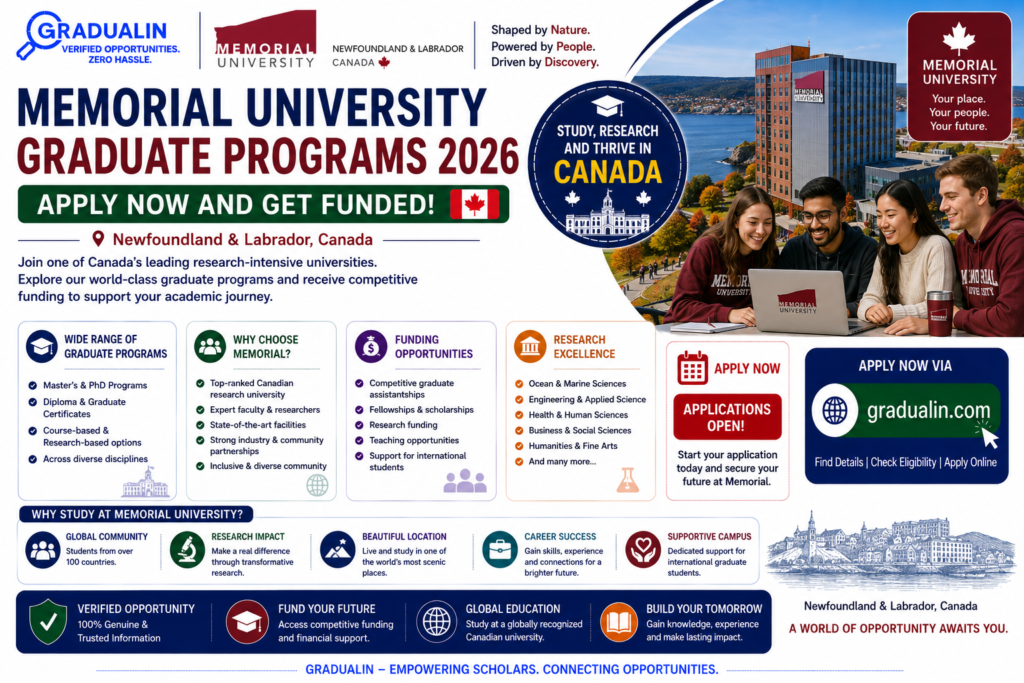

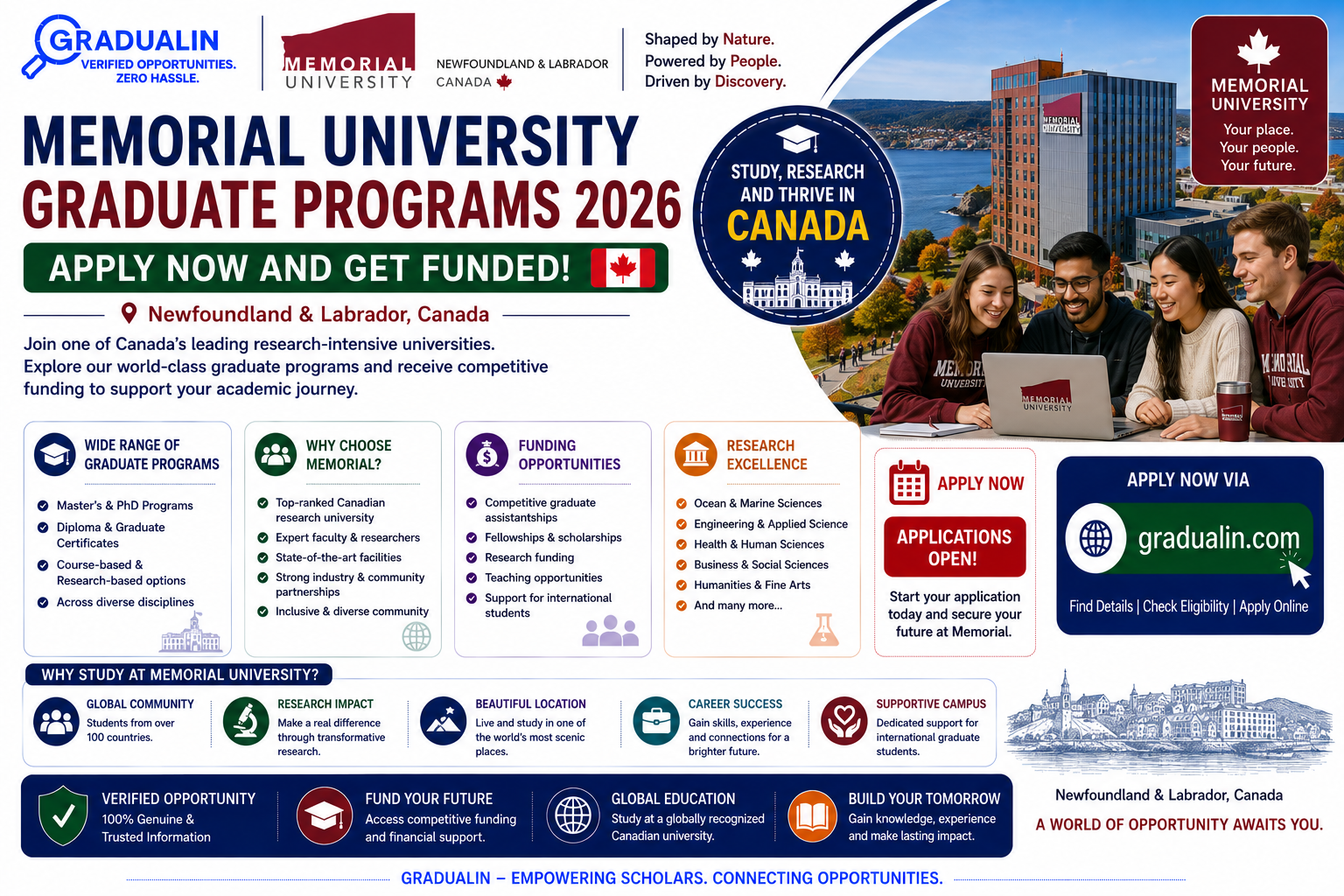
Memorial University Graduate Programs 2026 — Apply Now and Get Funded
Memorial University of Newfoundland (MUN) distributed more than CAD $30 million in financial support to over 2,000 graduate students in 2023–2024 alone — making it one of the most generously funded graduate schools in Atlantic Canada relative to its size. With more than 70 graduate programs across science, engineering, humanities, social sciences, medicine, and professional fields, and a rolling admissions structure that keeps deadlines open year-round, MUN is genuinely worth understanding as a graduate destination.
This guide covers everything you need to apply: the funding structure, the deadlines, the English proficiency requirements, and the honest answer to whether MUN is the right fit for your research profile.
| Detail | Information |
| University | Memorial University of Newfoundland (MUN) |
| Country | Canada 🇨🇦 |
| Location | St. John’s, Newfoundland and Labrador |
| Programs Available | 70+ graduate programs (Master’s, PhD, diplomas) |
| Degree Levels | Graduate Diploma, Master’s (thesis/course/internship routes), PhD |
| Annual Funding Awarded | CAD $30 million+ (2023–2024) |
| Application Fee | CAD $60 (Canadian) / CAD $120 (International) |
| English Requirement | IELTS 6.5 minimum (or equivalent; some programs require higher) |
| Deadlines | Rolling — varies by program (see full table below) |
| Official Application | Apply Here |
🎓 About Memorial University
Founded in 1925 as a memorial to Newfoundlanders who served in World War I, Memorial University has grown into Canada’s largest university by geographic catchment and one of its most internationally oriented research institutions. It holds a top 325 world ranking (Times Higher Education) and is the only university in Newfoundland and Labrador — a factor that concentrates provincial research funding and makes it the dominant academic institution in the region.
MUN’s strength lies in specific research areas shaped by its geography and history: ocean sciences, fisheries, marine engineering, Arctic and subarctic studies, and petroleum engineering are among the most internationally recognised. The university operates the Ocean Sciences Centre — one of North America’s premier marine research facilities — and has established research relationships spanning Europe, Asia, and the Americas.
Unlike the University of Toronto or McGill, which attract massive applicant pools and fund selectively, MUN’s School of Graduate Studies operates on a different model: funding is distributed more broadly across eligible research students, and international applicants are considered for the same funding packages as domestic ones. That structural difference matters for applicants from outside Canada who are comparing graduate funding chances across institutions.
🎓 Funding and Scholarships
Memorial University offers competitive funding packages to academically eligible full-time graduate students — both Canadian and international — in all eligible research programs. No separate application is needed for internal funding. Full-time applicants to eligible programs are automatically considered when applying.
Internal funding sources:
- SGS Fellowships — CAD $4,000 to $12,000 per year, awarded by the School of Graduate Studies
- Graduate Assistantships — CAD $3,000 to $6,000 per year (teaching/research assistantships governed by the TAUMUN collective agreement)
- Supervisor Grants and Contracts — CAD $3,000 to $15,000 per year, funded directly by your supervisor’s research grants
- Special Initiatives Funding — CAD $5,000 to $8,000 per year for specific research initiatives
In practice, a well-funded full-time Master’s student in a research-active department can expect a combined package from these sources that covers much or all of their annual tuition costs and provides a living stipend. PhD students have a funding eligibility window of four years (twelve semesters).
External Canadian awards — strongly encouraged:
The university actively encourages graduate students to apply for national tri-council awards. Recipients of Tri-Council scholarships (NSERC, SSHRC, CIHR) also receive the Dean’s Excellence Award of CAD $5,000 per year on top of their external scholarship — meaning competitive external funding is additive, not a replacement for what the university offers.
Notable external awards to target:
- Vanier Canada Graduate Scholarships (up to CAD $50,000/year for three years — open to international students)
- NSERC Canada Graduate Scholarships (Master’s and Doctoral)
- SSHRC Doctoral Fellowships and CGS awards
- CIHR Doctoral Research Awards and CGS-M awards
International bilateral agreements:
MUN has signed funding agreements with agencies in Colombia (COLFUTURO), Costa Rica (CONAPE), and Mexico (FUNED and JuventudEsGTO). Students from these countries should investigate their home-country agency’s terms alongside MUN’s baseline funding offer. Additional international students may be eligible through the China Scholarship Council, Vietnam International Education Development, and the King Abdullah Scholarship Program. (verify eligibility on official website)
Funding eligibility periods:
(full-time status required throughout):
- One-year master’s programs: one year
- All other master’s programs: two years
- PsyD: three years
- PhD: four years
🎓 Eligibility and English Proficiency
- A bachelor’s degree (four-year undergraduate or equivalent) from a recognised institution is required for master’s admission; a master’s degree for PhD admission in most programs
- All nationalities are eligible to apply
- Applications must be completed in English
English proficiency — clearly stated requirements:
Students who completed secondary schooling or an undergraduate/graduate degree at a recognised institution where English was the language of instruction are exempt from English proficiency tests. If your institution is outside Canada or the United States, you will need a Medium of Instruction (MOI) letter from it — not an IELTS or TOEFL score.
For all other applicants, minimum scores are:
- IELTS Academic: 6.5 (7.0 for programs with higher requirements)
- TOEFL: 80 aggregate (92 for higher-requirement programs)
- Duolingo English Test: 115 (125 for higher-requirement programs)
- PTE Academic: minimum 58 in each of reading, writing, listening, and speaking
- CAEL: 50–60 in each of four bands, with at least two band scores of 60
Applicants who do not currently meet the English proficiency threshold may be considered for conditional admission through MUN’s Intensive English Program at Grenfell Campus.
Note: the Faculty of Education requires a WES Course-by-Course Evaluation for credentials from non-Canadian or non-US institutions. Applications without it are rejected. Plan six to ten weeks ahead for WES processing if this applies to you.
🎓 Who Should Apply — and Who Probably Shouldn’t
✅ Strong fits:
- Researchers in ocean sciences, marine biology, fisheries, Arctic studies, petroleum engineering, or earth sciences — these are MUN’s globally recognised strengths, and supervisor availability and funding density are highest here
- Applicants from Latin America (Colombia, Costa Rica, Mexico) who can combine home-country agency funding with MUN’s baseline offer for a fully funded experience
- Students who want rolling admissions flexibility — MUN’s year-round intake structure means you are not locked into a single annual deadline cycle like you are at many Canadian universities
- Applicants who want Canadian study at a significantly lower cost of living than Toronto, Vancouver, or Montreal — St. John’s is consistently among the most affordable mid-sized Canadian cities
- PhD applicants who need four full years of guaranteed funding eligibility (vs. the two-year maximum common at master’s level)
❌ Weaker fits:
- Applicants looking for a large cosmopolitan city experience — St. John’s is a genuinely pleasant mid-sized city (~130,000 people), but it is geographically remote and not comparable to Toronto or Montreal for urban lifestyle
- Students in fields where MUN does not have strong supervisor density — before applying, check whether faculty with your specific research interest are actively recruiting. A program can exist without a supervisor available to take you in your sub-field
- MBA applicants expecting a globally ranked business school — MUN’s Faculty of Business Administration serves the region well, but is not positioned with global MBA rankings
- Applicants primarily interested in coursework-only programs with no research component — most of MUN’s funding is concentrated in thesis-based (research) programs
🎓 Available Programs
Memorial University offers graduate study across four broad areas. Within each, programs span graduate diplomas, master’s degrees (with thesis, course-only, or internship routes depending on the program), and doctoral degrees.
Sciences and Engineering Biology, Biochemistry, Boreal Ecosystems and Agricultural Sciences, Chemistry, Cognitive and Behavioural Ecology, Computer Science, Data Science, Earth Sciences, Engineering and Applied Science (all disciplines including Oil and Gas, Environmental Systems, Sustainable Infrastructure), Environmental Science, Fisheries Science, Food Science, Geography, Marine Biology, Marine Studies, Maritime Studies, Mathematics and Statistics, Medicine (multiple specialisations including Cancer and Development, Cardiovascular Sciences, Human Genetics, Neurosciences), Pharmacy, Physics and Physical Oceanography, Scientific Computing, Software Engineering, Sustainable Aquaculture, Theoretical Physics
Humanities and Social Sciences Anthropology, Archaeology, Classics, Economics, English, Ethnomusicology, Folklore, French Studies (temporarily suspended), Gender Studies, German Language and Literature, History, Humanities (MPhil), Linguistics, Philosophy, Political Science, Sociology
Professional and Interdisciplinary Programs Arctic and Subarctic Futures, Artificial Intelligence, Business Administration (MBA), Education (multiple streams), Employment Relations, Human Kinetics and Recreation, Interdisciplinary PhD, Maritime Management, Music, Nursing, Occupational Health and Safety, Psychology (MSc, PsyD), Public Health (MPH), Social Work, Technology Management, Transdisciplinary Sustainability
For the full program list with routes, visit MUN Graduate Programs.
🎓 Required Documents
- Online application form — completed in English via the MUN application portal
- Official transcripts — uploaded directly to the application; if your institution only releases transcripts to other universities, arrange for email delivery to gradapply@mun.ca
- Confirmation of degree — if degree completion is not reflected on your transcript, a separate letter is required
- Two letters of appraisal — referees receive an online link to submit directly; use institutional/professional email addresses for referees. Note: PsyD applicants require three letters.
- Resume or CV
- Statement of Interest — the university notes that most academic units place considerable emphasis on this section. It is not a formality.
- English proficiency evidence — IELTS/TOEFL score or Medium of Instruction letter, where applicable
- Application fee — CAD $60 (Canadian) / CAD $120 (international), payable by Visa or Mastercard only
- Program-specific extras — GRE or GMAT for certain programs (MBA, MSc Management, PhD Management, Applied Psychological Science); WES evaluation for Faculty of Education applicants with non-Canadian/US credentials; writing samples for specific humanities programs
🎓 Step-by-Step Application Process
- Choose your program, route, and intake semester. Review the Graduate Programs and Routes document carefully. Each program may offer thesis, course-only, and internship routes with different requirements. You can only apply for one route per application.
- Contact a potential supervisor before applying (for research programs). For thesis-based master’s and PhD programs, it is strongly recommended — and in some departments effectively required — to secure a supervisor’s interest before submitting your application. Visit Finding a Research Supervisor for MUN’s guidance. Cold emails with a tailored research proposal aligned to the supervisor’s current projects yield far better response rates than generic inquiries.
- Check the deadline for your specific program and semester. Deadlines range from December 1 to rolling (no set deadline). International applicants generally face earlier deadlines than domestic ones for the same program. Confirm your deadline from the official deadlines table.
- Submit your online application. Apply through apply.mun.ca. Credit card payment for the application fee is available Sunday–Friday, 5:01 a.m. to midnight Newfoundland time — it is unavailable on Saturdays. Upload supporting documents under “Documents and Supplemental Items” after submission. Documents cannot be deleted once uploaded.
- Monitor your referees. Your referees receive an automated email with a unique link. Verify their email addresses carefully. Submit your application 1–2 weeks before the deadline to give referees adequate time.
- Track your application status. A MUN student number will appear in your online account within 1–2 business days of submission. Use this number for all correspondence with the School of Graduate Studies.
Practical tip that changes outcomes: The Statement of Interest at MUN is treated as a writing sample and a research fit indicator simultaneously. Committees are specifically looking for whether you understand what research means at a graduate level — not just what topics interest you. The strongest statements articulate a specific research question, explain why it is worth asking, and show awareness of the existing scholarly conversation around it. A statement that reads like a graduate program wish-list rather than a research proposal is the most common rejection factor in competitive programs.
🎓 Important Dates
| Program | International Deadline | Domestic Deadline | Intake |
| Computer Science (MSc/PhD) | December 1 | December 1 | Fall |
| Engineering & Applied Science (MEng/PhD) | December 1 | December 1 | Fall |
| Artificial Intelligence (MAI) | December 1 | April 1 | Fall |
| Anthropology / Archaeology / English / History / Folklore | January 15 | January 15 | Fall |
| Earth Sciences (MSc/PhD) | January 15 | January 15 | Fall/Spring |
| Mathematics and Statistics | January 15 | January 15 | Fall |
| Biology / Cognitive and Behavioural Ecology | January 31 | January 31 | Fall/Spring |
| Business Administration (MBA) — International | February 1 | — | Fall |
| Chemistry (MSc/PhD) | February 1 | March 1 | Fall |
| Physics / Physical Oceanography | February 1 | February 1 | Fall |
| Psychology (MSc/PhD) | February 1 | February 1 | Fall |
| Engineering & Applied Science (MASc) | April 1 | April 1 | Fall |
| Marine Biology | No set deadline | No set deadline | Fall/Winter/Spring |
| Medicine specialisations (MSc/PhD) | No set deadline | No set deadline | Fall/Winter/Spring |
For the full, authoritative list of all deadlines, visit mun.ca/become/graduate/apply-to-memorial/application-deadlines/.
Bookmark this page and check back — Fall 2027 semester applications open in the first week of September 2026.
🎓 Why Study at Memorial — Why Newfoundland
St. John’s is one of North America’s oldest European settlements and has a character unlike anywhere else in Canada — a compact, walkable city with a strong community feel, a thriving arts and music scene, and what locals genuinely call the most dramatic coastline on the continent. For international students, the social integration experience at MUN tends to be significantly warmer than at a large anonymous urban campus.
The research argument is straightforward for those in the right fields. MUN’s proximity to the North Atlantic and the Grand Banks has made it the natural home for fisheries science, oceanography, and cold-ocean engineering research that no landlocked university can replicate. The university’s Arctic and Subarctic Futures program — one of the few in Canada dedicated entirely to this region — addresses research questions of growing global importance. In medicine and genetics, MUN’s access to Newfoundland’s historically isolated population has enabled population genetics research that has attracted international attention.
On cost: graduate students at MUN consistently report that St. John’s is among the most affordable places to live while studying in Canada. Tuition rates are competitive with other Canadian institutions, and the cost of housing, food, and transport is substantially below that of Toronto, Vancouver, or even Halifax.
Gradualin Editor’s Note: For international students weighing MUN against better-known Canadian names — UofT, UBC, McGill — the honest answer is that MUN competes strongly on funding accessibility, livability, and supervisor approachability, particularly in its signature research areas. If your field matches MUN’s strengths (ocean sciences, marine engineering, Arctic research, Newfoundland-specific health or humanities research), this is a compelling choice that many applicants overlook in favour of brand recognition. If your field is general enough that any strong Canadian university would serve you equally, MUN is still worth serious consideration for the funding density and quality-of-life value — but you should confirm supervisor availability in your specific sub-field before investing application effort.
🎓 FAQ
These questions are based on what students most commonly search about Memorial University graduate admissions.
Do international students at MUN receive the same funding as Canadian students? Yes — MUN’s School of Graduate Studies explicitly states that competitive funding packages are available to eligible full-time graduate students “both Canadian and international” in eligible research programs. There is no separate international funding pool; you compete on the same academic criteria.
Is IELTS required for Memorial University graduate programs? Not always. If you completed your undergraduate or graduate degree at an institution where English was the language of instruction — even outside Canada or the US — you may be exempt, provided you obtain a Medium of Instruction letter from that institution. If that does not apply, IELTS Academic 6.5 is the minimum (7.0 for some programs). Duolingo (115) and TOEFL (80) are also accepted.
Can I apply without a confirmed supervisor? For coursework-only programs, yes. For thesis-based master’s and all PhD programs, you should ideally contact potential supervisors before applying — some departments expect this, and admission without a supervisor willing to take you is uncommon in research programs. MUN’s guidance is explicit: review the Finding a Research Supervisor page before applying to any research program.
What is the application fee, and is it refundable? The application fee is CAD $60 for Canadian applicants and CAD $120 for international applicants. It is non-refundable. Payment is by Visa or Mastercard only, and is unavailable on Saturdays (Newfoundland time).
When do Fall 2027 applications open? Applications for the Fall 2027 semester open in the first week of September 2026. Winter 2027 and Spring 2027 applications are open now.
Is MUN among Canada’s top universities? MUN holds a top 325 world ranking (Times Higher Education). It is not a member of the U15 group of Canadian research universities, but it is a full-fledged research institution with recognised strengths in specific fields — particularly ocean and marine sciences, earth sciences, and northern studies. For those fields, MUN’s research environment is directly competitive with larger institutions.
🎓 Official Sources
- Apply to Memorial — Graduate Studies
- Online Application Portal
- Full Application Deadlines Table
- Graduate Programs List
- Funding and Scholarships
- Finding a Research Supervisor
- International Students at MUN
- Email (graduate applications): gradapply@mun.ca
- Email (School of Graduate Studies): sgs@mun.ca
🎓 Summary Table
| Detail | Information |
| University | Memorial University of Newfoundland (MUN) |
| Country | Canada 🇨🇦 |
| Location | St. John’s, Newfoundland and Labrador |
| Programs | 70+ graduate programs — Master’s, PhD, diplomas |
| Annual Funding | CAD $30 million+ awarded (2023–2024) |
| Fellowship Range | CAD $4,000–$12,000/year (SGS) |
| Supervisor Grants | CAD $3,000–$15,000/year |
| English Requirement | IELTS 6.5 / TOEFL 80 / Duolingo 115 (or MOI letter) |
| Application Fee | CAD $60 (Canadian) / CAD $120 (International) |
| Deadlines | Rolling — varies by program (Dec–Nov) |
| Fall 2027 Opens | First week of September 2026 |
| Application Portal | apply.mun.ca |
| Graduate Admissions | gradapply@mun.ca |
| Official Website | mun.ca |
Related Opportunities
- Study in Canada 2026 — Guide for International Students
- Fully Funded Scholarships in the USA 2026
- Fully Funded PhD Scholarships in the UK 2026
- Fully Funded PhD Positions in Switzerland 2026
- Study in Norway 2026 — Guide for International Students
Browse all open Scholarships | Jobs & Internships | Events & Conferences | Guidelines & Resources
Stay updated with the latest scholarships, jobs, and opportunities at Gradualin.com — your trusted guide to studying abroad for free.
Author: Faseeh Sultan — MSIT, PhD Scholar; 7 Years in Education