
University of Cagliari PhD Programmes 2026 — Apply by 28 September
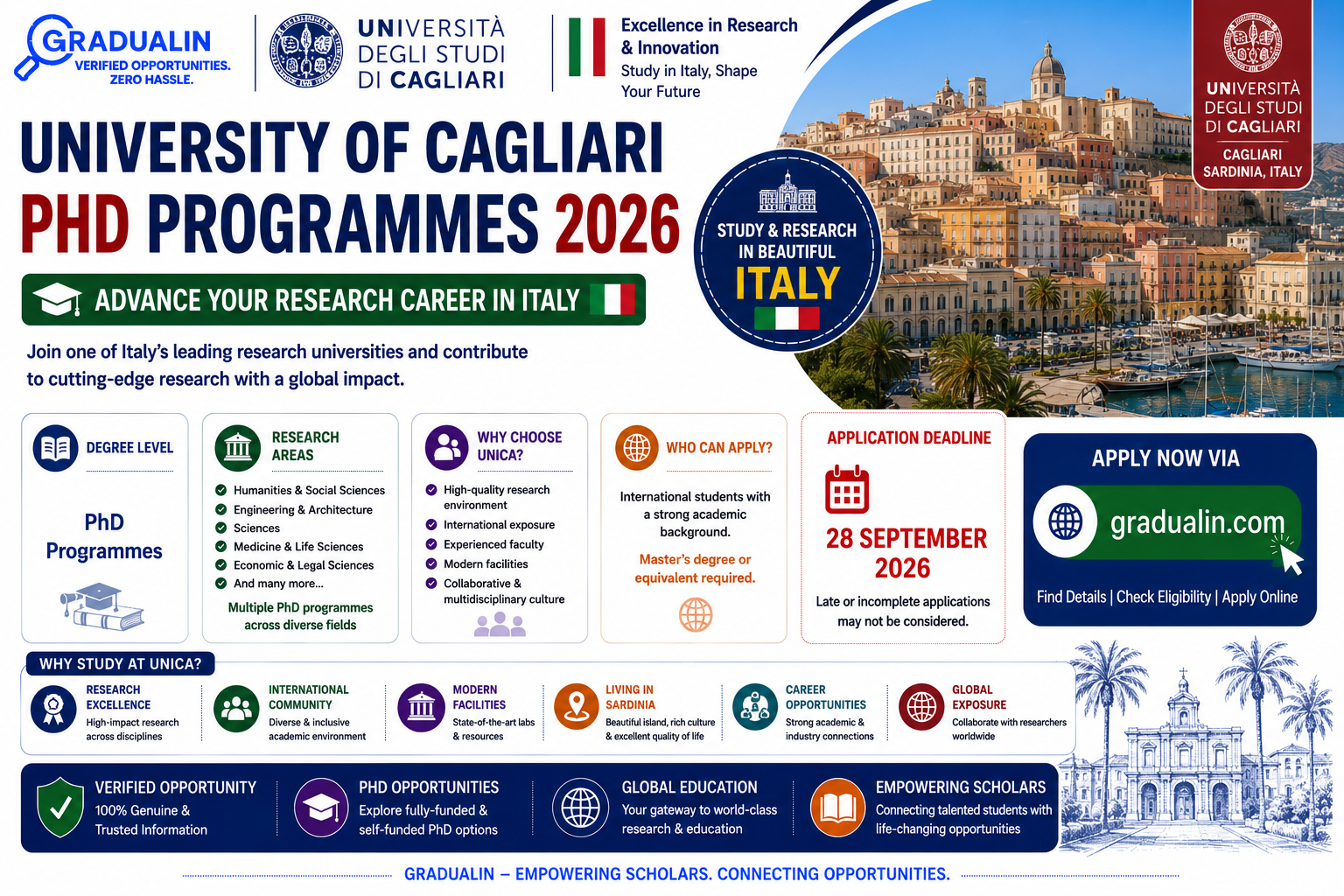
The University of Cagliari (UniCa) has published its official call for admission to Cycle 42 PhD programmes for the 2026/2027 academic year — and the window is open right now. With 18 research doctoral programmes across disciplines from Data Science to Neuroscience to Legal Studies, this is one of the broadest PhD calls at any Italian public university, and it is explicitly open to applicants holding degrees from foreign institutions.
The application deadline is 28 September 2026 at 23:59 (local Italian time). This article breaks down every programme, funding structure, and step of the application process — including things the official call document alone won’t tell you.
| Detail | Information |
| University | University of Cagliari (UniCa) |
| Country | Italy 🇮🇹 |
| Location | Cagliari, Sardinia |
| Degree Level | PhD (Dottorato di Ricerca) — Third Cycle |
| Duration | 3 years |
| Number of Programmes | 18 (Cycle 42) |
| Funding | Competitive scholarships available (PNRR, FSE+, institutional) |
| Deadline | 28 September 2026 at 23:59 (local time) |
| Open To | Italian and international graduates |
| Official Link | Apply Here |
🎓 About the University of Cagliari and This Call
Founded in 1606, the University of Cagliari is the oldest and largest university in Sardinia, and one of the historic public research universities of southern Italy. It operates across six faculties and multiple research departments, with active international partnerships spanning institutions in France, Canada, Spain, the United Kingdom, Portugal, China, and beyond — several of which feed directly into its doctoral programmes as formal consortia.
Cycle 42 represents the university’s 2026/2027 doctoral intake — evaluated and approved by ANVUR, Italy’s national agency for the evaluation of university and research quality. That accreditation matters: an ANVUR-approved Italian PhD is recognised across the European Higher Education Area and carries formal equivalence in most countries worldwide.
Unlike the Erasmus+ programme or bilateral bilateral exchange schemes, admission to a UniCa PhD is a competitive research position — not a course enrollment. You are being selected as a researcher, and most admitted candidates receive a stipend for the full three years.
One distinction worth noting: the University of Cagliari’s Sardinian location gives its researchers access to the PR Sardegna FSE+ 2021–2027 fund, a European Social Fund programme specific to the island region. This means some PhD positions carry regional co-funding on top of national PNRR allocations — a funding layer not available at most mainland Italian universities.
🎓 Funding and Scholarships
Scholarships for UniCa PhD positions come from several distinct sources, and understanding the difference helps you read the competition notice intelligently.
- Institutional scholarships — funded directly by the university, competitive across all applicants to a programme
- PNRR scholarships (National Recovery and Resilience Plan) — backed by the Italian Ministry of University and Research through Ministerial Decrees 629 and 630 (April 2024). These positions are tied to specific research themes aligned with Italy’s national recovery priorities: digital transition, green transition, innovation, and public-sector modernisation. They carry full stipends for three years.
- FSE+ Sardinia scholarships — funded through the European Social Fund programme for Sardinia (2021–2027), targeting regional development priorities. Available only at UniCa and the University of Sassari.
- Industry co-funded positions (innovative PhDs) — some positions are co-financed 50% by private companies under the PNRR innovative doctoral framework. These positions typically involve applied research with an industry partner.
Important: The exact number of funded positions per programme for Cycle 42 is specified in the official competition notice and annexes, which must be downloaded from the official page. Scholarship amounts for Italian PhD positions are set nationally — verify the current stipend figure on the official website, as it is subject to annual indexation. (verify on official website)
Not every admitted candidate receives a scholarship. The call specifies funded and unfunded positions separately for each programme. If you are admitted to an unfunded place, you would pay tuition fees and receive no stipend — a meaningful distinction to check before applying.
🎓 Eligibility Criteria
- A second-cycle degree (Master’s, Laurea Magistrale, Laurea Specialistica, or equivalent) from an Italian or foreign institution
- Foreign degree holders: your qualification must be considered equivalent for PhD access purposes by the admissions committee. You do not need formal recognition (dichiarazione di valore) before applying, but must provide documentation for evaluation
- English-language requirements: no standardised English test (IELTS, TOEFL, etc.) is listed as a mandatory admission requirement for international applicants in the general call. Individual programme annexes may specify language requirements for their selection interviews — check the annexe for your target programme (verify on official website)
- All nationalities are eligible — the call is explicitly open to candidates holding foreign degrees
- Applicants currently enrolled in another PhD programme in Italy may face restrictions — verify on the official website
- The application is submitted online through the university’s Esse3 portal; you must create an account before uploading documents
🎓 Who Should Apply — and Who Probably Shouldn’t
✅ Strong fits for this call:
- Researchers who want a publicly-funded Italian PhD in a southern European setting with strong Mediterranean and European network ties
- Applicants whose research interests align with PNRR priority themes: digital innovation, green transition, healthcare modernisation, or public sector research
- Candidates in STEM, health sciences, or social research looking for a programme with active international co-supervision agreements
- Applicants from developing countries whose degrees may be easier to evaluate at a university accustomed to international intake
- Anyone considering an Italian PhD who wants to live in a genuinely affordable, culturally rich city — Cagliari has a significantly lower cost of living than Rome, Milan, or Bologna
❌ Weaker fits:
- Applicants looking for a taught doctoral programme — UniCa PhDs are research-only, and independent research output is the core expectation
- Candidates who need a pre-confirmed supervisor before applying — Italian public university PhDs select supervisors post-admission within the programme
- Applicants with a very narrow or niche research topic that does not fall within any of the 18 listed programmes
- Those who cannot commit to three years of residence in Cagliari — the programmes require physical presence, and research activities abroad are supplementary, not the primary mode
🎓 Available PhD Programmes — Cycle 42
The following 18 programmes have been confirmed for Cycle 42 (2026/2027), all ANVUR-evaluated:
Sciences and Technology
- Data Science (joint programme with University of Messina, Federico II Naples, University of Pavia, Salento, and Campania “Luigi Vanvitelli”)
- Electronic and Computer Engineering
- Industrial Engineering
- Mathematics and Computer Science
- Physics
- Civil Engineering and Architecture
- Innovation Sciences and Technologies
- Life, Environmental and Drug Sciences
- Earth and Environmental Sciences and Technologies
Health and Medicine
- Personalized Medicine and Public Health
- Molecular and Translational Medicine
- Neuroscience
- Capacities Building for Global Health (joint with University of Ferrara, Foggia, and Salerno)
Humanities and Social Sciences
- Social Research and Innovation
- Legal Sciences
- History, Cultural Heritage and International Studies
- Philological and Literary, Historical and Cultural Studies
For full programme descriptions, supervisor lists, and the exact number of funded positions per programme, consult the Annexes to the PhD Programmes published on the official website.
🎓 Required Documents
The precise document list is specified in the official call and the Esse3 application system. Based on consistent UniCa practice across prior cycles, you should prepare:
- Valid identity document or passport
- Copy of your qualifying degree (Master’s or equivalent)
- Academic transcripts for all relevant qualifications
- Research statement or project proposal (format specified per programme in the annexe)
- Curriculum vitae / academic CV
- Letters of recommendation (number and format per programme — verify on official website)
- Any publications or research outputs you wish to submit (where the programme permits)
- For foreign degree holders: official transcripts with translation where required, and any degree recognition documents available
Flagged as programme-specific: some programmes in the sciences require a research proposal aligned with a specific advertised research topic. Read the annexe for your programme carefully before writing your proposal.
🎓 Step-by-Step Application Process
- Download the call and your programme’s annexe. The full competition notice and individual programme sheets are linked from the PhD programmes page. Your annexe specifies the number of positions, funded vs. unfunded places, selection criteria, and any programme-specific document requirements. Read it before doing anything else.
- Create an account in the Esse3 portal. All applications are submitted through Esse3 — the university’s online student management system. International applicants use a dedicated access route; check the guidelines page linked from the official call.
- Complete the online application form. Fill in personal information, select your target programme, and upload all required documents in the formats specified. The system closes at 23:59 on 28 September 2026 — do not wait until the final day given that file uploads can stall.
- Prepare for the selection examination. Each programme conducts its own selection, typically a combination of document evaluation and an oral interview. Some programmes also assess a written research proposal. Dates are published per-programme.
- Monitor results. Admission results are communicated through the Esse3 system and/or published on the university’s official notice board. Enrolment for successful candidates follows the calendar set in the competition notice.
Practical tip that actually makes a difference: In Italian public university PhD selections, the research proposal is often weighted heavily in disciplines outside pure sciences. Reviewers consistently note that proposals which clearly situate the candidate’s research question within the specific department’s existing research lines — rather than presenting a generic topic — perform significantly better. Before writing your proposal, check the programme’s published research interests and any recent publications by faculty listed in the annexe.
🎓 Important Dates
| Milestone | Date |
| Call published | August 2026 |
| Application deadline | 28 September 2026 at 23:59 (Italian local time) |
| Office summer closure | 10–21 August 2026 (offices reopen 24 August) |
| Selection examinations | Per programme — check official annexes |
| Results and enrolment | Following selection — check official notice board |
Note: emails sent to the PhD and Master’s Office during the summer closure period (10–21 August) will not be answered until 24 August 2026.
Bookmark this page and check back for updates.
🎓 Why Apply — Why Cagliari
Cagliari is one of the most underrated cities for doctoral study in Europe. The capital of Sardinia sits on a bay in the Mediterranean, combines a genuine research university environment with a cost of living well below the Italian average, and gives PhD researchers proximity to both the island’s exceptional natural environment and fast connections to major European cities.
For researchers in health sciences, the university’s location in Sardinia is academically meaningful — the island is the site of ongoing longitudinal population studies (notably the SardiNIA project) that have produced internationally cited findings in genetics and medicine. For environmental researchers, Sardinia’s distinct geological and ecological profile offers field research opportunities unavailable anywhere on mainland Italy.
Internationally, UniCa PhD programmes maintain active co-supervision agreements with institutions including Université Laval (Canada), the University of Edinburgh, Universitat de Barcelona, and Southwest Jiaotong University — meaning some admitted candidates can access structured periods of research abroad within the doctoral framework.
Gradualin Editor’s Note: The University of Cagliari PhD call is a genuine opportunity, but requires realistic self-assessment. Competition for funded positions is real — especially in popular programmes like Data Science, Engineering, and Life Sciences. Candidates with a clear research proposal aligned with a specific advertised research theme, a relevant Master’s thesis, and at least one verifiable research output (publication, conference paper, or thesis with distinction) are substantially better positioned than those applying with a general academic record alone. For applicants in humanities and social sciences, where funded positions are fewer nationally, this call’s mix of institutional and FSE+ Sardinia funding makes it one of the better options in Italy’s south. Average applicants should focus on programmes where their specialisation directly matches the advertised research lines rather than applying broadly.
🎓 FAQ
These questions are based on what students most commonly search about this programme.
Can international students apply for UniCa PhD programmes without an Italian degree? Yes. The call explicitly accepts degrees awarded abroad. You do not need to have your foreign degree officially recognised (dichiarazione di valore) before applying — the admissions committee evaluates equivalence during the selection process. However, you must provide full documentation of your qualification.
Is there a language requirement — do I need IELTS or TOEFL? The general call does not list a standardised English language test as a mandatory admission requirement. However, some programmes — particularly those with English-taught components or international joint supervision — may assess English proficiency during the oral interview. Check your specific programme’s annexe for any language specification. (verify on official website)
How many PhD positions are available in total for Cycle 42? The exact number of funded and unfunded positions per programme is detailed in the official competition notice and programme annexes, which must be downloaded from the official page. This information varies year to year and is not published in summary form outside the call document.
What is the PhD stipend amount in Italy? Italian PhD stipends are set by national legislation and subject to annual revision. The current base amount, along with the 50% increase available for periods of research abroad, is listed in the official call document. (verify on official website for the Cycle 42 figure)
Can I work during the PhD? Italian PhD regulations generally permit limited external work, but full-time external employment is incompatible with funded PhD commitments. The university’s regulations govern this — check the Rules and Regulations page.
What happens if I am admitted but do not receive a scholarship? Unfunded positions exist in every Italian PhD call. Admitted candidates in unfunded positions must pay enrolment fees and receive no stipend. This is a meaningful financial decision and should be factored into your application strategy — prioritise programmes where you have the strongest fit for a funded position.
🎓 Official Sources
- PhD Programmes — University of Cagliari (Official Page)
- Competition Notice — Cycle 42, A.Y. 2026/2027
- Programme Annexes — Cycle 42
- Application Guidelines and Forms
- Esse3 Application Portal
- NRRP Scholarship Information
- Rules and Regulations
- Email: dottoratiemaster@unica.it
- Office: PhD and Professional Master Office, Post Lauream Secretariat, Campus Aresu, Via San Giorgio 12, Cagliari
- Office hours: Monday and Wednesday, 9:00 a.m. – 12:00 p.m.
🎓 Summary Table
| Detail | Information |
| University | University of Cagliari (UniCa) |
| Country | Italy 🇮🇹 |
| Location | Cagliari, Sardinia |
| Degree Level | PhD (Dottorato di Ricerca) — Third Cycle |
| Duration | 3 years |
| Number of Programmes | 18 (Cycle 42) |
| Funding Types | PNRR, FSE+ Sardinia, institutional, industry co-funded |
| English Test Required | Not listed as mandatory in the general call (verify per programme) |
| Open To | All nationalities (Italian and foreign graduates) |
| Application Deadline | 28 September 2026 at 23:59 (local Italian time) |
| Application Portal | Esse3 Online System |
| Contact | dottoratiemaster@unica.it |
| Official Page | web.unica.it |
Related Opportunities
- Study in Italy 2026 — Guide for International Students
- Top 10 Fully Funded Scholarships in Asia 2027
- Fully Funded PhD Positions in Switzerland 2026
- Fully Funded PhD Scholarships in the UK 2026
- Study in Germany 2026 — Guide for International Students
Browse all open Scholarships | Jobs & Internships | Events & Conferences | Guidelines & Resources
Stay updated with the latest scholarships, jobs, and opportunities at Gradualin.com — your trusted guide to studying abroad for free.
Author: Faseeh Sultan — MSIT, PhD Scholar; 7 Years in Education