
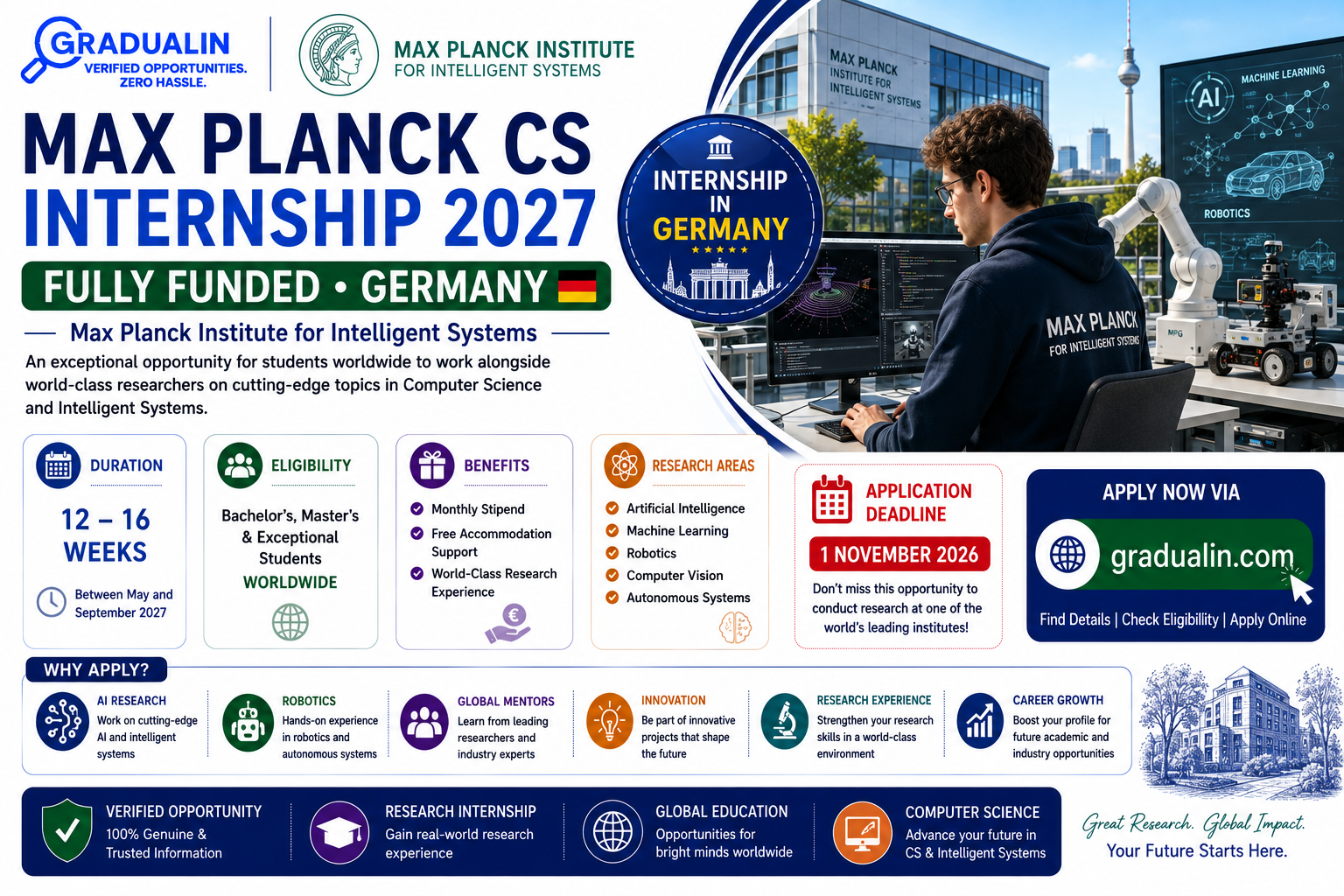
Fully Funded Max Planck CS Internship 2027 — Apply by November 1, 2026
The November 1, 2026 deadline for the Max Planck CS Internship 2027 is now less than three months away — and for serious computer science students, this is one of the most valuable research opportunities available anywhere in the world. Three of Germany’s most prestigious research institutes are accepting applications from Bachelor’s, Master’s, and PhD students worldwide, with a funding package that covers your monthly stipend, housing, and round-trip travel. No German required.
This guide covers everything you need to know: what’s funded, who qualifies, how the application works, and — critically — what separates successful applicants from the large pool of strong candidates who don’t make it.
| Detail | Information |
| Organisation | Max Planck Institutes (MPI-INF, MPI-SWS, MPI-SP) |
| Country | Germany |
| Level | Bachelor’s, Master’s, PhD students; select industry professionals |
| Funding Type | Fully Funded (stipend + housing + return travel) |
| Summer 2027 Deadline | November 1, 2026 (strict) |
| Rolling Deadline | At least 5 months before intended start |
| Open To | International students worldwide |
| Official Link | Apply Here |
💼 About This Program
The Max Planck Society is one of Europe’s foremost research organisations — the CS internship program sits within three of its most active institutes: the Max Planck Institute for Informatics (MPI-INF, Saarbrücken), the Max Planck Institute for Software Systems (MPI-SWS, Saarbrücken and Kaiserslautern), and the Max Planck Institute for Security and Privacy (MPI-SP, Bochum). These institutes collectively cover the full spectrum of computer science, from algorithms and machine learning to systems, security, and privacy.
MPI-INF has a strategic research partnership with Google — the Saarbrücken Research Center for Visual Computing, Interaction and Artificial Intelligence (VIA) — conducting frontier research at the intersection of computer graphics, computer vision, and AI. MPI-SP, the newest of the three, was founded in 2019 with a mission to develop the technical and interdisciplinary foundations of cybersecurity and privacy.
What makes this program genuinely distinct from most research internships is the mentorship structure. Unlike programs at large tech companies, where interns rotate through teams and work on existing products, every Max Planck intern is assigned directly to a faculty mentor and works on a research project tailored to their background. The ceiling here isn’t a polished presentation at the end of summer — successful internships often result in co-authored publications at top academic conferences. That is rare for an internship at any level.
For comparison: the ETH Zürich Summer Research Fellowship and the EPFL Excellence Research Internship Program offer similar academic environments, but both are more structured in their intake windows. The Max Planck program’s rolling non-summer track gives it meaningful flexibility that those programs don’t.
💼 Benefits / Funding
All internships are fully funded, covering living costs, housing, and round-trip travel. The complete package:
- Monthly stipend — sufficient to comfortably cover living expenses in Germany (verify current amount on official website, as exact figures are not published and vary by institute and duration)
- Housing — accommodation costs fully covered for the internship period
- Return flights — round-trip travel from your habitual place of residence to the host institute
- Visa support — official documentation provided to support your German/Schengen visa application; in many cases, interns may be exempt from visa fees for internships up to three months in duration
- Mentorship — direct faculty mentorship, with potential for co-authorship on academic publications
- Thesis conversion — your internship project can be converted into a Bachelor’s or Master’s thesis if your home university agrees
Note on exact stipend figure: No specific monthly amount is publicly stated by the program. Any figure you see on third-party websites is an estimate, not a confirmed number. Budget for German living costs (Saarbrücken and Kaiserslautern are significantly more affordable than Munich or Berlin).
💼 Eligibility Criteria
Internships are open to exceptional Bachelor’s, Master’s, and Doctoral students worldwide, as well as exceptional individuals from industry interested in gaining academic research experience in computer science.
- Must have completed coursework equivalent to the first three years of a CS undergraduate program by the start of the internship (not the application date — by the start date)
- Excellent academic record — no published minimum GPA, but the program emphasises that this applies regardless of how short your academic history is
- Professional fluency in English required — no formal test required; you may be interviewed in English
- No German required — all three institutes operate in English
- Interdisciplinary applicants (e.g., CS intersecting economics, law, or social science) are eligible, though the primary focus must be CS applications
- Industry applicants may apply if they have a relevant CS background and a genuine interest in academic research (not career advancement in industry)
- Applications are particularly welcomed from individuals belonging to underrepresented groups in Computer Science
💼 Who Should Apply — and Who Probably Shouldn’t
✅ Strong fit if you:
- Are a second- or third-year undergraduate, postgraduate, or PhD student with strong coursework in CS fundamentals
- Have prior research exposure — even a lab rotation, course project with faculty, or an unpublished independent study
- Can name specific faculty at MPI-INF, MPI-SWS, or MPI-SP whose work intersects with yours
- Are genuinely interested in academic research careers, not industry placements
- Are comfortable with a 12–14 week commitment requiring full research engagement
❌ Probably not the right fit if you:
- Are in your first year of undergraduate study with no research exposure yet
- Are looking for an industry-style internship with structured rotations and product work
- Want to continue in industry and are hoping this will advance a corporate career
- Cannot demonstrate CS fundamentals equivalent to three years of undergraduate study
💼 Research Areas / Fields
The program covers the full breadth of computer science across three institutes. You can indicate preferences when applying. Research areas include:
MPI-INF (Saarbrücken): Algorithms and Complexity, Computer Vision and Machine Learning, Computer Graphics, Databases and Information Systems, Internet Architecture, Visual Computing and AI
MPI-SWS (Saarbrücken & Kaiserslautern): Software Systems, Programming Languages and Verification, Distributed Systems, Networking, Social Computing
MPI-SP (Bochum): Cybersecurity, Privacy, Cryptography, Systems Security
For a full list of faculty and their research groups, browse the Jobs & Internships section on Gradualin or visit each institute’s faculty page directly:
Identifying one or two faculty members whose research you can speak to specifically is one of the clearest ways to strengthen your application — more on that below.
💼 Required Documents
All applications must be submitted online. You will need to provide:
- CV — academic and research history
- Transcripts — unofficial transcripts accepted; English translations acceptable (self-translated is fine if combined with the original in a single PDF)
- Contact information for at least one referee — the program contacts referees directly if needed; do not ask your referee to send the letter
- Major GPA — calculated as the average grade in your CS subjects specifically (calculate this yourself if your institution doesn’t declare it)
- Motivation letter (optional but strongly recommended — use it)
- Faculty preference (optional) — you may indicate specific faculty members you’d like to work with; this is treated as a preference, not a binding request
If your university doesn’t declare class rank, enter N/A in the field and leave a comment explaining this.
💼 Step-by-Step Application Process
- Research the faculty. Before opening the application form, browse the faculty lists at MPI-INF, MPI-SWS, and MPI-SP. Identify 1–2 researchers whose work genuinely overlaps with yours. You’ll reference them in your application.
- Prepare your major GPA. Calculate it yourself if your university doesn’t publish it — sum of grades in your CS-specific courses, divided by the number of courses. Document how you calculated it in the comments field.
- Prepare your materials. CV, unofficial transcripts (with English translation if necessary), and your motivation letter. Combine non-English transcripts with their translation into one PDF.
- Write a specific motivation letter. This is optional but matters significantly. The most effective letters name a specific faculty member, describe a specific research area in the applicant’s own words, and explain why that intersection matters to them — not generic enthusiasm for “cutting-edge research.”
- Submit at apply.cis.mpg.de. Do not email application materials — they are not accepted by email under any circumstances.
- Wait for the matching process. Research groups review applications. You may be contacted for a phone or video interview. Do not follow up asking about your referee’s letter — the program contacts referees only when needed.
- Check results by February 1, 2027 (for summer applications). If you haven’t heard by then, assume you were not selected. Rejection notices may not be sent to all applicants due to volume.
Practical tip: If you’re applying for a non-summer slot (September–December 2026 or January–April 2027), submit your application at least 5 months before your intended start date. Rolling applications are assessed based on project availability, so earlier is meaningfully better — not just marginally better.
💼 Important Dates
| Track | Deadline |
| Summer 2027 (May–August start) | November 1, 2026 (strict — no exceptions) |
| Non-summer (Sep–Dec 2026 or Jan–Apr 2027) | At least 5 months before intended start date |
| Summer 2027 notification | By February 1, 2027 |
| Non-summer notification | Within 4 months of application |
The November 1 summer deadline is firm. There is no late submission window. Bookmark this page and check back for updates.
💼 Why Germany — Why Max Planck
Germany hosts some of Europe’s most productive research environments, and Saarbrücken specifically is unusual: the Saarland Informatics Campus brings together MPI-INF, MPI-SWS, the German Research Centre for AI (DFKI), and Saarland University’s Computer Science department — covering the entire spectrum of CS in one location. For a CS intern, that density of expertise in one place is difficult to find anywhere outside a handful of US university campuses.
Saarbrücken and Kaiserslautern are both mid-sized German cities with significantly lower costs of living than Munich, Frankfurt, or Berlin — which matters when your housing is covered but day-to-day discretionary costs are your own. Bochum (MPI-SP) is similarly affordable and well-connected to the broader Ruhr region.
Beyond the location: a co-authored paper from a Max Planck internship carries real weight in PhD program applications. Several MPI alumni have gone on to faculty positions at top-tier institutions. The mentorship model — one faculty mentor per intern, project customised to your background — is closer to a PhD rotation than to a standard internship, and that’s exactly the experience that PhD admissions committees look for.
You can browse more opportunities in Germany and Europe through Gradualin’s Scholarships and Guidelines & Resources sections.
Gradualin Editor’s Note: This is one of the strongest fully funded research internships available to CS students globally — but it is genuinely selective. The program emphasises excellent academic record repeatedly in its eligibility criteria, and the competition is international. Average applicants with no research exposure and a generic motivation letter are unlikely to clear the matching process. The program is best suited to students who already know what research area they want to work in, can name specific faculty whose work they’ve read, and have at least some exposure to academic research — even informal. If that describes you, apply early and invest time in the motivation letter.
💼 Frequently Asked Questions
These questions are based on what students most commonly search about this program.
Is the Max Planck CS internship really fully funded, including flights? Yes — confirmed by the official program page. All interns receive a monthly stipend sufficient to cover living costs, housing during the internship, and round-trip travel from their habitual place of residence to the host institute. The exact stipend amount is not publicly disclosed; it varies by institute and intern. No third-party figure is confirmed by the program itself.
Do I need IELTS or TOEFL to apply? No formal English test is required. The program confirms professional fluency in English is required, but no certificate is needed — you may instead be interviewed in English as part of the selection process. This is confirmed by the official source.
Can I choose which Max Planck Institute and which faculty member I work with? You can indicate preferences in your application — for both institute and faculty — but these are treated as preferences, not guarantees. Your application is considered across all participating institutes unless you apply to a specific institute’s independent call. Naming a faculty member is strongly advisable because it signals genuine research interest and allows groups to identify good matches faster.
What happens if my referee doesn’t submit a letter? The program does not request reference letters from all applicants — only when needed. You should not follow up asking whether your referee has been contacted. If the letter is requested and not provided, your application will likely be rejected, so confirm your referee’s willingness before listing them.
Can I convert the internship into a thesis project? Yes, if both your internship mentor and your home university agree. State this clearly in a comment on your application if it’s your intention. This needs to be arranged proactively — it doesn’t happen automatically.
I applied for the summer cycle. When will I hear back? For summer 2027 (May–August start), all applications must be submitted by November 1, 2026. Results are communicated by February 1, 2027. If you have not heard by February 1, assume you were not selected.
💼 Official Sources
- Application Portal: apply.cis.mpg.de/register/internship
- Program Page: cis.mpg.de/internships
- Contact Email: cis-internships@cis.mpg.de — only for questions not answered on the official page
- MPI-INF: mpi-inf.mpg.de
- MPI-SWS: mpi-sws.org
- MPI-SP: mpi-sp.org
💼 Summary Table
| Detail | Information |
| Organisation | Max Planck Institutes (MPI-INF, MPI-SWS, MPI-SP) |
| Country | Germany |
| Level | Bachelor’s, Master’s, PhD students; select industry professionals |
| Funding Type | Fully Funded (stipend + housing + return travel) |
| Summer 2027 Deadline | November 1, 2026 (strict) |
| Rolling Deadline | At least 5 months before intended start |
| English Requirement | Professional fluency required — no formal test |
| German Requirement | Not required |
| Open To | International students worldwide |
| Duration | Typically 12–14 weeks (longer possible) |
| Official Link | Apply Here |
Related reading on Gradualin:
- Fully Funded PhD Scholarships in the UK 2026
- Fully Funded PhD Positions in Switzerland 2026
- Study in Germany 2026 — Guide for International Students
- Events & Conferences — for CS conferences and networking events
Stay updated with the latest scholarships, jobs, and opportunities at Gradualin.com — your trusted guide to studying abroad for free.
Author: Faseeh Sultan — MSIT, PhD Scholar | 7 Years in Education