
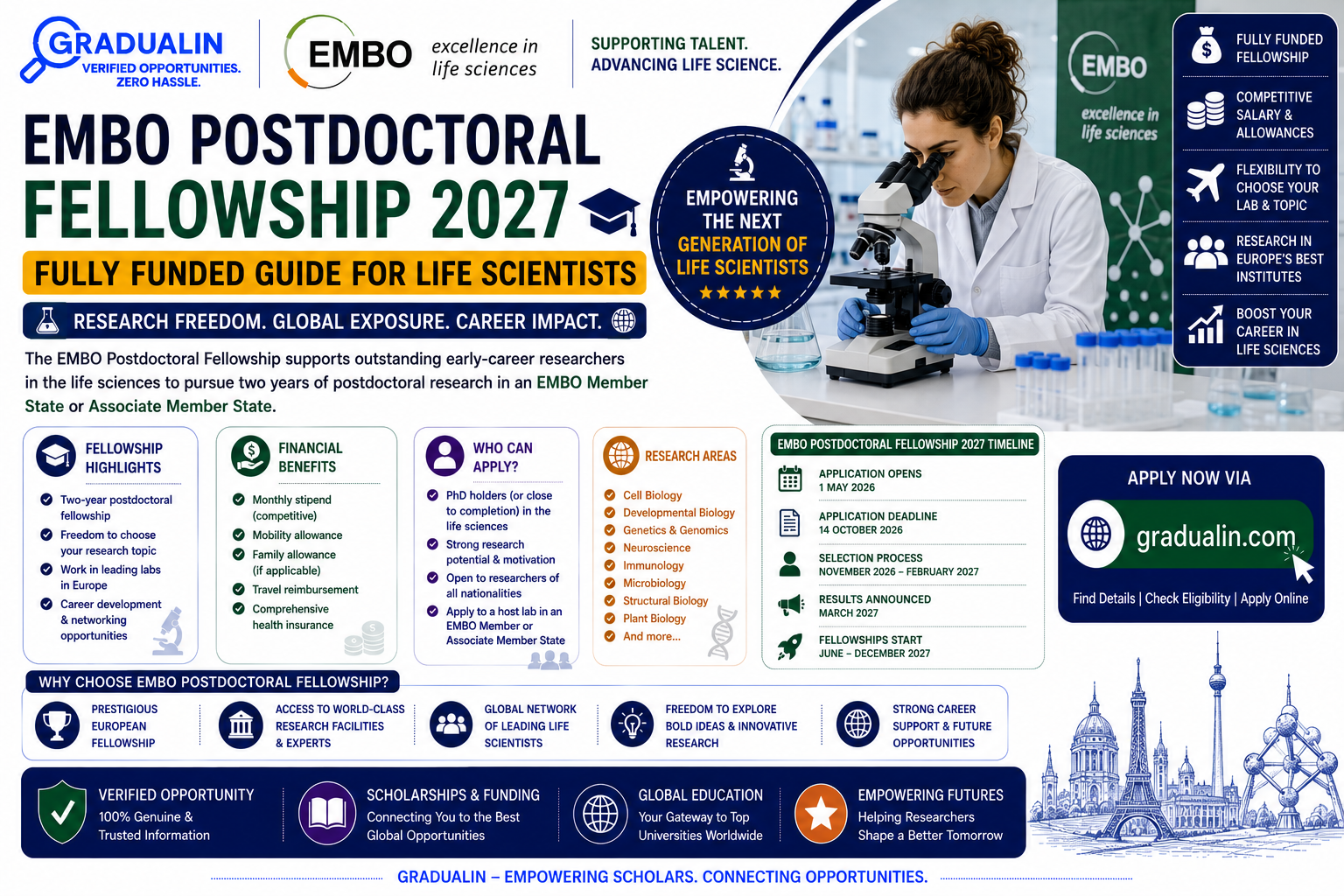
EMBO Postdoctoral Fellowship 2027 — Fully Funded Guide for Life Scientists
If you completed your PhD in the last two years and work in the life sciences, the EMBO Postdoctoral Fellowship is one of the most prestigious fully funded opportunities available anywhere in the world right now — and applications for the Spring 2027 round are open with a hard deadline of 22 January 2027 at 14:00 CET. EMBO has been funding internationally mobile postdoctoral researchers since 1962, and the fellowship carries real weight in any life sciences academic CV. This guide covers everything sourced directly from EMBO’s official pages: who qualifies, what the funding actually covers, the mobility rules most applicants misread, and a critical rule change taking effect from this round that every prospective applicant must know before submitting.
| Detail | Information |
| Programme | EMBO Postdoctoral Fellowship |
| Organisation | European Molecular Biology Organization (EMBO) |
| Field | Life sciences (all disciplines) |
| Level | Postdoctoral research |
| Duration | Up to 2 years (minimum 1 year) |
| Funding Type | Fully funded — employment contract (EMBC states) or stipend (non-EMBC) |
| Next Deadline | 22 January 2027, 14:00 CET (Spring 2027 round) |
| Open To | See eligibility — mobility and nationality rules apply |
| Official Link | Apply Here |
🎓 About EMBO and This Fellowship
The European Molecular Biology Organization (EMBO) is one of the most respected scientific bodies in the world, headquartered in Heidelberg, Germany, and funded by the European Molecular Biology Conference (EMBC), which includes over 30 member states across Europe and beyond. EMBO’s postdoctoral fellowship programme has run continuously since 1962 — over six decades of funding internationally mobile researchers at the critical early stage of their career.
The EMBO Postdoctoral Fellowship is specifically designed to support international mobility: you apply to move to a new country and a new lab, building research independence and cross-border scientific networks. This is not a programme for staying where you are. It funds up to two years of postdoctoral work in the life sciences — broadly defined to include molecular and cell biology, genetics, biochemistry, developmental biology, neuroscience, structural biology, and related areas.
What makes this fellowship stand apart from general postdoctoral grants is the combination of prestige and practical support. Unlike many fellowship schemes that pay a flat stipend, EMBO provides funds to host institutions in EMBC member states to issue full employment contracts — meaning fellows in Europe receive statutory social contributions, taxes, and net salary, not just a research grant. The acceptance rate sits at approximately 8% per evaluation round, making EMBO considerably more selective than DAAD PRIME (~12% acceptance) and roughly comparable to the Marie Skłodosska-Curie Actions Postdoctoral Fellowships in competitiveness, though with a narrower subject scope (life sciences only, versus MSCA’s cross-disciplinary remit).
Browse more European research funding options in our Study in Germany 2026 Guide, Fully Funded PhD Positions in Switzerland 2026, and the broader Scholarships category on Gradualin.
🎓 Benefits and Funding
The funding structure depends on where your host institution is located.
If your host lab is in an EMBC Member State (which includes most of Europe — Germany, France, UK, Switzerland, Italy, Netherlands, Spain, and others — verify the full list at the EMBO site):
- EMBO provides a grant to your host institution to cover the full cost of an employment contract, including your net salary, employer and employee social contributions, and taxes as required by national law
- You are treated as an employee of the host institution with access to the national welfare system, including parental benefits and health coverage
- Travel and relocation allowance — paid as a lump sum before your start date
- Parental leave — fellows whose children are born during the fellowship are entitled to an extension at no cost to EMBO, drawing on the host country’s welfare system
- Part-time work option — fellows can request 50% or 75% of full time; maximum total duration (full + part time combined) is 36 months
- EMBO Laboratory Leadership Course — free attendance for postdoctoral fellows (places are limited and first come, first served; must be claimed within three years of the award)
- EMBO Fellows’ Network — access to an international community of past and current fellows, with invitations to the EMBO Fellows’ Meeting held annually
If your host lab is outside EMBC Member States (including EMBC/EMBO global partners — Chile, India, Singapore, Taiwan — or non-member states):
- You receive a stipend designed to cover living costs in the host country; rates vary by destination and may be subject to local taxation (verify current rates at the official contract rates document)
- Child daycare allowance — up to €2,500 per year per child under six, prorated for partial years
- Dependent child allowance — additional support for dependent children under 18 (amount varies by country)
- Travel and relocation support, parental leave, and Laboratory Leadership course access also apply
EMBO does not cover bench fees, consumables, overheads, or any financial benefit to the host supervisor or institution beyond the fellow’s employment costs.
🎓 Eligibility Criteria
The eligibility rules for EMBO are more specific than many postdoctoral programmes — read these carefully before investing time in an application.
- PhD requirement: You must hold a doctorate or equivalent at the start of the fellowship. A PhD already held at the time of application is eligible only if it was obtained within the two years prior to the submission date. This two-year window is strict — no exceptions for voluntary career breaks, though exceptions exist for parental leave, severe illness, and military service, assessed case by case.
- Publication: You must have at least one first-author publication accepted or published in an international peer-reviewed journal at the time of application. A first-author preprint with verifiable, public, in-depth peer reviews from an independent peer review service is also acceptable — but informal comments or individual highlights are not. Co-authored papers do not satisfy this requirement; first authorship is specified.
- International mobility: All applications must involve movement between countries. Applications to work in the same country as your PhD institution, to return to a lab where you have worked for more than six months, or to work again with your PhD supervisor (regardless of their location) will not be considered.
- Country of PhD: Applications to go to the country where you obtained your PhD will not be considered.
- Host country mobility rules for non-EMBC destinations:
- To work in an EMBC Member State: any applicant, regardless of nationality, can apply — provided there is genuine international mobility
- To work in an EMBC/EMBO global partner (Chile, India, Singapore, Taiwan): you must be moving from, be a national of, and have done your PhD in either an EMBC Member State or one of the global partner countries
- To work in a non-EMBC, non-partner country: you must be a national of an EMBC Member State, have done your PhD in an EMBC Member State, and be moving from an EMBC Member State
- Already in the host lab: You can still apply if you have been working in the host lab for less than six months at the time of submission.
- One application per round: Candidates may submit only one application to one project at one host laboratory per selection round.
Critical rule change for the Spring 2027 round: Starting from the Autumn 2027 selection round — meaning for all applications submitted after 22 January 2027, 14:00 CET — re-applications will no longer be permitted. If you are planning to apply to the Spring 2027 round (deadline 22 January 2027), you still have one potential reapplication available if unsuccessful. After this deadline passes, each researcher will only ever be able to submit one EMBO Fellowship Proposal total. This makes the January 2027 deadline the last opportunity to apply under the old rules.
🎓 Who Should Apply — and Who Probably Shouldn’t
✅ Strong fit for EMBO:
- Life scientists within two years of their PhD who hold at least one first-author, peer-reviewed publication
- Researchers moving to a genuinely new country and a lab with no prior long-term connection to their PhD work
- Postdocs targeting Europe’s leading molecular biology, genetics, neuroscience, or structural biology labs — EMBO’s network is particularly dense in Germany, UK, Switzerland, France, and the Netherlands
- Applicants considering the Spring 2027 round who want to preserve the option to reapply once if unsuccessful — this is the last round under the current rules
- Researchers who want employment benefits (social contributions, parental leave access) rather than a bare stipend, when hosting in an EMBC state
❌ Poor fit — think carefully before applying:
- Researchers whose PhD was obtained more than two years before the application date — the two-year window is a hard cut with very limited exceptions
- Life scientists without a first-author peer-reviewed publication at the time of submission — co-authorship alone does not qualify
- Applicants planning to return to a country, lab, or supervisor from their PhD history — EMBO’s mobility rules will eliminate these applications at the eligibility stage
- Researchers from non-EMBC countries hoping to work at a non-EMBC host institution — the nationality and PhD-country conditions make this path very narrow
- Researchers outside the life sciences — EMBO is exclusively focused on biological research; applications from chemistry, physics, engineering, or social science backgrounds will not be considered
🎓 Life Sciences Fields Covered
EMBO’s programme covers research on the mechanisms of life at all levels — from single molecules to organisms and ecosystems. In practice, this includes:
- Molecular and cell biology
- Genetics and genomics
- Structural biology and biochemistry
- Developmental biology
- Neuroscience
- Immunology and infectious disease
- Plant biology
- Computational and systems biology with a life sciences focus
- Biomedical research
If your work sits at the boundary of life sciences and another discipline — computational genomics, biophysics, bioengineering — contact the EMBO Fellowship Office before applying to confirm eligibility. The office is reachable via the contact details on the official page and will provide a determination before submission for borderline cases.
You can also find broader European postdoctoral opportunities in our Guidelines & Resources section and explore country-specific guides including Study in Netherlands 2026 and Study in Norway 2026 for context on life in the EMBC host countries.
🎓 Required Documents
Based on EMBO’s official application guidelines (updated June–July 2026). All documents are submitted through the online application system — the portal only accepts text; image uploads are not supported for the application form itself.
- Completed online application form via the EMBO application portal
- Research proposal — describing the project to be carried out at the host laboratory
- CV — including full publication list with the first-author paper(s) clearly identified
- PhD certificate or equivalent (or a statement from your supervisor confirming expected completion date if not yet issued)
- Degree transcripts
- Letter of support from the host supervisor confirming the research environment and their willingness to host you
- Evidence of first-author publication — journal acceptance letter, published paper, or qualifying peer-reviewed preprint with verifiable review reports
- Any documentation supporting eligibility exceptions (parental leave, illness, military service) if applicable — must be discussed with the Fellowship Office prior to submission
For exact document specifications, carefully read the EMBO Postdoctoral Fellowships guidelines (June 2026) before preparing your application.
🎓 Step-by-Step Application Process
- Check your eligibility. Use the eligibility checker on EMBO’s site before doing anything else. The mobility rules and two-year PhD window eliminate more applicants at this stage than most realise.
- Identify and contact your host supervisor. Your host must be based at an institution in a country where you haven’t worked for more than six months previously. Contact potential supervisors with a concise pitch — your research background, the project idea, and why their lab specifically. Do this well in advance; a positive response from a supervisor is essential before you start the formal application.
- Confirm your first-author publication is in order. If you are relying on a preprint, verify it has been reviewed by an independent peer review service — not informal comments. Check EMBO’s current guidelines on what qualifies.
- Note the Spring 2027 deadline carefully. The hard cutoff is Friday 22 January 2027, 14:00 CET — not midnight, not end of day. The system closes at 14:00 precisely.
- Register and apply via the EMBO portal. Access the application system at applications.embo.org. Complete all sections; the portal accepts text only — no image uploads in the application form.
- Wait for eligibility screening. All applications undergo an eligibility check before proceeding to scientific review. Applications outside the criteria are not forwarded to the committee — which is why the eligibility page deserves a careful read before you spend weeks on a proposal.
- Scientific review and interview. Eligible applications go to the EMBO Fellowship Committee for scientific evaluation. Shortlisted candidates are invited to an online interview. Results for the Spring 2027 round are announced around mid-June 2027 (verify on official page).
- Fellowship start. Fellowships must begin within one calendar year from the relevant evaluation cutoff date.
The single most important practical tip: given that the reapplication option closes after this round, treat the January 2027 deadline as a one-shot opportunity. Do not submit an incomplete or under-prepared application banking on a second chance — after 22 January 2027, there are no second chances.
🎓 Important Dates
| Milestone | Date |
| Spring 2027 hard deadline | Friday 22 January 2027, 14:00 CET |
| Results announced | Around mid-June 2027 (verify on official page) |
| Reapplication rule change | Effective for all applications submitted after 22 January 2027 — no reapplications permitted thereafter |
| Fellowship start window | Within one calendar year from the evaluation cutoff |
Bookmark this page and the official EMBO postdoctoral fellowships page for updates.
🎓 Why Apply — EMBO, Heidelberg, and the European Life Sciences Network
The EMBO fellowship does something that funding alone cannot: it grants you membership in a global community of more than 2,200 EMBO Members — Europe’s leading life scientists — and connects you formally to the EMBO Fellows’ Network, which spans decades of alumni across every major research institution in the world. For researchers from Asia, Africa, and South Asia especially, that network access is one of the most valuable long-term outcomes of the fellowship, opening doors to collaborations and positions that a standard postdoc position does not.
EMBO’s home in Heidelberg sits within one of the densest concentrations of life science research in Europe. The European Molecular Biology Laboratory (EMBL), the German Cancer Research Center (DKFZ), Heidelberg University, and several Max Planck institutes are all within the same cluster. Fellows working in Germany can take full advantage of the country’s robust research infrastructure — covered in our Study in Germany 2026 Guide. For those heading to other EMBC destinations, our Study in Netherlands 2026 and Fully Funded PhD Scholarships in the UK 2026 guides offer practical context.
Gradualin Editor’s Note: The EMBO Postdoctoral Fellowship is one of the genuinely elite life sciences awards at the postdoctoral level — but its ~8% acceptance rate and the strict two-year PhD window mean this is a programme for researchers who are ready right now, not ones who plan to apply in a year or two. The rule change eliminating reapplications after January 2027 adds meaningful pressure: if you have a strong first-author publication and a realistic host supervisor identified, there is a real argument for submitting in January 2027 specifically, while the reapplication safety net still exists. Researchers who are on the edge of eligibility — PhDs granted just within the two-year window, publications in review but not yet accepted — should contact the Fellowship Office directly before applying. EMBO’s office is accessible and does make eligibility determinations before submission; using that resource costs nothing and can save weeks of wasted effort.
🎓 FAQ
These questions are based on what researchers most commonly search about the EMBO Postdoctoral Fellowship.
1. Can researchers from outside Europe apply for the EMBO Postdoctoral Fellowship? Yes, but with conditions that depend on where you want to go. If you want to work in an EMBC Member State — which covers most of Europe — any nationality can apply provided there is genuine international mobility. If you want to work outside EMBC countries, the requirements are stricter: you must be an EMBC national, have obtained your PhD in an EMBC country, and be relocating from an EMBC country. Researchers from South Asia, East Asia, and Africa most commonly apply to work in EMBC states, which is the most accessible pathway.
2. Is IELTS or any English language test required for EMBO? No English language test is required by EMBO. The fellowship operates on the assumption that researchers working in international life sciences labs are already proficient in English. Your host institution may have its own language requirements for residency or visa purposes, but EMBO itself imposes no language test condition.
3. What counts as a “first-author publication” — does a preprint qualify? EMBO’s guidelines (updated June 2026) confirm that a first-author preprint qualifies if it has been publicly peer-reviewed by an independent peer review service, with the reviews verifiably available. Informal comments, highlights, and reviews posted by individuals do not count. If you plan to rely on a preprint, read the current guidelines carefully to confirm your specific preprint platform and review process meet the criteria.
4. Can I apply if I am already working in the host lab? Yes — but only if you have been living in the host country for less than six months at the time you submit your application. If you have been in the host country for six months or more, you are not eligible for that host, regardless of when you started in the lab.
5. What is the acceptance rate and how competitive is EMBO really? EMBO receives approximately 1,000 applications per evaluation round, with a success rate of around 8%. The Fellowship Committee evaluates scientific quality of the proposal, the applicant’s track record (publications, awards, academic performance), and the quality and suitability of the host environment. Applications that are eliminated at the eligibility stage — missing first-author publications, incorrect mobility, PhD obtained more than two years earlier — do not reach the scientific review at all. Most rejections at the eligibility stage are avoidable.
6. Why is January 2027 a particularly important deadline? Starting from the Autumn 2027 evaluation round — all applications submitted after 22 January 2027 — reapplications will no longer be permitted. Under the current rules, an unsuccessful applicant can reapply once with significant changes. After January 2027, each researcher gets one lifetime application to EMBO. Submitting in the Spring 2027 round is therefore the last opportunity to retain the option of a second attempt if your first application is unsuccessful.
🎓 Official Source
- Programme page: EMBO Postdoctoral Fellowships
- Eligibility details: EMBO Postdoctoral Fellowships — Eligibility
- Benefits details: EMBO Postdoctoral Fellowships — Benefits
- Application portal: Apply Here
- Official guidelines (June 2026): Postdoctoral Fellowships Guidelines PDF
- Contract rates: Current Rates PDF
- Programme Head: Karin Dumstrei — +49 6221 8891 122
- Address: EMBO, Meyerhofstrasse 1, 69117 Heidelberg, Germany
🎓 Summary Table
| Detail | Information |
| Programme | EMBO Postdoctoral Fellowship |
| Organisation | European Molecular Biology Organization (EMBO) |
| Field | Life sciences |
| Level | Postdoctoral research |
| Duration | 1–2 years |
| Funding | Employment contract (EMBC states) or stipend (non-EMBC) |
| Acceptance Rate | ~8% per round |
| Next Deadline | 22 January 2027, 14:00 CET |
| Reapplication | Permitted once — ends after January 2027 round |
| Open To | Life scientists with 1st-author publication, PhD within 2 years |
| Official Link | Apply Here |
🎓 Related Opportunities You Should Explore
If you are preparing for EMBO, these articles will strengthen your planning:
- DAAD PRIME Fellowship 2027 — Complete Guide for Postdoctoral Researchers — the other major employment-based postdoctoral fellowship in Europe; if your field is outside life sciences, PRIME is your parallel option
- Study in Germany 2026 — Guide for International Students — essential reading if your target host lab is in Germany, which is home to a dense concentration of EMBO-eligible institutions
- Fully Funded PhD Scholarships in the UK 2026 — the UK is an EMBC Member State and one of the top EMBO host destinations; this guide covers the broader research environment there
Stay updated with the latest scholarships, jobs, and opportunities at Gradualin.com — your trusted guide to studying abroad for free.
Author: Faseeh Sultan — MSIT, PhD Scholar | 7 Years in Education