
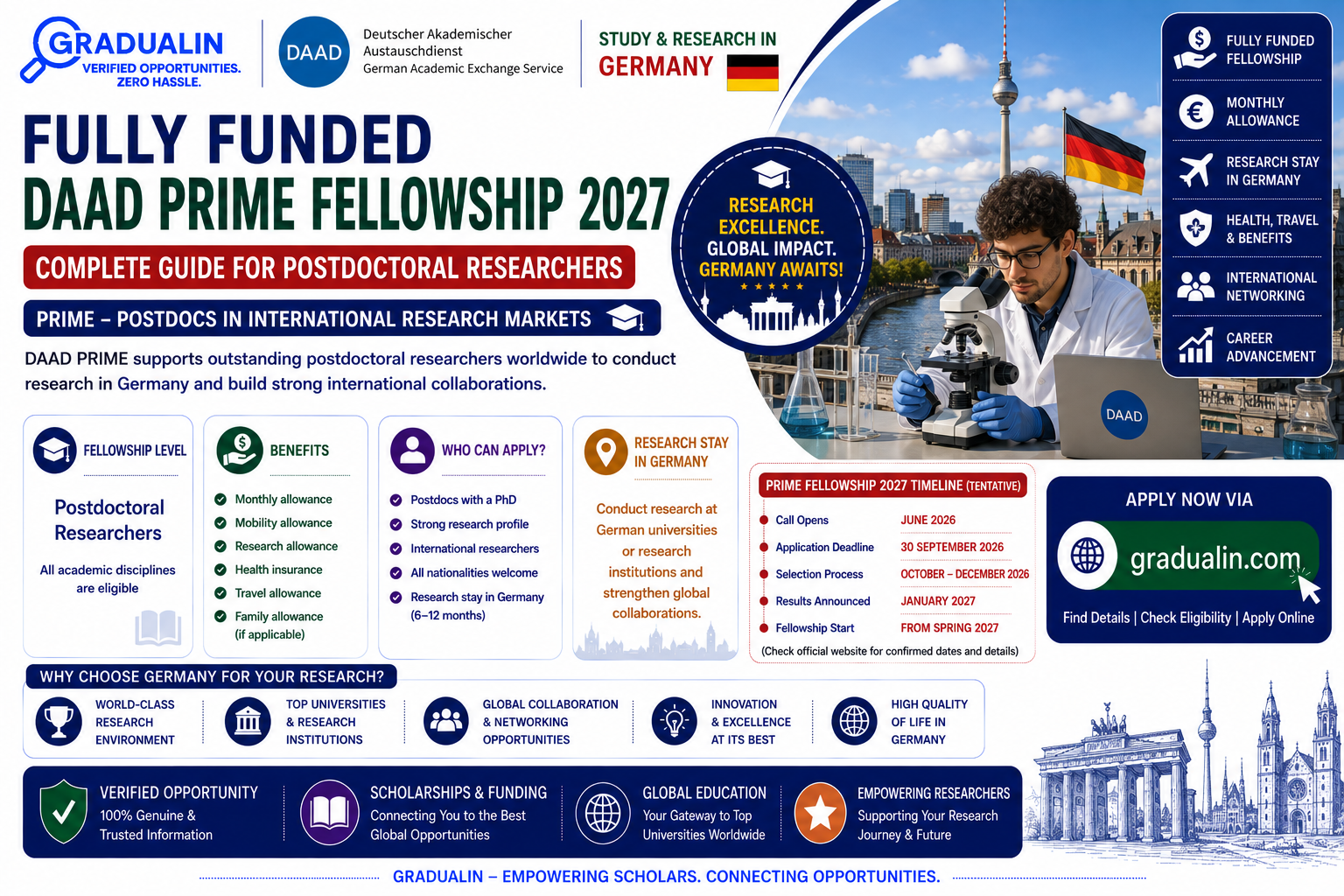
Fully Funded DAAD PRIME Fellowship 2027 — Complete Guide for Postdoctoral Researchers
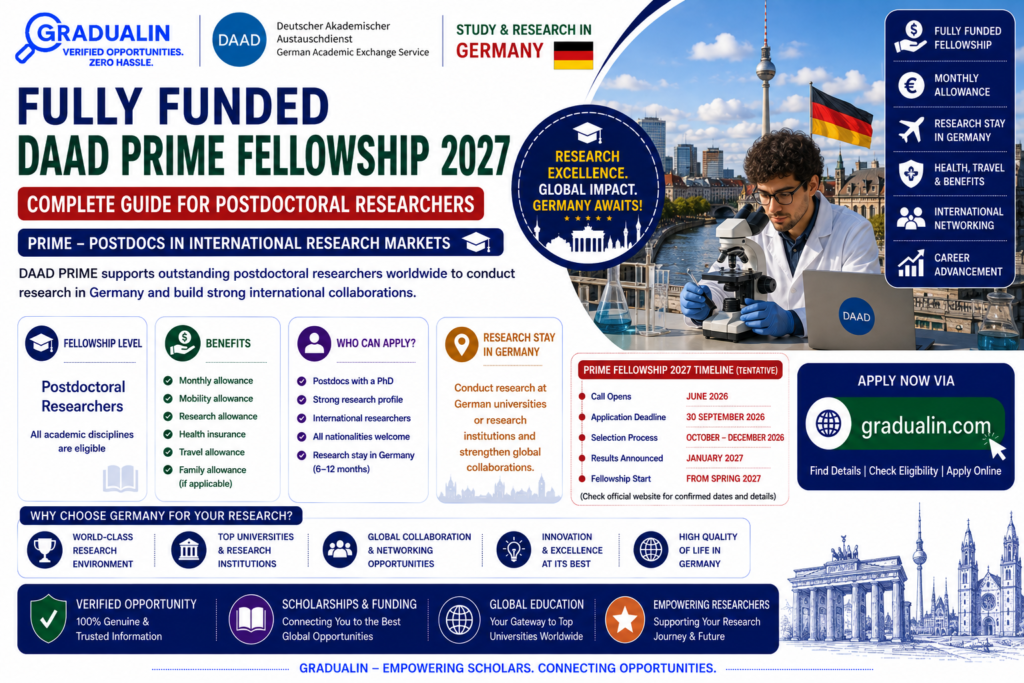
The DAAD PRIME Fellowship is one of the very few postdoctoral programs in the world that pays you a full German university salary — not a stipend, not a grant cheque, but an actual employment contract — while you conduct independent research abroad for a full year and then reintegrate into Germany’s academic system. The next call opens in April 2027 for funding starting 1 April 2028, and DAAD has already confirmed this on its official FAQ. If you are a postdoctoral researcher with a long-term academic career in Germany in your sights, this is the guide you need to start preparing now.
This article covers everything sourced directly from DAAD’s official programme page and call documents: what PRIME funds, who qualifies, how the selection committee actually evaluates applications, and the one strategic mistake most applicants make that costs them a spot.
| Detail | Information |
| Programme | DAAD PRIME — Postdoctoral Researchers International Mobility Experience |
| Administered by | German Academic Exchange Service (DAAD) |
| Funded by | German Federal Ministry of Research, Technology and Space (BMFTR) |
| Level | Postdoctoral research |
| Duration | 18 months (12 months abroad + 6 months reintegration in Germany) |
| Funding Type | Fully funded — employment contract + salary + allowances |
| Next Deadline | April 2027 (exact date to be confirmed — verify at official site) |
| Funding Starts | 1 April 2028 (earliest) |
| Open To | All nationalities, all disciplines |
| Official Link | Apply Here |
🎓 What Is the DAAD PRIME Fellowship and Why Does It Stand Apart?
DAAD — the German Academic Exchange Service — is one of the oldest and most respected academic exchange bodies in the world, founded in 1925 and backed by the German federal government. PRIME (Postdoctoral Researchers International Mobility Experience) is among its most distinctive programmes: rather than awarding a traditional scholarship, it funds a temporary employment position at a German university, giving you a real contract, statutory health insurance, pension contributions, and the legal protections of the German public sector pay scale.
What this means in practice is different from most fellowship models. The Marie Skłodosska-Curie Actions (MSCA) Postdoctoral Fellowships — the closest comparison in European research funding — operate on a similar employment-based structure, but MSCA is hosted through the European Commission and is considerably more competitive to administer institutionally. PRIME is administered directly by DAAD, meaning the process is more streamlined and the German university handles the employment paperwork once funding is confirmed.
The programme is designed specifically for researchers who intend to build their long-term academic career in Germany. This is not a fellowship for someone who wants to visit Germany briefly and return home — the reintegration phase exists precisely to anchor fellows in the German research system before they move into permanent positions. DAAD reports that the acceptance rate historically sits at approximately 12%, placing PRIME in the genuinely competitive tier of global fellowships without reaching the near-impossible odds of programmes like the Humboldt Research Fellowship.
If you are browsing Scholarships and want to compare this against other fully funded options in Europe, the Fully Funded PhD Scholarships in the UK 2026 and Fully Funded PhD Positions in Switzerland 2026 offer relevant context for postdoctoral-level funding in neighbouring systems.
🎓 Benefits and Funding — What PRIME Actually Pays
This is where PRIME separates itself clearly from stipend-based fellowships, and where candidates often underestimate just how generous the programme is.
- Monthly salary: Employed on the German public sector pay scale TV-L E13 for the full 18 months. DAAD’s own FAQ confirms a gross range of €5,000–€6,400 per month pre-tax, depending on experience and personal circumstances. This is a working salary with full social security contributions — not a subsistence grant.
- Expatriate allowance: During the 12-month international phase, you receive an additional monthly allowance of approximately €1,500–€2,800 (for Europe and North America destinations; higher rates apply for other regions). This covers the cost-of-living differential between Germany and your host country. Rates are subject to change — verify on the official page.
- Travel allowance: A DAAD lump-sum travel subsidy covers your international flights. Spouses (including under German civil partnership law) and children are also eligible for travel support if they accompany you for at least one month during the abroad phase.
- Family support: Additional allowances are available for accompanying family members during the international phase.
- Disability and chronic illness support: Fellows with documented needs may access up to €10,000 in additional support (verify on official website).
- Health and pension: Because you are employed rather than a scholarship recipient, you receive statutory German health insurance and pension contributions — benefits that most traditional scholarship holders do not get.
DAAD does not cover overhead costs, bench fees, or visa fees, though it issues award letters to support your visa applications.
🎓 Eligibility Criteria
PRIME is open to postdoctoral researchers of all nationalities and all academic disciplines. The conditions below are drawn directly from DAAD’s official call documents.
- Completed doctorate: Your PhD must be completed — with excellent results — before the start of funding. If your certificate is not yet issued at application time, your doctoral supervisor must provide a confirmed completion date.
- Recency rule: You must have obtained your first PhD no more than six years before the funding start date. Career breaks for parental leave, caring for relatives, illness, or displacement are considered and can extend this window — declare them explicitly in your application.
- Publications: A minimum of one peer-reviewed publication is required. Co-authored works are accepted. More publications strengthen your standing but one is the stated minimum.
- Mobility rule: You cannot have resided or worked in your intended host country for more than 12 months in total during the three years preceding the application deadline. Germany is excluded as a possible host country for the abroad phase.
- EU/non-EU destination rule: Applicants who are EU nationals, EU resident citizens, or have been continuously active in research in the EU for at least three years may conduct their international phase outside the EU. All other applicants must spend their abroad phase within the European Union.
- No permanent contract: You must not hold a permanent position at your proposed host institution.
- Career intent: You must demonstrate a genuine intention to pursue a long-term academic career in Germany after the fellowship concludes.
- Language: Your language skills must be sufficient to conduct research effectively at both host institutions.
🎓 Who Should Apply — and Who Probably Shouldn’t
✅ Strong fit for PRIME:
- Postdocs within six years of their PhD who are actively publishing and have at least one peer-reviewed paper in print
- Researchers who have already identified or are actively networking with a German university willing to serve as their employer/host
- Scholars from outside the EU who want a structured, funded entry point into the German academic system (noting the EU-destination rule for non-EU nationals)
- Researchers in any discipline — PRIME is genuinely field-agnostic, making it equally relevant for humanities scholars and STEM researchers
- Applicants who want employment benefits (health insurance, pension) rather than a scholarship top-up
❌ Poor fit — reconsider before applying:
- Researchers who have been living or working in their target host country for more than 12 of the last 36 months — the mobility rule will disqualify you
- Postdocs who do not have a realistic plan to build their career in Germany after PRIME — the selection committee assesses long-term career intent explicitly and reviewers flag weak career plans
- Researchers who have not yet identified a German host university willing to employ them — without this, the application cannot proceed at all
- Those expecting to pursue PRIME as an extension of their current position — permanent contract holders at the proposed host are ineligible
- Non-EU applicants hoping to spend their abroad phase outside Europe — the EU-destination rule applies unless you meet the three-year EU research residency threshold
🎓 Available Disciplines and Host Institutions
PRIME imposes no restriction by academic field. Natural sciences, engineering, medicine, humanities, social sciences, and interdisciplinary research are all eligible. This is one of PRIME’s meaningful distinctions from research council grants, which typically fund specific priority areas.
For the German host, any German university can serve as the employing institution — including those that have not nominated a PRIME contact person. DAAD maintains a list of contact persons at universities that have specifically opted in, available through the GERiT database (German Research Institutions service). Non-university research bodies — Max Planck, Helmholtz, Fraunhofer, and Leibniz institutes — can be involved in the research plan but must be coordinated alongside a German university that holds the employment contract.
For the international host phase, researchers can select universities, non-university research institutions, or industry research entities abroad, subject to the mobility and EU-destination rules above. The selection committee assesses whether the chosen foreign institution is genuinely the most suitable place to conduct the proposed research — a generic or unconvincing justification for host choice is a known weakness in rejected proposals. Find more context on the broader European research landscape through our Study in Germany 2026 Guide and Fully Funded PhD Positions in Switzerland 2026.
🎓 Required Documents
The following list is based on DAAD’s official call documents and checklist. All materials must be submitted in English via the DAAD online portal in PDF format before the deadline. Missing self-submitted documents result in automatic exclusion.
- Completed online application form (DAAD portal)
- Tabular CV — EU format recommended, no unexplained gaps (declare career breaks explicitly)
- Career plan — maximum one page
- Abstract of research proposal — maximum half a page, with title and keywords
- Full research proposal — maximum 7–8 pages
- Research timeline (Gantt chart or equivalent schedule)
- Declaration from German host university confirming employment commitment (Form 1)
- Invitation letter from German host institution (Form 2)
- Invitation letter from foreign host institution
- Ethics Issues Checklist (Form 3) — signed; ethical concerns not adequately addressed can delay or block funding
- Checklist of application documents (Form 4)
- PhD certificate and transcripts (Master’s certificates if relevant)
- Summary of PhD thesis — one to two pages
- Publication list (highlight up to three key publications)
- Confidential letter of recommendation — submitted directly by a university professor via the DAAD portal
Language certificates are required where applicable. Forms 1–4 are available for download on the official PRIME applicants page.
🎓 Step-by-Step Application Process
- Identify your German host university. This is the first and most time-consuming step — the German institution must be willing to employ you and submit Form 1. Use DAAD’s GERiT database and the list of PRIME contacts at German universities to find departments active in your research area. Contact potential mentors with a concise email including your CV, a one-paragraph project description, and evidence of your publications. Do this at least eight months before the deadline — employment decisions at German universities move slowly.
- Secure your foreign host institution. Choose an institution where the specific infrastructure, expertise, or data you need for your project genuinely exists — not simply a prestigious name. The selection committee’s reviewers specifically assess whether the foreign host is the most suitable environment for your proposed work. A poorly justified host choice is one of the most common reasons strong proposals are downgraded.
- Draft your research proposal. The proposal (up to 7–8 pages) is the centrepiece of your application. DAAD’s selection criteria weigh three things: (1) academic performance, (2) project quality — originality, feasibility, innovation, and alignment with both hosts, and (3) long-term career perspectives in Germany. Your career plan must credibly address how PRIME fits your trajectory toward a permanent position in Germany.
- Register on the DAAD portal. Access the Stipendiendatenbank, select English as your browser and portal language, fill in your research field and target country, filter for “Promovierte” (postdoctoral), and locate the PRIME programme. The portal for the 2027 call will open when the official call is announced — monitor the official page regularly from late 2026.
- Compile all documents in PDF. Every self-submitted document must be present — missing items cause automatic exclusion. Use Form 4 (the official document checklist) to verify completeness before submission.
- Submit before the April 2027 deadline. DAAD explicitly warns against last-minute submission — the portal experiences heavy traffic in the final hours and cannot be reopened after closing at 11:59 pm CET. Submit at least 48 hours early.
- Formal eligibility check. All submitted applications are first reviewed for eligibility and completeness. DAAD notifies applicants within eight weeks whether their proposal advances to peer review or is excluded for formal reasons.
- Peer review and committee decision. Eligible proposals are reviewed by independent international experts matched to the research topic. An interdisciplinary selection committee generates a final ranking based on reviews and available funds determine the number of awards.
🎓 Important Dates
| Milestone | Date |
| Next call opens | Expected late 2026 / early 2027 (monitor official page) |
| Application deadline | April 2027 (exact date to be confirmed — verify on official page) |
| Results notification | Approximately 8 weeks after deadline for formal check; final decisions expected early 2027 |
| Earliest funding start | 1 April 2028 |
| Fellowship start window | 1 April – 1 September 2028 (verify on official page) |
Bookmark this page and check back for updates — we will update the exact April 2027 deadline as soon as DAAD publishes it.
🎓 Why PRIME — and Why Germany
Germany’s research ecosystem is one of the most heavily funded in the world. The country hosts four major non-university research organisations — Max Planck, Helmholtz, Fraunhofer, and Leibniz — collectively employing tens of thousands of researchers across virtually every discipline. Postdoctoral positions in Germany typically carry genuine career capital: time-limited contracts at German universities are stepping stones to tenure-track professorships, and the German academic system values the structured international mobility that PRIME provides.
The practical realities of the fellowship also matter. Being employed rather than grant-funded means you accumulate German social security and pension credits during your 18 months — a real financial benefit that stipend-based programmes do not provide. The expatriate allowance during your abroad phase is calibrated to your destination’s cost of living, so your purchasing power is maintained whether you spend your international year in a high-cost city like London or New York, or a lower-cost research environment in Eastern Europe. For researchers from developing countries, the combination of a European-level salary and an internationally recognised German university affiliation is one of the most powerful career accelerants available.
Explore our Study in Germany 2026 Guide for a broader picture of life, costs, and opportunities in Germany for international academics. You may also find value in our roundup of Top 10 Fully Funded Scholarships in Asia 2027 if you are weighing regional alternatives.
Gradualin Editor’s Note: PRIME is a genuinely outstanding programme for the right applicant — but “the right applicant” is narrower than many postdocs assume. The 12% acceptance rate is not the main barrier; the German host university requirement is. Without an established academic network in Germany, or without a credible plan to build one, the application stalls before it begins. Average postdocs who cannot demonstrate either existing German connections or a compelling plan to establish them will find this significantly harder than candidates who have attended German conferences, collaborated with German labs, or completed part of their PhD in Germany. If you are starting from zero, the most productive use of the next 12 months is not writing a proposal — it is building the German academic relationships that make the proposal possible.
🎓 FAQ
These questions are based on what researchers most commonly search about the DAAD PRIME programme.
1. Do I need to speak German to apply for PRIME? No German language requirement is specified in the official call documents. However, DAAD states that your language skills must be sufficient to conduct your research effectively at both host institutions. If your abroad phase is in an English-speaking country and your German host works in English (common in STEM and many social science departments), you can realistically complete PRIME without German fluency. That said, basic German will significantly ease your reintegration phase and your long-term career prospects in Germany.
2. Can non-EU applicants spend their abroad year outside Europe — for example, in the USA or Canada? Only if you meet a specific threshold: you must be an EU national, an EU resident citizen, or have been continuously active in research in the EU for at least three years full-time equivalent prior to recruitment. If you do not meet this condition, your 12-month abroad phase must take place within the European Union. This is one of the most misunderstood rules in PRIME — read the official call document carefully and verify your status before committing to a foreign host outside Europe.
3. What happens if my PhD is not yet officially certified when I apply? You can still apply, but your doctoral supervisor must submit a written statement — either within their recommendation letter or as a separate document — confirming when your PhD completion is expected. DAAD strongly encourages applicants who have already received their certificate; uncertified status introduces risk if your defence is delayed.
4. Is PRIME open to researchers from developing countries? Yes — PRIME is open to all nationalities. There is no citizenship restriction. Researchers from Asia, Africa, Latin America, and the Middle East regularly feature among PRIME fellows. The mobility rule and EU-destination rule apply uniformly, so non-EU applicants from outside Europe must plan their abroad phase within the EU.
5. How competitive is PRIME really, and what do strong applicants have in common? DAAD’s published acceptance rate is approximately 12%. The selection committee evaluates three criteria: academic performance, project quality, and long-term career perspectives in Germany. Reviewers’ comments published by DAAD indicate that proposals fail most often on two grounds: insufficient justification for the choice of foreign host institution (reviewers want to see that the specific infrastructure or expertise at that institution is genuinely necessary for your project), and unconvincing career plans (reviewers flag plans that treat Germany as a temporary stop rather than a genuine long-term destination).
6. Can I apply to PRIME and another DAAD programme at the same time? Verify this directly on the DAAD portal for the 2027 call, as programme-stacking rules can change between cycles. As a general principle, DAAD discourages simultaneous applications to programmes with overlapping funding periods — check the official FAQ before submitting.
🎓 Official Source
- Programme page: DAAD PRIME — Information for Applicants
- Official FAQ: DAAD PRIME FAQ
- Application portal: Stipendiendatenbank für Deutsche
- GERiT — German Research Institutions database: research-in-germany.org
- Contact: info@daad.de
- Address: DAAD, Kennedyallee 50, 53175 Bonn, Germany
🎓 Summary Table
| Detail | Information |
| Programme | DAAD PRIME — Postdoctoral Researchers International Mobility Experience |
| Administered by | German Academic Exchange Service (DAAD) |
| Funded by | German Federal Ministry of Research, Technology and Space (BMFTR) |
| Level | Postdoctoral research |
| Duration | 18 months (12 months abroad + 6 months reintegration in Germany) |
| Salary | TV-L E13 scale — €5,000–€6,400/month gross (verify on official site) |
| Expatriate Allowance | ~€1,500–€2,800/month during abroad phase (varies by destination) |
| Acceptance Rate | ~12% historically |
| Next Deadline | April 2027 (exact date to be confirmed) |
| Funding Starts | 1 April 2028 (earliest) |
| Open To | All nationalities, all disciplines |
| Official Link | Apply Here |
🎓 Related Opportunities You Should Explore
If DAAD PRIME is on your radar, these resources will help you build a stronger application and compare your options:
- EMBO Postdoctoral Fellowship 2027 — Fully Funded Guide for Life Scientists — the closest European peer to PRIME; if your research is in the life sciences, this is your strongest alternative
- Study in Germany 2026 — Guide for International Students — everything you need to know about living, working, and researching in Germany before you commit to a host university
- Fully Funded PhD Positions in Switzerland 2026 — if Germany isn’t your only option, Switzerland’s postdoctoral landscape is equally strong and worth comparing
Stay updated with the latest scholarships, jobs, and opportunities at Gradualin.com — your trusted guide to studying abroad for free.
Author: Faseeh Sultan — MSIT, PhD Scholar | 7 Years in Education