
University of Trento PhD Scholarships 2026/2027 — Stipends, Fields & How to Apply
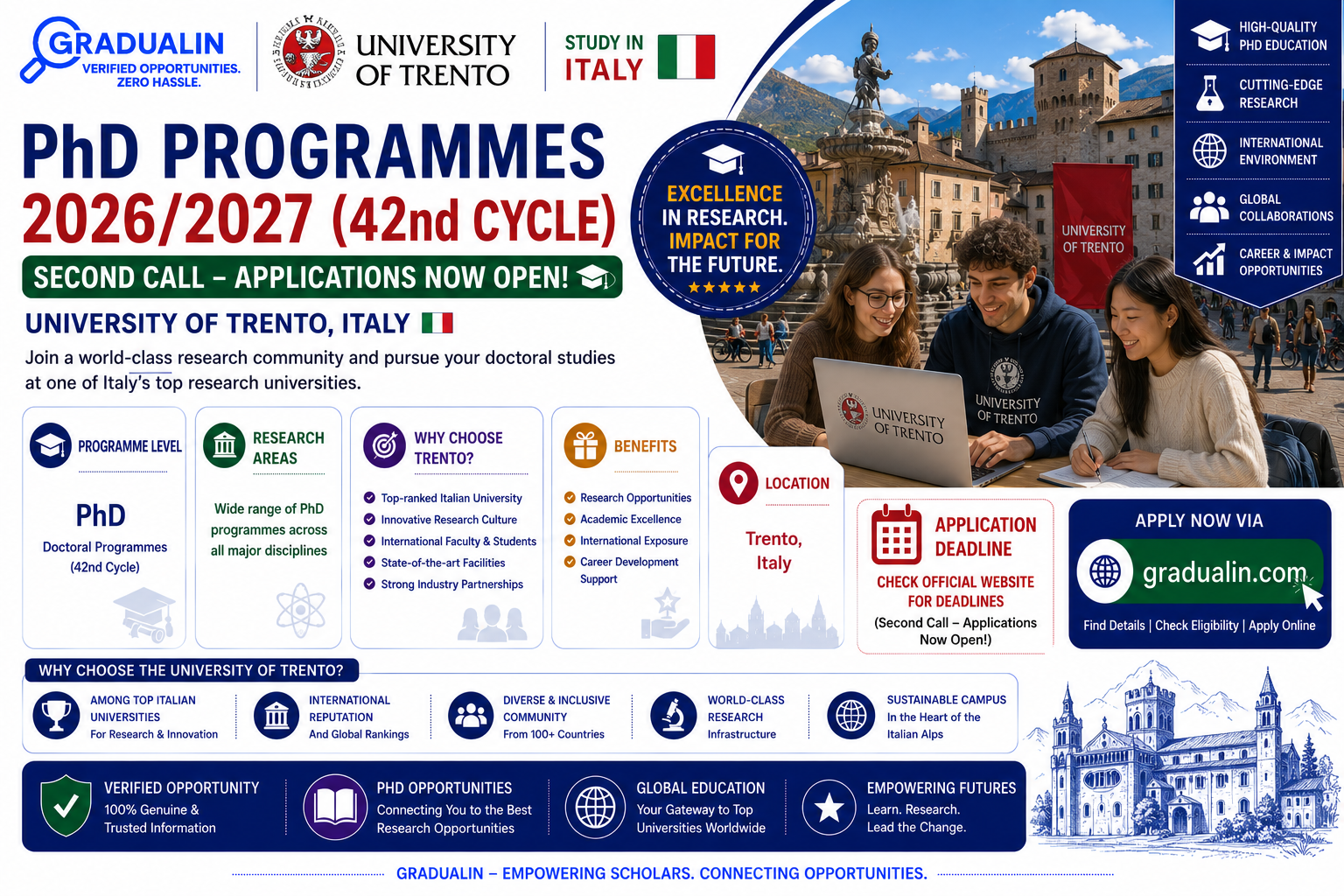
The University of Trento is one of Italy’s most research-intensive universities, and for the 42nd doctoral cycle (academic year 2026/2027) it has significantly increased its scholarship amounts — with some programmes now offering up to €25,200 gross per year, well above the national ministerial baseline. Across more than 20 doctoral programmes spanning science, engineering, law, economics, and cognitive science, international students compete on the same footing as Italian candidates for funded positions. This guide explains the funding structure, the available fields, the selection process, and the practical steps you need to take before the next call opens.
| Detail | Information |
| University | University of Trento (UniTrento) |
| Country | Italy |
| Level | PhD (Doctoral / Third Cycle) |
| Funding Type | Stipend-based scholarships (majority of positions funded) |
| Next Cycle | 43rd cycle — calls expected March–July 2027 |
| Open To | International students worldwide |
| Official Link | Apply Here |
🎓 About the University of Trento and Its Doctoral System
Founded in 1962 and consistently ranked among Italy’s top mid-sized universities, the University of Trento operates within the autonomous province of Trentino — a region with one of the highest per-capita research investment rates in Italy. This matters to doctoral candidates: UniTrento’s funding for PhD stipends consistently exceeds the national ministerial minimum, and from the 42nd cycle onward (2026/2027) the university has restructured its scholarship framework to allow individual programmes to offer substantially higher amounts.
The university currently lists 20 doctoral programmes across three broad disciplinary areas: Science and Technology, Cognitive Sciences, and Humanities. Most programmes are taught entirely in English, which is uncommon for Italian doctoral schools and makes UniTrento a strong choice specifically for non-Italian speakers.
Unlike programmes at larger Italian institutions such as the University of Bologna or Sapienza Rome — which may have dozens of doctoral schools with more fragmented funding — UniTrento’s smaller size means doctoral students typically have closer access to faculty supervisors, smaller cohorts, and a more active research community per programme. The university also participates in the ECIU University network alongside institutions like TU/e and Aalborg University, which creates genuine opportunities for international research collaboration during the doctorate.
🎓 Scholarship Amounts and Financial Benefits
This is where UniTrento genuinely stands apart from most Italian doctoral programmes.
- Standard stipend (up to 41st cycle): €18,345 gross per year — already above the national ministerial rate
- 42nd cycle onward (2026/2027): Amounts range from €18,345 to €25,200 gross per year depending on the programme. The exact figure for each programme is published in the individual call for admissions (verify on official website)
- Research period abroad: Stipend increases by +50% for the duration of any approved research period conducted outside Italy
- Annual research budget: Each PhD student receives a research activities budget equal to 10% of their annual stipend (20% for the Space Science and Technology national doctorate)
- Tuition fees: PhD students who hold a scholarship are generally exempt from standard tuition (verify this for your specific programme in the call)
- Application fee: €30, paid at the time of online application
Scholarships are paid in advance in two-month instalments, which is practical for budgeting. The first two months of each calendar year are settled by the end of January.
The research budget is worth highlighting because it appears less prominently on the official page. If your annual stipend is €20,000, you receive an additional €2,000 earmarked specifically for conference attendance, research materials, or field work — separate from the stipend itself. This is not a standard feature of all Italian PhD programmes and gives UniTrento candidates a meaningful practical advantage.
🎓 Who Should Apply — and Who Probably Shouldn’t
✅ Strong candidates:
- Applicants with a completed master’s degree (or equivalent) in a field directly matching the chosen programme
- Researchers with prior publications, conference presentations, or a strong thesis in a relevant area
- Candidates who have already identified a potential supervisor at UniTrento and made contact before applying
- Non-Italian speakers: the majority of programmes are conducted entirely in English, making this one of the most accessible Italian universities for international applicants
- Applicants from developing countries or with strong but non-elite academic backgrounds — UniTrento’s selection is merit-based and does not require candidates to come from internationally ranked universities
❌ Likely poor fit:
- Applicants whose research interest does not match any of the 20 listed programmes — UniTrento does not offer open-topic doctoral candidacies outside published calls
- Candidates expecting to combine the PhD scholarship with a research grant or other paid employment — the scholarship cannot be combined with research grants or other institutional study funding
- Those who already received a doctoral scholarship from another Italian institution — this disqualifies candidates from scholarship eligibility
- Applicants without a completed equivalent of a master’s degree at the time of enrolment
🎓 Available Programmes and Fields
UniTrento’s 20 doctoral programmes for the 42nd cycle span a wide range of disciplines. The English-taught programmes — the most accessible for international students — include:
Science and Technology (English-medium):
- Agrifood and Environmental Sciences (3 years)
- Biomolecular Sciences (3 years)
- Civil, Environmental and Mechanical Engineering (3 years)
- Human-centered Precision Medicine (3 years)
- Industrial Innovation (3 years)
- Information Engineering and Computer Science (3 years)
- Materials, Mechatronics and Systems Engineering (3 years)
- National PhD in Space Science and Technology (3 years — national programme, UniTrento is one of several partner institutions)
Cognitive Sciences (English-medium):
- Cognitive and Brain Sciences (4 years — one of few 4-year programmes in Italy)
Humanities and Social Sciences (English-medium):
- Economics and Finance (3 years)
- International Studies (3 years)
Several additional programmes are available in Italian only, including Comparative and European Legal Studies, European Cultures, and Forms of Cultural Exchange. For a full and current list, visit the official programmes page.
The Cognitive and Brain Sciences programme deserves particular attention: at 4 years with full funding, it is structured to accommodate the longer research timelines typical in neuroscience and cognitive psychology — a genuine structural advantage over 3-year programmes in the same field at many other Italian universities.
🎓 Eligibility Criteria
- A master’s degree (or equivalent second-cycle qualification) is required for enrolment. Candidates completing their degree may apply, but must provide the qualification before enrolment
- Open to Italian and international applicants worldwide — no nationality restrictions
- English language: Most English-taught programmes require demonstrated proficiency, but the requirement level and accepted certifications vary by programme. Verify the language requirement in the specific programme call — some programmes conduct English-language interviews as their assessment rather than requiring a pre-submitted certificate
- Previous doctoral scholarship at an Italian institution: disqualifies the candidate from scholarship eligibility (they may still be admitted to a non-funded position)
- Public employees on extraordinary leave who retain their economic and social security benefits are not eligible for the scholarship
- A €30 non-refundable application fee is required at submission
🎓 Required Documents
The exact document list is specified per programme in each call for admissions. Typically, doctoral applications at UniTrento require:
- Valid identity document (passport for international applicants)
- Academic transcripts (bachelor’s and master’s level)
- Proof of highest qualification awarded (or enrollment confirmation if degree is pending)
- Research proposal or statement of research interest (format varies by programme)
- Curriculum vitae / academic résumé
- Reference letters (number and format specified per programme)
- List of publications or academic work (if applicable)
- Language proficiency documentation (where required by the specific programme)
- Payment confirmation of the €30 application fee
International applicants whose qualifications were awarded outside Italy should check the evaluation of foreign qualifications guidance early — this process takes time and should not be left to the final days before submission.
🎓 Step-by-Step Application Process
- Choose your programme. Review the full list at unitn.it/en/study/courses/phd-programmes and confirm the programme aligns with your completed or near-completed master’s field.
- Read the call for admissions. Each programme publishes its own call document. This is the authoritative source for deadlines, required documents, selection criteria, and interview dates. Do not rely on general guidance alone.
- Contact a potential supervisor (optional but strategic). UniTrento faculty lists are public. Sending a concise, targeted email to a relevant faculty member before applying — mentioning your research interest and attached CV — meaningfully improves your visibility in a competitive selection.
- Register on the application portal. International applicants register as “guest” users at webapps.unitn.it/Apply. Italian applicants use SPID or CIE electronic identity.
- Complete the application form and upload documents. Follow the document checklist in the programme call exactly. Incomplete applications are typically rejected without review.
- Pay the €30 application fee. This is processed through the portal and must be completed before submission.
- Attend the selection exam. A public selection procedure must be passed. This typically includes evaluation of qualifications and an interview. Dates are published on the individual programme webpage.
- Accept the offer and enrol. Successful candidates are ranked by merit. Those awarded scholarships must confirm acceptance within the deadline stated in the results notice.
Practical tip: The single most common reason competitive candidates are ranked lower than expected is a research statement that is too broad. UniTrento selection committees are looking for applicants who have a specific research question and can connect it to the faculty and infrastructure available in Trento — not just a general interest in the field.
🎓 Important Dates
| Event | Timing |
| Calls for admissions published | Annually, March–July |
| 42nd cycle deadlines (now closed) | June–July 2026 |
| 43rd cycle calls expected | March–July 2027 |
| Selection exams | Varies by programme — see individual programme page |
| Programme start | Academic year 2026/2027 (42nd cycle) / 2027/2028 (43rd cycle) |
Bookmark this page and check back for updates — and set a calendar reminder for March 2027 if you are targeting the next cycle.
🎓 Why Apply — and Why Trento
Trento is a compact, walkable university city of around 120,000 people nestled in the Alps, 45 minutes by fast train from Verona and about 2.5 hours from Venice. The cost of living is meaningfully lower than Milan or Rome, which makes the UniTrento stipend go considerably further in practice. A doctoral student earning €18,000+ gross annually in Trento will find that rent, transport, and food costs are substantially below what the same stipend would cover in a major Italian metropolitan area.
From a career standpoint, UniTrento’s membership in the ECIU network, its volume of Horizon Europe grants, and its structured +50% abroad research increase are concrete signals that the university takes international research exposure seriously — not just as a branding exercise. Programmes in areas like Information Engineering and Computer Science, Cognitive and Brain Sciences, and Economics have placed graduates in both European research institutions and the private sector.
For international students specifically: this is one of the few Italian universities where you can complete a fully English-medium doctorate without knowing Italian, in a city where English is widely spoken at the university level.
Gradualin Editor’s Note: UniTrento’s PhD programmes are a strong option for well-prepared applicants — particularly those in STEM and cognitive science fields — but they are competitive. The scholarship rate (at least 75% of positions) is genuinely high by Italian standards, which means funded spots are real and attainable, not a theoretical possibility. Average applicants without clear research focus or supervisory contact are likely to reach interview but struggle at the ranking stage. Strong applicants — those with a specific research question, relevant master’s research, and at least one supervisor contact made before applying — are well-positioned. The 42nd cycle calls have now closed; use the time before the 43rd cycle opens to strengthen your research profile and reach out to faculty.
🎓 FAQ
These questions are based on what students most commonly search about this programme.
Can international students apply for UniTrento PhD scholarships? Yes — there are no nationality restrictions. International applicants register as guest users on the UniTrento application portal and follow the same selection process as Italian candidates. Scholarships are awarded on academic merit regardless of nationality.
How much is the PhD stipend at the University of Trento? From the 42nd cycle (2026/2027 academic year), the annual gross stipend ranges from €18,345 to €25,200 depending on the programme. The exact amount for each programme is published in the individual call for admissions. During approved research periods abroad, the stipend increases by 50%.
Do I need to know Italian to do a PhD at UniTrento? For most English-taught programmes — including Information Engineering, Biomolecular Sciences, Cognitive and Brain Sciences, Economics and Finance, and others — no Italian is required for the doctorate itself. Practical daily life in Trento is manageable in English, especially within the university environment, though some Italian will improve your experience of city life.
When do the PhD calls open each year? Calls for the University of Trento’s doctoral programmes are published annually between March and July. The 42nd cycle calls opened and closed in June–July 2026. The 43rd cycle is expected to follow the same pattern in spring 2027.
Can I hold a job or other scholarship alongside a UniTrento PhD stipend? The stipend cannot be combined with research grants, higher education and research contracts, or other institutional study grants. Short-term part-time work not in conflict with research duties may be possible, but the rules vary — verify with your doctoral programme office.
What happens if I spend time doing research abroad? UniTrento actively supports international research periods. During any approved period of research conducted abroad, the stipend increases by 50% for that duration. This is structured policy, not a case-by-case negotiation.
🎓 Official Sources
- Application portal: webapps.unitn.it/Apply
- Full programme list: unitn.it/en/study/courses/phd-programmes
- PhD scholarship details: unitn.it/en/study/fees-scholarships-accommodation/scholarships-and-awards/phd-scholarships
- Admissions guide: unitn.it/en/study/enrol/guide-admission/phd-programmes
Scientific Area Doctoral Office Via Sommarive 14 — 38123 Povo, Trento Tel: +39 0461 282194 Email: phd.office-st@unitn.it
Humanities and Cognitive Sciences Doctoral Office Via Tommaso Gar, 16/12 — 38122 Trento Tel: +39 0461 282377 Email: phd.office-cssh@unitn.it
🎓 Summary Table
| Detail | Information |
| University | University of Trento (UniTrento) |
| Country | Italy |
| Level | PhD (Doctoral / Third Cycle) |
| Duration | 3 years (most programmes); 4 years (Cognitive and Brain Sciences) |
| Funding | €18,345–€25,200 gross/year (42nd cycle onward) |
| Research Abroad Increase | +50% of stipend |
| Research Budget | 10% of annual stipend (20% for Space Science) |
| Scholarship Coverage | At least 75% of positions |
| Application Fee | €30 |
| Language | English (majority of programmes) |
| Next Call Expected | March–July 2027 |
| Open To | International students worldwide |
| Application Portal | Apply Here |
Related Opportunities — contextually placed:
For more fully funded opportunities in Italy, explore our Study in Italy 2026 — Guide for International Students and our curated list of Fully Funded PhD Scholarships in Italy 2026/2027 (coming soon — flag for new article). You may also find relevant opportunities in our Scholarships and Guidelines & Resources sections.
Readers interested in other European funded doctorate options can explore our guides on Fully Funded PhD Positions in Switzerland 2026, Fully Funded PhD Scholarships in the UK 2026, Study in Germany 2026, and Study in the Netherlands 2026.
For job and career opportunities alongside your PhD search, visit our Jobs & Internships section, and check Events & Conferences for academic events relevant to your field.
Stay updated with the latest scholarships, jobs, and opportunities at Gradualin.com — your trusted guide to studying abroad for free.
Author: Faseeh Sultan — MSIT, PhD Scholar | 7 Years in Education