
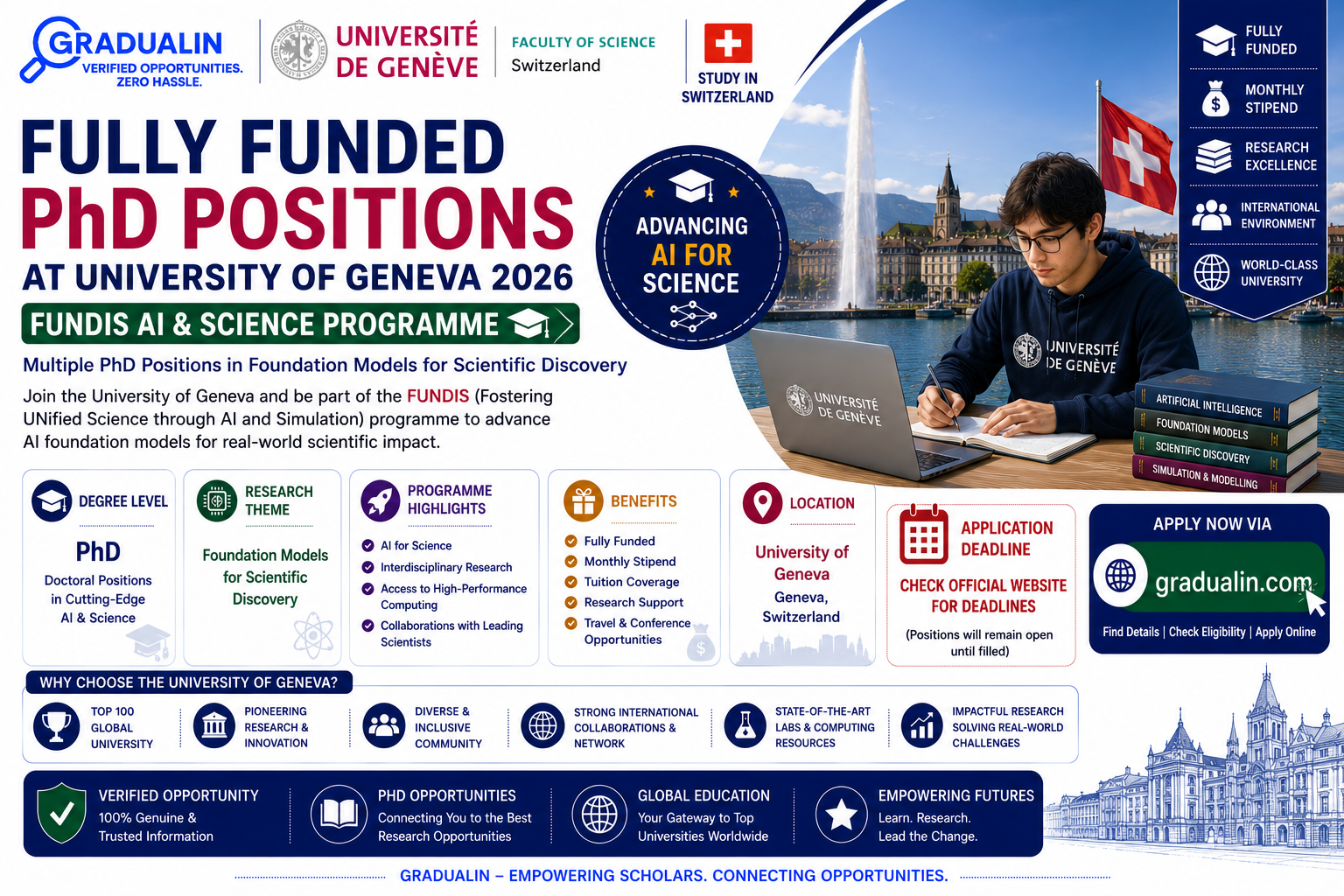
Fully Funded PhD Positions at University of Geneva 2026 — FUNDIS AI & Science Programme
The University of Geneva is hiring 9 fully funded PhD researchers for its FUNDIS project — one of Switzerland’s most ambitious interdisciplinary AI initiatives — and the deadline is just weeks away: 30 August 2026 at 23:59 CET. This is not a standard PhD advertisement. FUNDIS (Foundation Models for Scientific Discovery) is a university-wide grand project that brings together eleven principal investigators from computer science, astrophysics, particle physics, mathematics, climatology, digital humanities, and international governance under a single research umbrella.
If you have a strong quantitative background and want to work at the frontier of AI applied to real scientific problems — from analysing James Webb Space Telescope data to searching for new particles at CERN — this is worth your full attention. This guide covers what the FUNDIS project actually is (beyond the job listing), which supervisor best fits which research background, what Swiss PhD salaries look like in practice, and the one thing your application letter must do that most candidates skip entirely.
| Detail | Information |
| Institution | University of Geneva (UNIGE) |
| Country | Switzerland |
| Programme | FUNDIS — Foundation Models for Scientific Discovery |
| Level | PhD (Doctoral) |
| Number of Positions | 9 fully funded positions |
| Funding | Fully Funded — competitive Swiss PhD salary |
| Deadline | 30 August 2026, 23:59 CET |
| Open To | International applicants welcome |
| Application Portal | Apply Here |
🎓 What Is FUNDIS — and Why It Matters
FUNDIS stands for Foundation Models for Scientific Discovery, and it is not a loosely themed research cluster with a catchy acronym. It is one of the University of Geneva’s officially designated Grands Projets — a structured, multi-faculty initiative with direct institutional investment and a clear scientific mandate.
Coordinated by Professor Slava Voloshynovskiy at the Department of Computer Science, FUNDIS brings together researchers from four distinct faculties: the Faculty of Science, the Geneva School of Economics and Management, the Faculty of Humanities, and the Global Studies Institute. The core scientific objective is to build the next generation of AI foundation models — systems capable of learning from large volumes of heterogeneous data (images, time series, text) and adapting to complex scientific problems that current AI methods cannot solve cleanly.
What distinguishes FUNDIS from other AI PhD programmes in Europe is the seriousness of its application domains. These are not toy problems or benchmark datasets. FUNDIS PhDs will work with data from the James Webb Space Telescope (JWST), the Square Kilometre Array (SKA), the Euclid space mission, and the ATLAS experiment at CERN. That gives PhD candidates direct access to some of the most scientifically consequential datasets in the world — a level of real-world research infrastructure that even many well-funded German or Dutch AI groups cannot offer at the doctoral level.
Unlike the Erasmus Mundus Joint Doctorate programmes — which spread candidates across three or four institutions and often fragment research focus — FUNDIS positions are based at a single institution with a clearly identified supervisory team, which means deeper mentorship and a more coherent thesis trajectory.
🎓 Funding and What Swiss PhD Salaries Actually Mean
The posting confirms these are fully funded positions with competitive Swiss PhD salaries. The University of Geneva does not publish exact salary figures in the advertisement, but doctoral researchers at Swiss universities are employed as assistants under cantonal employment law — they are salaried employees, not stipend recipients. Based on published Swiss salary data, doctoral candidates earn between CHF 3,920 and CHF 6,690 gross per month depending on seniority and department — typically starting around CHF 4,400–4,800/month for first-year PhDs.
Geneva is an expensive city. The university’s own doctoral funding guidance notes that the basic bursary rate (CHF 1,920/month) does not cover living costs — but FUNDIS positions are not bursaries; they are full assistantship-level positions, which sit at the higher end of the range. A CHF 4,400–5,000/month salary in Geneva is liveable but not comfortable without careful budgeting. Swiss taxes, health insurance (mandatory), and Geneva’s high rental market will account for a significant share of gross income.
The practical implication: unlike many European PhD positions that require external fellowship applications to top up a partial stipend, FUNDIS candidates receive a single employment contract with the university that covers their full study period.
🎓 Research Areas — Which Position Fits You
FUNDIS operates across two primary thematic layers: core AI methods and scientific application domains. Understanding which combination maps to your background is the first step before writing a single line of your application.
Core AI Research Topics
These are the methodological areas the FUNDIS team is actively developing:
- Foundation Models and Self-Supervised Learning
- JEPA-like Architectures and World Models
- Representation Learning
- Explainable AI and Information Bottleneck Theory
- Bio-inspired AI
- Reasoning and Memory in Neural Systems
- Vision-Language Models
- Scientific Machine Learning
Scientific Application Domains
These are the real-world problems FUNDIS applies those methods to:
- Astronomy — SKA radio interferometry, JWST deep field imaging, Euclid cosmology (supervised by Profs. Schaerer, Oesch, and Paltani)
- High-Energy Physics — ATLAS experiment at CERN (supervised by Prof. Tobias Golling)
- Climate Science — climate modelling and forecasting
- Computational Art History & Digital Humanities — evolution of visual styles across centuries (supervised by Prof. Béatrice Joyeux-Prunel)
- Global Governance and Computational Diplomacy (supervised by Prof. Roland Bouffanais at the Global Studies Institute)
The full supervisory team of eleven PIs — confirmed by the UNIGE Faculty of Science newsletter — includes Slava Voloshynovskiy, François Fleuret, Roland Bouffanais, Daniel Schaerer, Pascal Oesch, Stéphane Paltani, Tobias Golling, Sebastian Engelke, Stefan Sperlich, Béatrice Joyeux-Prunel, and Stas Smirnov.
Browse Fully Funded PhD Positions in Switzerland 2026 on Gradualin for a broader picture of Swiss doctoral funding options.
🎓 Eligibility — Who Can Apply
The official posting does not publish a specific GPA cutoff, nationality restriction, or language test requirement. Based on the listing and standard University of Geneva doctoral admission requirements:
- Background: Computer Science, Artificial Intelligence, Mathematics, Physics, Astronomy, Cosmology, Statistics, Art History, Digital Humanities, Electrical Engineering, Data Science, or closely related fields
- Degree level: A Master’s degree (or equivalent) is required for PhD admission at UNIGE — applicants completing their Master’s by the expected start date may also apply (verify with the admissions office)
- Nationality: No restriction stated — international applicants are explicitly welcomed
- Language: The working language of FUNDIS is English. French is not required for research work, though it is the administrative language of Geneva. Verify language documentation requirements via the application form
- Motivation fit: Applicants must demonstrate genuine research interest in at least one FUNDIS core methodology and one scientific application domain
There is no indication of an IELTS or TOEFL requirement in the job posting. Verify any English language documentation requirement directly through the application form or by contacting the FUNDIS team.
🎓 Who Should Apply — and Who Probably Shouldn’t
✅ Strong fit if you:
- Hold or are completing a Master’s in Computer Science, Physics, Mathematics, Data Science, or a related quantitative field and want to do research-oriented AI work (not coursework)
- Have a genuine interest in applying AI to real scientific datasets — astronomy, particle physics, climate — not just benchmarking on standard computer vision or NLP tasks
- Want to be employed as a salaried researcher in Switzerland rather than holding a stipend with uncertain renewal
- Can commit to on-site work in Geneva — FUNDIS is an in-person research environment with seminars, reading groups, and interdisciplinary interactions built into the programme structure
- Come from Digital Humanities or Art History with strong computational skills and interest in image-based analysis at scale
❌ Not the right fit if you:
- Are primarily interested in applied AI or industry-facing work — this is a fundamental research programme aimed at publications in top AI and scientific journals
- Want to work on Natural Language Processing or large language model fine-tuning as a primary focus — FUNDIS is oriented toward multimodal scientific data, not text-based generative AI
- Are looking for a remote or part-time PhD — Swiss assistantship positions carry teaching and presence obligations
- Have a Bachelor’s only — a completed or near-completed Master’s is expected
🎓 Required Documents
The application is submitted through the Google Form portal. Based on the posting and standard Swiss doctoral application requirements:
- Curriculum Vitae (academic format — publications, theses, projects, not a professional résumé)
- Motivation letter — see the critical application tip below before writing this
- Transcripts from all prior degree programmes (Bachelor’s and Master’s)
- Contact details for at least two academic referees who can be contacted directly
- Research statement or writing sample (verify whether required in the form)
- Copy of Master’s degree certificate (or expected completion letter)
The Google Form is a preliminary screening tool — candidates selected at the first stage will likely be invited for interviews before formal UNIGE doctoral admission is initiated. Verify the exact document checklist in the form itself.
🎓 Step-by-Step Application Process
- Identify your supervisor match. Before touching the Google Form, read the FUNDIS team page and map your research interests to one or two of the eleven PIs listed. A motivation letter that does not name a specific supervisor — or names the wrong one for your stated research area — signals a generic application and is screened out at the first pass.
- Write a supervisor-specific motivation letter. This is the single most important document in your application. Name the PI you want to work with, describe the specific FUNDIS research topic that excites you, and explain — in concrete terms — how your Master’s thesis or existing project connects to that work. A 500-word letter that does this specifically will outperform a 1,200-word letter that describes your general enthusiasm for AI.
- Prepare your CV in academic format. List any publications (including preprints and workshop papers), your Master’s thesis title and abstract, any research internships, and technical skills directly relevant to FUNDIS themes. For physics or astronomy applicants, include your experience with relevant datasets (FITS files, radio interferometry, high-energy physics pipelines) — this signals genuine domain readiness.
- Contact referees before submitting. Swiss institutions typically contact referees promptly after application. Inform your referees before you submit, share the FUNDIS job description, and ask them to respond quickly — delayed reference letters have disqualified otherwise competitive applications.
- Submit via the Google Form at this link before 30 August 2026 at 23:59 CET. This is a hard deadline under Central European Time — account for your time zone accordingly.
- Prepare for a technical interview. FUNDIS positions at this level will almost certainly include a technical interview covering both AI methods and the relevant domain science. Review the basics of self-supervised learning, representation learning, and the specific scientific instrumentation (JWST, SKA, ATLAS) relevant to your target research area before any interview invitation.
🎓 Important Dates
| Milestone | Date |
| Application Deadline | 30 August 2026, 23:59 CET |
| Posting Published | 23 July 2026 |
| Expected Start | Not stated — verify with FUNDIS team (verify on official website) |
Bookmark this page and check back for updates. The deadline is firm — no extensions have been announced as of the publication of this article.
🎓 Why Geneva — and Why This Programme
The University of Geneva is one of Europe’s oldest and most internationally connected research universities, consistently ranked among the top 100 globally. Geneva itself is the home of CERN, WHO, WTO, and dozens of international research institutions — which means PhD graduates from FUNDIS step into a city whose professional ecosystem is almost entirely built around science, international organisations, and policy. That geographic and institutional context is a genuine career accelerator that most other European PhD locations cannot replicate.
FUNDIS is also structurally unusual in that it is explicitly interfaculty. Most AI research groups in Europe are siloed within a single computer science department. FUNDIS embeds AI researchers directly alongside astrophysicists, particle physicists, climate scientists, and digital humanists — which means co-authored publications across disciplines, access to non-standard datasets, and a research portfolio that stands out clearly in both academic and industry hiring.
For doctoral candidates in AI, the ability to publish in astrophysics journals (NeurIPS + ApJ, for example) while working on the same model architecture is a career distinction that compound-interest over the length of a research career.
Gradualin Editor’s Note: FUNDIS is a genuinely exceptional opportunity for the right candidate — but it is highly selective and research-focused. The eleven-PI supervisory structure means positions are genuinely competitive, with candidates expected to demonstrate both strong technical foundations and a credible connection to a specific scientific domain. For applicants with an AI/ML Master’s who also have real experience in physics, astronomy, or climate data, this is a top-tier European PhD opportunity. For candidates whose Master’s is entirely theoretical or whose domain science exposure is minimal, the competition will be steep. Apply early within the window — the Google Form deadline is hard.
The Fully Funded PhD Scholarships in the UK 2026 and Fully Funded PhD Positions in Switzerland 2026 pages on Gradualin are worth reviewing alongside this for comparable European doctoral opportunities. You can also browse all current Scholarships to build a parallel application pipeline — never apply to only one programme.
🎓 Frequently Asked Questions
These questions are based on what students most commonly search about PhD positions in Switzerland and AI research programmes.
Is a Master’s degree required, or can I apply with a strong Bachelor’s? The University of Geneva requires doctoral candidates to hold a Master’s degree or equivalent for admission to its PhD programmes. The FUNDIS posting does not create an exception to this. Candidates completing their Master’s by the planned start date may be able to apply provisionally — verify this with the FUNDIS admissions contact before applying.
Does this position require French language skills? The posting does not mention French as a requirement. FUNDIS is an English-language research environment. Geneva is a French-speaking city and some administrative processes at UNIGE are in French, but day-to-day research, meetings, and publications will be in English. Basic French is helpful for daily life but is not listed as a research requirement.
Can I apply to more than one FUNDIS research topic? The application form does not explicitly restrict this. However, applying to multiple topics without distinguishing your actual research focus reads as unfocused to review committees. If you have genuine interest in two supervisors whose work is methodologically connected (e.g., a self-supervised learning expert and an astronomy supervisor), you can address both in your motivation letter — but lead with your primary interest and supervisor.
Is there a teaching requirement attached to these PhD positions? Swiss assistantship positions at cantonal universities typically include a teaching component — usually around 50% research, with the remaining time split between teaching assistance, seminars, and administrative duties. This is standard for Swiss doctoral employment. Verify the exact allocation with the FUNDIS team.
What is the expected duration of the PhD? PhD programmes at Swiss universities typically run four years. The FUNDIS posting does not specify a duration — verify at info@fundis.unige.ch or through the application form.
Are there any citizenship or visa restrictions for non-EU applicants? The posting welcomes international applicants without restriction. Switzerland has robust international PhD recruitment. Non-EU applicants will need a Swiss residence permit (type B for employment), which UNIGE HR departments routinely assist with. Confirm the process with the HR office after receiving an offer.
🎓 Official Sources and Contact
| Resource | Link / Contact |
| Official Job Listing | Academic Positions — FUNDIS PhD |
| Application Form | Google Form Portal |
| University of Geneva | www.unige.ch |
| FUNDIS Newsletter (UNIGE) | Faculty of Science — FUNDIS |
| UNIGE Doctoral Funding | doctorat.unige.ch |
🎓 Summary
| Detail | Information |
| Institution | University of Geneva (UNIGE) |
| Country | Switzerland |
| Programme | FUNDIS — Foundation Models for Scientific Discovery |
| Level | PhD |
| Positions | 9 fully funded |
| Funding | Full salary — competitive Swiss assistantship |
| Deadline | 30 August 2026, 23:59 CET |
| Open To | International applicants |
| Application | Apply Here |
Related opportunities on Gradualin:
- Fully Funded PhD Positions in Switzerland 2026
- Fully Funded PhD Scholarships in the UK 2026
- Study in Germany 2026 — Guide for International Students
- Study in Netherlands 2026 — Guide for International Students
- Finland Scholarships 2026 — Tuition Waivers for International Students
Stay updated with the latest scholarships, jobs, and opportunities at Gradualin.com — your trusted guide to studying abroad for free.
Author: Faseeh Sultan — MSIT, PhD Scholar | 7 Years in Education