
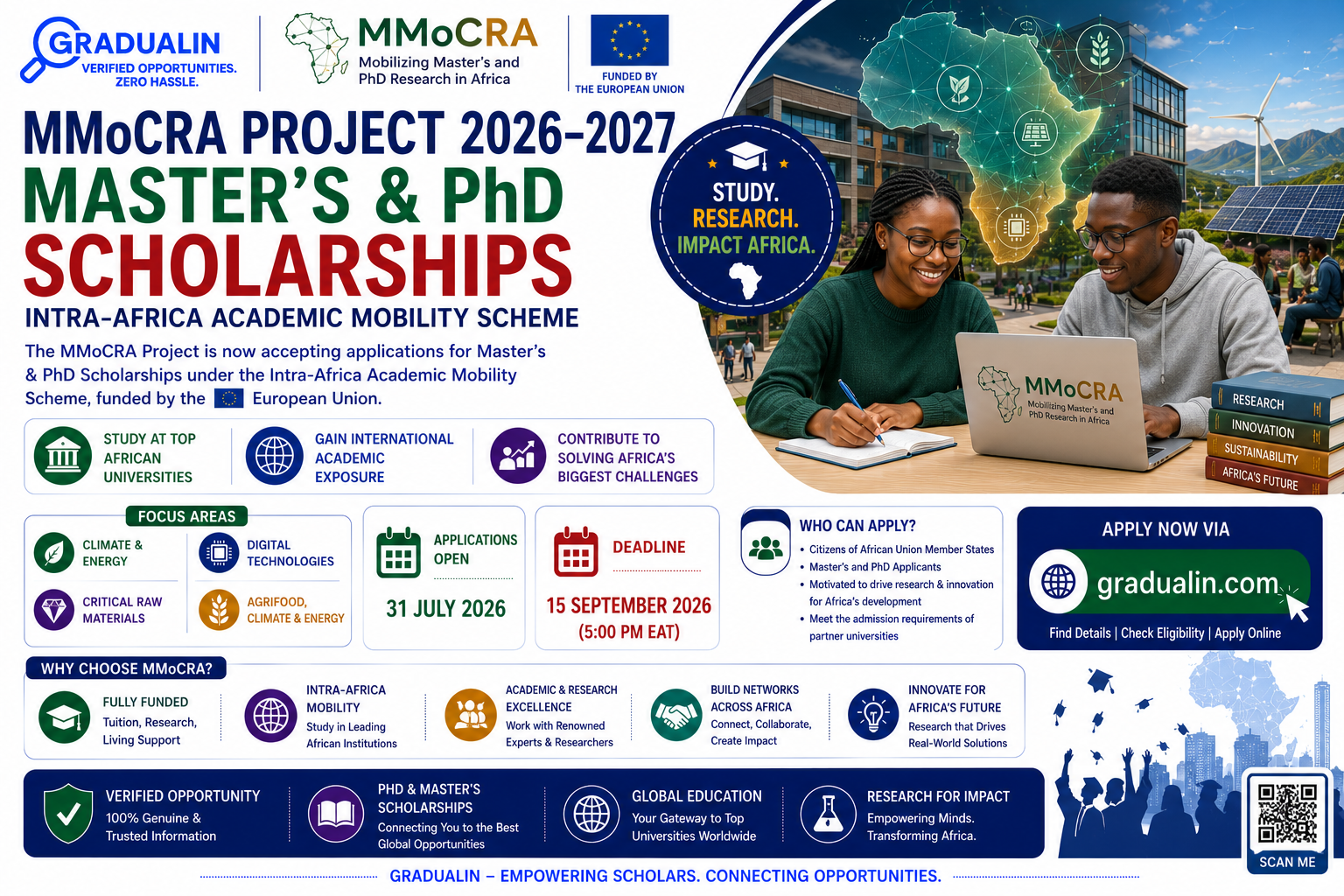
Fully Funded MMoCRA Scholarship 2026 — Africa Climate Research
The European Union has opened 95 mobility scholarships through the MMoCRA programme — and the application deadline is 15 September 2026. This is one of the few fully funded intra-African scholarship programmes that does not require you to leave the continent entirely: you move between African partner universities, supported end-to-end by EU funding, to pursue postgraduate research in climate resilience, agrifood systems, and clean energy.
If you are an African student, early-career researcher, or even a university staff member working in these fields, the MMoCRA Scholarship is worth understanding carefully. This guide covers everything not on the official website — who realistically gets selected, what the funding actually covers, how the five African partner institutions differ from one another, and the one document error that disqualifies more applications than any other.
| Detail | Information |
| Programme | MMoCRA (Multidisciplinary Mobility for a Climate Resilient Africa) |
| Funder | European Union (Intra-Africa Academic Mobility Scheme) |
| Country | Multi-country (Uganda, Kenya, Namibia, South Africa, Netherlands) |
| Degree/Level | Master’s (up to 24 months), Doctoral (up to 36 months), Traineeships (3–6 months), Staff Mobility (1–3 months) |
| Funding Type | Fully Funded — tuition, living stipend, travel costs |
| Total Scholarships | 95 (44 Master’s + 12 Doctoral + 20 Trainees + 19 Staff) |
| Deadline | 15 September 2026 |
| Open To | African nationals residing in Africa |
| Official Link | Apply Here |
🎓 About the MMoCRA Programme
MMoCRA — short for Multidisciplinary Mobility for a Climate Resilient Africa — is funded through the EU’s Intra-Africa Academic Mobility Scheme, a 2022–2027 initiative designed to build research capacity within the African continent itself. Rather than sending students to Europe, the scheme moves students and researchers between African institutions with full EU financial backing.
The programme is coordinated across six partner universities spanning East Africa, Southern Africa, and the Netherlands. Its research mandate focuses on two urgent global challenges: climate and energy (green power, biodiversity, water and air quality) and agrifood systems (climate-smart farming, food security, land degradation).
What sets MMoCRA apart from more generic African scholarship programmes is its scale and disciplinary integration. Unlike the TESIECS Intra-Africa Mobility Scholarship (hosted by the University of Johannesburg, focused primarily on environmental change solutions), MMoCRA brings together five African universities under a single consortium with defined thematic mandates per institution — so each campus you apply to has a distinct research specialisation rather than overlapping mandates. That specificity makes it easier to align your research proposal to the right host institution, which most successful applicants treat as the single most important factor in their application.
The programme directly contributes to the African Union’s Agenda 2063, UN SDGs 4, 5, 11, 13, and 17, and UNESCO’s Education for Sustainable Development framework — making MMoCRA outputs relevant not just to academic careers but to policy and development sector employment.
🎓 Benefits and Funding
The MMoCRA scholarship package covers all major cost categories. Based on confirmed information from the programme and comparable Intra-Africa Academic Mobility Scheme awards:
- Full tuition fees at the host partner institution
- Monthly living stipend — comparable Intra-Africa schemes under the same EU framework confirm €1,230/month for doctoral scholars and €890/month for Master’s students (verify exact MMoCRA figures on the official website — the programme website does not publish specific amounts)
- Travel allowance — return travel costs to and from the host institution are covered
- Settling/visa costs — typically bundled into the travel grant under this EU scheme
- Networking access — participants join a multi-institution African research network with connections to the University of Twente in the Netherlands
Staff mobility participants receive a similar package structure for short-term visits of 1–3 months focused on teaching collaboration and institutional capacity-building.
🎓 Eligibility Criteria
The MMoCRA programme is exclusively designed for African applicants. Based on the official programme site and confirmed Intra-Africa Academic Mobility Scheme requirements:
- Nationality: Must be a citizen of an African country currently residing in Africa
- Cross-border mobility: You must apply to study at a partner institution in a different country from your own — this is a fundamental requirement of the Intra-Africa scheme; nationals cannot study at their home country’s partner institution
- Academic level: Must meet the minimum admission requirements for Master’s or Doctoral programmes at the chosen host university
- Research alignment: Your proposed field of study must fall within MMoCRA’s two thematic areas — Climate & Energy or Agrifood Systems
- Previous EU scholarship: Applicants who have already benefited from a scholarship under any other Intra-Africa Academic Mobility Scheme 2022–2027 project are not eligible to apply again
- Dual-funding exclusion: Cannot hold another active EU-funded scholarship covering the same mobility period
- English language: The MMoCRA official website does not publish a specific English test requirement. Based on parallel Intra-Africa programmes (MOTION, INTERACT-Africa), applicants from non-English-speaking countries are typically required to demonstrate B2-level English proficiency when applying to English-medium institutions. Verify this requirement directly at info@mmocra.com before submitting your application.
- Provisional admission: Most Intra-Africa Mobility Scheme programmes require applicants to first obtain a provisional admission letter from the host institution before the mobility scholarship application is processed — confirm whether this applies to MMoCRA
🎓 Who Should Apply — and Who Probably Shouldn’t
✅ Strong fit if you:
- Hold African nationality and currently reside in an African country
- Are working in climate science, renewable energy, agrifood research, environmental management, or related STEM fields
- Want to do postgraduate research at an internationally connected African institution without leaving the continent
- Can demonstrate a clear research focus that maps to one of MMoCRA’s five thematic sub-areas
- Are a university lecturer, supervisor, or administrative staff member interested in short-term teaching collaboration at a partner institution
❌ Not the right programme if you:
- Are looking to study in Europe — this is an intra-Africa mobility scheme; the Netherlands’ University of Twente is a partner but is included to support consortium governance, not as a direct study destination for scholarship holders (verify on official website)
- Are currently enrolled at a home institution that is itself one of the six MMoCRA partner universities and want to stay there — cross-border mobility is non-negotiable
- Are studying a field outside climate, energy, or agrifood systems — the thematic mandate is strict
- Have already received a scholarship under any other 2022–2027 Intra-Africa Academic Mobility Scheme project
🎓 Partner Institutions and Research Focus Areas
The six MMoCRA partner institutions each carry a distinct research responsibility. Understanding which campus does what is essential before you apply — a misaligned application to the wrong institution is a common and avoidable error.
Busitema University (Uganda) — leads on agrifood systems, specifically cocoa and coffee value chains and sustainable critical raw materials. If your research touches on smallholder crop systems or agricultural supply chains, Busitema is your primary target.
Kyambogo University (Uganda) — focuses on crop production for climate resilience, particularly sustainable yields under changing climate conditions. Strong fit for agriculture, botany, and environmental science candidates.
Strathmore University (Kenya) — leads on green energy production and distribution, including renewable energy systems and clean energy access. Engineering, energy policy, and technology candidates should target Strathmore.
University of Cape Town (South Africa) — covers environmental sustainability, water and air pollution management. UCT is one of Africa’s highest-ranked universities and offers the strongest research infrastructure of the African partners — competition for placements here is likely the most intense.
Namibia University of Science and Technology (Namibia) — focused on biodiversity conservation and sustainable resource management.
University of Twente (Netherlands) — consortium partner. Role in direct student mobility placements should be verified with the programme office.
Explore Jobs & Internships in research and sustainability on Gradualin if you are building your CV while preparing an application.
🎓 Required Documents
The MMoCRA application portal requires account registration before submitting documents. Based on the programme structure and standard Intra-Africa Mobility Scheme requirements:
- Valid passport (confirming African nationality)
- Certified copies of academic transcripts and degree certificates
- Curriculum Vitae (academic/research format)
- Motivational letter — should address your specific research area within MMoCRA’s thematic mandate (not a generic statement of purpose)
- Research concept note — for doctoral applicants, typically one page outlining your proposed research question, methodology, and expected contribution
- Two academic reference/recommendation letters (at least one from a current or recent academic supervisor)
- Proof of current residency in Africa
- Provisional admission letter from the host partner institution (verify whether required before or after scholarship selection)
- Declaration of non-duplication — confirming you have not received a prior Intra-Africa Mobility Scheme scholarship
Important: Check the application portal at www.mmocra.com/apply-now for the full and current document checklist after creating your account — additional institution-specific requirements may apply.
🎓 Step-by-Step Application Process
- Identify your host institution. Match your research area to one of the five African partner universities listed above. This is the most consequential decision in your entire application — do it before writing a single word of your motivation letter.
- Contact the host institution first. For doctoral applicants especially, reaching out to a potential supervisor at your target institution before applying significantly increases your chances. A supervisor who knows your name and research interest will advocate for your placement during the selection process.
- Create an account on the MMoCRA portal. Go to www.mmocra.com/apply-now and register with your email. The portal is hosted on the official website and manages all application submissions.
- Prepare your motivation letter with institution-specific language. Generic motivation letters that describe your field broadly without referencing the specific thematic mandate of your target institution are the most common rejection trigger. Name the research cluster, cite the lead institution’s focus area, and explain why that specific environment advances your work.
- Prepare your research concept note (doctoral applicants). Keep it to one page. Lead with your research question, follow with your methodology approach, and close with the expected impact in the context of African climate resilience. Faculty reviewers spend less than three minutes on concept notes that do not lead with a clear research question.
- Gather reference letters early. Academic referees at African universities often take two to three weeks to respond to requests. Contact them at least six weeks before the 15 September 2026 deadline.
- Submit via the portal. Complete all fields, upload documents, and submit before the deadline. No late submissions are accommodated under EU-funded schemes.
🎓 Important Dates
| Milestone | Date |
| Application Deadline | 15 September 2026 |
| Kick-off Meeting (Programme) | 14–15 April 2026 (past) |
| Cluster Meeting | 16–17 April 2026 (past) |
Bookmark this page and check back for updates. The programme website is actively maintained — any extension or additional intake will be announced at www.mmocra.com/news.
🎓 Why Apply — and Why This Programme Makes Sense
Climate resilience is one of the fastest-growing sectors in both African government policy and international development funding. Completing a Master’s or PhD within a programme that carries direct EU backing and AU Agenda 2063 alignment positions you not just for academic careers but for roles in regional policy bodies, multilateral development organisations, and climate-focused NGOs.
The cross-border mobility component is itself a professional credential. African employers and international development organisations increasingly recognise the value of researchers who have worked across different continental contexts — East Africa to Southern Africa mobility, in particular, opens networks that stay active long after the scholarship ends.
The University of Cape Town, one of Africa’s top research universities and a regular feature in global QS rankings, is among the partner institutions. Completing a doctoral programme there under an EU-backed scholarship is a CV distinction that outlasts the funding.
Gradualin Editor’s Note: MMoCRA is a genuinely strong opportunity for focused applicants — but it is not a beginner scholarship. The cross-institutional research mandate, the requirement to align your work to specific thematic areas, and the expectation of a credible research concept note (for doctoral applicants) mean that applicants without a clear research identity will struggle to compete. For strong applicants with a defined climate, energy, or agrifood research focus, this is one of the best intra-African mobility opportunities currently open. For applicants still exploring their field, explore our Guidelines & Resources section first and build that focus before applying.
Browse the full list of Scholarships on Gradualin for additional options to build your portfolio while preparing.
🎓 Frequently Asked Questions
These questions are based on what students most commonly search about this programme.
Can I apply to MMoCRA if I am not in a science or engineering field? The programme’s thematic mandate is explicitly climate and energy or agrifood systems, both of which are multidisciplinary. Social scientists, economists, policy researchers, and even legal scholars working on climate governance or food policy have applied successfully to comparable Intra-Africa Mobility Scheme programmes. However, your research must connect directly to one of MMoCRA’s two thematic clusters — a general humanities or business application without that connection will not advance.
Do I need to secure admission at the host university before applying for the MMoCRA scholarship? The MMoCRA website does not state this requirement explicitly. However, the Intra-Africa Academic Mobility Scheme framework — which governs this programme — commonly requires applicants to hold a provisional admission letter from the host institution before or concurrently with the scholarship application. Contact info@mmocra.com directly to confirm the current requirement before submitting.
Is IELTS or another English test required? The MMoCRA website does not publish a specific English-test policy. Parallel programmes under the same EU scheme require B2-level English for applicants from non-English-speaking countries applying to English-medium institutions. Confirm this directly with the programme office before applying. Do not assume it is waived.
Can applicants from North Africa (Morocco, Egypt, Tunisia) apply? The programme covers East & Central Africa, the Indian Ocean Region, and Southern Africa. North African applicants should confirm their eligibility with the programme office at info@mmocra.com — the official eligibility language states “African nationals” broadly, but the regional focus of the partner institutions may affect placement availability.
What happens if I am accepted but cannot travel? EU-funded mobility scholarships are mobility-first programmes — the scholarship is specifically for the cross-border study period. If you cannot complete the mobility, the scholarship is forfeited. There are no remote or hybrid participation options.
Is this scholarship renewable or can I apply for a second year? The scholarship covers the full programme duration up to the stated maximum — 24 months for Master’s, 36 months for Doctoral — if admitted for the full period. It is not a year-by-year renewal; the award is made for the programme duration at selection. You cannot apply for a second MMoCRA scholarship if you have already been a beneficiary.
🎓 Official Sources and Contact
| Resource | Link |
| Official Website | www.mmocra.com |
| Scholarships Page | www.mmocra.com/scholarships |
| Application Portal | www.mmocra.com/apply-now |
| Mobility & Themes | www.mmocra.com/mobility |
| Partner Universities | www.mmocra.com/partners |
| info@mmocra.com | |
| EU Scheme Page | Intra-Africa Academic Mobility Scheme |
🎓 Summary
| Detail | Information |
| Programme | MMoCRA (Multidisciplinary Mobility for a Climate Resilient Africa) |
| Funder | European Union — Intra-Africa Academic Mobility Scheme |
| Country | Multi-country Africa (Uganda, Kenya, Namibia, South Africa) |
| Degree/Level | Master’s (24 months), Doctoral (36 months), Traineeship (3–6 months), Staff (1–3 months) |
| Funding Type | Fully Funded — tuition, stipend, travel |
| Total Scholarships | 95 |
| Deadline | 15 September 2026 |
| Open To | African nationals residing in Africa |
| Official Link | Apply Here |
Also explore these related opportunities on Gradualin:
- Top 10 Fully Funded Scholarships in Asia 2027
- Top Fully Funded Scholarships in Saudi Arabia 2026
- Fully Funded PhD Positions in Switzerland 2026
- Fully Funded Scholarships in Australia 2026
- Study in Netherlands 2026 — Guide for International Students
Stay updated with the latest scholarships, jobs, and opportunities at Gradualin.com — your trusted guide to studying abroad for free.
Author: Faseeh Sultan — MSIT, PhD Scholar | 7 Years in Education