
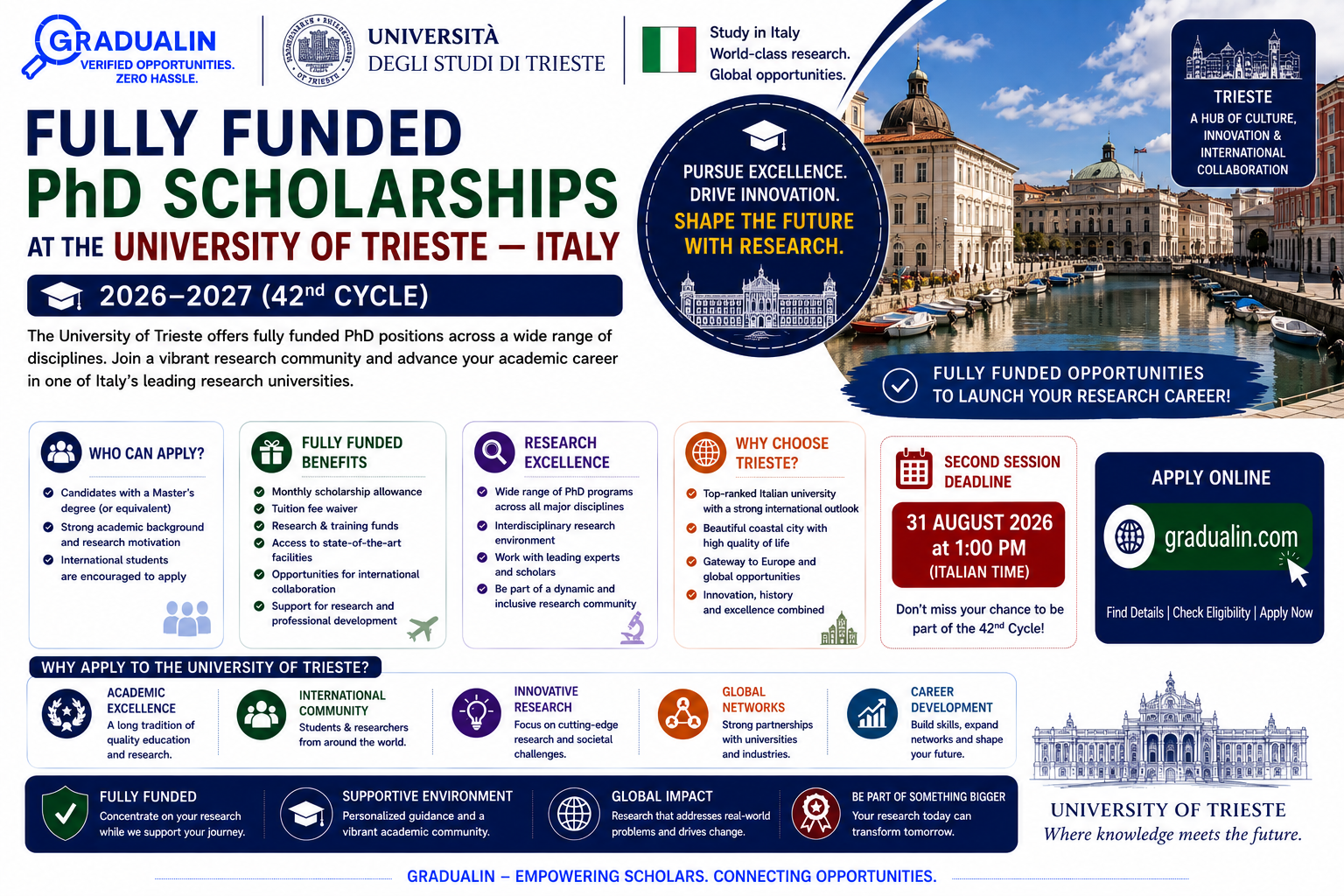
Fully Funded PhD Scholarships at the University of Trieste — Italy 2026–2027 (42nd Cycle)
One of Italy’s most research-active universities has just reopened its doctoral application window for 2026–2027, and the timing matters: the second session deadline is 31 August 2026 at 1:00 PM Italian time. The University of Trieste is offering 15 fully funded PhD programmes across science, engineering, medicine, AI, law, and humanities — all carrying a €16,243 annual stipend, full tuition coverage, and the possibility of a 50% stipend increase for research conducted abroad.
This is Italy’s structured doctoral system at its most accessible: a single national call, a competitive merit-based selection, and positions open to both domestic and international applicants. If you have missed the first session (May 2026), the second session is your last entry point for the 2026–2027 cycle.
| Detail | Information |
| University | University of Trieste (Università degli Studi di Trieste) |
| Country | Italy |
| Programme | PhD Scholarships — 42nd Cycle |
| Number of Programmes | 15 doctoral programmes |
| Funding Type | Fully Funded — Stipend + Tuition Coverage |
| Annual Stipend | €16,243 gross (subject to national insurance deductions) |
| Duration | 3 years (36 months), renewed annually |
| Second Session Deadline | 31 August 2026 at 1:00 PM (Italian time) |
| Open To | Italian and international applicants |
| Official Link | Apply Here |
🎓 About the University of Trieste and This Call
The University of Trieste — known locally as UniTS — sits in the northeastern corner of Italy, at the crossroads of Central Europe and the Mediterranean. It is a compact, research-focused university with roughly 16,000 students and a reputation that punches considerably above its size, particularly in physics, marine science, nanotechnology, and life sciences.
What makes Trieste unusual as a host city is its scientific density. The city is home to AREA Science Park — one of the largest science and technology parks in Europe — as well as international research institutions including the Abdus Salam International Centre for Theoretical Physics (ICTP), the International School for Advanced Studies (SISSA), and the Elettra Synchrotron facility. PhD students at UniTS often collaborate with these institutions, which means the research environment extends well beyond the university campus itself.
Compared to other Italian universities offering funded PhDs — such as the University of Bologna’s doctoral programmes or those at Sapienza Rome — Trieste’s call is notable for its breadth across disciplines and its explicit inclusion of ESF+ (European Social Fund Plus) funded positions, which carry specific conditions around skills development and regional industry collaboration. Unlike purely merit-funded positions, ESF+ slots are linked to digital competency and labour market integration objectives, which can be an advantage for candidates whose research intersects with applied or industry-relevant work.
The 42nd cycle covers the 2026–2027 academic year and is running a second application session specifically for positions that remain unfilled or have been added since the first session closed in May 2026.
🎓 Benefits and Funding
- Annual gross stipend: €16,243 — paid monthly for the full 36-month duration, renewed annually on satisfactory academic progress
- Stipend increase of up to 50% for research periods conducted abroad — making international research stays genuinely financially viable
- Additional research budget of at least 10% of the standard scholarship value to cover research-specific expenses (conference travel, materials, field work — verify specifics with your programme)
- Full tuition fee exemption for the entire duration of the programme
- Social security coverage included
- ESF+ funded positions available in selected programmes — these carry additional conditions but may come with stronger industry and regional institution links (verify on official website)
On the question of value: €16,243 gross per year is Italy’s standard national doctoral stipend rate. After national insurance deductions, the net figure is lower — and Trieste, while significantly cheaper to live in than Milan or Rome, is not inexpensive by Italian standards. Students should budget carefully. The abroad research increase (up to 50%) is meaningful for those planning international research visits, and the research expense budget provides genuine flexibility for conference attendance and fieldwork. This is a funded PhD, not a lucrative one — the value lies in the research environment and the credential, not the stipend alone.
🎓 Eligibility Criteria
- Degree requirement: A second-level Italian qualification (Laurea Magistrale or Laurea Specialistica), or an equivalent foreign master’s degree, or any academic qualification that grants access to doctoral study in the country where it was awarded
- Open to: Both Italian and international applicants — nationality is not a barrier
- Full-time commitment: Candidates must be available to commit exclusively and full-time to doctoral research for the entire three-year programme
- No active employment: Italian doctoral regulations generally prohibit concurrent full-time employment — confirm the specific rules for your programme
- English language: Not uniformly specified across all 15 programmes — check programme-specific annexes; international applicants should confirm requirements directly with the relevant department (verify on official website)
- Additional programme-specific requirements: Each of the 15 doctoral programmes has its own eligibility criteria detailed in the official call annexes — review these before applying
🎓 Who Should Apply — and Who Probably Shouldn’t
✅ Strong fit if you:
- Hold a master’s degree in a field matching one of the 15 available programmes
- Have a clear research interest within the listed disciplines — not just a general desire to do a PhD in Italy
- Are prepared to commit full-time and exclusively to research for three years
- Are genuinely interested in living and working in a mid-sized European city with an exceptional scientific ecosystem
- Have research experience — publications, conference papers, or substantive thesis work — that can anchor your application
❌ Poor fit if you:
- Are looking for a PhD with flexible topic choice across any field — these programmes have defined research scopes
- Need to maintain full-time employment alongside your studies — Italian doctoral programmes are full-time and exclusive by regulation
- Are not prepared to engage with Italian administrative processes, which can be slower and more paper-heavy than UK or US equivalents
- Are expecting a stipend comparable to northern European or Swiss PhD positions — at €16,243 gross, this sits at the lower end of European doctoral funding
🎓 The 15 Available PhD Programmes
Technology, Science, and Engineering
- Applied Data Science and Artificial Intelligence — one of the highest-demand programmes in the call; covers machine learning, data engineering, and AI applications
- Physics — benefits from proximity to ICTP and the Elettra Synchrotron
- Nanotechnology — strong links to AREA Science Park and applied materials research
- Chemistry
- Civil-Environmental Engineering and Architecture
- Industrial and Information Engineering
- Earth Science, Fluid-Dynamics and Mathematics — Interactions and Methods
- Circular Economy — ESF+ linked; strong applied and industry-facing research agenda
Life and Health Sciences
- Molecular Biomedicine
- Neural and Cognitive Sciences
- Personalized Medicine and Innovative Therapies
- Biodiversity, Evolution and Adaptation
Social Sciences and Humanities
- Advanced Interdisciplinary Legal Studies
- Philosophy, History and Political Studies
- Transcultural and Transmedia Studies: Literature, Linguistics, Interpreting and Translation
Each programme has its own dedicated website with programme-specific requirements, available positions, and selection schedules. Visit the programme page before applying — do not rely solely on the general call page.
For more funded PhD opportunities in Italy, see our Study in Italy 2026 — Guide for International Students.
🎓 Required Documents
Document requirements vary by programme, but the general application typically requires:
- Academic transcripts — for all degrees held
- Degree certificate(s) — with certified translation into Italian or English where required
- Curriculum Vitae (CV) — research-focused; lead with publications, thesis work, and relevant project experience
- Motivation letter or statement of research interest — clearly connecting your background to the chosen programme’s research scope
- Research proposal — required by some programmes, not all; check your programme’s annex
- Reference letters — typically two academic referees; confirm number and format per programme
- English or Italian language proficiency documents — where required by the programme
- Passport or national ID — for identity verification
Flag: Programmes in the Social Sciences and Humanities may require Italian-language materials. Confirm language requirements with the specific department before beginning your application.
🎓 Step-by-Step Application Process
- Identify your programme — visit the PhD Programmes page and select the doctoral programme that matches your research background. Read its dedicated programme website carefully — eligibility, positions available, and required documents differ between programmes.
- Read the official call — the formal call document is published on the UniTS Notice Board. Download the call and its annexes for your chosen programme. These contain the binding rules.
- Prepare your documents — compile transcripts, degree certificates, CV, and any required research proposal or reference letters. For international applicants, allow extra time for certified translations.
- Register and apply online — submit through the University of Trieste online admissions portal. Create an account, complete the application form, and upload all required documents before the deadline.
- Attend selection — shortlisted candidates will be invited for academic evaluation, which may include a research proposal assessment and an interview (conducted in person or via videoconference for international applicants).
- Check the ranking list — successful candidates are ranked by merit. Scholarship funding is assigned in merit order, so your position on the ranking determines whether you receive a funded or unfunded position.
Practical tip: The second session is specifically for positions remaining open after the first session. This means competition may be slightly lower than in May — but it also means some programmes may have fewer slots available than at first session. Check the second-session annexes on the notice board to confirm how many positions are available in your chosen programme before investing application effort.
🎓 Important Dates
| Event | Date |
| First Session Deadline (closed) | 25 May 2026 at 1:00 PM Italian time |
| Second Session Deadline | 31 August 2026 at 1:00 PM Italian time |
| Academic Year Start | 2026–2027 |
The 1:00 PM Italian time cutoff is strict — the portal closes at that time. Submit at least 24–48 hours early to avoid technical delays. Bookmark this page and check back for any updates.
🎓 Why Apply — Why Trieste
Trieste is not Florence or Rome. It does not sell itself on tourism or lifestyle prestige. What it offers instead is something rarer for a PhD candidate: density of serious science in a manageable, affordable city.
The presence of ICTP, SISSA, Elettra, and AREA Science Park within a few kilometres of the university creates informal collaboration networks that most PhD candidates at larger, busier universities simply do not have access to. Physics and nanotechnology students in particular benefit from shared infrastructure that would be financially out of reach at a standalone institution.
Beyond the science: Trieste sits at the border of Slovenia and Croatia, is a short train ride from Venice and Ljubljana, and has a Mediterranean climate with Adriatic coastline. The cost of living is meaningfully lower than Milan, Turin, or Bologna — making the €16,243 stipend stretch considerably further than it would in Italy’s larger cities.
A funded PhD from an Italian public university also opens doors across the European research system. Italy is a full participant in Horizon Europe, Marie Skłodowska-Curie Actions, and bilateral agreements with institutions across the EU — giving graduates recognised credentials and research networks across the continent.
Gradualin Editor’s Note: The University of Trieste’s PhD call is a solid, well-structured opportunity — but it rewards candidates who do their homework. With 15 programmes, the quality and competitiveness varies significantly. The Applied Data Science and AI and Molecular Biomedicine tracks are likely to be the most competitive in the second session. Humanities programmes tend to have fewer international applicants, which may make them more accessible for non-Italian candidates with strong academic records. For average applicants, the honest advice is: apply only to the programme that directly matches your master’s thesis or primary research area — a generic application across multiple fields is not possible here, and a weak fit with the programme’s stated research scope will not survive review.
For more Italy-specific scholarship resources, see our Study in Italy 2026 — Guide for International Students. If you are also exploring other European options, compare with Fully Funded PhD Positions in Switzerland 2026 and Study in Germany 2026.
🎓 Frequently Asked Questions
These questions are based on what students most commonly search about this programme.
Is the University of Trieste PhD scholarship fully funded for international students? Yes — the scholarship covers full tuition fees and pays a €16,243 annual gross stipend to all recipients regardless of nationality. International students are explicitly eligible to apply. Note that the gross stipend is subject to Italian national insurance deductions, so the net monthly amount will be lower than the annual figure divided by twelve.
Can I apply to more than one PhD programme in the same call? Each programme has its own application and selection process. Whether simultaneous applications to multiple programmes are permitted depends on the specific call rules — check the official call annexes on the UniTS notice board. In practice, most Italian doctoral calls restrict candidates to a single programme per session, but confirm this before applying.
Is a research proposal required? It depends on the programme. Some doctoral tracks require a detailed research proposal as part of the application; others do not. This is specified in the programme-specific annex attached to the official call. Review your chosen programme’s annex carefully before preparing application documents.
What happens if I am ranked but do not receive a scholarship? Italian doctoral systems distinguish between funded (borsa di dottorato) and unfunded (senza borsa) positions. You may be admitted to the programme without a scholarship if you rank above the cut-off for admission but below the cut-off for funding. Unfunded positions allow you to pursue the PhD without a stipend — feasible only with independent financial support. The merit ranking list determines both admission and funding allocation.
Are interviews conducted in Italian or English? This varies by programme and department. Science, engineering, and AI programmes typically conduct interviews in English, particularly for international candidates. Humanities programmes with Italian-language research focus may conduct interviews partly or fully in Italian. Confirm the language of interview with the relevant programme coordinator before applying.
Can I hold a part-time job while doing this PhD? Italian doctoral regulations generally prohibit PhD scholars from holding other full-time employment during the fellowship period. Part-time or occasional work may be permitted under specific conditions, but the programme requires full-time, exclusive commitment. Check the specific terms of your scholarship contract once awarded.
🎓 Official Sources and Contact
- PhD Call and Application Portal: portale.units.it — How to Enrol
- Official Notice Board (call documents and annexes): UniTS Notice Board
- PhD Programmes List: portale.units.it — Course List
- PhD Scholarships Information: portale.units.it — Scholarships
- University Address: Piazzale Europa, 1 — 34127 Trieste, Italy
- General University Contact: Tel. +39 040 558 7111
- PEC (Certified Email): ateneo@pec.units.it
🎓 Summary Table
| Detail | Information |
| University | University of Trieste (UniTS), Italy |
| Programme | 42nd Cycle PhD Scholarships — 2026/2027 |
| Number of Programmes | 15 across STEM, Health, and Humanities |
| Funding | Fully Funded — Tuition + Annual Stipend |
| Annual Gross Stipend | €16,243 (net lower after social security deductions) |
| Abroad Research Increase | Up to 50% stipend increase for research stays abroad |
| Research Expense Budget | At least 10% of scholarship value |
| Duration | 3 years, renewed annually |
| Second Session Deadline | 31 August 2026 at 1:00 PM Italian time |
| Open To | Italian and international applicants |
| Selection Basis | Academic merit + interview |
| Official Link | Apply Here |
Related Opportunities on Gradualin
- Study in Italy 2026 — Guide for International Students
- Fully Funded PhD Positions in Switzerland 2026
- Study in Germany 2026 — Guide for International Students
- Top 10 Fully Funded Scholarships in Asia 2027
Explore more opportunities across all categories: Scholarships | Jobs & Internships | Events & Conferences | Guidelines & Resources
Stay updated with the latest scholarships, jobs, and opportunities at Gradualin.com — your trusted guide to studying abroad for free.
Author: Faseeh Sultan — MSIT, PhD Scholar | 7 Years in Education