
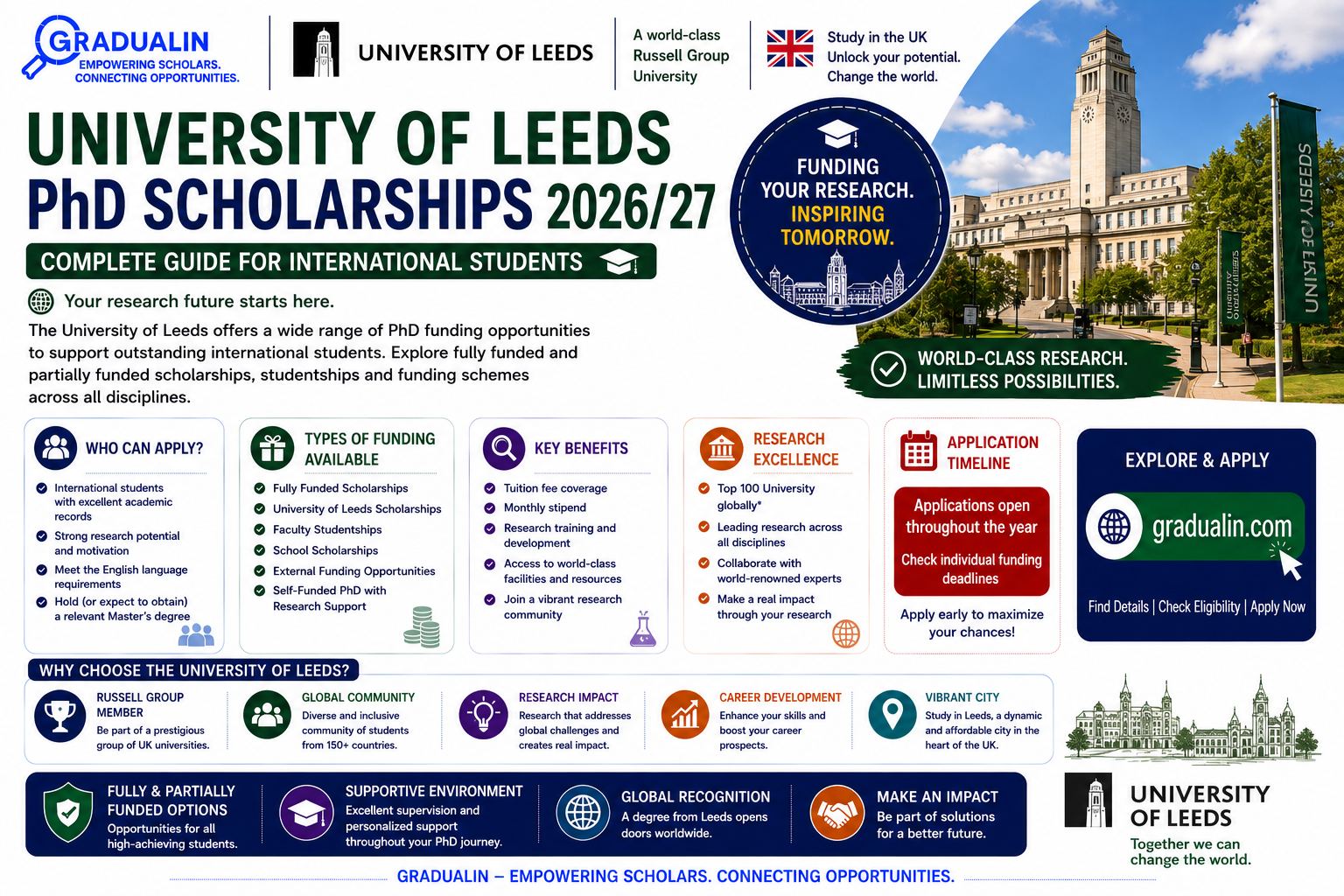
University of Leeds PhD Scholarships 2026/27 — Complete Guide for International Students
The University of Leeds is one of the UK’s top 10 research universities — and every year, it quietly funds a small number of doctoral researchers through scholarships most students never find because they are buried across different faculty pages. This guide maps every PhD funding route available for the 2026/27 cycle, identifies which are genuinely open to international and Pakistani students, and explains what competitors consistently get wrong about eligibility.
If you have searched for “Leeds PhD scholarship” and landed on a page telling you the Leeds Doctoral Scholarship is open to international students — stop. It is not. But there are routes that are, and one of them is specifically designed for students of Pakistani and South Asian background. Here is the full picture.
| Detail | Information |
| University | University of Leeds |
| Country | United Kingdom |
| Degree Level | PhD (Postgraduate Research) |
| Funding Type | Fully Funded (fees + maintenance) |
| Annual Stipend | £20,780 (2025/26 rate, rises annually with UKRI) |
| Next Cycle Opens | Autumn 2026 (2027/28 entry) |
| Open To | Varies by award — see breakdown below |
| Pakistani Students Eligible | Yes — via LORS and select school-level awards |
| Official Funding Hub | phd.leeds.ac.uk/funding |
🎓 About the University of Leeds
Founded in 1904, the University of Leeds consistently ranks among the UK’s top research institutions — it sits in the top 100 globally across multiple major rankings and has particular strength in medicine, engineering, education, business, and environmental sciences. The city of Leeds itself is the UK’s largest financial centre outside London, with a growing tech and creative sector that makes it an attractive post-PhD destination for researchers who want to transition into industry.
Leeds runs its PhD funding through a decentralised model: some scholarships are university-wide, others belong to individual schools or faculties. This is different from institutions like the University of Edinburgh or Manchester, where most PhD funding is pooled centrally and advertised through a single portal. At Leeds, a researcher in Education and one in Media and Communication could be competing for completely separate scholarship pools — with different deadlines, different eligibility rules, and different application processes. Understanding the structure is the first step toward applying successfully.
🎓 The Four Main Funding Routes — and Who They Are Actually For
This is where most guides go wrong. There is not one “Leeds PhD Scholarship” — there are several awards with different eligibility rules. Here is an accurate breakdown.
1. Leeds Doctoral Scholarship (PGR-F-209)
This is the most commonly searched award and the most commonly misrepresented. Multiple third-party scholarship sites describe it as open to “international students” — this is incorrect. <b>The Leeds Doctoral Scholarship is restricted to Home fee-rated applicants only.</b> If you would pay international (overseas) tuition fees at Leeds, you cannot apply for this award, regardless of your academic record.
What it does offer: full tuition fees, a maintenance grant of £20,780 per year (2025/26 rate), and funding for up to 3.5 years. It is awarded purely on academic merit through an internal selection process led by individual schools. Applicants need a First Class undergraduate degree or a Distinction at Master’s level. Around six awards are available per cycle across all faculties — making it extremely competitive even for eligible UK students.
Pakistani students: not eligible for this award unless you hold Home fee status (which requires ILR, settled status, or similar — see the UKCISA fee status guide if you are unsure of your status).
2. Leeds Opportunity Research Scholarship (LORS)
This is the award most relevant to Pakistani and South Asian students — and the one most often overlooked. LORS is a university-wide fully funded PhD scholarship specifically for postgraduate researchers from Black, Asian, and other minoritised ethnic groups. <b>The eligible ethnic categories explicitly include “Asian or Asian British — Pakistani.”</b>
Up to five awards are available per cycle across any faculty, covering full tuition fees for three years and a maintenance grant at the UKRI rate for 3.5 years. The 2026/27 cycle deadline was 1 April 2026; information for the 2027/28 entry will be available in autumn 2026.
There is one critical eligibility constraint: LORS requires applicants to be Home fee-rated. This means LORS is designed for Pakistani-heritage students who are UK residents — not students applying from Pakistan directly. If you are a Pakistani national based in Pakistan planning to study at Leeds, LORS is not your route; the school-level international awards below are.
If you are a UK-based Pakistani student (or hold settled/pre-settled status), LORS is one of the strongest PhD funding opportunities in the country. The combination of ethnicity-based eligibility and whole-university scope means competition is lower than for the standard doctoral scholarship.
3. School-Level International PhD Scholarships
Several Leeds schools run their own fully funded PhD scholarships explicitly open to international (overseas fee-rated) applicants. These are the most relevant routes for Pakistani students applying directly from Pakistan. Examples from the 2026/27 cycle include:
- School of Education Postgraduate Research Scholarship (International) — one award covering full fees for 3 years and maintenance for 3.5 years; open to overseas fee-rated students; focus on Education, Childhood, Youth, inclusion, language education, and related areas. IELTS 6.5 overall with no component below 6.0 required. Deadline: 15 April 2026 (2026/27 cycle — now closed; watch for 2027/28 opening in autumn 2026).
- School of Media and Communication PhD Scholarships 2026/27 — three awards, of which two are specifically for international candidates; covers full fees and maintenance at UKRI rate for 3.5 years. Start date of October 2026 or February 2027. Open to both Home and international applicants.
- School of Mathematics Scholarship (International) — one award open to all applicants; full fees and £20,780 maintenance for 3.5 years. Deadline: 27 February 2026 (2026/27 cycle closed).
- Leeds University Business School PhD Excellence Scholarships 2026/27 — two awards in Marketing; open to both Home and international candidates; stipend of £21,805 for 2026/27. Deadline: 11 March 2026 (now closed; 2027/28 round expected).
The pattern across school-level awards is consistent: they open in October–November for the following academic year and close between February and May. The 2026/27 round is now largely closed (it is August 2026). The 2027/28 round will begin advertising in autumn 2026.
4. External and Government Scholarships Combinable with Leeds
Leeds encourages international PhD students to seek external funding and use it to study at Leeds. The most relevant for Pakistani applicants:
- Commonwealth PhD Scholarships — for citizens of Commonwealth countries including Pakistan; covers full fees, airfare, and a living allowance. Administered by the Commonwealth Scholarship Commission; applicants apply through the HEC Pakistan.
- HEC IRSIP Programme — for Pakistani PhD students already enrolled at a Pakistani university who want a 6-month research placement abroad. Leeds qualifies as a host institution (it appears in QS and Times rankings). Economy-class return airfare up to USD 1,300 is covered.
- Chevening Scholarships — primarily Masters-level but occasionally has PhD-related tracks; strong track record of Pakistani recipients.
- GREAT Scholarships — the British Council administers these £10,000 partial awards specifically for Pakistani students at select UK universities, including Leeds (check current cycle eligibility each year).
🎓 Funding — What Is Actually Covered
All University of Leeds PhD scholarships in the 2026/27 cycle provide:
- Full academic tuition fees — for the full duration of the award (3 years full-time for most awards)
- Annual maintenance grant of £20,780 (2025/26 UKRI rate) — for 3.5 years, rising each year in line with UKRI increases
- The maintenance grant works out to approximately £1,732 per month before tax — sufficient for student living in Leeds, which is significantly cheaper than London
What is not covered (verify on official website for each award):
- Visa application fees and NHS surcharge
- Flights and relocation costs to the UK
- Dependent family member support
- Accommodation deposit
This is an important difference from programs like the Commonwealth Scholarship, which covers airfare and some relocation costs. Leeds institutional scholarships are tuition-plus-stipend only. For Pakistani students planning a move to the UK, budgeting for visa costs (currently around £490 for a Student visa) and NHS surcharge (currently around £776 per year of study) is essential before accepting any award.
🎓 Eligibility Criteria — Across All Awards
While specifics vary by award, the following apply broadly:
- LORS: Home fee-rated; identifies as Black, Asian, or other minoritised ethnic group (Pakistani explicitly included); must not hold a PhD or be currently registered for one; must live within reasonable commuting distance of Leeds while in receipt of the award
- School-level international awards: Overseas fee-rated; must be a new postgraduate researcher (not already registered for a PhD); First Class undergraduate degree or Distinction at Master’s level typically required; start date by October 2026 or February 2027 depending on the award
- English language: IELTS 6.0 overall with no component below 5.5 is the university minimum for most schools; the School of Education requires IELTS 6.5 overall with no component below 6.0. Some schools may set higher thresholds — always check the specific award page.
Pakistani students: eligible via LORS (if UK-resident) and via school-level international awards (if applying from Pakistan). Always check the specific award for the nationality/fee-status restriction before investing time in an application.
A note for Pakistani applicants on degree equivalence: Leeds accepts international qualifications assessed against UK standards. An HEC-recognised Pakistani master’s degree from an accredited institution is generally acceptable as equivalent to a UK master’s — but individual schools make the final determination. If in doubt, email the relevant school’s postgraduate admissions team before applying.
🎓 Who Should Apply — and Who Probably Shouldn’t
✅ Strong fit:
- UK-based students of Pakistani, Indian, Bangladeshi, or other South/Southeast Asian background who hold Home fee status — LORS is one of the best PhD funding opportunities in the UK for this group
- International students with a First Class undergraduate degree or Distinction at Master’s level, in fields aligned with school-level award areas (Education, Media, Mathematics, Business/Marketing)
- Pakistani researchers already enrolled in a PhD in Pakistan who want a funded research placement at Leeds — the HEC IRSIP route is designed exactly for this
- Applicants whose research interests genuinely align with Leeds’s strongest research areas: medicine and health, environment and sustainability, media and communication, education
❌ Poor fit:
- Pakistani nationals based in Pakistan applying for LORS — this award requires Home fee status; you are not eligible
- Students who already hold a PhD or are currently registered on a PhD programme — explicitly excluded from all Leeds institutional scholarships
- Applicants targeting engineering, computer science, or law PhD scholarships — Leeds school-level awards in these fields were not publicly advertised as international awards in the 2026/27 cycle; funding in these areas is more commonly through UKRI-funded DTPs, which are primarily Home-fee
- Students expecting visa, relocation, or dependent costs to be covered — they are not
🎓 Available Fields
School-level international awards in the 2026/27 cycle covered:
- Education (childhood, youth, inclusion, language education, digital education, curriculum and pedagogy, performing arts for inclusion, maths education)
- Media and Communication (any research topic within the school)
- Mathematics (applied mathematics and pure mathematics)
- Business — Marketing specifically (Leeds University Business School)
The LORS award is open to any faculty at Leeds — making it applicable to any research field for eligible Home-fee-rated students.
For the 2027/28 cycle, additional school-level international awards are expected. Monitor phd.leeds.ac.uk/funding from October 2026 onwards, filtering by “International” under eligibility.
🎓 Required Documents
The documents below apply broadly across Leeds PhD scholarship applications. Verify the specific list for each award on the official page.
- PhD study application with a 9-digit Student ID number — this must be obtained before you can submit the scholarship form (Stage 1 must precede Stage 2 for all Leeds awards)
- Research proposal — typically 1,000–2,000 words outlining your proposed topic, methodology, and how it aligns with the school’s research areas
- Full academic transcripts — all degree study to date, including grading scheme; if in your final year, transcripts to date are acceptable
- Personal statement — outlining research interests and background; this is separate from the research proposal for some schools
- Curriculum vitae
- English language certificate — IELTS or equivalent (dated within two years of the course start date)
- Two academic references — submitted directly through the Leeds online application system
Note for Pakistani applicants: Leeds does not require HEC attestation or degree equivalence certificates as part of the initial application. However, if you receive an offer, you may be asked to provide certified translations and verification of your Pakistani qualifications. It is worth having copies of your HEC-registered degree certificates ready in advance to avoid delays at the offer stage.
🎓 Step-by-Step Application Process
All Leeds PhD scholarship applications follow a two-stage process — this is non-negotiable and applies to every award.
- Find your supervisor and research project. Browse phd.leeds.ac.uk for advertised PhD projects, or contact a faculty member directly if you have a self-proposed research topic. Aligning your proposal with an existing supervisor’s research interests significantly improves your chances.
- Submit your PhD study application via the Leeds online application form. Include all required documents. State clearly in your application which scholarship you wish to be considered for.
- Receive your 9-digit Student Application ID. This is issued after your study application is received by the Admissions team. Do not submit the scholarship form until you have this number — applications without a valid Student ID are rejected.
- Submit the scholarship application form — a separate online form linked from each award’s page on phd.leeds.ac.uk. Deadlines are strict; late applications are not considered.
- Wait for the outcome. Leeds typically notifies applicants within 6–8 weeks of the scholarship deadline. Selection is based on academic merit alone; financial hardship is not a factor.
Practical tip: Submit your PhD study application (Stage 1) at least two weeks before the scholarship deadline. The Admissions team needs processing time to issue your Student ID — if you submit too close to the deadline, you may not receive your ID in time to submit Stage 2. This is the most common avoidable mistake and has cost applicants a full cycle.
For Pakistani applicants: There are no additional application steps specific to Pakistani nationals — you apply through the same portal as all other candidates. If you are applying via the HEC IRSIP route, you will additionally need an official acceptance/invitation letter from a Leeds supervisor or department, which you obtain after making contact with the faculty independently of the scholarship process.
🎓 Important Dates
| Award | Scholarship Deadline | Start Date |
| Leeds Doctoral Scholarship (PGR-F-209) | Watch phd.leeds.ac.uk from Oct 2026 | 1 Oct 2027 |
| Leeds Opportunity Research Scholarship (LORS) | ~April 2027 (TBC; based on 2026 cycle) | 1 Oct 2027 |
| School of Education (International) | ~April 2027 (TBC) | 1 Oct 2027 |
| School of Media & Communication | ~March 2027 (TBC) | 1 Oct 2027 or 1 Feb 2028 |
| School of Mathematics (International) | ~February 2027 (TBC) | 1 Oct 2027 |
| LUBS PhD Excellence Scholarships | ~March 2027 (TBC) | 1 Oct 2027 or 1 Feb 2028 |
All 2027/28 deadlines are based on the pattern from the 2026/27 cycle. Official 2027/28 dates will be published on phd.leeds.ac.uk/funding from autumn 2026. Bookmark this page — we update deadlines as soon as changes are announced.
🎓 Why Apply — Why Leeds
Leeds sits in a genuinely strong position for PhD researchers. The university’s research income consistently places it in the UK’s top ten, and its doctoral community spans over 3,000 active researchers across seven faculties. The city of Leeds has a relatively affordable cost of living compared to London or Edinburgh — the £20,780 UKRI stipend goes meaningfully further here than it would in most other major UK university cities.
For researchers in education, media, or sustainability, Leeds has particular depth. The School of Education hosts four internationally active research centres covering digital education, language education, curriculum and policy, and inclusion and childhood — an unusual concentration in a single school. The School of Media and Communication has a strong tradition of critical and cultural research with real international profile.
From a career trajectory standpoint, a Leeds PhD opens doors into UK academia, the British Council, international development organisations, and policy work — all sectors where a top-10 UK research degree carries real weight.
Gradualin Editor’s Note: For Pakistani students, the honest assessment is this: the LORS is one of the best PhD funding opportunities in the UK if you are already resident in the UK with Home fee status. If you are applying from Pakistan, the school-level international awards are the right route — but these are genuinely competitive (one to three places per school) and require a strong First Class record and a compelling, focused research proposal. Average applicants will struggle. Strong applicants — those with a Distinction at Master’s level, a clearly defined research question, and an existing supervisor connection — have a real chance.
🎓 FAQ
These questions are based on what students most commonly search about Leeds PhD funding.
Can Pakistani students apply for the University of Leeds PhD scholarship? Yes, but the answer depends on which award. Pakistani students who are UK residents with Home fee status can apply for the Leeds Opportunity Research Scholarship (LORS), which explicitly lists “Asian or Asian British — Pakistani” as an eligible ethnic category. Pakistani students applying from Pakistan can apply for school-level international awards such as the School of Education and School of Media scholarships, which are open to overseas fee-rated applicants. The main Leeds Doctoral Scholarship (PGR-F-209) is restricted to Home fee-rated students and is not open to international applicants regardless of nationality.
Is IELTS required for Leeds PhD scholarships? Yes. IELTS is required — the minimum across most Leeds schools is 6.0 overall with no component below 5.5. The School of Education sets a higher threshold of 6.5 overall with no component below 6.0. There is no IELTS waiver for PhD applicants at Leeds. This is different from some European universities that accept medium of instruction letters in lieu of a test — Leeds does not.
Does the University of Leeds accept HEC-recognised Pakistani degrees? Leeds accepts international qualifications from recognised institutions. An HEC-registered Pakistani master’s from an accredited university is generally treated as comparable to a UK master’s for admissions purposes. However, the final determination is made by the relevant school. If your institution is HEC-recognised but less well-known internationally, it is worth contacting the school’s admissions team directly before applying to confirm your qualifications will be considered.
When does the 2027/28 scholarship cycle open? Based on the pattern from previous years, the 2027/28 cycle is expected to open in autumn 2026 — typically October or November. Monitor phd.leeds.ac.uk/funding and set up email alerts from the University of Leeds research degrees pages.
Can I apply for a Leeds PhD scholarship without first contacting a supervisor? For school-level awards tied to a specific advertised project — no, a supervisor is already attached to the project and you apply for the place. For open awards like LORS or the School of Education scholarship, you are expected to propose your own research topic. In practice, contacting a potential supervisor before submitting your application significantly strengthens your case — it demonstrates that your research interests are viable and that a faculty member is willing to support your work. This is not strictly required but is strongly advisable.
🎓 Official Sources
- PhD Funding Portal: phd.leeds.ac.uk/funding
- Research Funding Overview: leeds.ac.uk/research-funding
- Scholarships for Under-Represented Groups: leeds.ac.uk/research-funding-scholarships/doc/scholarships-under-represented-groups
- Applying for Research Degrees: leeds.ac.uk/research-applying/doc/applying-research-degrees
- Contact (Postgraduate Research Admissions): leeds.ac.uk/research-applying/doc/postgraduate-research-admissions-contacts
- LORS Enquiries: pgrdiversity@leeds.ac.uk
🎓 Summary Table
| Detail | Information |
| University | University of Leeds |
| Country | United Kingdom |
| Degree Level | PhD (Postgraduate Research) |
| Funding Type | Fully Funded (fees + maintenance) |
| Annual Stipend | £20,780 (2025/26 UKRI rate) |
| Duration | 3.5 years full-time |
| Next Cycle Opens | Autumn 2026 (for 2027/28 entry) |
| Open To (LORS) | Home fee-rated, Black/Asian/minoritised ethnic groups |
| Open To (School-level) | International (overseas fee-rated) students |
| Pakistani Students Eligible | Yes — LORS (UK residents) + select school-level awards |
| IELTS Required | Yes — minimum 6.0 overall (6.5 for School of Education) |
| Official Link | phd.leeds.ac.uk/funding |
Explore more opportunities on Scholarships, Jobs & Internships, Events & Conferences, and Guidelines & Resources.
Related reading:
- Fully Funded PhD Scholarships in the UK 2026
- Study in Germany 2026 — Guide for International Students
- Top 10 Fully Funded Scholarships in Asia 2027
- Fully Funded PhD Positions in Switzerland 2026
- Fully Funded Scholarships in the USA 2026
Stay updated with the latest scholarships, jobs, and opportunities at Gradualin.com — your trusted guide to studying abroad for free.
Author: Faseeh Sultan — PhD Scholar, MSIT | 7 Years in Education