

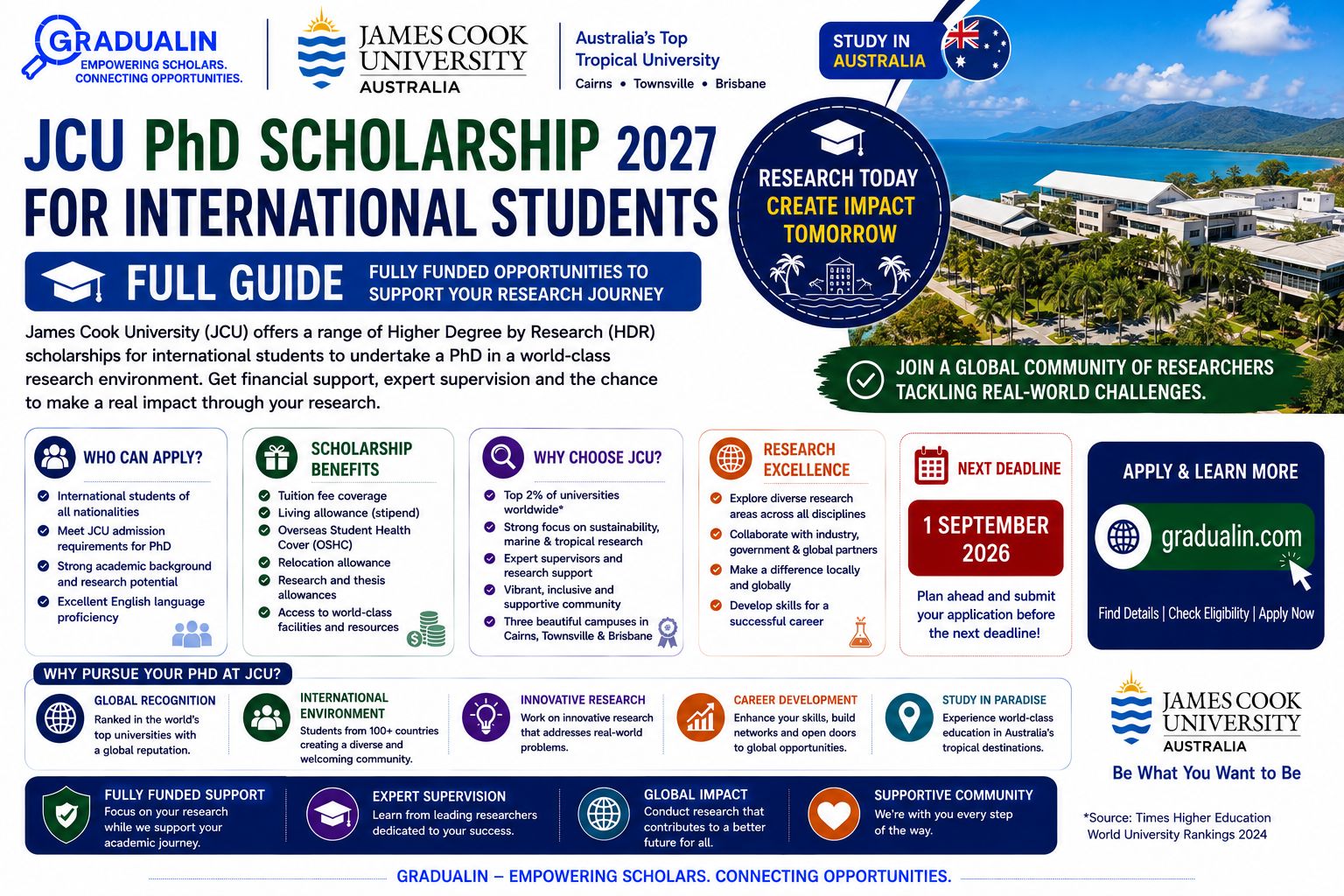
JCU PhD Scholarship 2027 for International Students — Full Guide
James Cook University is one of Australia’s most distinctive research institutions — and for international PhD students, it currently offers one of the highest base stipends of any Queensland university: AUD $37,500 per year for 2027 intake. The next application deadline for international candidates is 1 September 2026, with offers expected by 24 December 2026 and commencement in March 2027.
This guide covers every international HDR scholarship type available at JCU, what each covers, what each excludes (including some costs that catch applicants off guard), and how Pakistani and South Asian students can position themselves competitively.
| Detail | Information |
| University | James Cook University (JCU) |
| Country | Australia |
| Degree Level | PhD (Doctor of Philosophy) / MPhil (Master of Philosophy) |
| Funding Type | Fully Funded — tuition fees + living allowance stipend |
| Annual Stipend | AUD $37,500 (2027 rate) |
| Duration | 3.5 years (PhD) / 2 years (MPhil) |
| Next Deadline | 1 September 2026 |
| Open To | International students (excluding JCU Singapore-based for most awards) |
| Pakistani Students Eligible | Yes — no nationality restrictions |
| Official Link | jcu.edu.au/graduate-research-school/doctor-of-philosophy-candidates/postgraduate-research-scholarships/hdr-scholarships-for-international-candidates |
🎓 About James Cook University
Founded in 1970 and headquartered in Townsville, Queensland, James Cook University sits in a research niche no other Australian university occupies: the tropics. Its campuses in Townsville, Cairns, and Brisbane — along with a fully operational campus in Singapore — are positioned adjacent to two UNESCO World Heritage sites: the Great Barrier Reef Marine Park and the Wet Tropics rainforests of North Queensland.
That geography is not incidental to its research profile. <b>JCU is ranked #5 globally and #1 in Australia for Ecology</b> (ShanghaiRanking 2024), and <b>#4 globally for Marine and Freshwater Biology</b> (US News Best Global Universities 2024). Its research centres — including the Australian Institute of Tropical Health and Medicine, TropWATER, and the Cairns Institute — conduct internationally recognised work in coral reef science, tropical medicine, tropical public health, biodiversity, and climate adaptation.
For researchers from South Asia, this is worth understanding. Pakistan faces some of the most acute climate and environmental pressures in the world — glacial melt, flooding, coastal erosion, and water insecurity. JCU’s tropical research strengths are directly relevant to these challenges, and Pakistani researchers who align their PhD proposals with these themes can make a compelling case for why JCU is the right institution for their work. Unlike a general research university, JCU’s specificity is actually an advantage for applicants who know how to use it.
JCU’s international student community draws from over 100 countries, and the university explicitly positions itself as a research partner for developing regions — making it a more natural fit for South Asian researchers than its Queensland location might initially suggest.
🎓 The Four International HDR Scholarship Types
JCU does not offer a single catch-all PhD scholarship. There are four distinct awards for international candidates, each with different inclusions and one additional requirement for the AIMS@JCU award. All are assessed on academic merit through the same application; you are automatically considered for all awards you are eligible for.
1. International Research Training Program (RTP) Scholarship
This is the flagship award and the most comprehensive. It covers full tuition fees, a living allowance stipend of AUD $37,500 per year in 2027, and — critically — overseas student health cover (OSHC). For international students, OSHC is a significant cost (more on this below), and the RTP being one of the only JCU HDR awards to include it is a material financial distinction.
Duration: 3.5 years for PhD, 2 years for MPhil. Available to international students commencing at JCU’s Australian campuses (Townsville, Cairns, Brisbane) — not JCUS (Singapore).
RTP scholarships are funded through the Australian Government’s Research Training Program block grant, which gives JCU a fixed pool to allocate each year. This means the total number of awards is limited and competition is genuine.
2. JCU Postgraduate Research Scholarship (PRS)
The PRS covers full tuition fees and the AUD $37,500 stipend — but does not include OSHC. Functionally, this means it is a slightly less valuable award than the RTP, because international students must fund OSHC themselves before receiving a student visa.
In practice, the difference is real but manageable for a single applicant: OSHC for a single PhD candidate costs AUD $4,702 as a one-off upfront payment (2026 rate). For candidates accompanied by a partner the cost rises sharply to AUD $28,382, and for a family with children to AUD $50,478. These figures increase annually. Applicants planning to bring family to Australia need to factor this into their financial planning before accepting any JCU offer.
Duration and eligibility are identical to the RTP.
3. AIMS@JCU Scholarship
This is the highest-value award JCU offers internationally. It combines the standard stipend of AUD $37,500 per year with an additional AUD $7,500 per year — either as an additional living allowance or as project expenses, depending on the research project. Total potential value: AUD $45,000 per year.
The AIMS@JCU scholarship is linked to research in partnership with the Australian Institute of Marine Science (AIMS) — Australia’s leading tropical marine science agency. It is not open to all applicants; your proposed PhD research must align with AIMS’s research priorities, which centre on the Great Barrier Reef, tropical marine ecosystems, and reef monitoring and restoration science.
Applicants for AIMS@JCU must submit a separate scholarship application form alongside their HDR candidature application. The form is available at: AIMS@JCU Scholarship Application Form
Does not include OSHC or relocation expenses.
4. JCU Singapore Postgraduate Research Scholarship
This award is specifically for candidates based at the JCU Singapore campus. It provides a stipend of SGD $31,000 per year plus tuition fees. Candidates must have a primary advisor based at JCUS and be physically located in Singapore for at least the first year of their candidature.
It is not relevant to Pakistani students planning to study in Australia. Included here for completeness.
🎓 Benefits — What Is Covered
Across all Australian-campus scholarships (RTP, PRS, AIMS@JCU):
- Full tuition fees for the duration of the award — 3.5 years PhD / 2 years MPhil
- Living allowance stipend of AUD $37,500 per year (2027 rate) — paid fortnightly, tax-free for the scholarship component
- RTP additionally covers overseas student health cover (OSHC)
At AUD $37,500 per year, JCU’s base rate is notably competitive — it is stated to be the highest base stipend of any Queensland university. For context, Townsville and Cairns have significantly lower costs of living than Sydney or Melbourne, meaning the stipend goes meaningfully further than the same figure would at a Group of Eight university in a major metropolitan city.
Not covered by any JCU HDR scholarship (verify on official website):
- Relocation expenses to Australia
- Student Services and Amenities Fee (SSAF)
- Visa application costs
- OSHC (except RTP)
- Dependent family health cover
🎓 Eligibility Criteria
To be considered for any JCU international HDR scholarship, applicants must:
- Meet ELR Band 2 English language requirements — JCU’s equivalent of IELTS 6.5 overall; English proficiency is required and must be evidenced
- Hold minimum qualifications for HDR admission — typically an Honours degree (First Class or equivalent) or a research master’s degree with a strong research component
- Be able to meet all Conditions of Award for the scholarship
- Be classified as an international student (not a permanent resident or citizen of Australia or New Zealand)
- Not be based at JCU Singapore (for Australian campus awards)
Pakistani students: eligible — no nationality restrictions apply. JCU’s international HDR scholarships are open to all nationalities meeting the academic and English language requirements.
A note on English requirements for Pakistani applicants: JCU’s ELR Band 2 requirement is equivalent to approximately IELTS 6.5 overall. Pakistani students who completed undergraduate or postgraduate study through English-medium instruction at an HEC-recognised Pakistani university may be eligible for an English language exemption — but this is assessed case by case. Contact grs@jcu.edu.au before applying if you are uncertain.
HEC-recognised Pakistani degrees are accepted as international qualifications. A four-year BS (Honours) or an 18-year education structure (Matric + FSc + BS) is generally treated as equivalent to an Australian bachelor’s degree. An MS or M.Phil from a recognised Pakistani institution is treated as comparable to an Australian research master’s. As always with international equivalencies, confirm your specific qualification with JCU’s Graduate Research School before submitting.
🎓 Who Should Apply — and Who Probably Shouldn’t
✅ Strong fit:
- International researchers in marine science, tropical ecology, environmental science, public health, or any discipline with a clear tropical/environmental application — JCU’s world rankings in these fields mean a PhD here carries genuine weight
- Pakistani researchers whose work connects to climate adaptation, water security, coastal science, or tropical disease — strong alignment with JCU’s core research themes and a compelling narrative for the application
- Candidates with a First Class Honours degree or a Distinction-level master’s with a clear research trajectory
- Applicants who have already identified a potential JCU supervisor and made contact before submitting — this substantially strengthens any application
- Single applicants or those without dependents — the OSHC cost for families is significant and should be carefully budgeted
❌ Poor fit:
- Candidates who have not identified a research area or supervisor and plan to “figure it out” after applying — JCU’s HDR scholarship scoring places weight on research proposal quality and advisor endorsement
- Applicants expecting relocation costs or visa fees to be covered — they are not
- Candidates with dependents who have not accounted for OSHC costs, which run to AUD $28,000–$50,000 for accompanied families
- Students whose primary interest is coursework or professional master’s programs — these scholarships are for research degrees (PhD and MPhil) only
- Applicants to AIMS@JCU whose research is not genuinely aligned with tropical marine science — the additional form and AIMS partnership requirement are not optional
🎓 Available Research Fields
JCU’s HDR scholarships are not restricted by discipline — any faculty can supervise an international scholarship holder. That said, the university’s research profile means competition is strongest and supervisor depth is greatest in:
- Marine and Freshwater Biology — Great Barrier Reef ecology, reef restoration, coral bleaching, fisheries science
- Tropical Ecology and Biodiversity — rainforest ecosystems, species conservation, invasive species
- Environmental Science and Climate — climate adaptation, water management, tropical coastal systems
- Tropical Medicine and Public Health — vector-borne diseases, tropical health in underserved populations, infectious disease
- Geosciences — including mining and mineral engineering (top 100 globally)
- Nursing, Tourism and Hospitality — top 150 globally; strong industry links in Queensland
- Business, Law and Governance — including the JCU Singapore campus option
Research projects currently seeking HDR candidates are listed at jcu.edu.au/graduate-research-school/research-projects-requiring-hdr-candidates.
🎓 Required Documents
JCU’s application process is designed so that a single HDR candidature application considers you for all scholarships you are eligible for. No separate scholarship application is needed — except for the AIMS@JCU award.
Standard documents required:
- Completed HDR application form — submitted through the JCU application portal, indicating scholarship consideration
- Academic transcripts — all previous degrees, with certified English translations if not originally in English
- Research proposal — outlining your proposed topic, objectives, methodology, and how it connects to JCU’s research strengths
- Curriculum vitae — including publications, conference presentations, and research experience
- Evidence of English language proficiency — IELTS, TOEFL, PTE, or equivalent; dated within two years of proposed commencement
- Two academic references — submitted through the online system
- AIMS@JCU Scholarship Application Form — required additionally if applying for the AIMS@JCU award only
For currently enrolled JCU candidates (applying to upgrade or extend): email your CV and a publications spreadsheet to grs@jcu.edu.au, and ask your advisor to submit an Advisor Statement.
Note for Pakistani applicants: Degree certificates from HEC-recognised institutions are accepted. If your documents are in Urdu or another language, certified English translations are required. HEC attestation is not specifically mandated by JCU, but having your documents authenticated adds credibility and can reduce administrative back-and-forth at the offer stage.
🎓 Step-by-Step Application Process
- Identify your research area and a potential supervisor. Browse research.jcu.edu.au/portfolio/find-an-advisor to find academics working in your field. Email them with a brief research introduction and your CV. Supervisor buy-in before applying is not mandatory but significantly improves your scoring — nominated advisors are notified and asked to review and endorse your application.
- Check your eligibility. Confirm your degree qualifications meet HDR admission requirements and that your English proficiency meets ELR Band 2. If uncertain, contact grs@jcu.edu.au before investing time in a full application.
- Prepare your research proposal. This is the single most important document in your application. It should clearly define your research question, explain the methodology, and connect your work to JCU’s existing research strengths. Generic proposals are the most common reason competitive candidates are ranked lower than expected.
- Submit your HDR candidature application via the JCU application portal before the relevant deadline. Indicate that you wish to be considered for an HDR scholarship — no separate scholarship form is needed (unless applying for AIMS@JCU).
- Complete the AIMS@JCU form separately if your research is in tropical marine science and you want to be considered for the higher-value award. Submit this alongside your main application.
- Wait for advisor notification and outcome. Nominated advisors are contacted after submission and may request an interview. Offers for the 1 September 2026 round are expected by 24 December 2026.
Practical tip: The research proposal is weighted heavily in JCU’s Scholarship Scoring Procedure. Spend at least three to four weeks drafting it, with specific reference to JCU research centres and existing projects where relevant. A proposal that says “I want to study coral reef ecology at JCU’s world-class facilities” reads generically. A proposal that says “I want to extend the methodology used in [specific JCU project] to examine [specific gap]” demonstrates genuine engagement with the institution’s work.
🎓 Important Dates
| Round | Application Deadline | Commencement | Offers Expected |
| Round 1 — 2027 | 1 September 2026 | March 2027 | 24 December 2026 |
| Round 2 — 2027 | 1 February 2027 | July 2027 | 3 May 2027 |
| Round 1 — 2028 | 1 September 2027 | March 2028 | 24 December 2027 |
The 1 September 2026 deadline is approximately three weeks away from the date of this article. If you are targeting the March 2027 commencement, begin your supervisor outreach and proposal preparation immediately. The February 2027 round gives more time if needed, with a July 2027 start.
Bookmark this page — we update deadlines as soon as changes are announced.
🎓 Why Apply — Why JCU
JCU’s pitch to international PhD students is different from a standard Group of Eight university. It is not offering the broadest research base or the biggest campus city — it is offering world-leading depth in a specific niche, at a stipend rate that beats most of its Queensland peers, in a location with a genuinely lower cost of living.
Townsville has a relaxed pace compared to Sydney or Melbourne, and Cairns is one of Australia’s most popular international tourist destinations. Both cities have active international student communities, and JCU’s campus environments are closely integrated with the natural research settings that make the institution distinctive. Researchers at JCU regularly access the Great Barrier Reef, the Daintree Rainforest, and tropical field sites that exist nowhere else in the Australian university system.
For researchers in the right fields, the combination of a globally ranked research environment, a competitive stipend, and a significantly lower cost of living than major Australian cities makes this a financially and academically strong choice.
Gradualin Editor’s Note: JCU’s HDR scholarships are a genuinely strong opportunity, but the fit matters more here than at a general research university. A Pakistani researcher in tropical ecology, environmental science, public health, or marine biology has a compelling reason to choose JCU — and a compelling narrative for the application. A researcher in, say, computer science or social policy will find fewer natural supervisor connections and should weigh whether other Australian institutions better match their research agenda. The OSHC cost for families is a real financial consideration that should be resolved before accepting an offer, not after.
🎓 FAQ
These questions are based on what students most commonly search about JCU PhD scholarships.
Can Pakistani students apply for the JCU HDR scholarship? Yes. JCU’s international HDR scholarships carry no nationality restrictions — they are open to all international students meeting the academic and English language requirements. Pakistani students are fully eligible. There is no government statement or special documentation required specifically for Pakistani nationals. The application process is the same for all international candidates.
Is IELTS required for the JCU HDR scholarship? English proficiency is required. JCU’s ELR Band 2 standard is equivalent to approximately IELTS 6.5 overall. Accepted tests include IELTS, TOEFL, and PTE Academic. Pakistani applicants who completed their undergraduate or postgraduate degree entirely in English at an HEC-recognised institution may be able to apply for an exemption — contact grs@jcu.edu.au to confirm before applying.
What is the AUD $37,500 stipend equivalent to in Pakistani rupees? At current exchange rates (verify at the time of your offer), AUD $37,500 is approximately PKR 7,000,000–7,500,000 per year (verify on official website — exchange rates fluctuate). Paid fortnightly as a living allowance, this is designed to cover accommodation, food, transport, and daily costs in Townsville or Cairns. Both cities are significantly cheaper than Sydney; student accommodation near JCU Townsville typically runs AUD $200–350 per week.
Does the AIMS@JCU scholarship require a different application? Yes — the AIMS@JCU scholarship requires a separate application form submitted alongside your main HDR candidature application. It is only available to candidates whose research aligns with the Australian Institute of Marine Science’s research priorities in tropical marine science. The form is downloadable from the JCU scholarship page.
When does the next round open? The next deadline for international candidates is 1 September 2026 for March 2027 commencement. If you miss this, the following round closes 1 February 2027 for a July 2027 start. Both rounds are for 2027 intake.
🎓 Official Sources
- HDR Scholarships for International Candidates: jcu.edu.au — HDR Scholarships
- Find an HDR Advisor: research.jcu.edu.au/portfolio/find-an-advisor
- Research Projects Seeking HDR Candidates: jcu.edu.au/graduate-research-school/research-projects-requiring-hdr-candidates
- Scholarship Scoring Procedure: jcu.edu.au/policy/academic-governance/research-education/scholarship-scoring-procedure
- General Enquiries: grs@jcu.edu.au
- Phone (Townsville): +61 7 4781 4111
🎓 Summary Table
| Detail | Information |
| University | James Cook University (JCU) |
| Country | Australia |
| Degree Level | PhD / MPhil |
| Funding Type | Fully Funded — tuition + stipend |
| Annual Stipend | AUD $37,500 (2027 rate) |
| AIMS@JCU Additional | AUD $7,500 extra per year |
| Duration | 3.5 years (PhD) / 2 years (MPhil) |
| Next Deadline | 1 September 2026 |
| Offers By | 24 December 2026 |
| Commencement | March 2027 |
| Pakistani Students Eligible | Yes — no nationality restrictions |
| English Requirement | ELR Band 2 (~IELTS 6.5) |
| OSHC Included | RTP only — others exclude it |
| Official Link | JCU HDR Scholarships — International |
Explore more opportunities on Scholarships, Jobs & Internships, Events & Conferences, and Guidelines & Resources.
Related reading:
- Fully Funded Scholarships in Australia 2026
- Fully Funded PhD Scholarships in the UK 2026
- Top 10 Fully Funded Scholarships in Asia 2027
- Fully Funded PhD Positions in Switzerland 2026
- Study in Germany 2026 — Guide for International Students
Stay updated with the latest scholarships, jobs, and opportunities at Gradualin.com — your trusted guide to studying abroad for free.
Author: Faseeh Sultan — PhD Scholar, MSIT | 7 Years in Education


One Response