
Fully Funded PhD at Cranfield University 2026 — Wastewater Treatment
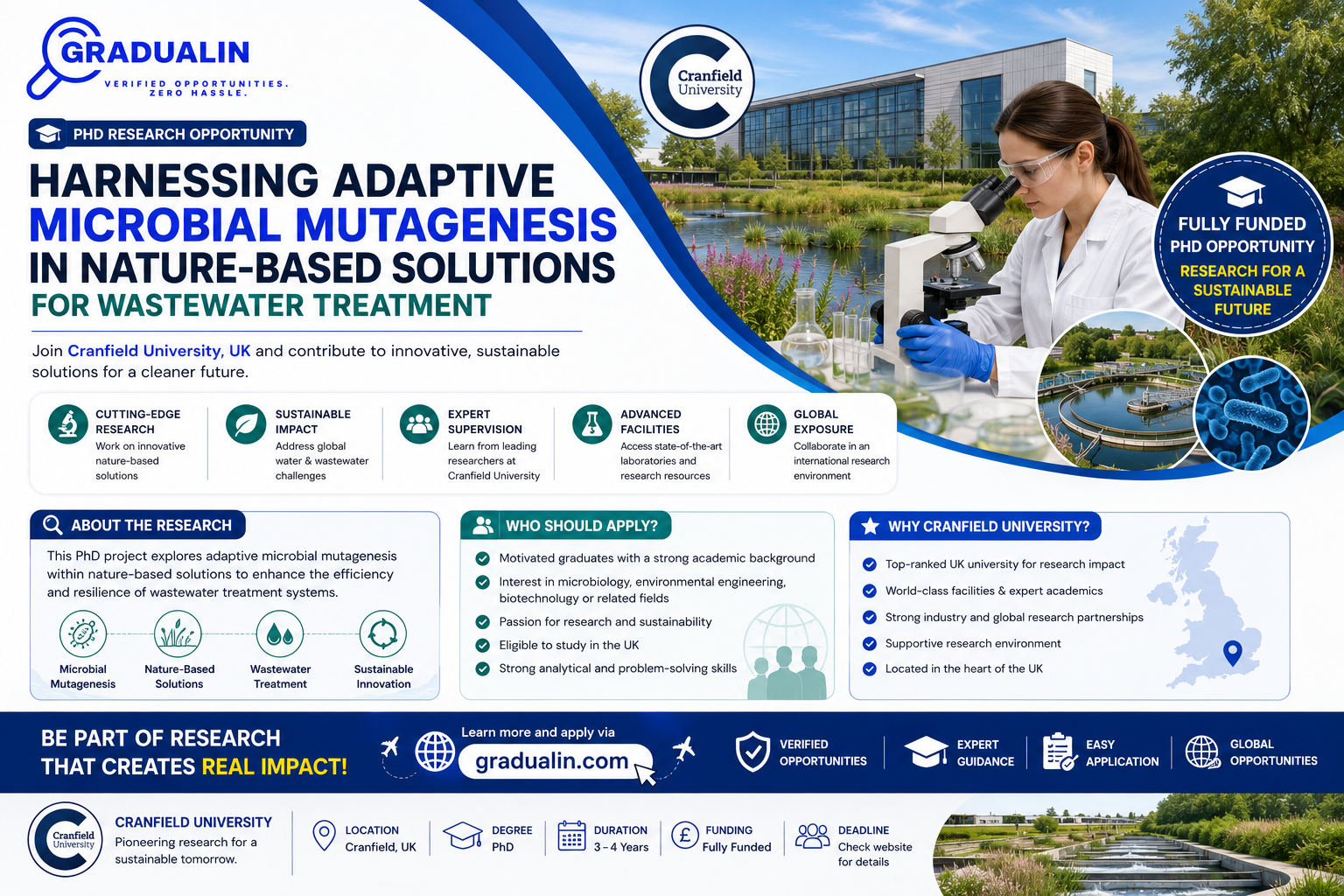
Cranfield University is offering a fully funded PhD studentship starting 28 September 2026, focused on one of the most pressing challenges in environmental science: how microbial communities in constructed wetlands adapt to emerging chemical pollutants — and how that adaptation can be harnessed to make wastewater treatment smarter and safer. The position comes with a tax-free stipend of £31,805 per year, full fees covered for four years, and additional support for training and placements. This is an exceptional opportunity for UK or Irish nationals who hold Home fee status and want to work at the cutting edge of environmental biotechnology, microbiology, and water engineering.
⚠️ Important: This studentship is open to UK Home fee status students only. International students are not eligible for this funding. If you are not sure of your fee status, check the UKCISA website before applying.
| Detail | Information |
| University | Cranfield University |
| Country | United Kingdom |
| Degree Level | Doctor of Philosophy (PhD) |
| Funding Type | Fully funded — stipend + fees covered |
| Annual Stipend | £31,805 (tax-free, enhanced rate) |
| Duration | 4 years (full-time) |
| Start Date | 28 September 2026 |
| Application Deadline | 5 August 2026 |
| Eligibility | UK Home fee status only |
| Reference Number | CRAN-0096 |
| Official Link | Apply at Cranfield |
🎓 About This Opportunity
Cranfield University is one of the UK’s most distinctive higher education institutions — a postgraduate-only university with deep specialism in applied science and engineering. It consistently ranks among the top institutions globally for its research in water, environment, aerospace, and manufacturing, and it works closely with both government bodies and industry partners across the UK and beyond.
This PhD sits within Cranfield’s strong water and environment research cluster and is sponsored by two significant partners. The first is the NERC Doctoral Focal Award in Engineering Biology for Environmental Applications (EngBio4Env) — a prestigious NERC-funded training programme that sits at the intersection of engineering biology, environmental science, and innovation. The second is Sanofi, a global healthcare company, through its Planet Care Challenge programme — reflecting Sanofi’s commitment to reducing the environmental impact of pharmaceutical residues across production and disposal pathways.
The research addresses a real, growing problem. Emerging micropollutants — including pharmaceuticals, PFAS (so-called “forever chemicals”), pesticides, and personal care products — are increasingly detected in wastewater systems and receiving water bodies worldwide. Nature-based solutions (NbS), and particularly constructed wetlands, are widely deployed because they treat pollutants while delivering ecosystem benefits. But the long-term effects of continuous chemical exposure on the microbial communities inside these systems remain poorly understood. This PhD is designed to change that.
🎓 Benefits and Funding
This is one of the most generously funded PhD studentships available in UK environmental engineering in 2026. Here is what the successful candidate receives:
- Annual tax-free stipend of £31,805 — an enhanced rate delivered through the EPSRC TechExpert Pilot scheme, significantly above the standard UKRI minimum rate
- Full tuition fees covered for the entire four-year duration — no fee liability for the student
- Training and placement costs covered — including any overseas or industry placements, subject to supervisor approval
- Interdisciplinary training through the EngBio4Env doctoral programme — workshops, schools, and professional development opportunities across the engineering biology and environmental science community
- Access to Cranfield’s world-class facilities in wastewater treatment, micropollutant analysis, molecular microbiology, and environmental modelling
- Industry collaboration — direct engagement with Sanofi through the Planet Care Challenge, providing real-world context and professional network access
- Conference participation and wider community engagement across engineering biology research networks
The enhanced stipend figure of £31,805 is worth emphasising: at the time of writing, the standard UKRI doctoral stipend is significantly lower. The TechExpert Pilot scheme provides the uplift that makes this position particularly attractive compared with most UKRI-funded PhD studentships.
🎓 Eligibility Criteria
Funding eligibility — the most important point first:
- This studentship requires UK Home fee status. As a guiding principle, UK or Irish nationals who are ordinarily resident in the UK or Republic of Ireland qualify for Home fees. Students from the Channel Islands and Isle of Man pay Overseas fees and are not eligible. All other international students are not eligible for this funding.
- If you are unsure of your fee status, use the UKCISA fee status checker before applying.
Academic eligibility:
- A first or upper second-class UK honours degree (or equivalent international qualification) in a relevant discipline
- Suitable subjects include: Environmental Engineering, Environmental Science, Biotechnology, Microbiology, Biochemical Engineering, Chemical Engineering, Water Engineering, or closely related science or engineering fields
- Prior experience or solid understanding of wastewater treatment, environmental microbiology, molecular biology, or biotechnology is advantageous
- Self-motivated with strong communication skills — the role requires regular interaction with both academic supervisors and industrial partners (Sanofi)
- Demonstrated interest in interdisciplinary and applied environmental research
🎓 Who Should Apply / Who Shouldn’t
✅ This is the right opportunity if you:
- Hold UK Home fee status (UK or Irish national ordinarily resident in UK or Republic of Ireland)
- Have a strong undergraduate or postgraduate background in an environmental or biological science or engineering discipline
- Are genuinely curious about how microbial communities respond to chemical stress — and how that response can be used to improve treatment systems
- Want to work at the boundary of field science, laboratory experimentation, molecular biology, and quantitative modelling
- Are looking for industry collaboration experience alongside rigorous academic training
❌ This is not the right fit if you:
- Are an international student — this funding is not available to overseas fee-status applicants
- Hold a lower second-class or third-class undergraduate degree without compensating postgraduate credentials
- Are looking for a part-time or distance PhD — this is a full-time, campus-based studentship at Cranfield
- Are not able to start by 28 September 2026
🎓 Research Focus and Scope
This is the part that makes this PhD genuinely exciting for anyone working in the environmental sciences. The core question the research asks is: can the way microbial communities naturally adapt to pollution stress be understood well enough to be deliberately harnessed for better wastewater treatment?
Here is the scientific context. Constructed wetlands expose their microbial communities to continuous, low-level chemical stress from micropollutants passing through the treatment system. Over time, those communities mutate and adapt. Some mutations may improve the community’s ability to degrade specific pollutants. Others may raise ecological safety concerns. Currently, we do not understand these dynamics well enough to design treatment systems that take advantage of beneficial microbial changes while avoiding harmful ones.
The PhD will investigate this across four interconnected areas:
- Microbial mutation, selection, and functional trait development under long-term exposure to pharmaceuticals, PFAS, pesticides, and other emerging contaminants in constructed wetland systems
- Field investigations at real constructed wetland sites to characterise how microbial communities change under sustained pollutant exposure
- Laboratory experiments to test specific hypotheses about microbial adaptation and pollutant degradation mechanisms
- Targeted biotechnology approaches — including controlled photonic stimulation — to determine whether beneficial microbial functions can be enhanced without compromising environmental safety
- Quantitative modelling to integrate findings and generate predictive tools for future treatment system design
This is one of the few PhD projects in the UK that combines molecular microbiology, environmental engineering, and engineering biology intervention in a single, coherent research programme. That interdisciplinary scope is precisely what the EngBio4Env training environment is designed to support.
🎓 Supervisory Team
The project is supervised by two of Cranfield’s leading experts in this field:
- 1st Supervisor: Dr Tao Lyu — Senior Lecturer in Green Technologies at Cranfield University. Dr Lyu’s research centres on nature-based solutions, constructed wetlands, and the engineering of sustainable water treatment systems. Contact: t.lyu@cranfield.ac.uk | +44 (0)1234 758302
- 2nd Supervisor: Professor Frederic Coulon — Professor of Environmental Chemistry and Microbiology at Cranfield. Professor Coulon brings deep expertise in environmental contamination, micropollutant remediation, and molecular approaches to environmental microbiology.
Together, this supervisory team offers coverage across the full disciplinary range of the project — from engineering design and wetland systems to molecular microbiology and chemical analysis.
🎓 Required Documents
Make sure all of the following are prepared and uploaded before submitting your application — incomplete applications will not be considered:
- Online application form — completed through the Cranfield application portal
- Academic transcripts — from all previously attended institutions
- Personal statement / research statement — explaining your academic background, research interests, and why this specific project aligns with your goals
- CV — including education, relevant research or work experience, publications (if any), and technical skills
- Two or three academic references — from supervisors or lecturers familiar with your research capabilities
- Proof of degree classification — confirmation of first or upper second-class honours (or equivalent)
- English language evidence — if your degree was not taught in English (Cranfield will advise on specific requirements)
Note: Cranfield states that applications will not be considered unless all relevant documents have been uploaded. Do not submit an incomplete file.
🎓 Step-by-Step Application Process
Step 1: Check your fee status. Before anything else, confirm you qualify as a Home fee student using the UKCISA fee status checker. Only proceed if you are eligible.
Step 2: Contact Dr Tao Lyu directly. While not strictly required, emailing the lead supervisor before applying is strongly advisable. Introduce yourself, describe your background, and express your interest in the project. A brief, professional email showing you have read the project description carefully can set you apart. Email: t.lyu@cranfield.ac.uk
Step 3: Prepare your full application package. Gather all required documents (see above) before starting the online form. Incomplete applications are rejected without review.
Step 4: Submit via the Cranfield online portal. Complete and submit your application at the Cranfield application portal. Reference number: CRAN-0096.
Step 5: Apply early. Cranfield explicitly states this position may be filled before the 5 August 2026 closing date. Do not leave this until late July. A strong early application is far more likely to secure an interview slot.
Step 6: Await contact. Shortlisted candidates will be contacted for interview. Be prepared to discuss your research background, your interest in microbial ecology and wastewater treatment, and how you would approach the interdisciplinary scope of this project.
💡 Pro tip: In your personal statement, link your specific academic background — whether that is environmental engineering, microbiology, or chemical engineering — explicitly to the project’s research strands. Show that you understand the distinction between field investigation, laboratory experimentation, and modelling, and that you are comfortable working across all three.
🎓 Important Dates
| Event | Date |
| Application deadline | 5 August 2026 |
| Start date | 28 September 2026 |
| Duration | 4 years (full-time) |
| Early application advised | Yes — vacancy may close before deadline |
Bookmark this page and check back for updates. Apply as early as possible — this position can be filled ahead of the official closing date.
🎓 Why Cranfield — Why This Project
Cranfield is one of a handful of UK universities that operates exclusively at postgraduate level. Every resource, every facility, and every member of faculty is focused entirely on research and advanced education. For a PhD student, that means a remarkably focused environment — no undergraduate noise, no competing priorities, just a community of researchers and doctoral candidates working on applied problems.
The Water Science Institute and Soil and Agrifood Institute at Cranfield are both internationally recognised. Cranfield’s work on constructed wetlands, micropollutant remediation, and environmental biotechnology is genuinely world-leading — not just within the UK, but globally. This is one of the few places in the world where you can pursue a project of this specific scientific scope with the right combination of supervisory expertise, analytical facilities, and industrial partnerships already in place.
The Sanofi partnership through the Planet Care Challenge is also meaningful beyond funding. Pharmaceutical companies are under increasing regulatory and reputational pressure to understand and reduce the environmental footprint of their products. Sanofi’s involvement means this research will be connected to real industry decision-making, not just academic publication. For a PhD graduate, that translates into a genuine professional network in both the environmental consultancy and pharmaceutical sectors.
At the end of four years, the university’s own assessment is that the successful candidate will be well positioned for a highly successful career in the water sector or in an academic role — with a strong publication record, advanced technical skills in molecular microbiology and environmental modelling, and an interdisciplinary network spanning academia and industry.
🎓 FAQ
Q: Can international students apply? No. This studentship requires UK Home fee status. International students (including EU nationals who do not meet the residency requirements for Home status) are not eligible for this funding. If you are uncertain about your status, consult the UKCISA website before applying.
Q: Is the stipend taxable? No. The £31,805 annual bursary is explicitly described as tax-free. It is also enhanced above the standard UKRI rate through the EPSRC TechExpert Pilot scheme.
Q: What is EngBio4Env and what does it add? EngBio4Env is a NERC Doctoral Focal Award in Engineering Biology for Environmental Applications. Beyond funding the studentship, it provides an interdisciplinary training environment — workshops, networking events, and collaborative opportunities across engineering biology and environmental science — that enriches the doctoral experience significantly beyond what a standard departmental PhD offers.
Q: Can I contact the supervisors before applying? Yes, and it is recommended. Dr Tao Lyu is the lead supervisor: t.lyu@cranfield.ac.uk | +44 (0)1234 758302.
Q: What if I have a 2:2 degree? The stated minimum is a first or upper second-class UK honours degree (2:1 or above). A 2:2 does not meet the standard eligibility threshold for this studentship.
Q: Is there flexibility on the start date of 28 September 2026? The official start date is 28 September 2026. Any flexibility would need to be discussed directly with the supervisory team before applying.
🎓 Official Sources
- Project Page: Cranfield University PhD — Wastewater Treatment
- Online Application: Apply via Cranfield Portal — Ref CRAN-0096
- Research Degrees at Cranfield: Applying for a Research Degree
- Lead Supervisor: Dr Tao Lyu — Profile | t.lyu@cranfield.ac.uk
- 2nd Supervisor: Professor Frederic Coulon — Profile
- General Enquiries: Submit an Enquiry | +44 (0)1234 758540
- Fee Status Checker: UKCISA — Find Your Fee Status
- EngBio4Env Training Programme: Verify details at the official NERC portal
🎓 Summary Table
| Detail | Information |
| University | Cranfield University, UK |
| Project Title | Harnessing Adaptive Microbial Mutagenesis in Nature-Based Solutions for Wastewater Treatment |
| Degree | PhD (4 years, full-time) |
| Annual Stipend | £31,805 tax-free (enhanced rate) |
| Fees | Fully covered for 4 years |
| Additional Support | Training and placement costs covered |
| Sponsors | NERC EngBio4Env + Sanofi (Planet Care Challenge) |
| Supervisors | Dr Tao Lyu (lead) + Prof Frederic Coulon |
| Start Date | 28 September 2026 |
| Deadline | 5 August 2026 (may close earlier) |
| Eligibility | UK Home fee status only |
| Reference | CRAN-0096 |
| Apply | Cranfield Application Portal |
Browse by Category:
Scholarships | Jobs & Internships | Events & Conferences | Guidelines & Resources
Standing Cluster Links:
- Fully Funded Scholarships in Australia 2026
- Fully Funded PhD Scholarships in the UK 2026
- Fully Funded Scholarships in the USA 2026
- Study in Italy 2026 — Guide for International Students
- Finland Scholarships 2026 — Tuition Waivers for International Students
- Top 10 Fully Funded Scholarships in Asia 2027
- Fully Funded PhD Positions in Switzerland 2026
Related Posts:
- Fully Funded PhD Scholarships in the UK 2026 — primary cluster anchor; add this article as a featured UK PhD position
- University of Glasgow PhD Scholarships 2026 — cross-link as another funded UK doctoral opportunity
Stay updated with the latest scholarships, jobs, and opportunities at Gradualin.com — your trusted guide to studying abroad for free.