
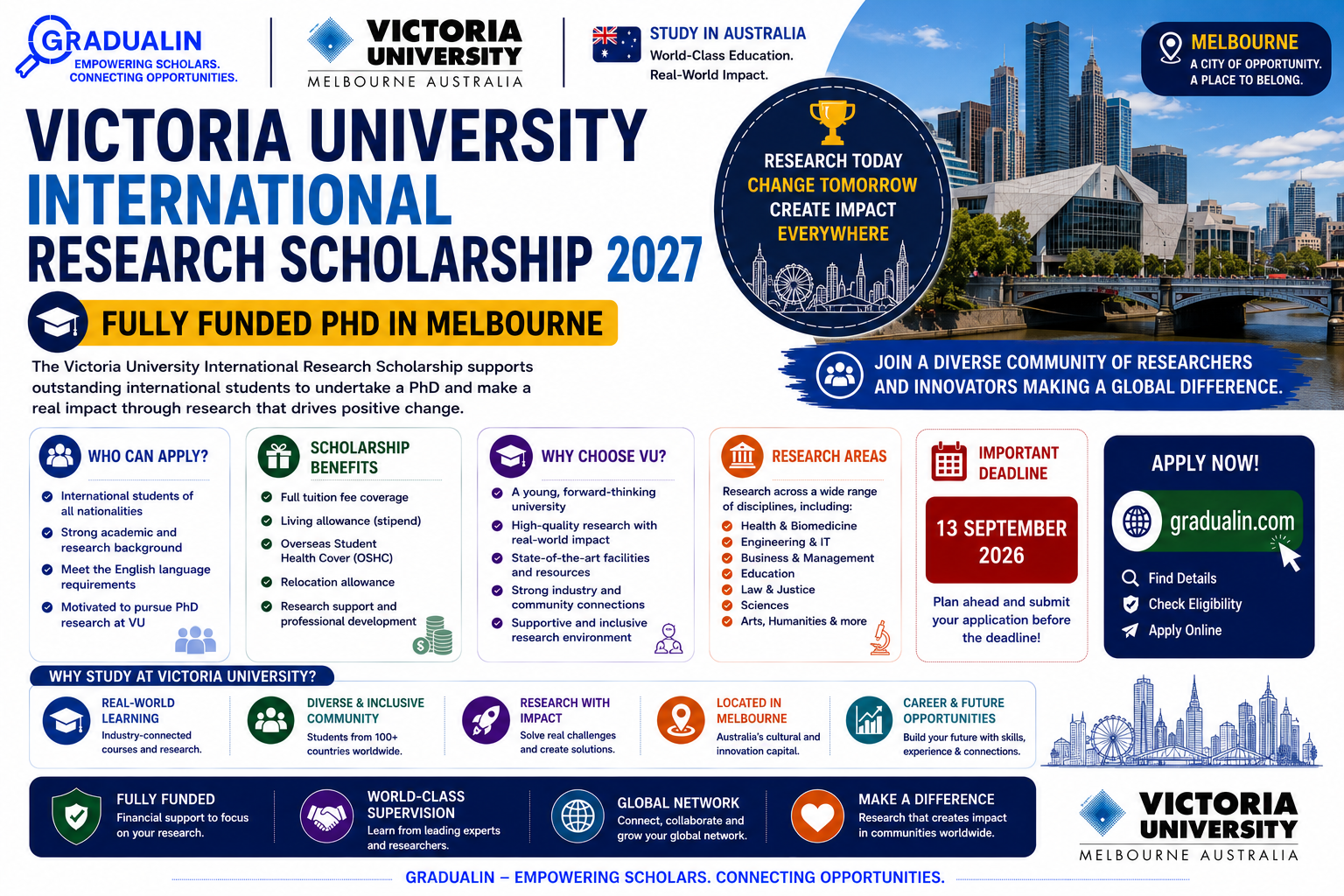
Victoria University International Research Scholarship 2027 — Fully Funded PhD in Melbourne, Deadline 13 September
Victoria University (VU) in Melbourne, Australia is currently accepting applications for its 2027 Round 1 International Research Scholarships — and the deadline is 13 September 2026. The flagship Research Training Program (RTP) Stipend Scholarship covers full PhD tuition, pays a living allowance of AUD $35,707 per year, and includes overseas health cover. There is no scholarship bond and no obligation to remain in Australia after completing your degree. Pakistani students are fully eligible and can meet the English proficiency requirement through medium-of-instruction certification — no IELTS required if your degree was taught in English.
This guide covers the full scholarship package, the critical Research Focus Outline step that most guides ignore, all eligibility criteria, the required documents with Pakistani-specific notes, and an honest assessment of what it takes to be competitive.
| Detail | Information |
| University | Victoria University (VU), Melbourne, Australia |
| Country | Australia |
| Degree Level | PhD (Doctor of Philosophy), Masters by Research |
| Funding Type | Fully Funded |
| Annual Stipend | AUD $35,707/year (2026 rate — verify 2027 rate on official page) |
| Tuition | 100% waived via RTP Fee Offset |
| Health Cover | Overseas Student Health Cover (OSHC) — single cover |
| Deadline | 13 September 2026, 11:59 PM AEST |
| Open To | International students (non-Australian, non-NZ citizens or PR) |
| Pakistani Students Eligible | Yes — fully eligible as international applicants |
| IELTS Required | IELTS 6.5 required (or equivalent — medium-of-instruction route available) |
| Official Link | Apply Here |
🎓 About Victoria University — and What Makes This Scholarship Different
Victoria University was established in 1916 and formally became a university in 1992. Today it operates across multiple campuses in Melbourne’s western suburbs — Footscray Park, St Albans, Sunshine — and in the CBD, serving over 50,000 students. It is one of the few Australian universities operating simultaneously as a higher education and TAFE institution, which gives its research environment a distinctly applied, industry-connected character.
In the Excellence in Research for Australia (ERA) national assessment, VU was rated above world standard in engineering, mathematical sciences, and applied mathematics, among other fields — a meaningful credential that distinguishes it from perception. Its two flagship research institutes — the Institute for Health and Sport and the Institute for Sustainable Industries and Liveable Cities — are where the majority of international PhD scholarship positions sit.
The feature that makes the VU RTP Scholarship genuinely different from comparable Australian PhD scholarships is the Research Focus Outline (RFO) system. Unlike the University of Melbourne’s RTP, where applicants propose their own research topic and find their own supervisor, VU requires you to select from a pre-approved list of RFOs — specific, supervisor-ready research projects across its priority areas. This means you are applying to an active, funded research agenda with a named supervisor already attached, not submitting a speculative proposal into the void. For international students without existing networks in Australia, this is a practical advantage: the supervisor relationship is embedded in the process from the start.
🎓 Scholarship Types — What Is Available
VU offers three distinct international research scholarship pathways under this round.
Research Training Program (RTP) Stipend Scholarship — International The flagship award. Combines a full tuition fee waiver (RTP Fee Offset), an annual living allowance of AUD $35,707 (2026 rate, indexed annually), and single-cover Overseas Student Health Cover. A separate scholarship application is not required — your eligibility is assessed automatically as part of your PhD admission application. This scholarship specifically supports students commencing a Doctor of Philosophy (PhD).
Tony Kruger Education for Social Justice Doctoral Research Scholarship A specialty award established in memory of Associate Professor Tony Kruger, a VU educator from 1987–2020 and Head of the School of Education from 2006–2011. This scholarship offers a higher annual stipend of AUD $40,707 (2026 rate) — AUD $1,000 more per year than the standard RTP — plus a full tuition fee waiver and OSHC. It is restricted to doctoral research in social justice within Education. This scholarship will next be awarded for Research Period 1 2027 — meaning the current round is the active cycle.
Project-Based Scholarships VU also offers PhD and Masters by Research scholarships tied to specific externally-funded research projects. These include at minimum an annual stipend and fee offset, with project-specific terms varying. Details on active project scholarships are listed separately under VU’s Project and Industry Research Scholarships page.
Fallback option — VU Global Research Scholarship: International applicants who do not qualify for the RTP Stipend Scholarship can receive a 20% tuition fee reduction for the full duration of their research degree through VU’s Global Research Scholarship. This is not a full scholarship but provides meaningful cost relief for self-funding researchers.
🎓 Benefits — In Practical Terms
The RTP package is worth understanding in actual numbers, not just headlines.
- Stipend: AUD $35,707 per year is approximately PKR 6.5–7 million annually at current exchange rates (verify for current conversion — rates fluctuate). In Melbourne, this covers rent, groceries, transport, and basic living expenses for a single person, particularly if living in shared accommodation or in VU’s Footscray or St Albans catchment areas, which are more affordable than the city centre.
- Tuition waiver: PhD tuition at VU for international students runs approximately AUD $30,000–$40,000 per year without a scholarship. The fee offset is therefore worth AUD $90,000–$160,000+ over a standard 3–4 year PhD duration.
- Health cover: Overseas Student Health Cover (OSHC) for a single student is included. This covers general practitioner visits, hospital treatment, and prescription medications through Australia’s health system.
- Duration: Standard PhD duration at VU is 3–4 years full-time. The scholarship is funded for the “timely duration” of the degree — meaning extensions require university approval and are not automatic.
- No bond: There is no return-of-service obligation. VU does not require graduates to remain in Australia or work for any particular employer after completing their degree.
Compared directly to the University of Melbourne’s RTP, which offers AUD $39,500 per year (2026 rate), VU’s stipend is AUD $3,793 lower annually. UoM also carries significantly higher international prestige and global rankings. However, VU’s RFO system makes it more accessible for international students who do not yet have supervisor contact in Australia, and VU’s research selectivity in some applied areas — particularly sport science, education, and engineering — is genuinely strong. For Pakistani applicants with research interests in these fields and a competitive academic record, VU is a practical and legitimate target.
🎓 Eligibility Criteria
To qualify for the RTP Stipend Scholarship — International:
- Citizenship: Must be a citizen of any country other than Australia or New Zealand, and must not hold Australian Permanent Residency. Pakistani students: fully eligible.
- Academic level: Must be commencing (not continuing) a Doctor of Philosophy (PhD) program at VU.
- Academic performance: Must have a Weighted Average Mark (WAM) or Honours year grade of H1 (85% or above on the VU grading scale), or equivalent in your most recent eligible qualification.
- Research Focus Outline: Must nominate an approved RFO as part of your application — this is mandatory for RTP consideration, not optional.
- Enrollment: Must enroll as a full-time student.
- English proficiency: Must meet VU’s English language requirements for research degree entry (see English Requirements section below).
Not eligible if:
- You are currently studying, or have recently completed, an AIDAB or AUSAID-funded scholarship and are applying immediately after those studies.
- You have previously held an IPRS, VUIPRS, or OPRS scholarship, unless that scholarship was for a Masters by Research and you are now applying for a PhD — in which case you remain eligible.
- Priority is given to applicants who have not already obtained a PhD. Applicants seeking a second doctorate are considered lower priority.
The competitive benchmark, per VU’s own guidance: applicants realistically need the equivalent of 85–90% on VU’s grading scale to receive a PhD stipend scholarship. The university receives a large volume of high-quality applications and cannot fund all eligible candidates.
🎓 Who Should Apply — and Who Probably Shouldn’t
✅ Strong candidates:
- Pakistani PhD applicants with a CGPA of 3.5/4.0 or above from an HEC-recognized university, particularly in engineering, education, health and sport sciences, AI, or applied mathematics — VU’s ERA rankings and research infrastructure are strongest in these areas
- Students who can identify and match a specific Research Focus Outline to their existing research experience — the closer the fit between your background and the RFO, the stronger the application
- Applicants with publications, conference presentations, or demonstrated research outputs — VU explicitly scores publications as part of merit assessment, and supporting evidence for each claimed publication is required
- Students who have completed an Honours year or equivalent research component — the H1 (85%+) requirement is specifically assessed against your most recent Honours or equivalent qualification
❌ Less likely to succeed:
- Applicants with a CGPA below 3.2/4.0 on a standard Pakistani university scale — the 85%+ equivalent benchmark is the competitive floor, not the average of funded recipients
- Students who cannot identify a Research Focus Outline that genuinely matches their background — submitting against a mismatched RFO signals poor research judgment and reduces ranking
- Those applying for broad fields without research focus specificity — “I want to study AI” is not a research proposal; the RFO system forces applicants to engage with specific, defined research problems, and vague interest statements fare poorly
- Students who delay requesting certified academic documents — VU’s application requires complete documentation at submission, and HEC attestation and verification of Pakistani transcripts add processing time
Pakistani applicant note: Pakistani graduate students from HEC-recognised institutions in engineering, computer science, and education fields have a genuine match with VU’s research focus areas. The applied, industry-linked research culture at VU is closer to the research environment at Pakistani public sector universities than the pure-research environment at institutions like ANU or UoM — which is an advantage for Pakistani PhD applicants who come from applied research backgrounds rather than theoretical ones.
🎓 Research Focus Areas Available
VU organises its doctoral research across six priority areas, each aligned with its two flagship institutes:
Institute for Health and Sport:
- Sport for performance, community participation, and healthy living (sports science, exercise physiology, sport history, sociology of sport, medical physiology)
- AI developments in health, biochemistry and cell biology, biomedical engineering, clinical sciences, health services and systems
Institute for Sustainable Industries and Liveable Cities:
- Innovating education and future-proofing Australia’s workforce (curriculum, pedagogy, education systems, psychology, public health, information systems, management)
- Engineering, AI and intelligent systems, built environment and design, food sciences, transportation, logistics and supply chain
- First Nations knowledge — Aboriginal and Torres Strait Islander culture, language, history, social psychology
- Visitor economy and tourism innovation
Applicants must browse the full Research Focus Outline list on the VU Research Focus Outlines page and select the RFO that most closely matches their research background and interest. Each RFO includes an RFO number, named supervisor(s), associated institute, course code, and Field of Research (FoR) code — all of which are required fields in the application.
🎓 English Language Requirements
VU’s research degree English requirement is IELTS 6.5 overall with no individual band below 6.0, or the TOEFL equivalent (minimum 79 iBT).
Alternative route for Pakistani applicants: If your previous degree — Bachelor’s, Master’s, or Honours — was completed entirely in English as the medium of instruction and assessment, VU may accept a Medium of Instruction (MOI) letter from your university instead of an IELTS score. This applies to most Pakistani university graduates from HEC-recognized institutions, where English is the standard medium of instruction. However, the MOI exemption must have been completed within a specified recency window — confirm the exact time limit with VU before relying on this route.
If your IELTS score is below 6.5 but you have a conditional admission offer, VU’s own English Language preparation programs (VU English — EAP Level 6) can be used as an alternative pathway. Note, however, that IELTS and English preparation program costs are not covered by the scholarship — this is an out-of-pocket cost.
🎓 Required Documents
Based on VU’s application guide and research degree requirements. Verify the current full list in the 2027 Application Guide (PDF) before submitting.
- Completed VU research degree application form — submitted through the Apply for Graduate Research portal
- Research Focus Outline (RFO) number and details — mandatory; select before starting the application
- Academic transcripts — all prior degrees, certified copies
- Degree certificates / graduation certificates — certified copies
- English language evidence — IELTS/TOEFL score report or Medium of Instruction letter (within recency requirements)
- Curriculum Vitae (CV) — reverse-chronological, maximum 2 pages; highlight academic achievements, research outputs, and relevant professional experience
- 200-word personal statement — explaining why you want to undertake this specific research and describing your academic trajectory; this is a scored criterion
- Publication evidence — for each claimed publication or creative work, supporting evidence plus a brief statement (up to 50 words) describing your contribution; acceptance letters required for unpublished-but-accepted work. Publications with no supporting evidence receive zero score.
- Two referees — academic referees familiar with your research capacity; reference letters or referee contact details as specified
- Passport copy — clear scan of biographical page
Pakistani applicant note: Academic transcripts from Pakistani universities must typically be certified. HEC attestation is the standard verification route for transcripts and degree certificates from Pakistani institutions. Allow 2–4 weeks for HEC processing before VU’s 13 September deadline — submitting an unattested transcript is a common reason for incomplete application rejection.
🎓 Step-by-Step Application Process
- Browse the Research Focus Outlines at VU’s RFO page and identify the outline that most closely matches your research background, field, and interests. Record the RFO number, supervisor name, institute, course code, and FoR code.
- Contact the Principal Supervisor named in your chosen RFO to discuss your interest and suitability. This is a required step, not optional — VU asks you to do this before submitting, and a supervisor who recognises your name and background from prior contact is better positioned to support your application.
- Download and read the Application Guide — the 2027 Application Guide PDF is the authoritative instruction document and specifies exactly how each criterion is scored.
- Prepare your documents in advance: HEC-attest your Pakistani transcripts, prepare your 200-word personal statement, compile publication evidence with contribution statements, and have referees ready to respond.
- Submit through the Apply for Graduate Research portal — follow the steps at VU’s Apply for Graduate Research page. The scholarship eligibility is assessed as part of your admission application — there is no separate scholarship form.
- Submit before 13 September 2026, 11:59 PM AEST. Late applications are not considered.
- Await outcome. Successful applicants are normally notified within two months of the closing date — so results are expected by approximately November 2026.
One practical tip that actually matters: Most rejected applications at competitive Australian research scholarship rounds contain a publication list with no supporting evidence. VU explicitly states that unsupported publication claims receive zero score. Before you finalize your application, print the scoring guide from the application guide PDF and verify that every claimed publication has an attached evidence document and a contribution statement. This alone separates prepared applicants from the rest.
🎓 Important Dates
| Milestone | Date |
| Applications for Research Period 1 2027 open | 27 July 2026 |
| Application deadline | Sunday, 13 September 2026, 11:59 PM AEST |
| Estimated outcome notification | Within 2 months of closing (~November 2026) |
| Research Period 1 2027 commencement | Early 2027 |
📌 Bookmark this page — we update deadlines as soon as changes are announced.
🎓 Why Study at Victoria University in Melbourne
Melbourne consistently ranks among the world’s most liveable cities, and VU’s campuses in the city’s western suburbs sit in communities that are among the most culturally diverse in Australia — with strong South Asian, Pakistani, and broader international student communities already established. This is a practical advantage for Pakistani students navigating a first move abroad: food, mosques, community networks, and culturally familiar environments are not hard to find.
VU’s research environment is applied and industry-connected in a way that directly benefits PhD graduates from developing countries. Research outputs from VU’s health, education, and engineering institutes regularly translate into real-world policy engagement with Australian government departments and community organisations — giving doctoral graduates a profile that extends beyond academic publishing into demonstrable impact.
The VU Block Model, while primarily a teaching innovation, also shapes the graduate research culture: supervisors and research teams at VU tend toward structured, milestone-based progress monitoring, which international students — particularly those accustomed to less structured supervision in Pakistani universities — often find helps them stay on track through a long doctoral program.
Gradualin Editor’s Note: The VU International Research Scholarship is a realistic target for strong Pakistani PhD applicants, particularly those in education, engineering, sport science, and applied AI. It is more accessible than the University of Melbourne’s RTP in terms of entry competition, and VU’s RFO system removes the supervisor cold-contact barrier that defeats many international applicants at other Australian universities. The gap in stipend compared to UoM (AUD $3,793 per year) is real but modest relative to the cost of living savings in VU’s campus areas versus central Melbourne. For the right applicant — specific research background, matching RFO, publications with evidence — this is an excellent opportunity. For those applying broadly with no supervisor contact and a generic research interest, the application guide’s scoring rubric will not be kind.
🎓 FAQ
These questions are based on what students most commonly search about this program.
Can Pakistani students apply for the Victoria University International Research Scholarship? Yes — Pakistani students are fully eligible as international applicants. Pakistan is not among the excluded nationalities (Australian and New Zealand citizens and Australian permanent residents are excluded). Pakistani applicants can meet the English proficiency requirement through an IELTS score of 6.5 overall, or via a Medium of Instruction letter if their previous degree was completed entirely in English — which applies to most HEC-recognized Pakistani university graduates.
Is IELTS required for this scholarship? IELTS 6.5 overall (with no band below 6.0) is VU’s standard English requirement for research degrees. However, Pakistani applicants who completed their Bachelor’s or Master’s degree entirely in English may qualify for a Medium of Instruction exemption instead — confirm with VU’s admissions team that your specific situation qualifies before relying on this route. Note that IELTS testing fees are not covered by the scholarship.
What is the Research Focus Outline, and why does it matter? The Research Focus Outline (RFO) is a pre-approved doctoral research project with a named supervisor, field, and research scope published by VU. You must select an RFO that matches your background and nominate it as part of your application — without this, you cannot be considered for the RTP Stipend Scholarship. This is the step that most scholarship listing sites fail to explain, and it is the step where most applications stall. Browse the full list at VU’s RFO page before doing anything else.
Does VU accept HEC-attested transcripts from Pakistani universities? Yes. Certified academic transcripts from HEC-recognized Pakistani universities are accepted as part of the VU research degree application. HEC attestation is the standard certification route for Pakistani academic documents. Allow 2–4 weeks for HEC processing before the 13 September 2026 deadline.
What GPA do I need as a Pakistani student? VU requires a Weighted Average Mark equivalent to H1 — 85% or above on VU’s grading scale — in your most recent eligible qualification. On a standard Pakistani university scale of 4.0, this generally corresponds to a CGPA of approximately 3.5 or above. VU indicates that the realistic competitive range for funded PhDs is 85–90% on their scale — applicants near the minimum threshold are eligible but less likely to receive a stipend given the competitive pool.
When will I hear back after applying? VU normally notifies successful applicants within two months of the application closing date. With a 13 September 2026 deadline, results are expected around November 2026.
🎓 Official Sources
- VU International Research Scholarships — Official Page
- Research Focus Outlines — Browse Available RFOs
- Apply for Graduate Research — VU Application Portal
- 2027 Application Guide PDF
- VU English Language Requirements for International Students
- General enquiries: 1300 842 864 or GoToVU online
🎓 Summary
| Detail | Information |
| University | Victoria University (VU), Melbourne, Australia |
| Country | Australia |
| Degree Level | PhD (Doctor of Philosophy), Masters by Research |
| Funding Type | Fully Funded |
| Annual Stipend | AUD $35,707/year (2026 rate) |
| Tuition | 100% waived — RTP Fee Offset |
| Health Cover | OSHC single cover included |
| Tony Kruger Specialty Award | AUD $40,707/year — Education / Social Justice PhD |
| Deadline | 13 September 2026, 11:59 PM AEST |
| Outcome Notification | Within ~2 months of closing |
| Open To | International students (non-AU/NZ) |
| Pakistani Students Eligible | Yes |
| IELTS Required | 6.5 overall / MOI exemption available |
| Bond | None |
| Official Link | Apply Here |
For more fully funded Australian scholarship opportunities, visit our Scholarships section. If you are exploring work alongside your studies, see our Jobs & Internships listings. Our Guidelines & Resources section has SOP and research proposal writing guides to help you prepare a competitive application. You can also browse upcoming academic Events & Conferences to build your research profile before applying.
If you are comparing Australian scholarships or other fully funded options, also read:
- Fully Funded Scholarships in Australia 2026
- Fully Funded PhD Scholarships in the UK 2026
- Fully Funded PhD Positions in Switzerland 2026
- Fully Funded Scholarships in the USA 2026
- Top 10 Fully Funded Scholarships in Asia 2027
Stay updated with the latest scholarships, jobs, and opportunities at Gradualin.com — your trusted guide to studying abroad for free.
Author: Faseeh Sultan — PhD Scholar & MSIT |7 Years in Education