
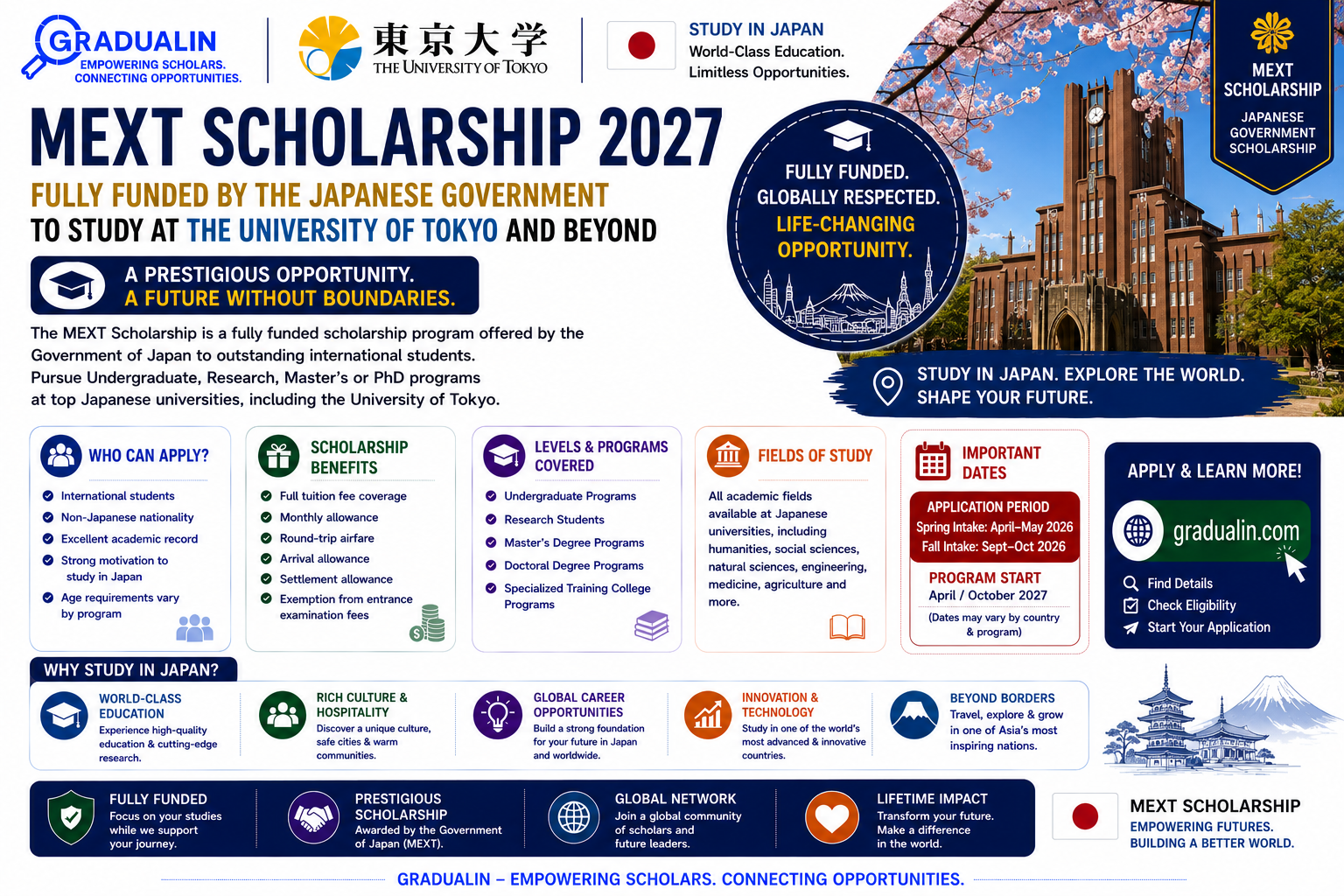
MEXT Scholarship 2027 — Fully Funded by the Japanese Government to Study at the University of Tokyo and Beyond
One of the most generous government-funded scholarships in the world covers your full tuition, pays you ¥143,000–145,000 per month (roughly PKR 300,000–320,000 at current rates), flies you to Japan and back, and asks for nothing in return — no bond, no service obligation, no repayment. That is the MEXT Scholarship, offered by Japan’s Ministry of Education, Culture, Sports, Science and Technology, and it is open to Pakistani students right now through two distinct routes. This guide covers everything you need to know: the benefits broken down in practical terms, the eligibility rules, the two application routes, the UTokyo-specific university recommendation process, and an honest assessment of what it actually takes to win one of these awards as a Pakistani applicant.
Whether you are targeting a Master’s, a PhD, or undergraduate study in Japan, read this before you open any application form.
| Detail | Information |
| Offered By | Ministry of Education, Culture, Sports, Science and Technology (MEXT), Japan |
| Host Universities | All national and private universities in Japan, including University of Tokyo |
| Degree Level | Undergraduate, Master’s, PhD, Research Student (non-degree) |
| Funding Type | Fully Funded |
| Monthly Stipend | ¥143,000 (research student / non-degree), ¥144,000 (Master’s), ¥145,000 (PhD) |
| Deadline (Embassy Route — Pakistan 2027) | 26 May 2026 (closed — 2028 cycle opens ~April 2027) |
| University Recommendation Deadline | November 2026–January 2027 (varies by graduate school) |
| Open To | International students from countries with diplomatic ties to Japan |
| Pakistani Students Eligible | Yes — via Embassy of Japan Islamabad or Consulate-General Karachi |
| English Test Required | No IELTS/TOEFL required — English proficiency certificate accepted from most applicants |
| Official Link | Apply Here |
🎓 What Is the MEXT Scholarship — and Why Does It Stand Apart
Japan’s MEXT Scholarship has been running for decades, making it one of the oldest and most institutionally respected government scholarship programs in Asia. Unlike merit scholarships tied to a single university or field, MEXT covers virtually every discipline across hundreds of Japanese universities simultaneously — from engineering at Tohoku to medicine at Osaka to humanities at Kyoto.
What separates MEXT from comparable awards is the combination of scale and freedom. The Chevening Scholarship (UK) requires you to return home and work for two years after graduating. The DAAD (Germany) is highly competitive and often tied to specific research agreements. MEXT imposes neither condition — you complete your degree, and you are free. The scholarship also does not require you to surrender your home-country university affiliation before applying, which matters for Pakistani students at HEC-recognized institutions who may be mid-career.
Approximately 8,000–10,000 new MEXT scholars are selected annually across all categories worldwide. The Research Student and Undergraduate categories attract the largest pools of applicants, and Pakistan is an established receiving country with a recognized track record of successful awardees.
🎓 What the Scholarship Covers — Funding Breakdown
The MEXT Scholarship is fully funded. Here is what that means in practice, not just on paper:
- Monthly stipend: ¥143,000 for research students (non-degree), ¥144,000 for Master’s students, ¥145,000 for PhD students. An additional ¥2,000–3,000 per month is added for students in designated high-cost areas.
- Tuition: 100% waived — entrance examination fees, admission fees, and tuition at national universities are all covered by MEXT.
- Airfare: Round-trip economy airfare between your home country and Japan, paid by MEXT.
- Japanese language preparation: A free six-month intensive Japanese course at a designated preparatory school before university enrollment begins.
- Health insurance: Access to the national university health system and associated student insurance programs.
In practical terms for Pakistani applicants: ¥145,000 per month converts to approximately PKR 305,000–320,000 at current exchange rates (verify on official website for current rates). Outside central Tokyo, this covers comfortable living — rent, food, transportation, and modest savings — for a single graduate student. In Tokyo itself, shared accommodation keeps costs manageable. Most MEXT awardees describe the stipend as adequate for living without needing part-time work, though working up to 28 hours per week is permitted with immigration authorization.
There is no return-of-service obligation. The Japanese government explicitly does not require MEXT graduates to remain in Japan or work for any Japanese institution after their degree. This is unusual among major government scholarship programs.
🎓 Eligibility Criteria
For Research Students (Master’s / PhD / Non-Degree Graduate):
- Nationality: Must be a citizen of a country with diplomatic relations with Japan. Pakistani students: fully eligible. Apply through the Embassy of Japan in Islamabad or the Consulate-General of Japan in Karachi (see application process below).
- Age: Born on or after 2 April 1992 for 2027 intake (i.e., under 35 at program start). Verify the equivalent cut-off for 2028 applications on the official guidelines.
- Academic background: Must hold — or expect to hold before arrival in Japan — a bachelor’s degree for Master’s/research student entry, or a Master’s degree for PhD entry.
- GPA: MEXT uses its own 3.0 grading scale. The working floor across most countries is a score of 2.30 out of 3.00, which translates roughly to a CGPA of 3.0/4.0 or above on a standard Pakistani university scale. This is the minimum, not the competitive target — successful applicants from Pakistan typically present 3.5+ CGPAs.
- Field of study: Applicants should apply in a field related to or directly matching their previous degree. No field is excluded — science, engineering, medicine, humanities, social sciences, arts, and professional fields all qualify.
- Health: Must be in good physical and mental condition. Active military personnel are not eligible.
For Undergraduate Students:
- Age: 17 to under 25 years old
- Completed 12 years of schooling (or equivalent)
- Pakistani students: eligible via Embassy of Japan Islamabad. The 2027 undergraduate deadline was 5 June 2026 (now closed). The 2028 cycle opens approximately April 2027.
English test requirement: No IELTS or TOEFL is required for either route. If your previous degree was taught entirely in English — as is the case for most Pakistani university graduates — an English Proficiency Certificate from your institution is accepted. However, holding a TOEFL or IELTS score strengthens your application materially for competitive placements, so submitting one is advisable if you have it.
🎓 Who Should Apply — and Who Probably Shouldn’t
✅ Strong fits for this scholarship:
- Pakistani graduate students with a CGPA of 3.5 or above from an HEC-recognized university, targeting Master’s or PhD study in STEM, engineering, or applied sciences — Japan’s research infrastructure in these fields is world-class
- Students who have already identified a specific research area and can write a detailed, focused research proposal — the quality of the research plan is the single biggest differentiator at the screening stage
- Applicants willing to learn Japanese or who already have some exposure — JLPT N4 or N3 certification, even basic, gives a visible signal of commitment that reviewers notice
- Mid-career Pakistani professionals targeting Japan as a gateway to Asia-Pacific research networks, where Japanese lab affiliations carry significant weight
❌ Less likely to succeed:
- Students applying without a clear research direction and relying on a generic study plan — MEXT reviewers read thousands of these and quickly identify proposals without intellectual specificity
- Applicants who have not researched specific Japanese universities or identified a potential supervisor — particularly for the University Recommendation route, where professor contact is mandatory before submission
- Those expecting an experience equivalent to European or North American graduate study — Japanese academic culture, lab norms, and working hours are genuinely different; applicants not prepared for this often struggle with fit
- Anyone who cannot commit to the full scholarship duration — MEXT requires degree completion within the funded period, and early withdrawal reflects poorly on Pakistan’s future country quota
One specific note for Pakistani applicants: Pakistan’s annual MEXT Research Student quota through the Embassy Recommendation route is approximately 15–30 awardees, drawn from an estimated applicant pool of 200–400. That translates to a realistic acceptance rate of roughly 7–12% — tighter than most Pakistani students expect. Competition is real, and the bar is calibrated accordingly.
🎓 Fields of Study Available
There are no academic field restrictions under MEXT. All disciplines taught at Japanese national and private universities are available, including:
- Engineering and Technology (strongest Japanese university offering)
- Natural Sciences (physics, chemistry, biology, mathematics)
- Computer Science and Artificial Intelligence
- Medicine, Pharmacy, and Health Sciences
- Agriculture and Environmental Sciences
- Humanities and Social Sciences
- Law, Economics, and Management
- Japanese Language and Culture
- Arts and Design
Applicants should apply in a field related to their previous degree. Switching fields entirely — for example, applying for a science PhD with an arts undergraduate background — is not prohibited but requires a particularly compelling justification in the research proposal.
🎓 Required Documents
The standard document list for the Research Student category (embassy route). Verify the complete current list against the official JASSO application guidelines before submitting.
- Completed MEXT application form (official form, available from your embassy or JASSO website)
- Academic transcripts — format depends on your background:
- Graduates: transcript of your completed degree
- Graduate degree holders: transcripts of both undergraduate and graduate programs
- Current undergraduates: transcript up to the most recently graded term
- Degree certificate / graduation certificate — attested copy
- Research plan / study proposal (typically 2–4 pages) — the most critical document in the file
- Two letters of recommendation from university professors or supervisors who can assess your academic and research ability; written in English
- Medical health certificate (on the MEXT form)
- Passport scan (if available at application time)
- Academic thesis or publications if applicable — strongly recommended for PhD applicants
Pakistani applicant note: Transcripts and degree certificates must be attested by HEC (Higher Education Commission) before submission. This step is commonly overlooked and causes applications to be rejected at intake. Allow 2–4 weeks for HEC attestation before your embassy deadline. Students from private universities in Pakistan should confirm their institution’s HEC recognition status in advance — some newer institutions have recognition at the BS level but not yet at the MS level, which affects how MEXT evaluates the credential.
🎓 Two Routes to the MEXT Scholarship — and the UTokyo-Specific Path
MEXT runs through two distinct application routes. Understanding which applies to you is essential before you begin.
Route 1: Embassy Recommendation You apply directly through the Japanese Embassy or Consulate in your home country. The embassy screens applicants, conducts written exams and interviews, then forwards recommended candidates to MEXT in Tokyo for final placement.
For Pakistani students:
- Islamabad channel: Embassy of Japan, Public Affairs Section, 53-70, Ramna 5/4, Diplomatic Enclave 1, Islamabad — for applicants whose CNIC permanent address is outside Karachi
- Karachi channel: Consulate-General of Japan, Japan Cultural Centre, 6/2 Civil Lines, Abdullah Haroon Road, Karachi — for applicants based in Karachi
- Apply through the channel corresponding to your CNIC permanent address. Applying through the wrong channel is a common reason for rejection at intake, with no exceptions.
The written exam tests English language ability and Japanese language (no prior Japanese knowledge required — this portion is assessed comparatively, not as a pass/fail threshold at most embassies). Subject-specific examinations in fields like mathematics or sciences may also be administered.
Route 2: University Recommendation A Japanese university selects and nominates you directly to MEXT as a candidate. This route bypasses the embassy exam process but requires prior contact with a Japanese professor who agrees to supervise your research and support your nomination.
The UTokyo-specific process: The University of Tokyo operates its own University Recommendation system across its graduate schools. Key facts:
- In the most recent cycle, each graduate school at UTokyo was permitted to nominate at most one applicant, with UTokyo as a whole nominating a maximum of three candidates to MEXT.
- Applicants must first contact a prospective supervisor at their target UTokyo graduate school and obtain a conditional acceptance for supervision.
- The supervisor signs Form 5 (official MEXT form), which the applicant then submits through UTokyo’s web application system together with the rest of the documentation.
- The UTokyo admissions process and MEXT screening process run in parallel — an offer from UTokyo does not guarantee the MEXT scholarship, and vice versa. Both screenings must be passed.
For the October 2027 intake via university recommendation at UTokyo, the application deadline for enrollment and MEXT scholarship nominations was 5 January 2027 (verify the 2028 equivalent on the UTokyo graduate school page).
🎓 Important Dates
| Milestone | 2027 Cycle Dates |
| Embassy Recommendation applications open (Pakistan) | ~April 2026 |
| Embassy Recommendation deadline — Pakistan Research Students | 26 May 2026 (closed) |
| Embassy Recommendation deadline — Pakistan Undergraduate | 5 June 2026 (closed) |
| Embassy written exams and interviews | July–August 2026 |
| University Recommendation application window (UTokyo) | November 2026–January 2027 |
| UTokyo University Recommendation submission deadline | 5 January 2027 |
| MEXT final selection results announced | January–March 2027 |
| Arrival in Japan (standard intake) | April 2027 / October 2027 |
| 2028 Embassy Recommendation cycle opens (Pakistan) | ~April 2027 |
📌 Bookmark this page — we update deadlines as soon as changes are announced.
For the 2028 cycle, Pakistani applicants should begin preparing their research proposals and securing professor contact by January–February 2027, and request HEC attestation at least a month before the expected embassy deadline.
🎓 Why Study in Japan — Why UTokyo
The University of Tokyo consistently ranks among the top 30 universities globally and is the single most selective destination under the MEXT University Recommendation route. Its graduate schools in engineering, sciences, medicine, and interdisciplinary research are equipped with infrastructure that most Pakistani researchers encounter only in published journals — not in person.
Beyond UTokyo specifically, Japan’s research environment offers something distinct from both Western and South Asian alternatives: a deeply systematic approach to methodology, an academic culture that values precision and long-term thinking, and access to industries — robotics, semiconductor manufacturing, precision engineering, pharmaceutical research — that do not exist at the same scale anywhere else in Asia. For Pakistani students in engineering, applied sciences, or technology fields, a Japanese lab affiliation is a credential that opens doors in both the private sector and academia internationally.
Tokyo itself is expensive relative to other Asian cities but remains significantly more affordable than London, New York, or Sydney. The MEXT stipend covers living costs adequately, and Japan’s low violent crime rate, efficient public transport, and high-quality healthcare infrastructure make it a practical choice for international students — particularly those who have not lived abroad before.
Gradualin Editor’s Note: For average to strong Pakistani applicants, the Embassy Recommendation route is a realistic target — but only for those willing to invest in a genuinely specific research proposal. Generic proposals modeled on scholarship blogs are rejected. The University Recommendation route at UTokyo specifically is highly competitive even by MEXT standards: with UTokyo nominating a maximum of three candidates university-wide, this is effectively a shortlist process. Average Pakistani applicants should first aim for the Embassy Route with a strong research plan, and consider UTokyo University Recommendation only after establishing contact with a specific professor willing to actively support the nomination.
🎓 FAQ
These questions are based on what students most commonly search about this program.
Can Pakistani students apply for the MEXT Scholarship 2027? Yes — Pakistan is an active MEXT-receiving country. Pakistani students apply through the Embassy of Japan in Islamabad (for most applicants) or the Consulate-General of Japan in Karachi (for applicants based in Karachi). The 2027 embassy route deadline has passed; the 2028 cycle opens approximately April 2027. The University Recommendation route at UTokyo and other Japanese universities has separate deadlines running into early 2027.
Is IELTS required for the MEXT Scholarship? No IELTS or TOEFL is required for most MEXT applicants. Pakistani university graduates whose degrees were taught in English can submit an English Proficiency Certificate from their institution instead. That said, holding a TOEFL or IELTS score does strengthen a competitive application, and some graduate schools at specific universities may request it for the University Recommendation route — always verify with the specific graduate school you are targeting.
Does UTokyo accept HEC-attested degrees for MEXT University Recommendation? Yes, but the attestation must be completed correctly. Transcripts and degree certificates should be attested by HEC before submission. For embassy route applications, the Embassy of Japan in Pakistan explicitly accepts HEC-attested documents. Allow 2–4 weeks for HEC processing. Students from recently established private universities in Pakistan should also confirm that their institution is fully HEC-recognized at both the bachelor’s and master’s level.
What is the minimum GPA to apply? MEXT uses its own 3.0 grading scale. The official minimum is 2.30/3.00 — equivalent roughly to a CGPA of 3.0/4.0 on a standard Pakistani university scale. However, applicants from Pakistan who are selected through the Embassy Recommendation route typically present significantly higher academic records. A CGPA below 3.2 on a 4.0 scale makes a competitive application difficult, though not impossible with exceptional research proposals or publications.
Can I choose the University of Tokyo as my host university? Through the Embassy Recommendation route, MEXT places candidates at Japanese universities based on a combination of your stated preferences and available capacity — UTokyo placement is not guaranteed, and is among the most competitive placements. Through the University Recommendation route, you apply specifically to UTokyo and must secure supervisor contact in advance. UTokyo’s annual university-recommendation MEXT quota is small (a maximum of three nominees university-wide in recent cycles).
What happens after the MEXT scholarship period ends? MEXT scholars who complete their degree with satisfactory performance can apply for a scholarship extension to continue to the next degree level at the same or a different Japanese university, subject to MEXT approval. Alternatively, students may continue as privately-funded students. There is no obligation to remain in Japan or to return immediately to Pakistan — the award carries no post-scholarship conditions.
🎓 Official Sources
- MEXT Scholarship Official Information — JASSO Study in Japan
- University of Tokyo MEXT Scholarship Page
- Embassy of Japan in Pakistan — MEXT Research Scholarship
- Embassy of Japan in Pakistan — MEXT Undergraduate Scholarship
- MEXT Official Scholarship Hub
- Contact — Public Affairs Section, Embassy of Japan, Islamabad: [Tel: +92 (51) 9072-223]
🎓 Summary
| Detail | Information |
| Offered By | Ministry of Education, Culture, Sports, Science and Technology (MEXT), Japan |
| Host Universities | All Japanese national and private universities, including University of Tokyo |
| Degree Level | Undergraduate, Master’s, PhD, Non-Degree Research Student |
| Funding Type | Fully Funded |
| Monthly Stipend | ¥143,000–145,000 + regional supplement |
| Tuition | Fully waived |
| Airfare | Round-trip economy class, Japan ↔ home country |
| Japanese Language Course | Free 6-month preparatory course included |
| Application Routes | Embassy Recommendation / University Recommendation |
| Pakistani Students Eligible | Yes — Islamabad Embassy or Karachi Consulate-General |
| English Test Required | No IELTS/TOEFL — proficiency certificate accepted |
| 2028 Embassy Route Opens | ~April 2027 |
| UTokyo University Rec. Deadline | 5 January 2027 (2027 cycle) |
| Official Link | Apply Here |
For more fully funded scholarship guides, browse our Scholarships section. If you are also exploring career opportunities alongside your studies, check our Jobs & Internships listings, or visit Events & Conferences for academic networking opportunities. Our Guidelines & Resources section covers SOP writing, document preparation, and study-abroad planning.
If you are researching other Asian scholarship opportunities, also see:
- Top 10 Fully Funded Scholarships in Asia 2027
- Top Fully Funded Scholarships in Saudi Arabia 2026
- Fully Funded PhD Scholarships in the UK 2026
- Fully Funded Scholarships in the USA 2026
- Fully Funded PhD Positions in Switzerland 2026
Stay updated with the latest scholarships, jobs, and opportunities at Gradualin.com — your trusted guide to studying abroad for free.
Author: Faseeh Sultan — PhD Scholar & MSIT | 7 Years in Education