
Fully Funded Karsh International Scholars Program 2027 — Duke University
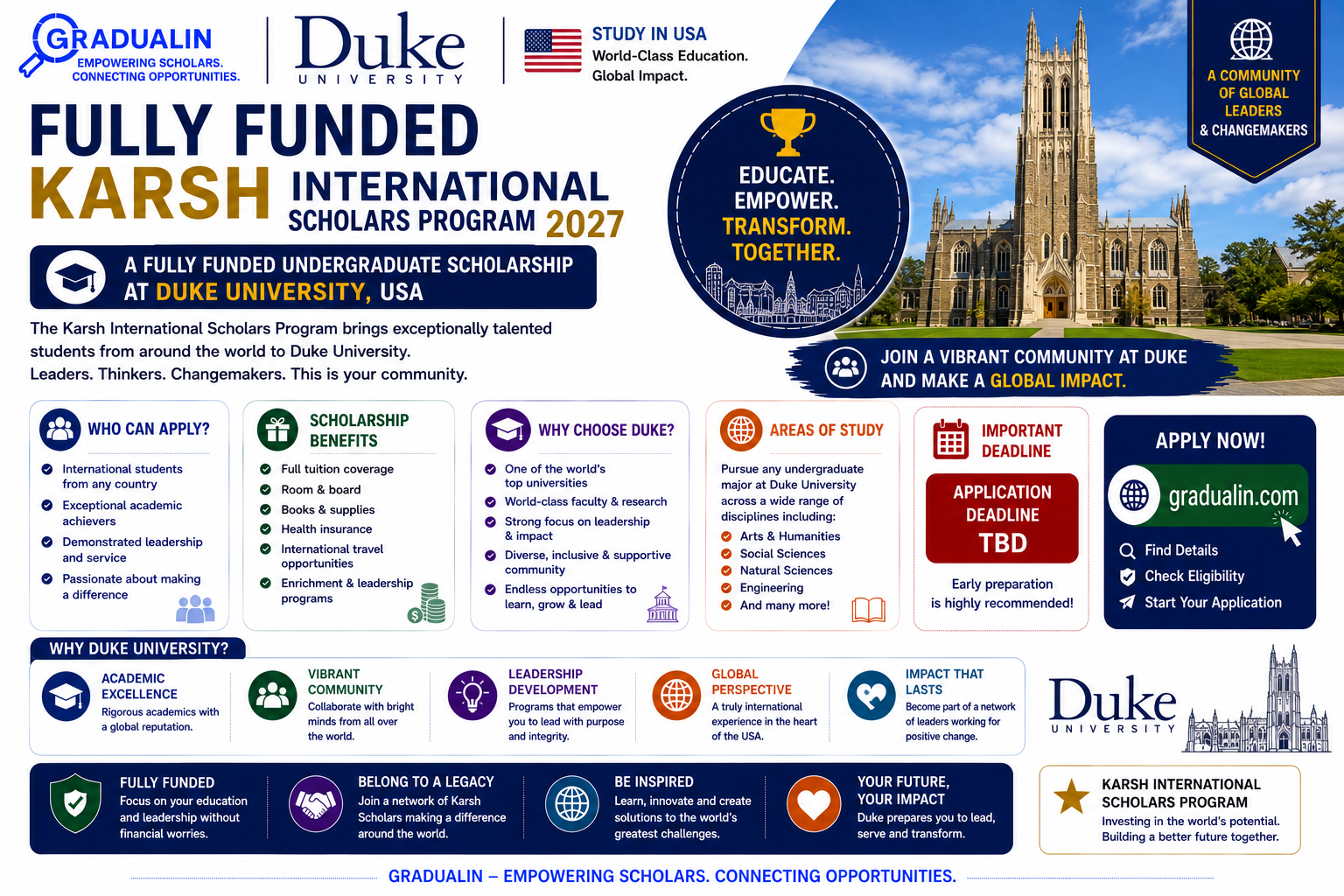
Duke University is one of fewer than a dozen American universities that meets 100% of demonstrated financial need for international undergraduates — no loans, only grants. The Karsh International Scholars Program sits at the top of that commitment. It covers everything: tuition, room and board, mandatory fees, and three full summers of funded research or internships. Pakistani students are in the current cohort, and the program actively recruits from South Asia. If you are a high-achieving Pakistani student finishing secondary school, this guide explains exactly how the Karsh Scholarship works, what it pays, who actually gets it, and how to build an application that stands a real chance.
| Detail | Information |
| University | Duke University |
| Country | United States of America |
| Degree / Level | Undergraduate (Bachelor’s) |
| Funding Type | Fully Funded (merit + need-based) |
| Early Decision Deadline | November 3, 2026 |
| Regular Decision Deadline | January 5, 2027 |
| Financial Aid Deadline (RD) | February 1, 2027 |
| Open To | All international students (non-US citizens, no dual US nationality) |
| Pakistani Students Eligible | Yes — Pakistan is explicitly listed in the current cohort |
| Official Link | Apply Here |
🎓 About the Karsh International Scholars Program
The Karsh International Scholars Program was established in 2010 through a personal donation from Martha L. and Bruce A. Karsh — philanthropists with a long track record of funding access to elite higher education. The scholarship does not exist to fill a diversity quota. It exists because Duke’s leadership made a deliberate institutional decision: international students who push the intellectual culture of campus deserve to be here regardless of what their families can afford.
The program selects a small cohort each year — typically around four to eight students — from the entire global pool of international applicants who apply for financial aid. The current cohort includes students from Botswana, Brazil, Bulgaria, Chile, England, Ethiopia, Ghana, India, Iran, Kenya, Mongolia, Nepal, New Zealand, North Macedonia, Norway, Pakistan, Romania, Russia, Rwanda, Syria, Tunisia, Vietnam, and Zimbabwe. That list tells you something important: this is not a scholarship designed for students from wealthy countries. It skews toward emerging economies and highly competitive academic traditions — which puts South Asian applicants in a genuinely strong position.
Unlike programs such as the Chevening Scholarship or even the DAAD, the Karsh is embedded directly inside Duke’s admissions process. There is no external portal, no separate essay round, and no recommendation letters submitted to a scholarship committee. You apply to Duke University, request financial aid, and the scholarship selection happens internally. That simplicity is both a feature and a trap — because it means the scholarship committee never sees a “Karsh application.” They see your Duke application. Everything is riding on that document.
🎓 Benefits and Funding
The Karsh Scholarship is legitimately fully funded. Based on published Duke scholarship data, the total value over four years is estimated at over $315,000 (verify current estimate on the official page), making it one of the most financially comprehensive undergraduate awards anywhere in the world.
What it covers:
- Full tuition for four years of undergraduate study
- Room and board — on-campus housing and meal plan
- Mandatory fees — all required university and student fees
- Demonstrated need beyond standard costs — if your financial situation requires support above tuition and living, that is factored in
- Three summers of funding — up to $7,000 per summer (verify on official page) for research projects, unpaid internships, and other approved academic opportunities
- Technology support — scholars may apply for computer and equipment support (verify on official website)
To put this in Pakistani context: Duke’s annual tuition alone exceeds USD 76,000 per year (approximately PKR 21 million at current exchange rates — verify rates at time of application). The Karsh Scholarship removes every one of those costs entirely.
🎓 Eligibility Criteria
- Must be an international student — not a US citizen and not a dual national holding US citizenship alongside another passport
- Must be applying as a first-year undergraduate — students who already hold a B.A. or B.S. degree are not eligible
- Must demonstrate financial need — completing the CSS Profile and Duke’s financial aid forms is required
- Must show strong academic preparation — Duke’s admitted class typically holds marks in the top 5–10% of their secondary school cohort
- Must apply to Duke University directly and check the financial aid interest box on the admissions application — if you do not check this box at application, you cannot access financial aid or this scholarship later
English test requirement: Duke does not mandate a TOEFL or IELTS score for undergraduate applicants. Testing requirements are identical for domestic and international students. However, submitting a strong English proficiency score (IELTS 7.5+ or TOEFL 110+) is strongly recommended for international applicants whose schooling was not in English — it removes any doubt about language readiness.
Pakistani students: Fully eligible. Pakistan is explicitly named among the countries represented in the current Karsh cohort on Duke’s official program page. No nationality restrictions apply beyond the US citizenship exclusion.
🎓 Who Should Apply — and Who Probably Shouldn’t
✅ Strong fits:
- Pakistani students with A-level results in the top tier (4–5 A*s or equivalent) or FSc students with 95%+ marks who have been preparing for US admissions
- Students with a visible record of civic or research engagement — published work, olympiad results, community leadership, or sustained independent projects
- Applicants whose families genuinely cannot afford US education costs, making the financial need component authentic and documentable
- Students applying through Common App who have already invested in strong essays and letters of recommendation
✅ Pakistani applicants specifically: Past cohorts have included Pakistani scholars, and South Asian students with strong HEC-aligned academic records are competitive. The key differentiator for Pakistani applicants is typically the depth of extracurricular leadership and the quality of application essays — not just marks.
❌ Poor fits:
- Students applying purely for the scholarship without genuine interest in Duke’s specific academic culture and research environment
- Applicants with strong marks but no evidence of intellectual curiosity or civic engagement outside the classroom
- Students who have already completed a bachelor’s degree — this scholarship is strictly for first-year undergraduates
- International transfer students — Duke does not offer need-based or merit scholarships for international transfers
🎓 Fields and Programs Available
The Karsh Scholarship is open to all undergraduate programs at Duke. There is no field restriction. Duke offers over 60 majors and the flexibility to combine disciplines — current and past Karsh Scholars have studied across:
- STEM fields — Engineering (Electrical, Computer, Biomedical), Computer Science, Mathematics, Biology, Physics
- Social Sciences — Economics, Political Science, Public Policy, Psychology
- Humanities — History, Philosophy, Literature, Languages
- Pratt School of Engineering — a distinct engineering school within Duke with its own academic culture
- Trinity College of Arts and Sciences — the main undergraduate college
Pakistani students with strong science and engineering backgrounds should note that Duke’s Pratt School of Engineering is particularly strong in biomedical and electrical engineering — fields where Pakistani students have historically competitive preparation through the FSc and A-level systems.
For a full list of majors and programs, visit the Duke Undergraduate Admissions page.
🎓 Required Documents
The Karsh Scholarship has no separate document list — all documents are submitted through the standard Duke admissions application. Here is what you need:
- Common Application — Duke accepts the Common App; complete all sections fully
- School Counselor Report and Transcript — submitted directly by your school; for Pakistani students, this means your FSc or A-level marksheets and predicted grades
- Two Teacher Recommendations — from teachers in core academic subjects taught within the last two years
- Personal Essay — the Common App personal statement (650 words)
- Duke Supplemental Essays — Duke’s own short-answer questions (check Duke’s current supplement on the Common App portal each cycle)
- CSS Profile — the financial aid form required for need assessment; complete this carefully and honestly; it asks for detailed family financial information
- Duke Financial Aid Forms — additional forms available through the Duke Financial Aid website
Pakistani student note: Your FSc or A-level marksheets and predicted grades are accepted as transcripts. You do not need to have them evaluated by WES or a credential evaluation service for undergraduate admissions (verify this directly with Duke Admissions — policies can be updated). If your transcripts are not in English, an official translation is required alongside the original documents.
🎓 Step-by-Step Application Process
- Create a Common App account at commonapp.org and add Duke University to your college list
- Check the financial aid interest box on the Duke section of your Common App — this is the single most important step; missing it makes you ineligible for all need-based support including the Karsh Scholarship
- Complete the CSS Profile at cssprofile.collegeboard.org — use Duke’s CSS code (5156) and enter your family’s financial details accurately and thoroughly
- Write your application essays — the personal statement and Duke supplemental essays; these carry significant weight in Karsh consideration because they reveal intellectual curiosity and civic commitment
- Request school reports and recommendations — give your counselor and teachers at least four to six weeks’ notice; Pakistani students should ensure their school can submit the counselor report directly through Common App
- Submit by your chosen deadline — Early Decision (November 3, 2026) is binding; Regular Decision (January 5, 2027) is non-binding. If Duke is your clear first choice, ED strengthens your chances
- Complete financial aid by the matching deadline — the ED financial aid deadline matches the ED application deadline (November 3, 2026); the RD financial aid deadline is February 1, 2027
- Finalists are interviewed — shortlisted Karsh candidates are contacted by the OUSF and interviewed (historically by video call) in late March; recipients are notified shortly after
Pakistani student note: There is no HEC degree attestation required at the application stage since this is an undergraduate scholarship (you are applying before completing a degree). However, if admitted, Duke may request verification of your secondary school credentials. Keep original FSc/A-level documents accessible and note that Duke’s admissions office can guide you through any additional verification steps.
🎓 Important Dates
| Milestone | Date |
| Early Decision Application Deadline | November 3, 2026 |
| Early Decision Financial Aid Deadline | November 3, 2026 |
| Regular Decision Application Deadline | January 5, 2027 |
| Regular Decision Financial Aid Deadline | February 1, 2027 |
| Finalist Interviews (approximate) | Late March 2027 |
| Award Notification | Spring 2027 |
📌 Bookmark this page — deadlines are updated as soon as changes are announced.
🎓 Why Apply — Why Duke University
Duke is consistently ranked among the top 10 universities in the United States and top 25 globally. It is a genuine research university — not a teaching college with research branding. Over 53% of Duke undergraduates participate in faculty-led research. For a Karsh Scholar, that access begins immediately: the scholarship’s summer funding is explicitly designed to support research and internship experiences from the summer after freshman year.
Durham, North Carolina sits inside the Research Triangle — one of the most concentrated technology and biomedical research ecosystems in the world, alongside UNC Chapel Hill and NC State. For students interested in engineering, medicine, public policy, or technology, the regional network around Duke is a meaningful career asset.
The program’s Faculty Director, Dr. Giovanni Zanalda, is a professor of economics and history with a background at the World Bank — which signals something about the kind of intellectual environment Karsh Scholars enter. This is not a scholarship that puts you in a cohort and leaves you alone. There is a faculty director, a staff team, and a community of peers from across the world.
Gradualin Editor’s Note: The Karsh Scholarship is one of the genuinely competitive awards in this guide. Duke’s overall undergraduate acceptance rate for international students is around 4–5%. Karsh selection happens from within an already-admitted or near-admission-level pool of international financial aid applicants — the bar is high. Average Pakistani applicants with good marks but limited extracurricular depth are unlikely to be competitive. Students who have genuinely pursued something — research, leadership, a creative or civic project — and who can write about it compellingly have a real shot. If you are a strong applicant who needs full funding to attend a US university, this scholarship is worth the full effort of a serious application. If you are building your profile, spend the next one to two years creating something worth writing about.
🎓 FAQ
These questions are based on what students most commonly search about this program.
Can Pakistani students apply for the Karsh International Scholarship? Yes. Pakistan is explicitly named among the countries represented in the current Karsh cohort on Duke’s official program page. There are no nationality restrictions beyond the exclusion of US citizens and US dual nationals. Pakistani students have successfully been selected for this scholarship in past cycles.
Is IELTS or TOEFL required for the Karsh Scholarship / Duke undergraduate admissions? No English proficiency test is mandated for undergraduate applicants at Duke. The university applies the same testing policy to all applicants regardless of nationality. That said, submitting strong IELTS or TOEFL results (IELTS 7.5+ or TOEFL 110+ are competitive benchmarks) is strongly recommended for applicants whose secondary schooling was not in English, as it removes any ambiguity about language readiness for the admissions committee.
Is there a separate Karsh Scholarship application? No. You apply to Duke University through the Common App and complete the financial aid forms. The Karsh selection committee reviews international applicants who qualify for financial aid from within that pool. There is no external portal, no separate essay, and no separate nomination process.
What is the realistic chance of getting this scholarship? The Karsh Scholarship is among the most selective awards in this guide. Duke admits roughly 4–5% of undergraduate applicants internationally, and Karsh recipients are a small subset of admitted international financial aid recipients. Exact selection numbers are not published publicly by Duke, but sources have cited cohorts of approximately four to eight scholars per year. This is a high-aspiration target, not a backup plan.
Does Duke accept FSc results from Pakistan? Yes. Duke accepts international secondary school credentials including FSc and A-levels. Transcripts do not need to be evaluated by WES for undergraduate admissions (verify directly with Duke Admissions for your specific cycle). Official translations are required if transcripts are not in English.
What makes Karsh different from Duke’s other financial aid? Duke meets 100% of demonstrated need for all admitted international undergraduates who apply for aid — that is the institutional baseline. What makes Karsh different is the community, the three summers of funded research and internship opportunities, the faculty mentorship, and the recognition as a named scholar. Financially, the aid package may be similar for any fully need-met student; the Karsh designation adds the co-curricular infrastructure built around it.
🎓 Official Sources
- Program Page: Karsh International Scholars Program
- Admissions Portal: Duke Undergraduate Admissions
- Financial Aid: Duke Financial Aid for International Students
- Common Application: commonapp.org
- CSS Profile: cssprofile.collegeboard.org
- Contact (OUSF): ousf@duke.edu | +1 (919) 660-3070
- Mailing Address: Smith Warehouse, 114 South Buchanan Blvd., Bay 8N, Durham, NC 27701
🎓 Summary
| Detail | Information |
| University | Duke University |
| Country | United States of America |
| Degree / Level | Undergraduate (Bachelor’s) |
| Funding Type | Fully Funded (merit + need-based) |
| Total Estimated Value | Over $315,000 (verify on official page) |
| Early Decision Deadline | November 3, 2026 |
| Regular Decision Deadline | January 5, 2027 |
| Financial Aid Deadline (RD) | February 1, 2027 |
| Open To | All international students (non-US citizens, no dual US nationality) |
| Pakistani Students Eligible | Yes — explicitly listed in current cohort |
| IELTS / TOEFL Required | Not mandatory (strongly recommended) |
| Official Link | Apply Here |
For more fully funded opportunities in the United States and beyond, explore:
- Fully Funded Scholarships in the USA 2026
- Top 10 Fully Funded Scholarships in Asia 2027
- Fully Funded Scholarships in Australia 2026
- Fully Funded PhD Scholarships in the UK 2026
- Study in Canada 2026 — Guide for International Students
Browse all opportunities by category: Scholarships | Jobs & Internships | Events & Conferences | Guidelines & Resources
Stay updated with the latest scholarships, jobs, and opportunities at Gradualin.com — your trusted guide to studying abroad for free.
Author: Faseeh Sultan — PhD Scholar & MSIT |7 Years in Education