
Fully Funded POSCO Global Scholarship Korea 2027 — Complete Guide
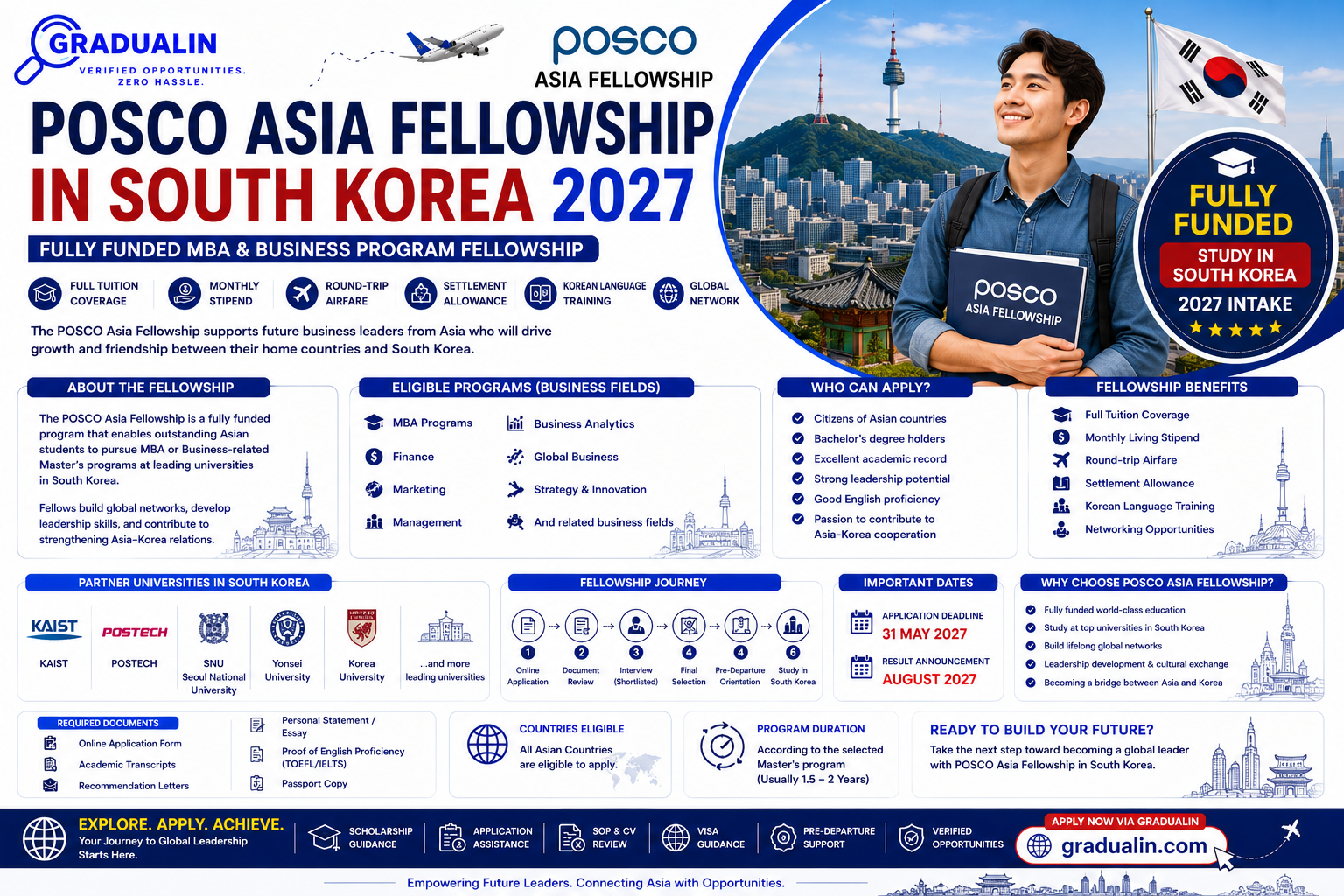
South Korea’s most prestigious corporate-backed graduate scholarship has been running for over two decades — and for 2027, it is now open to students from 27 countries across Asia, Europe, the Americas, and Africa. The POSCO Global Scholarship in Korea, offered by the POSCO TJ Park Foundation, covers full tuition and a monthly living allowance for international students pursuing Master’s or Doctoral degrees at some of South Korea’s top-ranked universities. If you have already been admitted — or are planning to apply — to a participating Korean graduate school, this scholarship could fund your entire degree. This guide covers everything: benefits, eligible countries, partner universities, the application process, and how to prepare for the 2027 cycle.
| Detail | Information |
| Organisation | POSCO TJ Park Foundation |
| Country | South Korea |
| Degree / Level | Master’s, Doctoral, Integrated Master’s–Doctoral |
| Funding Type | Fully Funded |
| Application Cycle | Annual — 2027 cycle expected November 2026 |
| Open To | Nationals of 27 designated countries (non-Korean) |
| Official Link | POSCO TJ Park Foundation |
🎓 About the POSCO Global Scholarship in Korea
The POSCO TJ Park Foundation is the philanthropic arm of POSCO, one of the world’s largest steel producers and a defining force in South Korea’s industrial story. The Foundation established this inbound scholarship program back in 2005, and over the past two decades it has supported 532 scholars from across the globe — with cumulative funding exceeding KRW 22.8 billion.
What makes this different from most Korean scholarships is its direction. Rather than sending Korean students abroad, this program brings the world to Korea — welcoming outstanding international graduate students to study at the country’s most respected universities. Scholars don’t just attend class; they engage in Korean industry visits, cultural programs, and a growing alumni network that stretches across dozens of countries.
For the 2027 cycle, the program continues its expanded scope — now drawing applicants from 27 countries spanning four continents. This expansion, first introduced for the 2026 cohort, signals that the Foundation is building something genuinely global, not just regionally focused. Up to 20 students are selected per year, making this one of the more selective fully funded opportunities available in Asia.
🎓 Scholarship Benefits
This scholarship is genuinely comprehensive. Here is exactly what recipients receive:
- Full tuition coverage — 4 semesters for Master’s students; 6 semesters for Doctoral and Integrated Master’s–Doctoral students
- Monthly living expenses — KRW 1,000,000 per month for the duration of the programme (22 months for Master’s; 36 months for Doctoral/Integrated)
- Settlement fee — a one-time payment of KRW 1,000,000 upon arrival in Korea
- National Health Insurance (NHIS) premium — covered throughout the scholarship period
- Korean language education — structured language learning support to help scholars settle in and communicate
- Cultural experience programmes — industry visits, cultural immersion activities, and Foundation events
- Certificate award ceremony — recognition as a POSCO Global Scholar at the annual March ceremony
- Welfare services — ongoing support from the Foundation for scholars throughout their studies
Note: The Foundation confirms these figures on its official website. Verify the exact monthly amounts for the 2027 cycle at postf.org when the new announcement is released.
🎓 Eligibility Criteria
Before you get excited about the benefits, check whether you qualify:
- You must hold (or be expected to hold) a Bachelor’s degree at the time of application
- You must hold non-Korean nationality — applicants with Korean citizenship, including dual citizens, are not eligible
- You must have already been admitted to a Master’s, Doctoral, or Integrated Master’s–Doctoral programme at a designated Korean graduate school — admission comes first, scholarship application comes second
- You must be recommended by your admitting institution — the university nominates and submits your application to the Foundation on your behalf
- You must be a national of one of the 27 designated countries (verify the current list on the official site, as it is subject to change)
- Applicants must study in the humanities, social sciences, natural sciences, or engineering
Important note on English requirements: The Foundation does not publish a universal minimum English test score on its programme page. Requirements are set at the graduate school level. Check the language requirements of your specific Korean university and programme directly. (verify on official website)
🎓 Who Should Apply — Who Shouldn’t
✅ Strong candidates:
- International students who have already secured (or are actively pursuing) admission to SNU, Korea University, Yonsei, POSTECH, or another partner school
- Students in humanities, social sciences, engineering, or natural sciences planning a Master’s or PhD in South Korea
- Nationals from any of the 27 eligible countries (Asia, Europe, Americas, Africa) who are not Korean citizens
- Applicants who want a fully funded graduate experience paired with genuine cultural immersion in Korea
- Those who can prepare their university admission application by October–November 2026
❌ Not a fit if:
- You hold Korean citizenship or dual Korean nationality
- Your country is not among the 27 designated nations (verify the current list)
- You want to choose your own university freely — participation is limited to specific partner institutions
- You need the scholarship before gaining university admission — this is not a standalone scholarship; admission is the prerequisite
- You are planning undergraduate study (graduate level only)
🎓 Partner Universities and Eligible Fields
The scholarship is linked to a specific set of top Korean graduate schools. Based on confirmed data, eligible universities include:
- Seoul National University (SNU)
- Korea University
- Yonsei University
- POSTECH (Pohang University of Science and Technology)
- KDI School of Public Policy and Management
- The Academy of Korean Studies
The Foundation notes that the eligible university list is tentative and subject to change each cycle. Additional institutions may be added or removed for 2027 — always confirm the current list at postf.org when the new notice is released.
Eligible fields span a broad range: humanities, social sciences, natural sciences, and engineering. This is one of the few Korea-based graduate scholarships that covers both STEM and non-STEM disciplines at this level, making it more accessible than many competing programmes.
🎓 Required Documents
Document requirements are managed at the university level, but based on past cycles at SNU and other partner schools, you should prepare:
- Completed scholarship application form (provided by your graduate school’s international office)
- Official Bachelor’s degree certificate (or expected graduation letter)
- Official academic transcripts from all previous institutions
- Proof of nationality (valid passport copy)
- Letter of recommendation from your graduate school (submitted by the institution, not you personally)
- Statement of purpose / research plan (requirements vary by university)
- English proficiency certificate if required by your programme
- Any additional documents requested by your specific graduate school
The Foundation receives your application through your graduate school, not directly. Confirm with your international office well before the deadline — early submission is strongly recommended in every cycle.
🎓 Step-by-Step Application Process
The POSCO Global Scholarship in Korea has a unique application flow that puts your university admission first. Here is how to prepare:
- Research and shortlist — identify which of the eligible partner universities and graduate programmes align with your academic goals
- Apply for graduate school admission — submit your application to the Korean university directly, targeting November admission decisions (~November each year)
- Secure your admission letter — you must have confirmed or expected admission before the scholarship application is submitted
- Contact your international/graduate office — once admitted, notify your school’s international office about the POSCO Global Scholarship and ask to be considered for the institutional nomination
- Prepare your documents — gather everything on the required documents list; your graduate school will advise on the specific format
- Graduate school submits your nomination — by the Foundation’s December deadline, your school submits the recommendation to the POSCO TJ Park Foundation on your behalf
- Foundation interview — shortlisted candidates are interviewed by the Foundation (typically January of the new year)
- Final selection announced — results are typically published in February
- Certificate ceremony — successful scholars attend the official award ceremony in March, with studies beginning that semester
Practical tip: Contact the international office of your target Korean university as soon as you decide to apply — not after admission. Ask them directly whether they nominate students for the POSCO Global Scholarship and what internal deadlines they set. Schools like SNU have their own submission deadlines several days before the Foundation’s official cut-off.
🎓 Important Dates
| Stage | Approximate Timing |
| Graduate School Admission | By November (each year) |
| University Recommendation Submission | By December (each year) |
| Foundation Interview | January |
| Final Selection Announcement | February |
| Certificate Award Ceremony | March |
For the 2027 cycle, prepare your university admission application from August–October 2026. Bookmark this page and check postf.org for updates — the Foundation publishes the new notice through partner universities around November each year.
🎓 Why Korea — Why This Scholarship
South Korea is not just rising as an academic destination — it has arrived. Universities like Seoul National University, POSTECH, and Korea University consistently rank among the top institutions in Asia, with globally recognised research output in engineering, materials science, economics, and the humanities.
Here is the best part: studying in Korea through the POSCO programme gives you more than a degree. Scholars gain direct exposure to Korea’s industry ecosystem — POSCO is a cornerstone of Korean industrial development — along with a Foundation-supported network of hundreds of alumni now working in government, academia, and business across 27+ countries. Seoul is one of Asia’s most connected, modern, and affordable capital cities for students. The cost of living is manageable, public transport is excellent, and the safety record for international students is consistently strong.
What makes this particular scholarship stand out is its combination of financial comprehensiveness and cultural depth. The language education, industry visits, and Foundation events mean you leave Korea not just with a degree, but with a genuine understanding of one of Asia’s most influential economies. That combination is rare in scholarship programmes at this level.
🎓 Frequently Asked Questions
Q: My country isn’t in Asia — can I still apply? A: Yes. The 2026 expansion brought in students from Germany, the United States, the United Kingdom, Brazil, Egypt, South Africa, and more. The programme now covers 27 countries across four continents. Check the current eligible country list at the official website to confirm your nationality.
Q: Do I apply to the Foundation directly? A: No. You first apply for graduate school admission at a participating Korean university. Once admitted, your university’s international office submits the scholarship nomination to the POSCO TJ Park Foundation on your behalf. You cannot apply independently.
Q: Is this scholarship compatible with the Global Korea Scholarship (GKS)? A: The POSCO TJ Park Foundation has indicated incompatibility between the two programmes in some cycles. Confirm this directly with your university’s international office before applying to both.
Q: What fields of study are covered? A: Humanities, social sciences, natural sciences, and engineering are all eligible. This is broader than many Korea-focused scholarships that restrict to STEM only.
Q: How many students are selected each year? A: Up to 20 students per year, subject to change. The 2026 cohort selected 19 scholars.
Q: Can I apply if I already started my graduate programme? A: The scholarship targets newly admitted students. Based on past announcements, applicants must be entering their programme in the upcoming semester. Confirm with your graduate school whether continuing students are considered.
🎓 Official Source
- Programme page: POSCO Global Scholarship in Korea — Program
- FAQ: POSCO Global Scholarship — FAQ
- Foundation contact: asiafellowship@postf.org
- Phone: +82-2-562-0227
- Address: 5th Floor, West Wing, POSCO Center, 440 Teheran-ro, Gangnam-gu, Seoul, South Korea
🎓 Summary Table
| Detail | Information |
| Scholarship Name | POSCO Global Scholarship in Korea |
| Offered By | POSCO TJ Park Foundation |
| Country | South Korea |
| Level | Master’s, Doctoral, Integrated Master’s–Doctoral |
| Funding | Full tuition + KRW 1,000,000/month living expenses |
| Settlement Fee | KRW 1,000,000 (one-time) |
| Health Insurance | Covered (NHIS) |
| Number of Awards | Up to 20 per year |
| Eligible Countries | 27 countries (Asia, Europe, Americas, Africa) |
| Eligible Fields | Humanities, Social Sciences, Natural Sciences, Engineering |
| Partner Universities | SNU, Korea University, Yonsei, POSTECH, KDI School, Academy of Korean Studies (verify for 2027) |
| Application Route | Through university international office — not direct |
| 2027 Cycle Expected | November 2026 (admission); December 2026 (nomination) |
| Official Website | postf.org |
Explore more opportunities on Gradualin:
Related reads from Gradualin:
Top 10 Fully Funded Scholarships in Asia 2027
Fully Funded PhD Scholarships in the UK 2026
Fully Funded PhD Positions in Switzerland 2026
Stay updated with the latest scholarships, jobs, and opportunities at Gradualin.com — your trusted guide to studying abroad for free.