
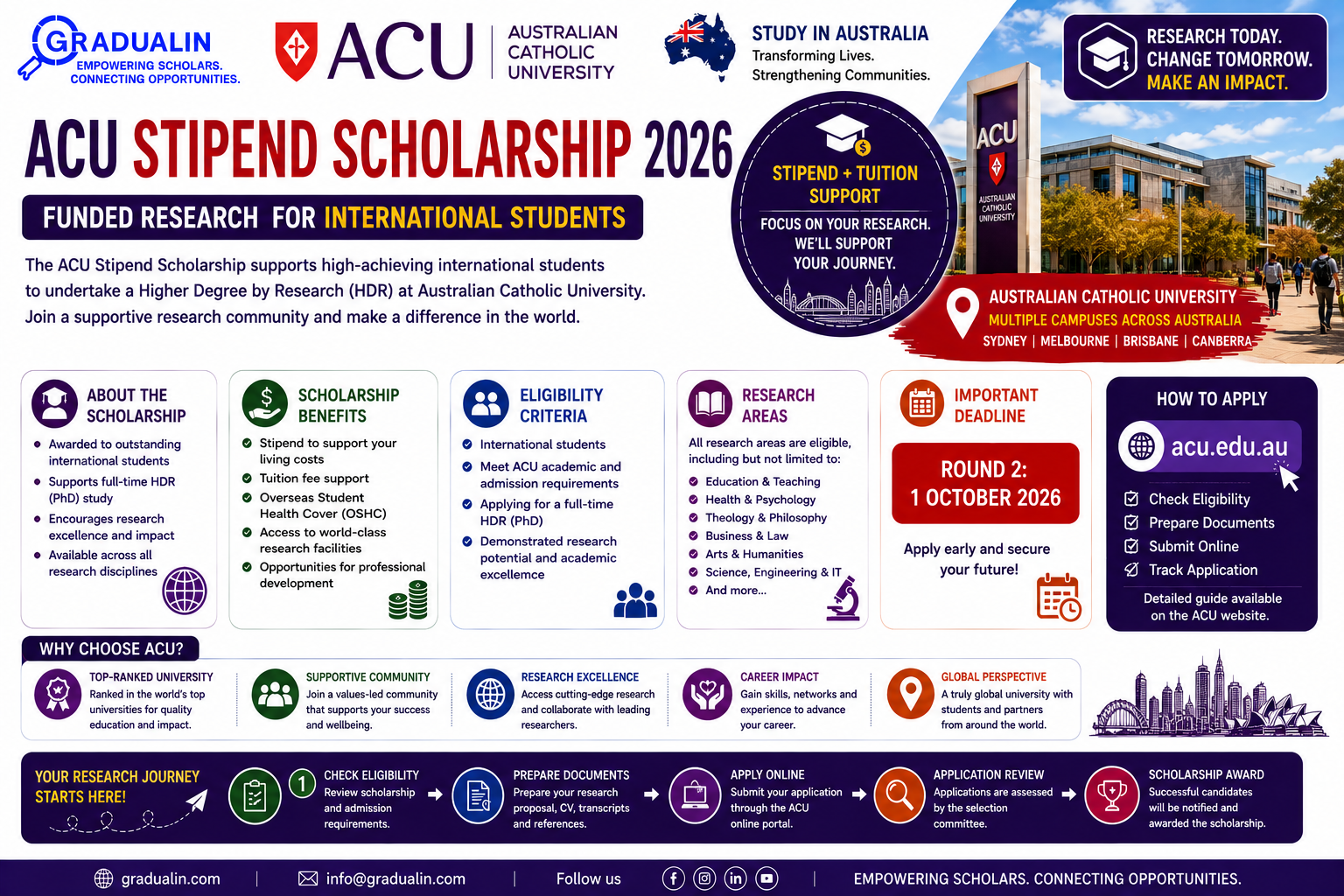
ACU Stipend Scholarship 2026 — Funded Research for International Students
The Australian Catholic University is offering one of the most accessible research funding packages available to international students in Australia right now: the ACU Stipend Scholarship, which combines a AUD $34,315 annual living stipend with a full tuition fee offset, health cover, and a relocation allowance — all in a single package. Pakistani and South Asian students pursuing a PhD or Master of Philosophy (MPhil) are fully eligible to apply, and applications open twice per year, giving you more than one shot to secure funding.
This guide covers everything the official page doesn’t: how the full scholarship package actually stacks up, what ACU’s English proficiency requirement means for international applicants, what your research proposal needs to include, and how the two application rounds work in practice.
| Detail | Information |
| University/Organization | Australian Catholic University (ACU) |
| Country | Australia |
| Degree/Level | Research Doctorate (PhD, DMin) and Research Masters (MPhil) |
| Funding Type | Stipend + Fee Offset + OSHCP + Relocation Allowance |
| Deadline | Round 2: 1 October 2026 |
| Open To | Domestic and International Students |
| Pakistani Students Eligible | Yes |
| Official Link | Apply Here |
🎓 About ACU and This Scholarship
The Australian Catholic University is a nationally and internationally recognised research university with campuses across six Australian cities — Brisbane, Melbourne, Sydney (North Sydney and Strathfield), Canberra, Ballarat, and Blacktown — plus a presence in Rome. Despite the “Catholic” in its name, ACU is non-discriminatory in admissions and explicitly open to students of all faiths and none. The university consistently ranks among the world’s top Catholic universities and holds strong positions in the Times Higher Education and QS rankings, particularly in nursing, education, theology, and health sciences.
The ACU Stipend Scholarship sits within ACU’s broader Graduate Research School funding framework, funded directly by the university and governed by its Research Training Program (RTP) Scholarship Policy. What makes it distinct from the federal government’s Australian Government RTP Stipend — which is quota-limited and highly competitive nationally — is that this is a university-administered award assessed against ACU’s own merit criteria. That means international applicants are not competing against the entire Australian university system; they are competing within ACU’s applicant pool specifically, which is a meaningfully different proposition.
The scholarship is awarded twice a year, aligning with ACU’s April and October application rounds, which gives strong candidates a second opportunity if they miss one round or need more time to strengthen their application.
🎓 Benefits — What the Full Package Covers
The ACU Stipend Scholarship is structured as a combined package. Here is what successful applicants receive:
- Living stipend: AUD $34,315 per annum (full-time rate, 2026 value, indexed annually)
- Full tuition fee offset: approximately AUD $34,728 per annum — this covers your research degree fees entirely, so you are not paying out of pocket for tuition
- Overseas Student Health Cover Policy (OSHCP): a single policy covering you for the duration of your candidature (international students only)
- Relocation allowance: up to AUD $2,000 as a one-off payment to help offset the cost of relocating to Australia (international students only)
At the current PKR exchange rate, AUD $34,315 is approximately PKR 6.2–6.5 million per year (verify current rates before applying). That is a meaningful living allowance in Australian cities, though it will be tighter in Sydney and Melbourne than in Canberra or Ballarat, where living costs are lower.
One important distinction worth noting: the tuition fee offset for domestic students is automatically provided via the federal Research Training Program Fees Offset Scholarship. For international students, ACU offers its own ACU Tuition Fee Scholarship, which is competitive and separately assessed. The stipend scholarship application covers both, but international applicants should be aware that the fee offset is not guaranteed — applicants who are not awarded the tuition scholarship will be required to pay full international tuition fees.
🎓 Eligibility Criteria
- Must be enrolled (or gaining admission) in an accredited Research Doctorate or Research Masters at ACU — this includes the PhD, Doctor of Ministry (DMin), and Master of Philosophy (MPhil)
- Open to both domestic and international students
- Proposed research must align with ACU’s research areas, which span Education and Arts, Health Sciences, Law and Business, Theology and Philosophy, and Computer Science and Data Science
- Award is merit-based — strong academic credentials and demonstrated research potential are required
- English language proficiency is required for all applicants whose first language is not English, or who completed prior university studies in a non-English medium. This must be demonstrated through a recognised test (IELTS, TOEFL, PTE, or equivalent) completed within two years of your intended start date. The specific minimum scores are outlined in Appendix C of ACU’s Higher Degree Research Policy — verify these on the official page before applying
Pakistani students: Eligible. There are no stated nationality restrictions. Pakistani applicants must meet the English proficiency requirement above, which typically means an IELTS Academic score of 6.5 or higher overall (verify on official page — ACU’s HDR policy sets the exact threshold). Pakistani universities recognised by HEC are generally accepted, but you will need certified/attested transcripts (see Documents section below).
🎓 Who Should Apply — and Who Probably Shouldn’t
✅ Strong candidates for this scholarship:
- Applicants with a completed Honours thesis, published research, or a strong MPhil/Masters-level research record
- Students whose research interests align clearly with ACU’s faculty strengths — particularly health sciences, education, and theology/philosophy
- Pakistani students from HEC-recognised universities with First Class or distinction-level academic records and a clear research idea
- Applicants who can develop a credible 2,000-word research proposal before the deadline
- International students who have already identified a potential ACU supervisor or research project to anchor their application
❌ This scholarship may not be the right fit if:
- Your research area sits entirely outside ACU’s current expertise — the university does not cover all disciplines equally, and proposing a topic with no available supervisors is the single most common reason applications fail
- You cannot demonstrate English proficiency through a recognised test — unlike some research scholarships, ACU has no stated waiver for this requirement
- You are looking for a scholarship covering an undergraduate or taught postgraduate degree — the ACU Stipend is for research degrees only
- You need funding to begin immediately — allow at least 12 weeks from application to commencement
One specific note for Pakistani students: applicants from public universities (University of Karachi, University of Punjab, NUST, COMSATS, QAU, and similar HEC-recognised institutions) have a realistic path here, provided their research proposal is strong and their transcript is properly attested. A First Class (3.5 GPA or above on a 4.0 scale) is the competitive baseline.
🎓 Available Research Areas and Degree Options
ACU supports research across five broad faculty areas:
- Faculty of Education and Arts — curriculum studies, linguistics, history, creative arts, philosophy of education
- Faculty of Health Sciences — nursing, midwifery, physiotherapy, exercise science, nutrition, paramedicine
- Faculty of Law and Business — accounting, law, management, social work
- Faculty of Theology and Philosophy — moral theology, bioethics, church history, philosophy
- Computer Science and Data Science — emerging and expanding research area
Degree options: Doctor of Philosophy (PhD), Doctor of Ministry (DMin), and Master of Philosophy (MPhil). The DMin is specifically for ministry practitioners and is distinct from the academic PhD. The MPhil is a shorter research degree suited to applicants who want to transition into doctoral study or produce a focused original research contribution.
You can browse ACU’s full research expertise directory to identify supervisors actively working in your proposed area before applying.
🎓 Required Documents
- Academic resume (CV) — include qualifications, relevant employment, research experience, publications, awards, scholarships, and exhibitions or performances
- Research proposal (2,000 words) — submitted as a text-searchable PDF or .docx. This is your single most important document
- Certified copies of academic transcripts — all higher education study to date
- Copies of completed research — published articles, thesis extracts, book chapters, or research reports where available
- Thesis from any previously completed degree, along with examination reports
- Proof of identity — birth certificate, citizenship certificate, or passport (including visa pages)
- Two referee reports — your nominated referees receive an email invitation directly from ACU’s online system and submit their reports independently
For Pakistani applicants specifically: Your academic transcripts and degree certificates will need to be certified/attested. HEC attestation of your degree and transcripts is the standard process for Pakistani graduates applying to international institutions. If you are currently enrolled in another research program, you will also need an official enrolment summary from your current institution confirming your program, load consumed, and scholarship status. Do not send unattested copies — this is one of the most common processing delays for Pakistani applications.
🎓 Step-by-Step Application Process
- Choose your research degree — decide between PhD, DMin, or MPhil based on your academic background and research goals
- Define your research area — browse ACU’s research expertise directory and identify supervisors working in your proposed field. You may (optionally) contact a potential supervisor before applying to discuss your proposal — but note that supervisor interest does not guarantee admission
- Write your 2,000-word research proposal — this is the centrepiece of your application. Focus on your research question, methodology, and its relevance to existing scholarship. ACU states perfection is not expected, but clarity and feasibility matter most
- Gather and certify your documents — obtain HEC-attested transcripts and degree certificates if you are a Pakistani applicant; have your passport and identity documents ready
- Nominate two referees — enter their correct email addresses in the online application; they will receive an automated invitation. You are responsible for ensuring both reports are submitted before the deadline
- Submit your application via the ACU online portal — visit How to Apply and follow the domestic or international applicant guide
Practical tip that actually matters: Submit your completed application — including confirmed referee reports — at least one week before the scholarship deadline, not just before the general research degree application deadline. ACU’s own guidelines state this explicitly, and applications with outstanding referee reports at the closing date are not assessed.
For Pakistani applicants: HEC attestation can take 4–8 weeks. Factor this into your timeline and do not leave document preparation until the last month before the deadline.
🎓 Important Dates
| Round | Application Deadline | Domestic Commencement | International Commencement |
| Round 1 | 1 April 2026 (closed) | First workday of August | First day of Research Term D (October) |
| Round 2 | 1 October 2026, 11:59 PM AEST | First workday of February 2027 | First day of Research Term C (July 2027) |
Round 2 (1 October 2026) is the next open deadline. Bookmark this page — we update deadlines as soon as changes are announced.
🎓 Why Apply — Why ACU and Australia
Australia is consistently ranked among the top study destinations in the world for graduate research, and for good reason: the research environment is internationally collaborative, English-language, and opens direct pathways into academia, government, and industry both within Australia and globally. An Australian research degree from a recognised university is well-regarded by HEC Pakistan for faculty recruitment and promotion purposes, which matters if your career goal is academic.
ACU specifically offers something that larger Go8 universities (University of Melbourne, ANU, University of Sydney) do not always provide to international candidates: a community-driven, mission-aligned research environment where individual candidates tend to receive more direct supervision attention. This is not a sprawling research university where PhD students can get lost. The faculties are smaller, supervision is more personalised, and the university’s stated commitment to human dignity and community engagement shapes the kind of research it actively supports — particularly in health, education, and social ethics.
The combination of a living stipend, full fee offset, OSHCP, and relocation support means the total funding package for an international student is worth well over AUD $70,000 in the first year alone, before factoring in the value of the degree itself.
Gradualin Editor’s Note: The ACU Stipend is a realistic target for Pakistani and South Asian applicants who have a strong academic record and a genuine research idea — it is not a lottery-style award. The competitive bar is meaningful but not out of reach for motivated candidates from top HEC-recognised universities. The biggest differentiator in this application is the research proposal: a vague, generic proposal will not succeed, while a focused, supervisor-matched proposal from a candidate with a 3.5+ GPA has a legitimate shot. If your research area fits ACU’s faculty strengths, this is worth prioritising.
🎓 FAQ
These questions are based on what students most commonly search about this program.
Can Pakistani students apply for the ACU Stipend Scholarship? Yes. There are no stated nationality restrictions on the ACU Stipend Scholarship. Pakistani students are fully eligible to apply, provided they meet the academic and English proficiency requirements. The scholarship is open to all international candidates enrolled in or applying for a Research Doctorate or Research Masters at ACU.
What English test score does ACU require for research degrees? ACU requires English language proficiency from applicants whose first language is not English or who completed prior studies in a non-English medium. Recognised tests include IELTS, TOEFL, and PTE Academic. The minimum score requirements are set out in Appendix C of ACU’s Higher Degree Research Policy — verify the exact thresholds on the official page before applying. Tests must have been completed within two years of your intended start date.
Do I need to contact a supervisor before applying? No — it is optional. ACU will allocate a suitable supervisor if your application is successful. However, contacting a potential supervisor beforehand can strengthen your application: it demonstrates initiative, allows you to refine your proposal with subject-matter input, and may increase your chances of having appropriate supervision available. Browse the ACU supervisor directory to identify potential matches.
Does ACU accept HEC-attested degrees from Pakistani universities? ACU’s admissions process accepts certified copies of transcripts and degree certificates. For Pakistani graduates, HEC attestation is the standard certification route recognised internationally — ensure your transcripts and degree certificates are HEC-attested before applying. If your institution is HEC-recognised, your qualification will meet ACU’s basic entry requirements, subject to meeting minimum GPA and research degree entry standards.
How competitive is this scholarship? ACU does not publicly disclose the number of awards per round or the applicant-to-award ratio. Selection is merit-based, with academic credentials and research potential as the primary criteria. Given that the award covers tuition fees, a living stipend, and additional support for international applicants, competition is genuine. Your research proposal and referee reports carry significant weight — these are the components you can most actively control in your application.
What happens if I am not awarded the tuition fee offset alongside the stipend? The ACU Tuition Fee Scholarship (fee offset) is a separate award assessed concurrently with the stipend application for international students. Domestic students automatically receive a federal RTP Fees Offset. If an international applicant is awarded the stipend but not the tuition scholarship, they will be liable for full international tuition fees, which would significantly reduce the net value of the award. Confirm the current fee rates on the International Student Fees page before making a financial plan.
🎓 Official Source
- ACU Stipend Scholarship — Official Page
- How to Apply — Graduate Research School
- ACU RTP Scholarship Policy
- English Language Requirements (Appendix C, HDR Policy)
- Graduate Research School contact: graduateresearch@acu.edu.au
🎓 Summary
| Detail | Information |
| University/Organization | Australian Catholic University (ACU) |
| Country | Australia |
| Degree/Level | Research Doctorate (PhD, DMin) and Research Masters (MPhil) |
| Funding Type | Stipend + Tuition Fee Offset + OSHCP + Relocation Allowance |
| Annual Stipend | AUD $34,315 (2026 value, indexed annually) |
| Tuition Fee Offset | ~AUD $34,728 per annum (competitive for international students) |
| Relocation Allowance | Up to AUD $2,000 (international students) |
| Deadline — Round 2 | 1 October 2026, 11:59 PM AEST |
| Open To | Domestic and International Students |
| Pakistani Students Eligible | Yes |
| Official Link | Apply Here |
For more research funding opportunities in Australia, explore our guide to Fully Funded Scholarships in Australia 2026. If you are weighing research options across countries, our Fully Funded PhD Scholarships in the UK 2026 and Fully Funded PhD Positions in Switzerland 2026 are also worth reviewing. For a broader view of opportunities open to Pakistani students, browse our Scholarships section, check Jobs & Internships, stay current with Events & Conferences, or visit Guidelines & Resources for step-by-step application guides.
Stay updated with the latest scholarships, jobs, and opportunities at Gradualin.com — your trusted guide to studying abroad for free.
Author: Faseeh Sultan — PhD Scholar & MSIT | 7 Years in Education