
Fully Funded Weidenfeld-Hoffmann Scholarship Oxford 2027 — Complete Guide
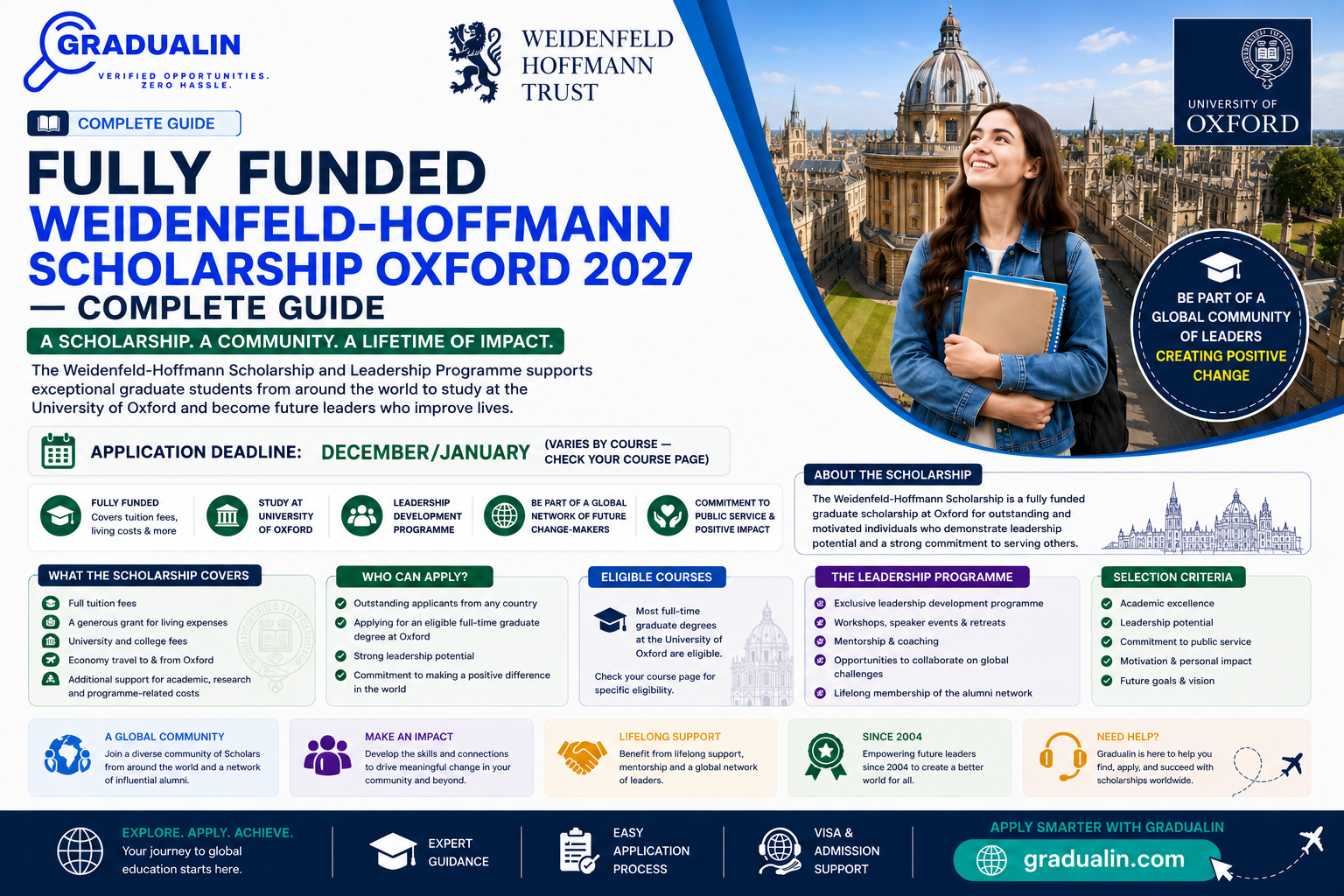
Oxford University is one of the hardest institutions in the world to get into — and one of the most expensive to attend. The Weidenfeld-Hoffmann Scholarship and Leadership Programme removes both barriers at once. It covers 100% of course fees, provides a £21,805 living stipend for the year, and wraps around 200 hours of leadership training into the scholarship package. Students from low and middle-income countries — including Pakistan, India, Bangladesh, Nepal, and over 150 other eligible nations — can apply. Applications open in September 2026 for the 2027/28 academic year. This guide covers everything: what the scholarship actually funds, what Oxford and WHT are looking for, how Pakistani and South Asian students should approach the application, and the one step most applicants miss.
| Detail | Information |
| Scholarship Name | Weidenfeld-Hoffmann Scholarships and Leadership Programme |
| University | University of Oxford, UK |
| Degree Level | Postgraduate Master’s (1-year courses only) |
| Funding Type | Fully Funded — 100% course fees + living stipend + Leadership Programme |
| Stipend | £21,805 (2026–27 figure; 2027–28 to be confirmed) |
| Application Opens | September 2026 |
| Application Deadline | December/January (varies by course — check your course page) |
| Study Begins | September 2027 |
| Open To | Graduates and early career professionals from 150+ countries |
| Pakistani Students Eligible | Yes — Pakistan is explicitly on the eligible country list. Oxford Pakistan Partnership sub-scheme also available. |
| Official Link | Apply Here |
🎓 About the Weidenfeld-Hoffmann Trust and This Scholarship
The Weidenfeld-Hoffmann Scholarship was established in 2015 to mark the 95th birthday of Lord Weidenfeld, the Austrian-British publisher and philanthropist who built one of the most distinguished publishing houses in the English-speaking world. In 2017, Trustee and Chairman André Hoffmann donated £9 million to the Trust, matched by £6 million from Oxford University — effectively doubling the scholarship’s reach.
The programme operates as part of Oxford’s Graduate Scholarships, funded 60% by the Trust and its donors and 40% by the University of Oxford itself. This is not a fringe award — it sits within Oxford’s formal funding infrastructure, and successful scholars are formally affiliated with partner Oxford colleges, adding a collegiate layer to the experience.
What genuinely distinguishes this scholarship from comparable UK awards like the Chevening Scholarship is the Leadership Programme. Chevening is a prestigious UK government diplomatic programme that selects for future leaders in government and civil society — it is primarily about networks and national profiles. The Weidenfeld-Hoffmann programme is narrower in scope (Oxford only, Master’s only) but deeper in its academic and leadership integration: scholars engage in philosophical discussions, business skills training, communication development, and cohort-based activities across the academic year. The Leadership Programme runs from mid-September (before the academic term begins) through to early July — scholars are expected to be in Oxford for this full extended period.
🎓 Funding and Benefits
- Course fees: 100% covered for the full duration of the eligible course (9–12 months)
- Living stipend: £21,805 for the 2026–27 year (2027–28 figure to be confirmed — verify on official website). Approximately PKR 7.9 million / USD 27,000 at current rates — a genuinely comfortable living allowance for Oxford
- Leadership Programme: Approximately 200 hours of professional development, training, and cultural activities — fully funded and compulsory as part of the scholarship award
- College membership: Scholarship holders are transferred to a partner Oxford college, which includes access to college facilities, accommodation priority, and the academic and social life of an Oxford college
What is not covered:
- International travel to and from the UK
- Family dependant costs (note the 2023 UK visa rule change — family members cannot join as dependants for non-government-funded scholarships, which affects WHT scholars unless they specifically hold the WHT-Chevening combined award or are in a research programme)
- Costs beyond the standard duration of the course
The £21,805 stipend is set at a level Oxford estimates as adequate for a single student living in Oxford. Oxford is not cheap — but the stipend is benchmarked against Oxford’s own cost-of-living estimates, and most scholars manage comfortably within it.
🎓 Eligibility Criteria
- Must be applying to start a new, full-time graduate course at Oxford — from the list of eligible programmes (see next section)
- Must be ordinarily resident in one of the 150+ eligible countries — Pakistan, India, Bangladesh, Nepal, Sri Lanka are all eligible
- Must intend to return to your country of ordinary residence after completing the course
- Must demonstrate a clear connection between your chosen course and your longer-term career objectives and how your work will benefit public life in your home country or region
- Must be offered a place at Oxford (scholarship consideration only happens after Oxford offers you admission — the two processes run in parallel but are distinct)
- Not eligible if you hold a deferred Oxford offer from a previous cycle
- Not eligible if you are already studying at Oxford (unless you are a current WHT scholar)
- No age limit — but typical scholars are early career professionals with five or more years of work experience
- English language proficiency: Oxford’s standard English requirements apply. The specific test and score depend on your course — IELTS is the most common requirement. Check your course page for the exact English requirement (verify on official website)
Pakistani students: Pakistan is explicitly named on the eligible country list. Additionally, the Oxford Pakistan Partnership is a named sub-scheme under the Weidenfeld-Hoffmann Trust — Pakistani applicants may be considered for this partnership alongside the main scholarship. This makes Pakistani applicants particularly well-positioned compared to applicants from countries without a named bilateral arrangement. (Verify current Oxford Pakistan Partnership availability on the official WHT or Oxford website.)
🎓 Who Should Apply — and Who Probably Shouldn’t
✅ Strong fit:
- Graduates from Pakistan, India, Bangladesh, or other South Asian countries with strong academic records from HEC-recognised or equivalent national universities
- Early career professionals (5+ years) who can show concrete impact in their field — policy, development, public health, environment, education, governance
- Applicants who genuinely intend to return home after Oxford and can articulate this credibly (the scholarship is specifically designed for this profile)
- Students applying to the specific list of eligible Master’s courses — especially development-adjacent programmes like MSc Economics for Development, MSc Global Governance and Diplomacy, MSc Refugee and Forced Migration Studies, MSc Water Science Policy and Management, and MSc Modern South Asian Studies
- Pakistani applicants with experience in government, civil society, or development sectors — these profiles align directly with WHT’s stated mission
❌ Not a strong fit:
- Students seeking a PhD or DPhil — the scholarship explicitly does not support doctoral degrees. This is a key difference from many other fully funded awards
- Students who primarily want to remain in the UK or pursue a career in Europe after completing their course — the return-home commitment is central to the scholarship’s mission and is assessed at interview
- Fresh graduates with no professional experience and no demonstrated commitment to social, political, or economic change — experience is not a requirement, but the scholarship is heavily weighted toward those who have already made an impact
- Students whose course of interest is not on the eligible list — there is no flexibility on this
🎓 Eligible Courses
The scholarship supports a fixed list of one-year Master’s programmes at Oxford. DPhil (PhD) degrees are not eligible. Selected programmes from the eligible list include:
- MBA (Master of Business Administration)
- MPP (Master of Public Policy)
- MSc Advanced Computer Science
- MSc African Studies / Latin American Studies / Modern South Asian Studies / Modern Middle Eastern Studies
- MSc Biodiversity, Conservation and Nature Recovery
- MSc Comparative Social Policy
- MSc Economics for Development
- MSc Education (Comparative and International, Higher Education, Digital and Social Change)
- MSc Energy Systems / Environmental Change and Policy
- MSc Evidence-Based Social Intervention and Policy Evaluation
- MSc Financial Economics
- MSc Global Governance and Diplomacy
- MSc Global Health Science and Epidemiology
- MSc Migration Studies / Refugee and Forced Migration Studies
- MSc Social Data Science
- MSc Sustainability, Enterprise and the Environment
- MSc Water Science, Policy and Management
- BCL (Bachelor of Civil Law) / MJur (Magister Juris)
- MSt Islamic Studies and History / Jewish Studies / Women’s, Gender, and Sexuality Studies
The full list is on the Oxford University scholarship page. If your course is not on this list, you are not eligible — do not assume flexibility exists.
🎓 Required Documents and Application Components
Unlike most scholarships that have a standalone portal, the Weidenfeld-Hoffmann application is embedded within the Oxford graduate application itself. You do not apply to WHT separately.
Key documents:
- Oxford graduate application form — completed via the Oxford admissions portal, with WHT selected in the Scholarships section
- Weidenfeld-Hoffmann Scholarships Statement — a specific additional form downloaded from the Oxford website and uploaded alongside your graduate application. This is distinct from your general personal statement. It asks specifically about: your motivation and commitment to development in your home country or region; your leadership experience; and how the WHT Leadership Programme will help you achieve greater impact
- Academic transcripts and references — standard Oxford graduate application requirements
- English language test result — per Oxford’s requirements for your specific course
Note for Pakistani students: Oxford generally accepts IELTS, TOEFL, or C1 Advanced for English proficiency. If your institution was accredited by HEC and your medium of instruction was English, this may satisfy some requirements — but verify this carefully on your course page, as English-medium instruction waivers vary by department. Do not assume; confirm in advance.
🎓 Step-by-Step Application Process
- Check the eligible course list on the Oxford University WHT page and identify the programme that matches your career objectives and field. Do not start an Oxford application without confirming your course is on the list.
- Start your Oxford graduate application from September 2026 via the Oxford admissions portal. In the Scholarships section, select Weidenfeld-Hoffmann Scholarships and Leadership Programme.
- Download the WHT Scholarships Statement from the Oxford page. This is a separate document — do not confuse it with your standard personal statement. Write it specifically around your commitment to change in your home country and your leadership trajectory.
- Submit before your course’s December or January deadline. Deadlines vary by course — check your specific course page. Missing the December/January deadline means you cannot be considered for WHT, even if Oxford considers your application via the March deadline. This is the step most applicants miss.
- Await Oxford’s admissions decision. Only after Oxford offers you a place are you considered for the scholarship. The two processes run in parallel — Oxford assesses your academic fit; WHT assesses your leadership profile.
- If shortlisted, attend a virtual interview (typically April). The selection panel includes Oxford academics, WHT staff, and alumni. They assess leadership potential, commitment to returning home, and your ability to handle the Leadership Programme alongside academic demands.
- Receive scholarship decision. Decisions are expected by end of May 2027. If you have not heard by then, assume the application was unsuccessful — WHT does not provide individual feedback to unsuccessful applicants.
Practical tip: The WHT Scholarships Statement is the most important piece of writing in this application. Do not write it as a personal statement about your achievements. Write it as a document about impact: what you have done, what you are going to do, and why Oxford and the WHT Leadership Programme are the specific bridge between those two. Reviewers see hundreds of applications from high-achieving graduates. The ones who succeed demonstrate a clear, credible account of change they have already made and a specific vision for what comes next.
🎓 Application Timeline
| Milestone | Timing |
| Application Portal Opens | September 2026 |
| Application Deadline | December 2026 or January 2027 (varies by course) |
| Shortlist Interviews | April 2027 (virtual, online) |
| Scholarship Decisions Announced | End of May 2027 |
| Leadership Programme Introductory Event | September/October 2027 (compulsory) |
| Study Begins | Academic Year 2027/28 |
📌 Bookmark this page — we update deadlines as soon as changes are announced.
🎓 Why Apply — Why Oxford, Why WHT
Oxford needs no introduction academically. What is worth noting for South Asian applicants is the specific career trajectory the WHT scholarship opens. The scholar cohort is international, leadership-focused, and overwhelmingly drawn from exactly the sectors where Pakistani, Indian, and Bangladeshi graduates want to make an impact: public policy, development economics, environmental governance, health systems, and education.
The Leadership Programme — around 200 hours of training — is not a token addition. It includes ethical leadership discussions, a business challenge (enterprise training), and structured communication skills development. For a student from Lahore or Dhaka who returns home after Oxford and wants to run a ministry, a development organisation, or a research institution, this programme builds the practical leadership literacy that few academic programmes teach directly.
Oxford is also the university behind the Oxford Pakistan Programme, which has a dedicated track within WHT. For Pakistani applicants, this creates a specific community within the broader WHT cohort — Pakistani scholars at Oxford, connected to one another and to Oxford’s Pakistan-focused academic networks.
Unlike the Rhodes Scholarship (which is DPhil-level and intensely competitive even at national level), WHT targets one-year Master’s students with a development focus. The selectivity is still high, but the profile is more accessible: you do not need to be a nationally ranked sportsperson or a published researcher. You need to show genuine impact and a credible plan to return and do more of it.
Gradualin Editor’s Note: This is one of the most valuable scholarships available to Pakistani and South Asian students applying to Oxford — and one of the most underutilised by Pakistani applicants relative to applicants from Africa and Latin America. The Oxford Pakistan Partnership sub-scheme is a direct signal that the Trust actively wants Pakistani scholars in the cohort. The scholarship suits applicants who have worked in development, policy, education, health, or civil society for five or more years and have a specific course in mind. Fresh graduates with strong academics but no professional impact story will struggle at the WHT Statement and interview stage. If that describes you, apply to Oxford first and build two to three more years of demonstrable impact before targeting WHT.
🎓 Frequently Asked Questions
These questions are based on what students most commonly search about this programme.
Can Pakistani students apply for the Weidenfeld-Hoffmann Scholarship? Yes. Pakistan is explicitly listed among the eligible countries for the Weidenfeld-Hoffmann Scholarship. Additionally, the Oxford Pakistan Partnership is a named sub-scheme within the WHT framework, which means Pakistani applicants may be considered for a dedicated funding track. Pakistani students with strong academic and professional records from HEC-recognised universities are competitive for this award.
Does the scholarship cover a PhD at Oxford? No. This is a critical distinction many applicants miss. The Weidenfeld-Hoffmann Scholarship supports one-year Master’s programmes only. DPhil (PhD) degrees are not eligible. If you are looking for PhD funding at Oxford, you will need to explore other funding routes such as the Fully Funded PhD Scholarships in the UK 2026.
What English language score does Oxford require for this scholarship? The English language requirement is set by Oxford and varies by course — not by WHT. Most courses require IELTS 7.0 or above (with minimum scores in each component), though some require higher. Check your specific course page for the exact requirement. There is no IELTS waiver for WHT, though some Oxford departments waive the requirement for applicants who completed their undergraduate degree in English — verify this on your course page.
Is there a separate application to the Weidenfeld-Hoffmann Trust? No. You do not apply to WHT separately. You select WHT in the Scholarships section of your Oxford graduate application and upload the WHT Scholarships Statement alongside your standard application. Everything goes through Oxford’s admissions portal.
What is the difference between the standard WHT scholarship and the WHT-Chevening scholarship? These are two separate awards with separate application processes. The standard Oxford-Weidenfeld and Hoffmann scholarship is applied for through Oxford’s graduate application portal. The WHT-Chevening scholarship is applied for through the Chevening website — you must list Oxford as your first-preference university. Chevening and WHT then evaluate applications jointly. Some applicants may be considered for both, but being selected for one does not guarantee the other. The funding packages and conditions differ between the two routes.
Is professional work experience required? Not formally — there is no stated minimum years of experience. However, the scholarship strongly favours early career professionals with five or more years of experience. Fresh graduates can apply, but they need to demonstrate exceptional academic achievement and already-demonstrated commitment to social, economic, or political impact — a high bar without professional experience behind it.
🎓 Official Sources
- WHT Scholarship Application Page: whtrust.org/scholarship-application
- Oxford University Full Details (Eligibility + Courses + Application): Oxford WHT Scholarship Page
- Check Eligibility: whtrust.org/scholarship-application/check-eligibility
- Selection Criteria: whtrust.org/scholarship-application/selection-criteria
- Leadership Programme: whtrust.org/leadership-programme
- WHT FAQs: whtrust.org/scholarship-application/faqs
- Contact: info@whtrust.org | +44 (0)1865 411514
- Address: WHT House, 70 Walton Street, Oxford OX2 6AG, United Kingdom
- Chevening route (separate application): chevening.org/apply
🎓 Summary Table
| Detail | Information |
| Scholarship Name | Weidenfeld-Hoffmann Scholarships and Leadership Programme |
| University | University of Oxford, UK |
| Degree Level | Postgraduate Master’s (1-year only — no PhD) |
| Funding | 100% course fees + £21,805 stipend + Leadership Programme |
| Application Opens | September 2026 |
| Deadline | December 2026 or January 2027 (course-dependent) |
| Study Begins | September 2027 |
| Eligible Countries | 150+ nations including Pakistan, India, Bangladesh, Nepal, Sri Lanka |
| Pakistani Students Eligible | Yes — Oxford Pakistan Partnership sub-scheme also available |
| Official Link | Apply Here |
Explore more opportunities on Gradualin:
Related Reading:
- Fully Funded PhD Scholarships in the UK 2026
- Fully Funded Scholarships in the USA 2026
- Study in Netherlands 2026 — Guide for International Students
- Study in Germany 2026 — Guide for International Students
- Top Fully Funded Scholarships in Asia 2027
Stay updated with the latest scholarships, jobs, and opportunities at Gradualin.com — your trusted guide to studying abroad for free.
Author: Faseeh Sultan — PhD Scholar & MSIT | 7 Years in Education