
📅 Last Updated: 22 October 2026
DIW Berlin Economics PhD 2027 — 5 Years Funded, No Tuition
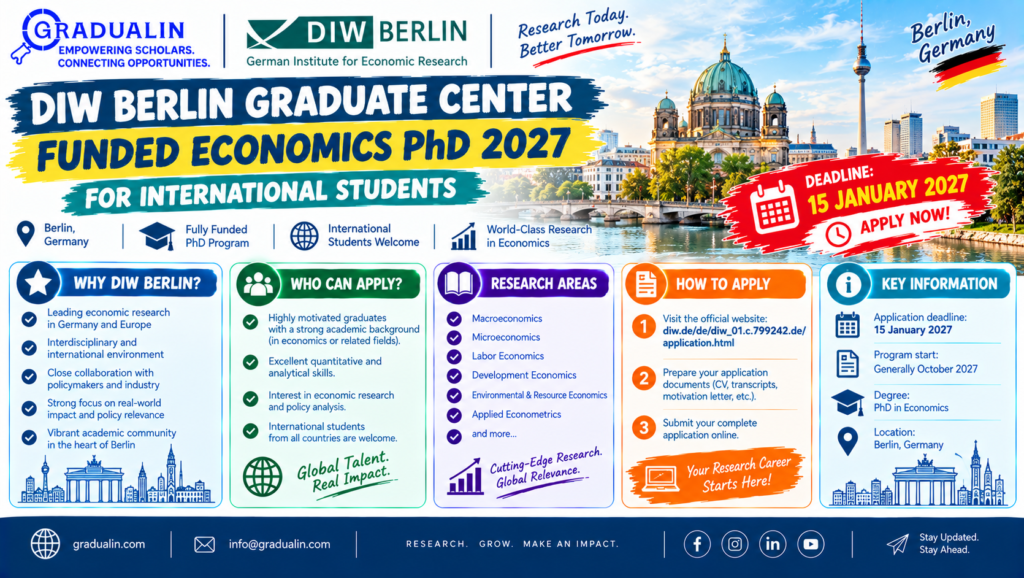
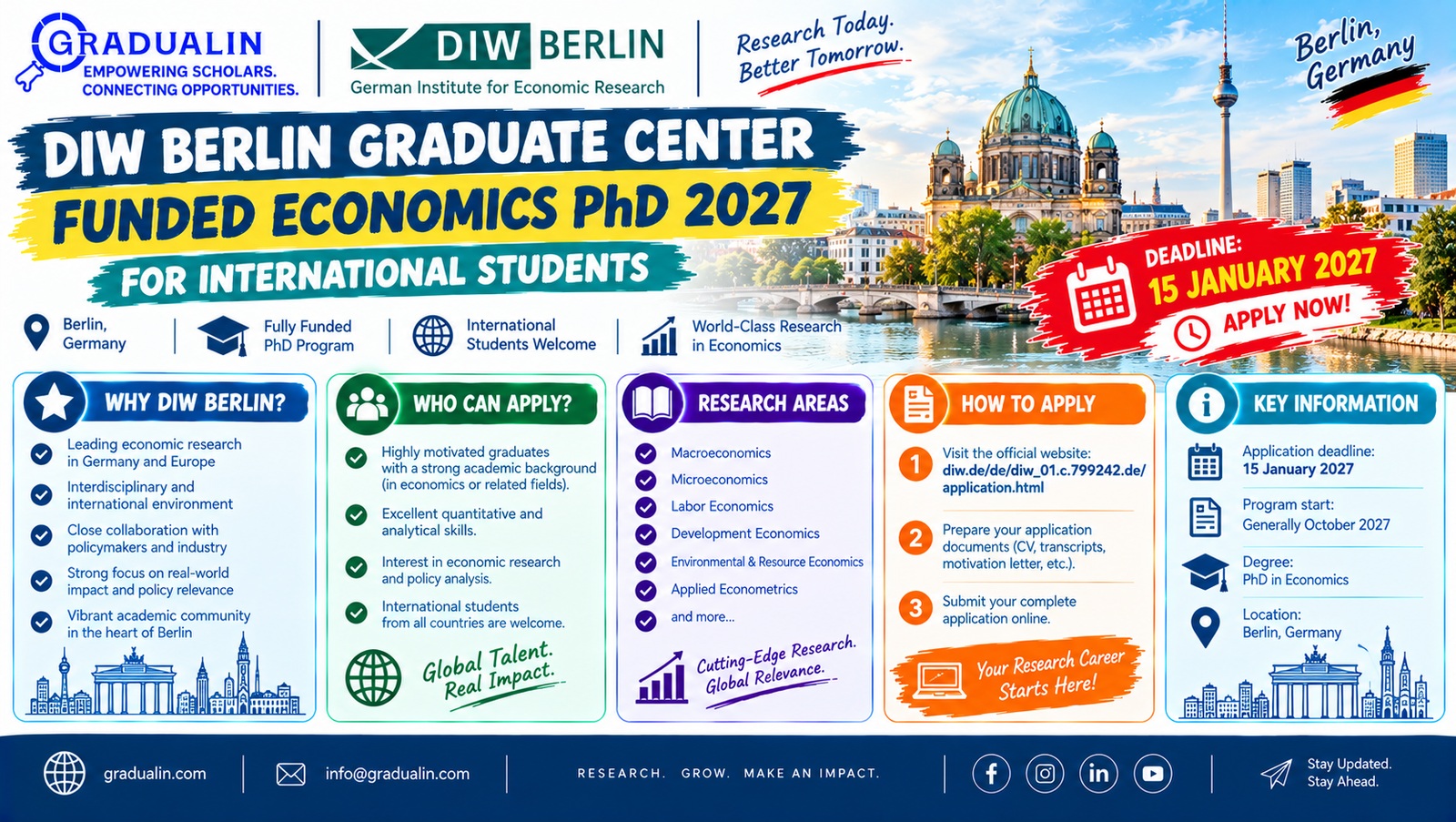
Germany has few economics PhD routes that are fully structured, fully in English and funded from day one, and the DIW Berlin Graduate Center is one of the best. DIW Berlin (the German Institute for Economic Research) is one of Germany’s leading economic research institutes. Its Graduate Center recruits a new PhD cohort every year for a five-year programme. In Year 1 you receive a €1,650 monthly stipend while taking core PhD courses. From Year 2 you normally become a paid DIW researcher on a public-sector contract (TVöD EG 13, 75%). There are no tuition fees, no German is needed, and interviews take place by video. Your doctorate is awarded by Humboldt, Freie Universität, TU Berlin or the University of Potsdam. Applications for the 2027 intake are open until 15 January 2027, 23:59 CET.
| 🏛️ Institution | DIW Berlin: German Institute for Economic Research, Graduate Center (GC) |
| 🎓 Degree | PhD in Economics, awarded by HU Berlin, FU Berlin, TU Berlin or University of Potsdam |
| ⏳ Duration | 5 years funded (completion usually takes 4–5 years) |
| 💰 Year 1 Funding | €1,650 per month stipend |
| 💼 Years 2–5 | Normally a research job at DIW (TVöD EG 13, 75%), subject to performance criteria |
| 🎓 Tuition | None (university semester fee of about €380 if enrolled) |
| 🗣️ Language | All courses in English; German not required |
| 📝 English Test | TOEFL/IELTS “highly recommended” (no minimum set). Not required if you studied 1+ year in an English-taught programme |
| 📊 GRE | GRE General Test “strongly recommended” (not mandatory) |
| 📅 Deadline | 15 January 2027, 23:59 CET |
| 💻 Interview | Video conference; no travel needed |
| 🇵🇰 Pakistani Students Eligible | Yes. No nationality restriction; a master’s in economics or business (or a related quantitative field) is required |
| 🔗 Apply | DIW GC application page |
About DIW Berlin and the Graduate Center
DIW Berlin is one of Germany’s largest economic research institutes. Its research shapes policy debates on energy, climate, public finance, labour markets and inequality. It also runs the Socio-Economic Panel (SOEP), one of the world’s longest-running household surveys. The Graduate Center is DIW’s structured PhD programme, built to train economists who combine rigorous academic research with policy relevance.
The programme is full-time and in person in Berlin. Remote or part-time study isn’t possible. Most courses are taught jointly with the Berlin School of Economics (BSE), but the GC is a separate programme with its own application, and DIW recommends applying to the GC directly.
How it compares: many German PhD positions are single research-assistant jobs advertised by one professor, and you must find the supervisor yourself. The DIW GC works more like a US-style PhD: you’re admitted as part of a cohort, take core coursework in Year 1, and only then choose your supervisor. Unlike most US programmes, though, funding comes through a German public-sector employment contract from Year 2, with social security and pension contributions included.
💰 Funding and Benefits
- ✅ Year 1: a stipend of €1,650 per month during the course phase
- ✅ Years 2–5: usually a job at a DIW research department under TVöD EG 13 (75%). Based on the public TVöD pay table, that’s roughly €3,400–3,700 gross a month (verify on official website). It’s linked to meeting performance criteria set at the start of the programme
- ✅ No tuition fees. If you enrol at a Berlin university, there’s a semester fee of about €380, which includes a public transport ticket
- ✅ On-the-job training in a DIW research department: policy reports, data work and the publication pipeline
- ✅ A doctorate from a top Berlin university (HU, FU, TU or Potsdam)
- ✅ Prior PhD-level course credits may be transferred case by case
In PKR: the Year 1 stipend of €1,650 is roughly PKR 5 lakh or more a month (check the current rate). Berlin rents have risen sharply, so budget carefully in Year 1. Once you’re employed, German social insurance (health, pension, unemployment) is deducted from your gross salary and covers you.
📋 Eligibility
- A master’s degree or diploma in Economics or Business Studies. You can apply while studying if you finish before the programme starts
- Related quantitative fields (statistics, quantitative social sciences, engineering, mathematics) are accepted if you have enough economics or business background
- English: proof is needed if you’re not a native speaker, unless your degree is from an English-speaking country or you studied at least one year in an English-taught programme. A high TOEFL or IELTS score is sufficient, and no minimum is set
- GRE General Test (including GRE at Home) is not mandatory, but applicants without it “have lower chances”. GMAT and Subject Tests aren’t accepted. Scores are valid for 5 years
- No German required
- No research proposal required. Attaching one gives no advantage
🇵🇰 Pakistani students: eligible. You need a master’s (MPhil or MS in Economics, or an MBA or MS with strong quantitative economics). A 4-year BS on its own isn’t enough. Graduates of PIDE, QAU, LUMS, IBA Karachi, GCU Lahore, FCCU, Punjab University and NUST (S3H) fit well. Because most Pakistani programmes are taught in English, check whether a letter confirming English-medium instruction can count as proof (verify on official website). We still strongly recommend taking the GRE: a quant score of 165+ makes a big difference for economics PhDs.
✅ Apply if you…
- Have a master’s in economics with strong econometrics and maths
- Can score well on the GRE quant section (or already have)
- Want policy-relevant research: climate, energy, macro, public finance, inequality
- Have two academic referees who know your work well
- Want a structured, cohort-based PhD with funding guaranteed for 5 years
❌ Skip it if you…
- Only have a bachelor’s degree
- Need a remote or part-time PhD
- Can’t provide academic references (business references aren’t accepted)
- Have weak quantitative training and no time to prepare for the GRE
- Want to pick your supervisor before you apply (that happens in Year 1)
📚 Programme Structure and Research Areas
Year 1: course phase (all in English, mostly taught jointly with the Berlin School of Economics):
| Semester | Courses |
|---|---|
| Semester 1 | Econometrics I, Microeconomics I, Macroeconomics I |
| Semester 2 | Econometrics II + choice of Microeconomics II or Macroeconomics II |
Years 2–5: research phase. You work on your dissertation while employed in one of DIW’s research units:
- Macroeconomics
- Forecasting and Economic Policy
- Energy, Transportation, Environment
- Climate Policy
- Firms and Markets
- Public Economics
- Socio-Economic Panel (SOEP)
- Entrepreneurship Research Group
- Gender Economics Research Group
You choose your supervisor during Year 1, and enrol at the Berlin university where that supervisor is a professor.
📄 Required Documents
- Motivation letter, maximum 2 pages
- Detailed CV, without a photo
- Two academic recommendation letters from senior academics (professors or postdocs), uploaded by the referees themselves through DIW’s recommendation portal
- Transcripts and certificates (bachelor’s and master’s)
- Completed application form (PDF, downloadable from the application page)
- TOEFL/IELTS and GRE reports, if you have them
⚠️ Referee rules: only senior academics at academic institutions. Business references are rejected, referees can’t be changed after you submit, and letters sent by email or uploaded after the deadline are ignored. Brief your referees early and give them the deadline.
HEC note for Pakistani applicants: upload clear scans of your HEC-attested degrees and transcripts in English, with your university’s grading-scale explanation. Keep the originals ready, because you’ll need them for enrolment and the German visa if you’re admitted.
🪜 Step-by-Step: How to Apply
- Book the GRE now (GRE at Home is accepted). Scores take time to arrive, so aim to test by December.
- Take TOEFL or IELTS if you don’t have a full year of English-taught study (strongly recommended either way).
- Ask two professors for recommendations. Send them DIW’s recommendation form and portal link.
- Write a 2-page motivation letter. Name 1–2 DIW departments, your research interests and your quantitative training.
- Fill in the application form (PDF) and upload all documents on the DIW application portal.
- Submit before 15 January 2027, 23:59 CET. Applications by email aren’t considered.
- Shortlist and video interview. Don’t ask about your status until at least six weeks after the deadline.
- If admitted: apply for a German visa, find housing in Berlin, and start Year 1 coursework in autumn 2027.
Note: DIW says contacting GC staff or DIW researchers in advance does not improve your chances. Put that effort into your GRE, letter and referees instead.
📅 Important Dates
| Milestone | Date |
|---|---|
| Application portal opens | 15 October 2026 |
| Application deadline | 15 January 2027, 23:59 CET |
| First selection | After the deadline |
| Video interviews | Early 2027 (verify on official website) |
| Final decisions | Shortly after interviews |
| Programme start | Autumn 2027 (verify on official website) |
🌍 Why Apply
For a policy-minded economist, DIW offers a rare combination: rigorous Year 1 PhD training, five years of funding, a real research job at an institute that advises the German government and the EU, and access to datasets like SOEP. Berlin is also a major hub for economics, with the Berlin School of Economics, the Hertie School and the WZB, and has a large international community.
❓ Frequently Asked Questions
Can Pakistani students apply for the DIW Berlin PhD?
Yes. There’s no nationality restriction. You need a master’s in economics or business (or a related quantitative field with enough economics). All teaching is in English, and interviews are by video.
Is the GRE required?
It isn’t mandatory, but DIW says applicants without GRE scores have lower chances. Only the GRE General Test (including GRE at Home) is accepted, not the GMAT or Subject Tests. Scores are valid for 5 years.
Do I need IELTS or TOEFL?
Not if your degree is from an English-speaking country or you studied at least one year in an English-taught programme. Otherwise a high TOEFL or IELTS score is needed. DIW sets no minimum and recommends submitting one anyway.
How much will I earn?
€1,650 a month as a stipend in Year 1. In Years 2–5 you’re normally employed under TVöD EG 13 at 75%, roughly €3,400–3,700 gross a month based on the public pay table (verify on official website). Continued funding depends on meeting performance criteria.
Should I contact DIW researchers about supervision before applying?
No. DIW says this won’t be considered and doesn’t improve your chances. You choose a supervisor during Year 1, and admission isn’t tied to a supervision agreement.
Is a research proposal required?
No. You can attach one, but DIW says it gives no advantage. Focus on your motivation letter (maximum 2 pages), CV, transcripts, referees and test scores.
🔗 Official Sources
- DIW Graduate Center application page (English)
- DIW Graduate Center
- Programme structure
- Application form, intake 2027 (PDF)
- Questions: gradcenter@diw.de · Technical: recruiting@diw.de
📊 Summary Table
| Detail | Information |
|---|---|
| Programme | DIW Berlin Graduate Center PhD in Economics |
| Degree from | HU Berlin, FU Berlin, TU Berlin or Uni Potsdam |
| Funding | Year 1: €1,650/month; Years 2–5: TVöD EG 13 (75%) |
| Tuition | None |
| Language | English (no German needed) |
| Tests | GRE + TOEFL/IELTS strongly recommended |
| Referees | 2 academic letters |
| Deadline | 15 January 2027, 23:59 CET |
| Pakistani Students | Eligible (master’s required) |
Explore more on Gradualin: Scholarships, Jobs & Internships, Events & Conferences, and Guidelines & Resources.
Stay updated with the latest scholarships, jobs, and opportunities at Gradualin.com — your trusted guide to studying abroad for free.