
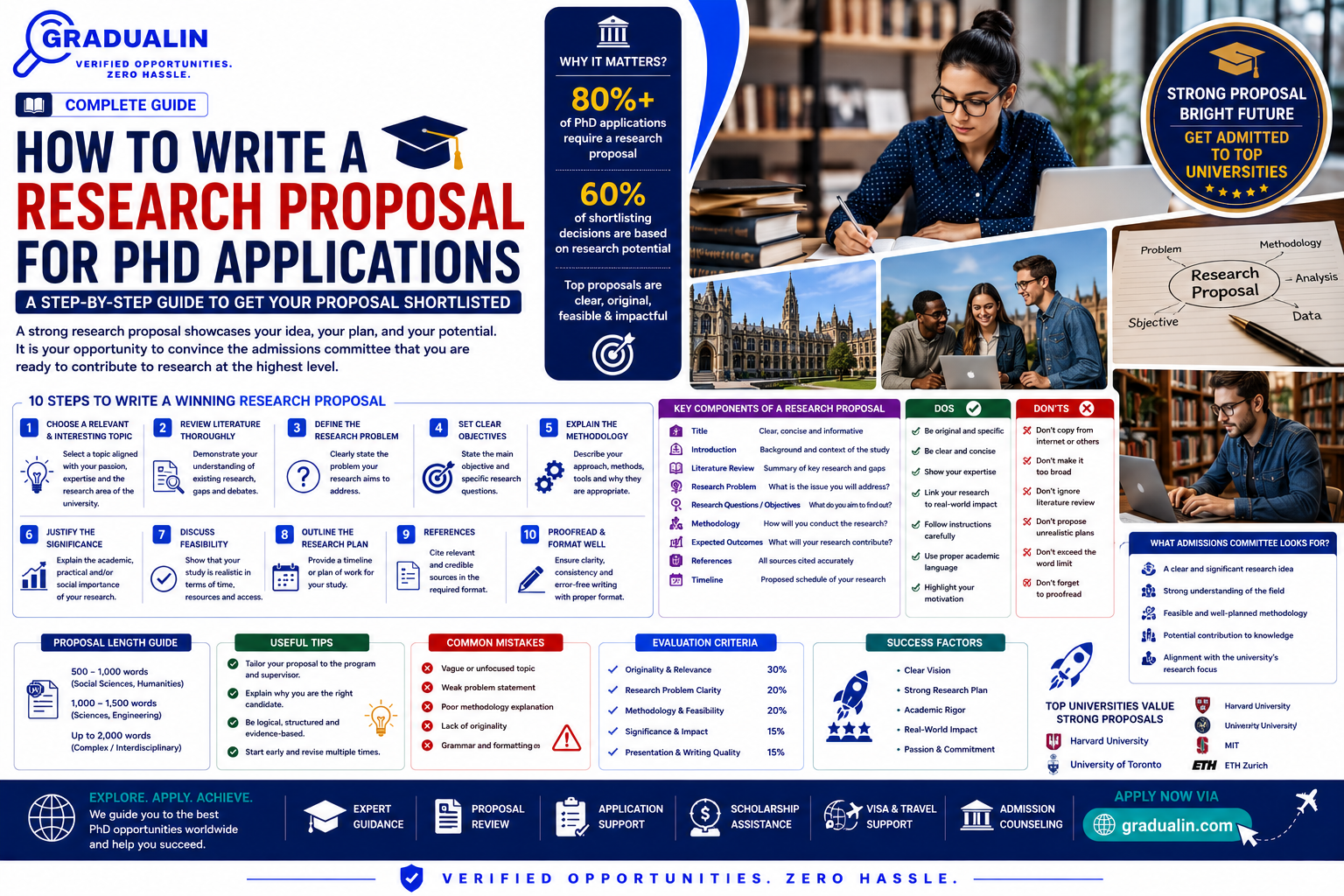
Your research proposal can make or break your PhD application — even if your academic record is strong. Universities and scholarship committees don’t just want to know what you want to study. They want to know that you’ve thought carefully about why it matters, how you’ll do it, and whether you’re ready to carry out independent research at the highest level. A poorly written proposal can sink an otherwise strong application. A well-written one can get you in even when the competition is fierce.
The good news? A great PhD research proposal follows a clear, learnable structure. This guide breaks it down section by section — what to include, how long each part should be, what examiners are actually looking for, and the mistakes that knock most proposals out immediately. By the end, you’ll know exactly what to write and how to write it.
📚 Quick Info Box
| Detail | Information |
| Document Type | PhD Research Proposal |
| Typical Length | 1,500 – 3,000 words (varies by institution) |
| Who Needs It | PhD applicants, scholarship applicants, research programme candidates |
| When You Need It | At the time of PhD application or scholarship application |
| Key Sections | Title, Abstract, Introduction, Literature Review, Methodology, Timeline, References |
| Common Mistakes | Too vague, too broad, no clear gap, weak methodology |
| Useful For | Fully funded PhD scholarships, university PhD applications worldwide |
📚 What Is a PhD Research Proposal and Why Does It Matter?
A PhD research proposal is a document you submit as part of your PhD or scholarship application. Its job is simple but demanding: convince the admissions committee or scholarship panel that your research idea is worth funding, that it’s achievable within a PhD timeframe, and that you are the right person to carry it out.
Think of it less like an essay and more like a pitch. You’re selling your research idea — its originality, its significance, and your ability to execute it.
Most universities and fully funded PhD scholarship programmes (think Chevening, Commonwealth, DAAD, Erasmus Mundus, and university-specific scholarships) require a research proposal. Some ask for as few as 500 words. Others want 3,000 words with full bibliography. Always check the specific requirements of each institution before you begin — word counts and required sections vary significantly.
What doesn’t change is the underlying logic. Every strong research proposal answers four core questions:
- What are you studying?
- Why does it matter?
- How will you do it?
- What will it contribute?
Everything else in the document supports these four answers.
📚 How Long Should a PhD Research Proposal Be?
There’s no universal rule, but here’s a practical framework:
| Application Type | Typical Length |
| University PhD application (general) | 1,500 – 2,000 words |
| Funded scholarship application | 1,000 – 1,500 words |
| Research council or competitive grant | 2,000 – 3,000 words |
| Preliminary / expression of interest | 500 – 800 words |
When a university or scholarship gives you a specific word limit, treat it as a ceiling — not a target to hit exactly, but a boundary never to cross. Reviewers notice when applicants ignore instructions.
📚 The Full Structure of a PhD Research Proposal
Here’s what a complete, well-structured PhD research proposal looks like — section by section.
1. Title
Your title should be specific, descriptive, and informative. It doesn’t need to be elegant — it needs to tell the reader exactly what your research is about.
❌ Weak title: “Climate Change and Agriculture” ✅ Strong title: “The Impact of Prolonged Droughts on Smallholder Rice Farming in Sub-Saharan Africa: A Case Study of Northern Ghana, 2010–2024”
A strong title signals that you’ve already narrowed your focus to something researchable.
2. Abstract or Executive Summary (150–250 words)
Not all proposals require a formal abstract, but including one is always a good idea. It gives the reader a bird’s-eye view before they dive into the detail.
Cover these four things in your abstract:
- The research problem
- Why it matters
- Your approach
- What you expect to contribute
Write the abstract last, after you’ve completed the rest of the proposal. It’s much easier to summarize something you’ve already written.
3. Introduction and Research Problem (300–400 words)
This is the most important section of your proposal. If the reader isn’t convinced by your introduction, nothing else will save the document.
Your introduction needs to do three things:
a) Establish the context. Start with the broader field or problem — give the reader the landscape they need to understand why your research matters. Keep this to 2–3 sentences. Don’t write three paragraphs of background before getting to the point.
b) Identify the gap. This is the heart of your proposal. What is missing from the current research? What has been overlooked, understudied, or debated without resolution? Be specific. “Not much research has been done on this” is weak. “Existing studies have focused on X, but none have examined Y in the context of Z” is strong.
c) State your research question. Your research question is the exact problem your PhD will address. It should be a real question — one that cannot be answered with a simple yes or no, and one that hasn’t already been definitively answered. Most proposals have one central research question supported by two or three sub-questions.
Here’s what a good research question looks like in practice:
“To what extent does access to mobile banking services affect household savings behaviour among low-income women in rural Kenya?”
That question is specific, answerable through research, and clearly addresses a real-world issue with academic dimensions.
4. Literature Review (400–600 words)
The literature review serves two purposes: it shows you know your field, and it demonstrates precisely where your research fits within it.
You are not writing a history of every paper ever published on your topic. You are building a logical argument that leads to your research gap.
A good structure for the literature review section:
- Start broad: Summarize the dominant theories and debates in your field
- Narrow down: Identify the specific sub-area your research falls within
- Identify the gap: Show what existing research has not addressed, or where it has produced conflicting results
- Position your study: Explain how your research will fill, challenge, or extend existing knowledge
Cite accurately and consistently. Use the referencing style specified by the institution (APA, Harvard, Chicago, etc.). Reviewers notice when citations are sloppy or padded.
What to avoid: listing papers one by one without synthesis. The literature review should read as a conversation between scholars — not a bibliography with commentary.
5. Research Aims and Objectives (150–200 words)
After the literature review, state your aims and objectives clearly. These are different things:
- Aim: The broad purpose of your research. What you ultimately want to achieve. (Usually one sentence.)
- Objectives: The specific, measurable steps you’ll take to achieve the aim. (Usually 3–5 bullet points.)
Example:
Aim: To examine the relationship between digital financial inclusion and household savings among low-income women in rural Kenya.
Objectives:
- To review existing literature on mobile banking adoption in sub-Saharan Africa
- To collect and analyse primary data from 200 low-income women in two rural counties
- To identify socioeconomic factors that mediate the relationship between mobile banking access and savings behaviour
- To develop policy recommendations for financial inclusion programmes
6. Research Methodology (400–500 words)
This is where most proposals fall apart — and where strong proposals stand out the most.
Your methodology section explains how you will conduct your research. It needs to justify every major decision you make. Reviewers want to see that you understand the practical implications of your approach.
Cover the following:
Research design: Will your study be qualitative, quantitative, or mixed-methods? Why is this the right approach for your research question?
Data collection methods: How will you gather your data? Interviews, surveys, archival analysis, experiments, fieldwork, secondary datasets? Be specific about your sample size, selection criteria, and why this approach is appropriate.
Data analysis methods: How will you analyse what you collect? Thematic analysis, regression modelling, discourse analysis, comparative case study? Name the specific method and briefly explain why it fits your research.
Ethical considerations: Will your research involve human participants? If so, how will you address informed consent, confidentiality, and any potential risks to participants? Even if ethics approval isn’t required, acknowledging this shows maturity.
Limitations: Every methodology has limitations. Acknowledging them briefly and explaining how you’ll manage them strengthens your proposal — it shows intellectual honesty.
What makes a methodology section weak: vague language (“I will collect data and analyse it”), no justification for choices, or a methodology that doesn’t match the research question.
7. Timeline (100–150 words or a table)
A timeline shows the admissions committee that your research plan is realistic and that you’ve thought through what a PhD actually involves. A simple table works well here:
| Phase | Activity | Timeframe |
| Phase 1 | Literature review and research design | Months 1–6 |
| Phase 2 | Data collection | Months 6–18 |
| Phase 3 | Data analysis | Months 18–28 |
| Phase 4 | Writing and drafting | Months 28–36 |
| Phase 5 | Review, revisions, submission | Months 34–42 |
Adjust the timeline to match your degree structure (3-year PhD vs 4-year, with coursework or without). Show that you understand the progression from start to completion.
8. Expected Contribution and Significance (150–200 words)
This section answers the “so what?” question. Why does your research matter? Who benefits from it?
Your contribution can be:
- Theoretical: You’re adding to or challenging existing academic frameworks
- Empirical: You’re producing new data or evidence in an under-researched area
- Practical/Policy: Your findings will inform real-world decisions, programmes, or policies
Be honest and appropriately modest. You don’t need to claim you’ll revolutionize a field — but you do need to show that your research will make a genuine, specific contribution that no existing work has already made.
9. References / Bibliography
Every source you cite in the proposal must appear in a properly formatted reference list. Use the referencing style required by the institution. A proposal with inconsistent or missing references looks careless and undermines your credibility as a researcher.
📚 Common Mistakes That Sink PhD Proposals
These are the errors reviewers see most often — and the ones most likely to cost you a place:
1. The topic is too broad. “I want to study climate change and global food security” is a PhD topic for several lifetimes. Narrow it down to something genuinely researchable in 3–4 years.
2. There’s no clear research gap. If you can’t explain specifically what existing research hasn’t addressed, your proposal has no foundation. The gap is everything.
3. The methodology doesn’t match the research question. A research question about lived experience needs qualitative methods. A question about statistical relationships needs quantitative methods. Mismatches tell reviewers you don’t understand your own research.
4. It reads like an essay, not a plan. A research proposal is a planning document. It should be structured, precise, and forward-looking — not a flowing discussion of why a topic is interesting.
5. Vague language throughout. Words like “explore,” “examine broadly,” and “look into” signal a lack of precision. Use active, specific language: “analyse,” “measure,” “compare,” “test.”
6. No evidence of engagement with the literature. If your proposal doesn’t cite relevant scholarship, reviewers will assume you haven’t done the reading. Even a brief literature review must include genuine engagement with key sources.
📚 Tips for International Students
Writing a research proposal in a second language — or for a university system very different from your own — adds an extra layer of challenge. Here’s what helps:
- Read proposals that worked. Many universities publish examples of successful proposals. Find two or three in your field and study their structure, tone, and how they frame the research gap.
- Match your proposal to the supervisor. If you’ve identified a potential supervisor, read their recent publications and align your proposed research with their current work. Mention their work briefly and explain how your study relates to or builds on it.
- Follow the institution’s guidelines exactly. Word counts, required sections, referencing styles — check the specific requirements for every university you apply to. A proposal that ignores the guidelines signals carelessness.
- Get feedback before you submit. Ask a lecturer, academic mentor, or graduate student in your field to read your draft. Fresh eyes catch gaps in logic that you’ll miss after reading your own work ten times.
- Start early. A strong proposal takes multiple drafts. Give yourself at least four to six weeks from first draft to final submission.
📚 FAQ
Q: Do all PhD programmes require a research proposal? Not all — some PhD programmes, particularly in the sciences and in some North American institutions, assign supervisors and research topics after admission. But most research-based PhDs at UK, Australian, European, and many Asian universities require one. Always check the specific requirements of each programme you’re applying to.
Q: How do I know if my research topic is original enough? Search Google Scholar, your institution’s library databases, and relevant journal archives for recent papers on your topic. If you can find five papers that have already answered your research question exactly, you need to refine your angle. If you find significant literature on the general area but a clear gap around your specific question, you’re in good shape.
Q: Can I change my research topic after I start my PhD? Yes — and it’s very common. Your proposal is a starting point, not a binding contract. Most PhD students refine or significantly shift their research focus during the first year in consultation with their supervisor. The proposal needs to be credible and well-thought-out, not set in stone.
Q: Should I contact a potential supervisor before submitting? For many UK and Australian universities, yes — and it’s strongly recommended. Making contact with a potential supervisor before applying shows initiative, and their positive response can significantly strengthen your application. For large North American programmes with open admission, this is less necessary.
Q: How do I write a proposal if I don’t know my exact methodology yet? At proposal stage, you don’t need to have every methodological detail finalized — but you do need to demonstrate that you’ve thought seriously about how you’ll approach your research question. Outline your intended approach, justify it in general terms, and acknowledge that it may evolve in consultation with your supervisor.
📚 Official and Useful Resources
- Finding PhD programmes: www.findaphd.com
- Scholar databases for literature search: www.scholar.google.com , www.jstor.org , www.researchgate.net
- Referencing tool: www.citethisforme.com , www.zotero.org Zotero (free)
- Academic writing support: Purdue OWL — www.owl.purdue.edu
📚 Summary Table
| Section | Purpose | Typical Length |
| Title | Identify the specific topic | One line |
| Abstract | Overview of the whole proposal | 150–250 words |
| Introduction | Establish context and research gap | 300–400 words |
| Literature Review | Show field knowledge and gap | 400–600 words |
| Aims and Objectives | State what you want to achieve | 150–200 words |
| Methodology | Explain how you’ll do the research | 400–500 words |
| Timeline | Show the plan is realistic | 100–150 words |
| Contribution | Explain why it matters | 150–200 words |
| References | Cite all sources used | As needed |
| Total | 1,500–3,000 words |
Explore more opportunities and guides on Gradualin:
Related reading:
- Fully Funded PhD Scholarships in the UK 2026
- Fully Funded PhD Positions in Switzerland 2026
- Fully Funded Scholarships in Australia 2026
Stay updated with the latest scholarships, jobs, and opportunities at Gradualin.com — your trusted guide to studying abroad for free.