
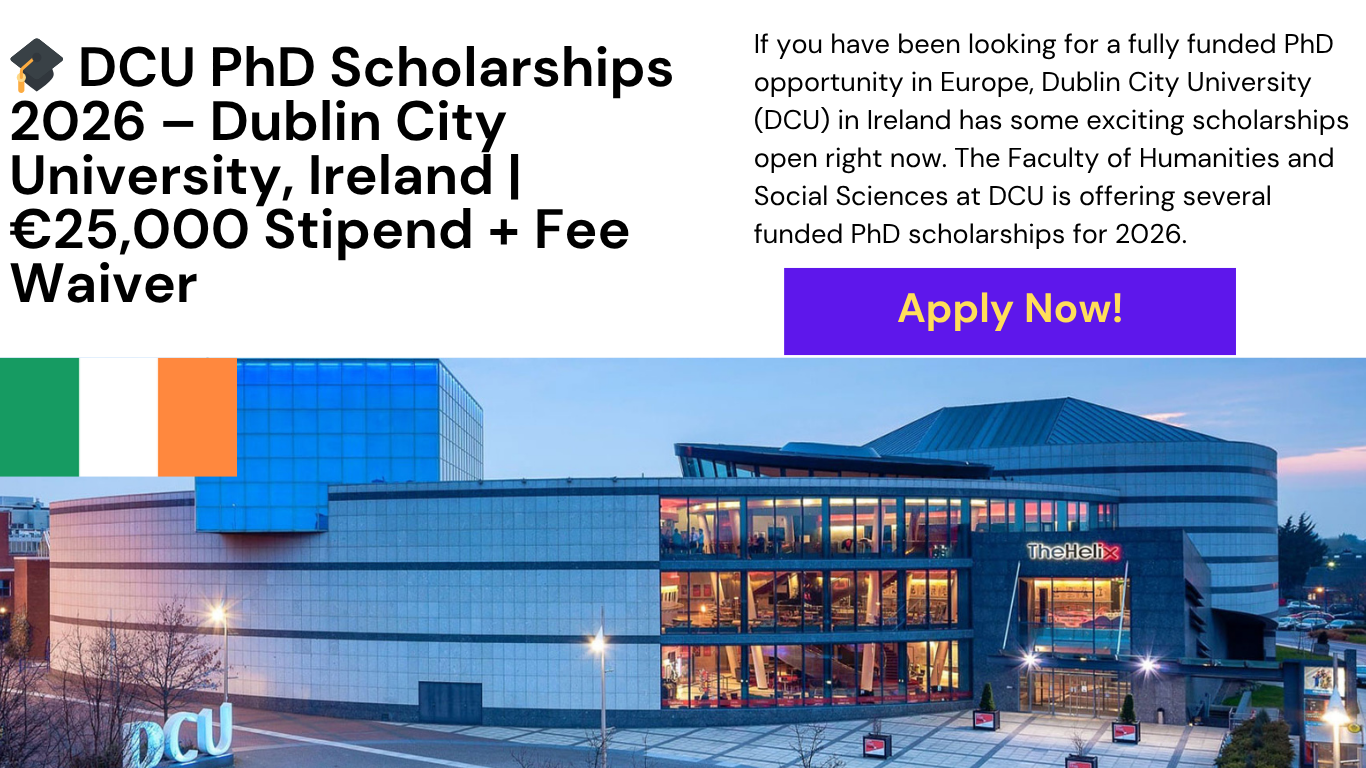
If you have been looking for a fully funded PhD opportunity in Europe, Dublin City University (DCU) in Ireland has some exciting scholarships open right now. The Faculty of Humanities and Social Sciences at DCU is offering several funded PhD scholarships for 2026, with a generous annual tax-free stipend of €25,000 and a complete tuition fee waiver for up to four years.
This is a rare and competitive opportunity for passionate researchers who want to pursue doctoral studies in Ireland at one of the country’s most dynamic and forward-thinking universities. Whether your background is in communications, media studies, English literature, languages, law, history, or theology — DCU has a scholarship path for you.
Read everything you need to know below, including scholarship details, research areas, eligibility, application requirements, and deadlines.
🎓 Scholarship Overview
University: Dublin City University (DCU) Faculty: Faculty of Humanities and Social Sciences (FHSS) Degree Level: PhD (Doctor of Philosophy) Location: Dublin, Ireland Mode: Full-time, on-campus (Dublin residency required) Scholarship Type: Fully funded — stipend + fee waiver Start Date: September 2026
DCU’s Faculty of Humanities and Social Sciences is home to seven schools, each conducting world-class research across disciplines ranging from media and journalism to law, literature, history, languages, and theology. In 2026, the Faculty is inviting ambitious doctoral candidates to join their research community through a set of funded PhD positions.
These scholarships are not just financial awards — they are full academic appointments that come with mentoring, teaching experience, conference travel funding, and access to a rich intellectual community in the heart of Dublin.
🎓 Scholarship Benefits / Funding
Each funded PhD scholarship at DCU offers the following:
- Annual Stipend: €25,000 tax-free per year
- Tuition Fee Waiver: Full fees covered for up to 4 years
- Duration: 4 years (full-time)
- Conference & Travel Funding: Additional support for attending academic conferences
- Paid Teaching Experience: Scholarship holders are assigned paid tutoring duties as part of their career development
- Research Support: Access to world-class university libraries, special collections, and research infrastructure
- Journal Publication Scheme: Competitive grants available for research leading to publication in SCOPUS-ranked journals (up to €1,000)
- Conference and Travel Grant: Available through the DCU Graduate Studies Office for all registered postgraduate research students
This is effectively a fully funded PhD — your studies, living costs, and professional development are all covered.
🎓 Available PhD Research Areas / Schools
The Faculty of Humanities and Social Sciences is offering PhD scholarships across multiple schools. Here are the key opportunities currently open for 2026:
📌 School of Communications — 3 Funded Positions
The School of Communications at DCU is internationally recognized for its research in media, journalism, and digital society. Three funded PhD positions are available in the following thematic areas:
1. Deepfake, Nudification & Non-Consensual Intimate Imagery (NCII) Technologies This project examines the technical, social, and behavioral dimensions of harmful digital imagery technologies. Research will cover user experience design, platform algorithms, user access pathways, and real-world user experiences. Relevant backgrounds include digital media studies, human-computer interaction, or computer science. Supervisors: Prof. Debbie Ging & Dr. Kata Szita
2. Documentary Subjects: Consent, Rights & GDPR This project explores the intersection of documentary filmmaking, data protection law (particularly GDPR in Ireland), and the ethics of consent. Researchers will examine privacy rights, representation, and archival repurposing in documentary media. Industry experience in cultural production is a bonus. Supervisors: Dr. Dragana Jurisic & Dr. Tom Burke
3. Generative AI & Memory Studies This project critically investigates how AI technologies — such as large language models and diffusion systems — shape how societies remember, forget, and narrate the past. Topics include synthetic memory, public commemoration, archival practices, and algorithmic memory cultures. Supervisors: Dr. Declan Tuite & Dr. Dónal Mulligan
Stipend: €25,000 per annum + full fee waiver Duration: 4 years Start: September 2026
📌 School of English — 2 Funded Positions
The DCU School of English is a research-focused department with expertise across literary eras, genres, and critical traditions. Two funded PhD positions are available:
Call One — Literary and Cultural Studies Proposals are welcome in areas including visual and material culture, Irish literature, modern poetry, intermediality, modernism, and queer literature. Supervisor: Dr. Jack Quin
Call Two — Children’s and Young Adult Literature This position invites research proposals drawing on DCU Library’s world-class special collections in children’s and young adult literature. DCU holds rare collections including the Bartlett Puffin Collection, Children’s Books Ireland Collection, Padraic Colum Collection, Patricia Lynch Collection, Ladybird Collection, Hans Christian Andersen Collection, and more. Supervisors: Dr. Jennifer Mooney & Dr. Keith O’Sullivan
Stipend: €25,000 per annum + full fee waiver for up to 4 years
📌 Other Schools Offering PhD Scholarships
Additional PhD scholarship opportunities are available in the following schools within the Faculty. Check each school’s dedicated page for specific research areas and deadlines:
- School of Applied Language and Intercultural Studies (SALIS)
- Fiontar & Scoil na Gaeilge (Irish language & culture research)
- School of History and Geography
- School of Law and Government
- School of Theology, Philosophy, and Music
🎓 Eligibility Criteria
To be eligible for DCU PhD scholarships in 2026, you generally need to meet the following requirements:
- An undergraduate degree at 2.1 (Upper Second Class Honours) or First Class Honours level in a relevant field
- It is highly desirable (though not always mandatory) to hold a relevant Master’s degree
- Candidates who are currently completing their Master’s degree are welcome to apply
- You must be available to register and begin full-time research by September/October 2026
- You must reside in Dublin for the full duration of your studies (remote study is not available)
- No nationality restriction — international students are welcome to apply
- Non-native English speakers must meet DCU’s English language requirements (typically IELTS 6.5+ overall or equivalent TOEFL/PTE score)
- Applicants must not already be receiving another government or institutional scholarship that would conflict
🎓 Who Should Apply
You are a strong candidate if you:
- Hold a relevant undergraduate or master’s degree in humanities, social sciences, communications, media, law, literature, or related fields
- Have a clear and original research idea in one of the listed thematic areas
- Are passionate about contributing to academic knowledge and public discourse
- Want to live and study in Dublin — one of Europe’s most vibrant university cities
- Are interested in gaining teaching experience and building an academic career
- Want to benefit from a fully funded position with no tuition costs and a livable stipend
You should NOT apply if:
- You cannot be physically present in Dublin for the full duration of your PhD
- You have already completed a funded PhD at the same level
- Your research interests do not align with the available thematic areas (unless you are willing to self-fund or seek IRC funding)
- You do not meet the academic entry requirements
🎓 Required Documents
Applications for DCU PhD scholarships generally require the following:
- A research proposal (approximately 1,500–2,000 words) including a preliminary literature review, clearly defined research questions, proposed methodology, and a bibliography
- A CV with academic qualifications and professional/research experience
- A personal statement explaining your suitability and motivation for the scholarship
- Copies of undergraduate and postgraduate degree certificates
- Official academic transcripts from all previous institutions
- Names and contact details of two academic referees
- Proof of English language proficiency (if applicable)
🎓 Application Process
Step 1: Identify the research area and school that best matches your academic background and research interests.
Step 2: Contact the listed supervisors for your chosen thematic area BEFORE submitting your application. This is mandatory for some schools (especially Communications) — applications without prior supervisor contact may be disqualified.
Step 3: Prepare your application package — research proposal, CV, personal statement, transcripts, and degree certificates.
Step 4: Submit your application to the designated contact for the school. For Communications, all applications go to Ms. Eileen Myers at commsschooloffice@dcu.ie. For English, submit directly to the relevant supervisor.
Step 5: Shortlisted candidates will be invited for an interview (in person or online) in April/May 2026.
Step 6: Successful candidates will then formally apply for PhD admission through DCU’s Graduate Studies Office.
🌐 Official Application Portal: https://www.dcu.ie/graduatestudies/scholarships-opportunities
🎓 Important Dates
| School / Programme | Deadline |
| School of English — PhD Scholarships 2026-2027 | 10 April 2026 at 5:00 PM |
| School of Communications — 3 Funded PhDs | 13 March 2026 (now closed — watch for future calls) |
| Interviews (shortlisted candidates) | April / May 2026 |
| PhD Start Date | September 2026 |
⚠️ The School of English deadline is TODAY — 10 April 2026 at 5:00 PM. If you are eligible, submit your application immediately!
For other schools (History, Law, Languages, Theology), check individual school pages for their current deadlines.
🎓 Why Apply / Why Study at DCU Ireland
Dublin City University is one of Ireland’s fastest-growing and most innovative universities. Here is why a DCU PhD could be the right choice for you:
- Globally recognized research — DCU is ranked among the top young universities in the world
- Vibrant Dublin location — Ireland’s capital is a major European hub for technology, media, and culture
- Strong industry links — DCU has partnerships with global companies and media organizations
- Welcoming international community — Ireland is known for being one of the most foreigner-friendly countries in Europe
- English-medium instruction — no language barrier for international students
- Post-study opportunities — Ireland offers a Stamp 1G graduate visa allowing you to stay and work after completing your degree
- Competitive stipend — €25,000 per year is a solid living stipend for Dublin
- Career development built in — paid teaching duties, conference travel, and publication support are all part of the package
Ireland is also a gateway to Europe — making it easy to connect with researchers and institutions across the EU during your studies.
🎓 Official Source
For full scholarship details, research area descriptions, and application contacts, visit the official DCU Faculty of Humanities and Social Sciences scholarship page:
🌐 https://www.dcu.ie/humanities-and-social-sciences/phd-scholarships
School of English PhD scholarships: 🌐 https://www.dcu.ie/english/doctoral-research-scholarships-2026-2027
School of Communications PhD scholarships: 🌐 https://www.dcu.ie/communications/phd-scholarship-call-2026-school-communications-dcu
🎓 Scholarship Summary
| Feature | Details |
| University | Dublin City University (DCU) |
| Country | Ireland 🇮🇪 |
| Degree | PhD (Full-time) |
| Stipend | €25,000 per year (tax-free) |
| Fee Waiver | Full tuition covered for up to 4 years |
| Fields | Communications, English, Law, History, Languages, Theology & more |
| Nationality | Open to all nationalities |
| English Requirement | Yes (IELTS 6.5 or equivalent) |
| Start Date | September 2026 |
| School of English Deadline | 10 April 2026 |
🔗 Related Opportunities on Gradualin
Looking for more PhD and postgraduate scholarships in Europe and beyond? Explore these guides: