
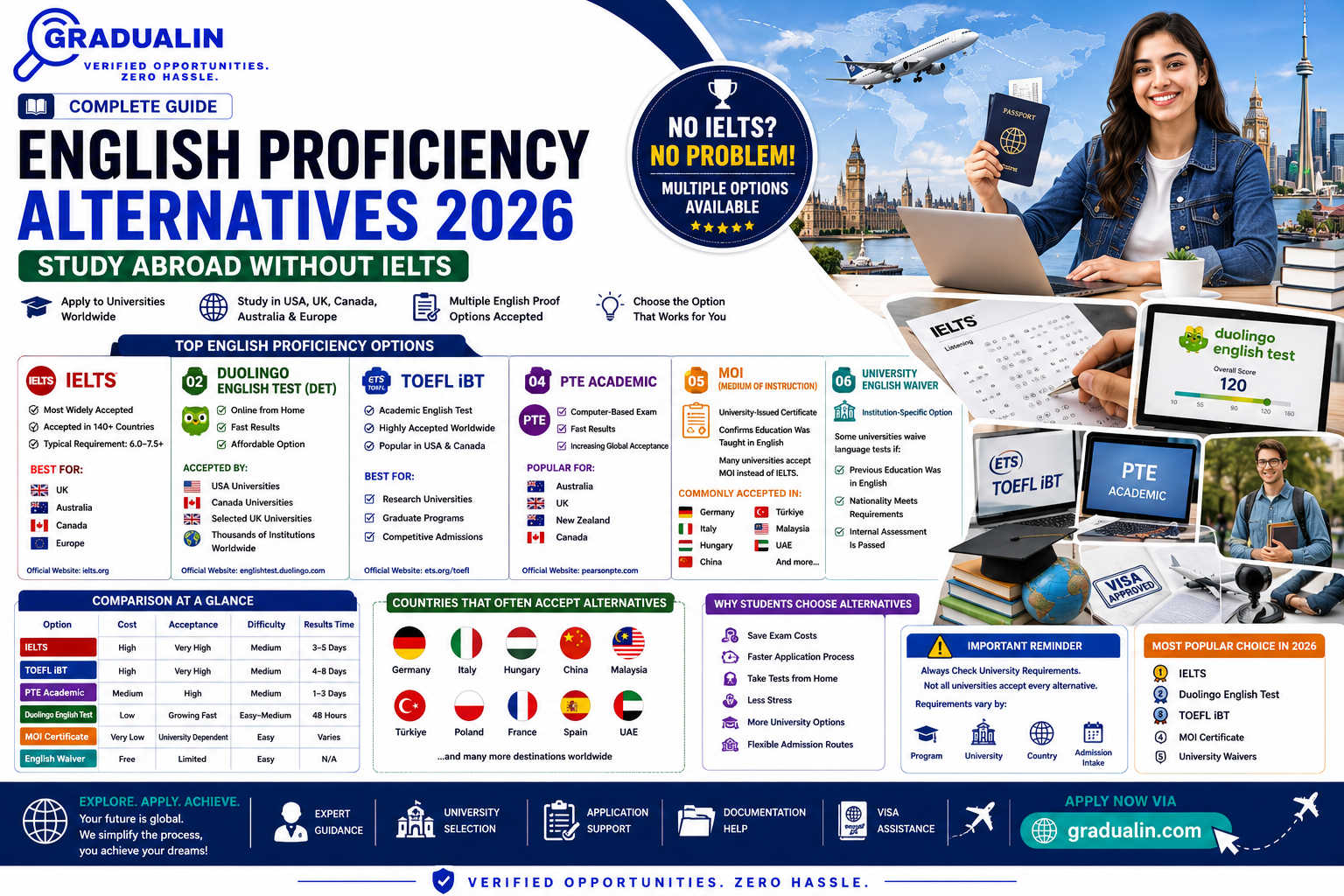
If IELTS is the only thing standing between you and your study abroad dream, here’s something you need to know: it is not your only option. Not even close.
Universities worldwide are now offering flexibility by accepting alternative tests like the Duolingo English Test, TOEFL iBT, and PTE Academic, accepting a Medium of Instruction certificate showing you studied in English, or allowing internal English interviews as proof of language ability. In 2026, a growing number of top destinations — including the UK, USA, Canada, Australia, and Germany — all recognize multiple pathways to demonstrating English proficiency.
This guide covers every major alternative to IELTS that is widely accepted in 2026: what each option is, what it costs, how its scores compare to IELTS, which countries and universities accept it, and — critically — who each option is best suited for. By the end, you will know exactly which route makes the most sense for your situation.
📚 Quick Info Box
| Detail | Information |
| Topic | English proficiency alternatives to IELTS for study abroad |
| Main Alternatives | Duolingo, TOEFL iBT, PTE Academic, Cambridge English, MOI Certificate |
| Accepted By | USA, UK, Canada, Australia, Germany, Netherlands, Nordic countries, and more |
| Cheapest Option | Duolingo English Test (~$65 USD) |
| Fastest Results | Duolingo English Test (48 hours) |
| Who Can Use MOI | Students who completed previous study in English medium |
| Official IELTS Cost | $245–$275 USD (verify on official website) |
📚 Why So Many Students Are Looking Beyond IELTS
IELTS has been the standard English proficiency test for international students for decades. It is widely accepted, globally recognized, and trusted by universities and visa authorities alike. But it is also expensive, takes weeks to schedule in some countries, and requires an in-person visit to a test center — factors that create real barriers for many applicants.
The dream of studying abroad often comes with a formidable hurdle in the form of the IELTS examination, which can be both stressful and costly for many aspiring international students. However, as we move toward 2026, the global education landscape is becoming increasingly flexible and inclusive, and studying abroad without an IELTS score is no longer an exception — it is a viable option supported by a growing number of countries, universities, and alternative admission pathways.
What makes this particularly exciting is that the alternatives are not inferior substitutes — many are faster, cheaper, and equally trusted at institutions you actually want to attend.
📚 Who Should Read This Guide / Who Shouldn’t
✅ This guide is for you if you:
- Have not taken IELTS and want to explore whether alternatives are accepted at your target university
- Have already studied in an English-medium school or university and may qualify for an MOI exemption
- Are on a tight budget and want the most cost-effective English proficiency route
- Are applying to universities in the USA, UK, Canada, Australia, Germany, or the Netherlands
- Have a tight application deadline and need faster results than IELTS can offer
❌ This guide may not be sufficient if you:
- Are applying to highly selective institutions that explicitly list IELTS as the only accepted test — always verify with admissions directly
- Need English proficiency proof for a student visa (some countries’ visa authorities, not just universities, specify which tests they accept — check embassy requirements separately)
- Have already scored well on IELTS — in that case, use what you have
📚 The Main English Proficiency Alternatives in 2026
Here are the six primary alternatives to IELTS that international students are using successfully in 2026.
🎓 1. Duolingo English Test (DET)
The Duolingo English Test has gone from pandemic-era workaround to mainstream credential in just a few years. At just $65 USD, completable from home in under an hour, and accepted by more than 5,000 universities and programs worldwide, the DET has matured from a niche workaround into a mainstream choice for English proficiency test alternatives in 2026.
How it works: The test is taken entirely online from your home computer. It is adaptive — meaning the difficulty adjusts as you answer — and covers reading, writing, listening, and speaking. Results are available within 48 hours.
Scoring: The DET is scored on a scale of 10 to 160. A score of roughly 110–120 is equivalent to IELTS 6.5, the most common university requirement. A score of 110 is sufficient for many strong universities in the USA, Canada, UK, and Germany, but falls short of the 115–125+ range expected by highly selective institutions such as Ivy League graduate programs and competitive Russell Group departments.
Cost advantage: IELTS Academic costs $245–$275 USD, TOEFL iBT approximately $235 USD, and PTE Academic approximately $200–$230 USD. The DET offers savings of $170–$210 USD per attempt over IELTS, making it the most affordable formally recognized option for international students today.
Best for: Students with tight budgets or deadlines, applying to mid-tier to strong universities in the USA, Canada, UK, and parts of Europe.
Watch out for: Visa authorities. Many student visa systems, including UKVI, do not currently accept Duolingo as proof of English proficiency for the visa application itself — even if the university does. Always verify the visa requirement separately.
🎓 2. TOEFL iBT (Test of English as a Foreign Language)
TOEFL is the second-most globally accepted English proficiency test after IELTS and is particularly dominant in the United States. More than 11,000 colleges worldwide recognize the TOEFL score.
How it works: TOEFL iBT is a four-section test covering reading, listening, speaking, and writing. It runs approximately 2 hours and is available at test centers and as a home edition (TOEFL iBT Home Edition) in most countries.
Scoring: A score equivalent to IELTS 6.5 — the most common university minimum — translates to roughly TOEFL 79–93 on the traditional 0–120 scale. Note that ETS has officially introduced an updated 1–6 band scale reported in 0.5-point increments, though the traditional 0–120 total remains active for historical reference.
Cost: Approximately $235 USD (verify on official website — varies by country).
Best for: Students applying to US universities, where TOEFL is often preferred over other alternatives and accepted for both university admission and visa purposes.
🎓 3. PTE Academic (Pearson Test of English)
PTE Academic is a fully computer-based English test produced by Pearson. It has gained significant traction since 2020, particularly for Australian and UK immigration and an increasing number of universities worldwide. Its fully automated scoring means results come back in 1–2 days.
How it works: PTE Academic lasts about two hours and tests reading, writing, listening, and speaking. Because all scoring is machine-automated (no human examiners), results are fast and consistent.
Scoring: PTE is scored on a scale of 10–90. An equivalent to IELTS 6.5 falls around PTE 58–64.
Cost: Approximately $200–$230 USD (verify on official website — pricing varies by location).
Best for: Students applying to Australian or UK universities, where PTE has strong acceptance including for visa purposes. Also a solid choice for students who prefer computer-based over human-scored tests.
🎓 4. Cambridge English Qualifications
Cambridge English tests — particularly C1 Advanced (CAE) and B2 First (FCE) — are long-established qualifications accepted by thousands of universities, particularly in the UK and Europe.
How it works: Cambridge qualifications test all four language skills and are graded on the Cambridge English Scale (aligned to CEFR levels A1–C2). Unlike IELTS or TOEFL, Cambridge certificates do not expire after two years — they are a permanent qualification you hold for life, which makes them particularly valuable for students who plan to apply to multiple institutions over time.
Scoring: C1 Advanced (CAE) corresponds to CEFR level C1, equivalent to approximately IELTS 7.0–8.0. B2 First (FCE) corresponds to CEFR B2, equivalent to approximately IELTS 5.5–6.5.
Cost: Varies by country and test center (verify on official website at cambridgeenglish.org).
Best for: Students who want a permanent certificate rather than a time-limited score, or those applying primarily to UK and European institutions.
🎓 5. Medium of Instruction (MOI) Certificate
The MOI certificate is not a test at all — it is a document. Students who have completed their previous studies from an English-medium university or school can be exempted from appearing in the IELTS for admission to European universities. However, students must submit a Medium of Instruction letter from their previous institution to evidence their English proficiency.
How it works: You request an official letter from your previous school or university confirming that all or most of your instruction was delivered in English. The letter is then submitted alongside your university application.
Cost: Usually free or a small administrative fee from your institution.
Where it’s accepted: Germany accepts MOI certificates as proof of English proficiency at many universities, as does the Netherlands. Nordic countries including Sweden, Norway, Denmark, and Finland commonly grant IELTS waivers to students whose previous degrees were taught in English. Chinese universities and government scholarships also frequently accept English proficiency certificates instead of IELTS.
Important caveat: MOI certificates are almost universally accepted for university admission purposes. However, they are typically not accepted for student visa applications. Countries like the UK, Australia, and Canada require an approved English test (IELTS, TOEFL, PTE, etc.) for the visa itself, even if the university waives the test for admission. Always verify both requirements separately.
Best for: Students who studied in English-medium schools or universities — particularly applicants to German, Dutch, Nordic, and Asian universities.
🎓 6. University-Specific Internal Assessments
Some institutions assess English ability directly through internal interviews or their own assessments. This is less common but worth checking — particularly at smaller or more internationally-oriented universities that have built their own language evaluation frameworks.
Additionally, some universities — particularly in the UK — accept strong academic performance in English as a subject (such as high marks in O-levels, A-levels, or equivalent national curricula) as a substitute for a standalone test. Many UK universities accept high marks in English, often 70% or equivalent, from recognized boards as evidence of English proficiency.
📚 Score Equivalency Table
Use this as a reference guide — always verify specific requirements with your target institution, as individual programs may set higher or lower thresholds.
| IELTS Band | TOEFL iBT (0–120) | PTE (10–90) | Duolingo (10–160) | CEFR Level |
| 5.5 | 46–59 | 42–49 | 85–95 | B2 |
| 6.0 | 60–78 | 50–57 | 95–110 | B2+ |
| 6.5 | 79–93 | 58–64 | 110–120 | C1 |
| 7.0 | 94–101 | 65–72 | 120–130 | C1+ |
| 7.5 | 102–109 | 73–78 | 130–140 | C1+ |
| 8.0 | 110–120 | 79–90 | 140–160 | C2 |
Based on standard concordance data. Individual university mapping may vary — verify on official website.
📚 Which Test Should You Choose? — Decision Framework
Here is a simple way to think through this decision:
Choose Duolingo if: You need results fast, you’re on a budget, and your target universities are in the USA, Canada, UK, or Germany. Best when applying to a range of institutions, not a single highly selective one.
Choose TOEFL if: You’re applying primarily to US universities, need a test accepted for both admission and visa purposes, and prefer a well-established credential with strong brand recognition in North America.
Choose PTE Academic if: Your primary destinations are Australia or the UK, and you want fast automated results. PTE is also increasingly accepted for Australian and UK visa purposes.
Choose Cambridge English if: You want a permanent qualification that never expires, you’re applying across European institutions, or you have already taken Cambridge exams through school.
Use an MOI Certificate if: You genuinely studied in an English-medium institution and your target university explicitly accepts MOI in lieu of a test. Confirm this with the admissions office in writing before applying.
Note: IELTS, TOEFL, and PTE offer a secure, traditional pathway trusted for both global universities and visa applications. If you are unsure which route a specific embassy or visa authority accepts, always default to IELTS or TOEFL — they carry the most universal recognition across both admissions and immigration systems.
📚 Required Documents for Each Route
For any formal English test (IELTS / TOEFL / PTE / Duolingo / Cambridge):
- Valid government-issued photo ID (passport recommended)
- Test registration and fee payment confirmation
- Official score report (sent directly to institutions or available via score portal)
For MOI Certificate:
- Official letter from your previous institution on letterhead, signed and stamped
- Transcript showing you completed your studies in English medium
- In some cases: a university or admissions office confirmation that MOI is accepted for your specific program
📚 Important Dates & Planning Timeline
| Step | Recommended Timing |
| Confirm which tests your target university accepts | As early as possible — before registering |
| Confirm which tests your target country’s visa authority accepts | Same time — do not assume university acceptance = visa acceptance |
| Register for your chosen test | At least 4–6 weeks before needed |
| Allow time for prep | 4–8 weeks of focused practice for most students |
| Receive results | IELTS: 3–5 days (online), TOEFL: 4–8 days, PTE: 1–2 days, Duolingo: 48 hours |
| Submit scores to universities | Before application deadlines |
Bookmark this page and check back for updates — test acceptance policies at individual universities change regularly.
📚 Why This Matters More Than Ever in 2026
Many students now prefer IELTS alternatives for study abroad because they are faster, cheaper, and easier to access than traditional exams. Today, universities care more about real communication ability, not only one exam — which is why alternatives are growing fast.
For students in countries where IELTS test centers are limited, expensive, or heavily booked, alternatives like Duolingo and PTE have genuinely leveled the playing field. A student in a smaller city who cannot access a test center for three months now has a legitimate path forward through an at-home option.
The important thing is to approach this strategically. The best test is the one that is accepted by your target university and your target country’s visa authority, fits your timeline, and gives you the strongest score relative to your current English level.
📚 FAQ
Q: Is Duolingo accepted for student visas, or just university admissions? A: This is the most important question. Duolingo is widely accepted for university admissions but is generally not accepted by visa authorities in the UK, Australia, or Canada as of 2026. Always check both the university’s requirements and the embassy’s requirements before choosing your test. Verify on official embassy websites.
Q: What is an MOI certificate and how do I get one? A: An MOI (Medium of Instruction) letter is an official document from your previous institution confirming that your education was conducted in English. Students who completed previous studies at an English-medium institution can use this to demonstrate English proficiency instead of a standardized test at universities that accept it. Request it from your school or university’s administration office.
Q: Which is the easiest English proficiency test? A: Most students find the Duolingo English Test easier because it is shorter, adaptive, and taken from home. However, “easiest” depends on your strengths — students who are stronger in writing may find PTE more straightforward, while those comfortable with academic reading and listening often score well on TOEFL.
Q: Can I use TOEFL instead of IELTS for a UK student visa? A: The UK’s UKVI (UK Visas and Immigration) maintains its own approved list of Secure English Language Tests (SELTs). IELTS for UKVI and Trinity College London SELT are among the accepted options. TOEFL and Duolingo are generally not on the UKVI approved SELT list. Verify current requirements directly at gov.uk/student-visa before registering for any test.
Q: Do Cambridge English qualifications expire like IELTS? A: No — this is one of their biggest advantages. Cambridge English certificates are permanent qualifications that do not carry an expiry date, unlike IELTS, TOEFL, and PTE scores which are valid for two years.
Q: If a university says “no IELTS required,” does that mean any alternative works? A: Not automatically. “No IELTS required” usually means the university accepts alternatives — but those alternatives are specific. Some accept only TOEFL, others accept MOI, others accept Duolingo. Always read the fine print and contact the admissions office to confirm exactly which alternatives are accepted for your program. Accuracy here can save you from redoing the whole process.
📚 Official Sources
- IELTS: ielts.org
- TOEFL: ets.org/toefl
- PTE Academic: pearsonpte.com
- Duolingo English Test: englishtest.duolingo.com
- Cambridge English: cambridgeenglish.org
- UK UKVI Approved Tests: gov.uk/student-visa (English language requirements section)
Always verify current test acceptance with your target university admissions office and your target country’s visa authority — policies update regularly.
📚 Summary Table
| Test | Cost (approx.) | Duration | Results | Scored Out Of | IELTS 6.5 Equivalent |
| IELTS Academic | $245–$275 | 2h 45min | 3–5 days | Band 9 | 6.5 |
| TOEFL iBT | ~$235 | ~2 hours | 4–8 days | 120 | 79–93 |
| PTE Academic | $200–$230 | ~2 hours | 1–2 days | 90 | 58–64 |
| Duolingo (DET) | ~$65 | ~1 hour | 48 hours | 160 | 110–120 |
| Cambridge C1 | Varies | ~4 hours | 2–3 weeks | 230 (scale) | C1 level |
| MOI Certificate | Free/minimal | N/A | N/A | N/A | Depends on institution |
Costs verified as of early 2026 — verify on official websites before registering.
Browse more opportunities on Gradualin:
Related guides you’ll find useful:
- Complete Student Visa Application Guide 2026 (link once published)
- Fully Funded Scholarships in Australia 2026
- Fully Funded PhD Scholarships in the UK 2026
- Fully Funded Scholarships USA 2026
- Study in Italy 2026 — Complete Guide
- Finland Scholarships 2026 — Tuition Waivers
- Top 10 Fully Funded Scholarships in Asia 2027
Stay updated with the latest scholarships, jobs, and opportunities at Gradualin.com — your trusted guide to studying abroad for free.