
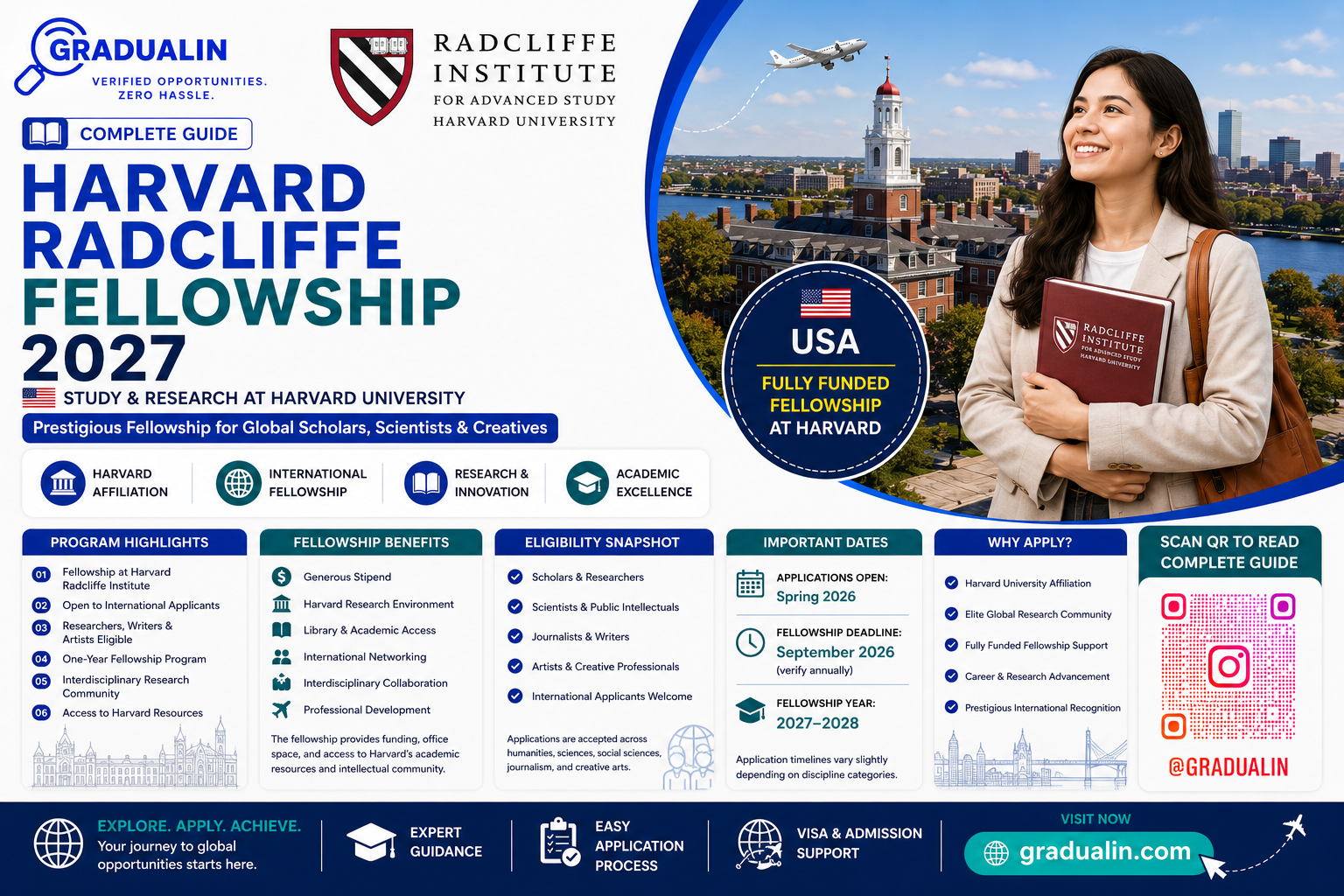
A fully funded year at Harvard University, working on the project of your life, alongside some of the most extraordinary minds in the world. No teaching obligations. No administrative duties. Just your work, a $78,000 stipend, and access to one of the greatest research universities on earth.
That is the Radcliffe Fellowship — and applications for the 2027–2028 programme are now open.
This is not a student scholarship. It is not a postdoctoral grant. The Harvard Radcliffe Institute Fellowship is something rarer: a mid-to-senior career fellowship that brings together scientists, novelists, historians, journalists, poets, filmmakers, and public intellectuals under one roof at Harvard for a full academic year. Past fellows include Pulitzer Prize winners, Nobel laureates, cabinet members, and some of the most influential voices in global intellectual life. If that is the level you are working at — or aiming for — this guide covers everything you need to know to apply.
🎓 Quick Info Box
| Detail | Information |
| Fellowship | Harvard Radcliffe Institute Fellowship |
| Host Institution | Radcliffe Institute for Advanced Study, Harvard University |
| Location | Cambridge, Massachusetts, USA |
| Duration | Full academic year — September through May |
| Stipend | $78,000 USD |
| Project Expense Fund | $5,000 USD |
| Additional Support | Relocation, housing, childcare funds, and healthcare support (as needed) |
| Number of Fellows | ~50 per cohort |
| Open To | Scholars, artists, writers, scientists, journalists, public intellectuals — all career stages |
| International Applicants | Yes — open worldwide |
| IELTS / English Test Required | Not stated on official website — no language test requirement listed |
| Application Deadlines | September 10, 2026 (humanities, social sciences, creative arts, nonfiction/journalism) · October 1, 2026 (science, engineering, mathematics) |
| Result Notification | End of March 2027 |
| Official Link | radcliffe.harvard.edu/radcliffe-fellowship |
🎓 About the Radcliffe Institute for Advanced Study
The Radcliffe Institute for Advanced Study sits inside Harvard University’s historic Radcliffe Yard in Cambridge, Massachusetts. It was formally established as an interdisciplinary institute in 1999, evolving from Radcliffe College — Harvard’s historic women’s college — into one of the world’s most prestigious centres for advanced scholarship and creative inquiry.
What makes Radcliffe genuinely distinctive is its refusal to be boxed into a single discipline. In any given cohort, a molecular biologist might share a corridor with a fiction writer, a legal scholar, and a documentary filmmaker. That is not accidental — it is the entire point. The Institute believes that intellectual breakthroughs happen across disciplinary lines, not within them, and it designs every aspect of the fellowship experience around that principle.
The institute supports roughly 50 fellows per year, drawn from across the United States and around the world. Past fellows include writer Zadie Smith, former US Secretary of State Samantha Power, historian Jill Lepore, legal scholar Elizabeth Warren, and Nobel laureate economist Michael Kremer. The standard this fellowship holds its fellows to — and the standard your application will be measured against — is among the highest of any fellowship programme in the world.
🎓 What the Fellowship Offers — Benefits in Full
This is one of the more complete fellowship packages available anywhere, particularly for mid-career professionals who need protected time to finish a major project.
Stipend: Fellows receive a stipend of $78,000 USD for the academic year. This is a personal income stipend, not a research grant — it is yours to live on during the fellowship.
Project expense allowance: An additional $5,000 USD is provided to cover project-specific expenses — research travel, transcription, materials, and similar costs directly tied to your fellowship project.
Office or studio space: Fellows receive dedicated office or studio space in Byerly Hall, located in Radcliffe Yard on Harvard’s campus.
Harvard appointment: All fellows receive a full-time appointment as Visiting Fellows at Harvard University, granting access to the Harvard Library system — one of the largest academic library collections in the world — and University athletic facilities.
Additional financial support: Relocation funds, housing assistance, and childcare support are available to help fellows make the transition to Cambridge. Healthcare support is also made available as needed. Exact amounts for these supplementary funds are not listed on the public website — verify on the official financial support overview page at radcliffe.harvard.edu/radcliffe-fellowship/radcliffe-fellowship-overview-of-financial-support.
Community and professional development: Fellows participate in a weekly programme of talks, professional development workshops, and social events across the fellowship year — September through May.
🎓 Who Should Apply / Who Shouldn’t
✅ You are a strong candidate if you:
- Are an established professional — scholar, scientist, writer, artist, journalist, or public intellectual — with a strong published or exhibited body of work
- Have a specific, ambitious project you need protected time to complete — a book, film, research framework, or major creative work
- Received your doctorate at least four years ago (by December 2023 for the 2027–2028 year) — relevant for academic applicants
- Are open to an interdisciplinary environment and genuine cross-field conversation
- Can commit to full-time residence in the Cambridge/Boston area from September through May
- Are applying from any country in the world — this fellowship is explicitly open internationally
❌ This fellowship is not for you if you:
- Are currently enrolled in any degree programme — ineligible
- Are applying as a postdoctoral fellow — the fellowship explicitly states it is not intended to serve as a postdoctoral fellowship
- Were previously a Harvard Radcliffe fellow between 1999 and the present — ineligible to reapply
- Cannot relocate to Cambridge, Massachusetts for the full September–May academic year — residency is required and non-negotiable
- Are in the early stages of your career without a track record of published, exhibited, or produced work — the selection standard is demonstrated achievement, not potential alone
🎓 Eligible Disciplines and Fields
The Radcliffe Fellowship is genuinely broad in what it considers. Applications are organised into four programme areas:
Humanities and Social Sciences Covering history, philosophy, sociology, economics, political science, law, anthropology, linguistics, education, and all related disciplines. The full discipline listing is at radcliffe.secure-platform.com/site/page/disciplines-listing.
Science, Engineering, and Mathematics Open to researchers across the physical, biological, and computational sciences, engineering fields, and mathematics. This track has a distinct, later application deadline (October 1, 2026).
Nonfiction and Journalism Open to working journalists with at least five years of professional experience, and nonfiction writers with published books, a book contract, or at least three substantial published works.
Creative Arts Open to fiction writers, poets, playwrights, visual artists, filmmakers and video artists, and music composers — each with their own discipline-specific eligibility thresholds (detailed in the eligibility section below).
Interdisciplinary projects are explicitly welcomed. If your work crosses fields, you select the area that best matches your primary project and educational background, and designate a secondary disciplinary area on the application form.
The Institute also invites — though does not require — proposals relevant to its 2024–2029 multiyear focus area: academic freedom and connecting across difference. Proposals addressing intellectual virtues, free inquiry, political polarisation, peace and conflict, religious pluralism, and inequality as they relate to higher education are particularly encouraged during this period.
🎓 Eligibility Criteria — By Discipline
The Radcliffe Fellowship has specific eligibility thresholds by programme area. Read yours carefully before applying.
Humanities and Social Sciences
- Doctorate (or equivalent: PhD, MD, JD, DPhil, DEd) received at least four years before the fellowship appointment — meaning by December 2023 for the 2027–2028 year
- Published a monograph OR at least two articles in refereed journals or edited collections
Science, Engineering, and Mathematics
- Doctorate received by December 2023 (same four-year rule)
- At least five articles in refereed journals — the official page notes that most science, engineering, and math fellows have published dozens of articles
Nonfiction and Journalism
- Journalism: at least five years of professional journalism experience
- Nonfiction: one published book, OR a contract for a book-length manuscript, OR at least three shorter published works (longer than newspaper articles)
Creative Arts
- Fiction: one published book, OR a book contract, OR at least three shorter published works
- Poetry: at least 20 poems or a book of poetry published in the last five years, and currently completing a manuscript
- Playwriting: a significant body of independent work — plays produced or under option
- Visual Arts: at least five years as a professional artist, participation in several curated group shows, and at least two professional solo exhibitions
- Film and Video: a body of independent work of significant achievement — typically exhibited, shown at festivals, or broadcast
- Music Composition: a PhD or DMA is desirable but not required; strong evidence of professional achievement with recent performances
All applicants: Those currently enrolled in a degree programme are ineligible. Former Harvard Radcliffe fellows (1999–present) are ineligible.
No language test requirement is listed on the official website — the fellowship does not state an IELTS or TOEFL requirement. International applicants should verify directly with the Institute at the contact details listed below if they have questions about language expectations (verify on official website).
🎓 Required Application Materials
All materials are submitted through the online application portal at radcliffe.secure-platform.com.
- Completed application form — accessed after creating an account on the portal
- Curriculum vitae (CV) — full academic, professional, or artistic record
- Project proposal — maximum 1,400 words, plus a bibliography where appropriate. This is the centrepiece of your application — it must be clear, ambitious, and demonstrate why this project matters
- Writing or work sample — format varies by discipline (see below)
- Three letters of recommendation — you provide the contact information of three referees, who are prompted by email to upload their letters directly
Work sample requirements by programme area:
- Humanities and Social Sciences: Writing relevant to your proposed project (unpublished is acceptable) OR a published article or book chapter. Maximum 40 pages.
- Science, Engineering, and Mathematics: Three published articles.
- Nonfiction: A recent book chapter, short story, manuscript, or article — approximately 30 pages total. Related to your project preferred; published material required if unrelated.
- Journalism: Three substantive published articles, approximately 30 pages total. Up to 15 minutes of audio/video work may also be submitted.
- Fiction: Same as nonfiction — approximately 30 pages, related to your project preferred.
- Poetry: Up to 10 poems.
- Playwriting: One play or section of a play — no more than 30 pages.
- Visual Arts: 12 images and, if applicable, up to 3 moving-image excerpts.
- Film and Video: Maximum 15 minutes of work on Vimeo or YouTube. Provide timestamps if your total exceeds 15 minutes.
- Music Composition: One to three samples on SoundCloud, Vimeo, or YouTube — all accompanied by written scores except for electronic or improvisational work.
🎓 Step-by-Step Application Process
Step 1 — Confirm your eligibility Read the discipline-specific eligibility requirements carefully before investing time in the application. Check the official FAQ at radcliffe.secure-platform.com for additional eligibility clarifications.
Step 2 — Create your account Register at radcliffe.secure-platform.com/site/account/login with your name, email address, and a password. This gives you access to the online fellowship application portal.
Step 3 — Select your programme area Choose from: Humanities and Social Sciences; Creative Arts; Nonfiction and Journalism; or Science, Engineering, and Mathematics. Select a primary discipline from the listing, and designate a secondary area if your work is interdisciplinary.
Step 4 — Prepare your project proposal Your 1,400-word proposal is the most important element of your application. It should clearly articulate what your project is, why it matters, what you will produce during the fellowship year, and why a year at Harvard Radcliffe is the right environment for this particular work. This is where most strong candidates separate themselves — invest serious time here.
Step 5 — Prepare your work sample Gather the appropriate materials for your discipline. Ensure written samples are clean, well-edited documents. For film, audio, or music submissions, upload to Vimeo, YouTube, or SoundCloud before submitting.
Step 6 — Nominate your three referees Enter the contact information of your three referees in the application portal. They will receive automated emails prompting them to upload their letters directly. Contact your referees well in advance of the deadline — give them at least four to six weeks.
Step 7 — Submit before your deadline
- September 10, 2026, at 5:00 PM ET — Humanities, social sciences, creative arts, nonfiction and journalism
- October 1, 2026, at 5:00 PM ET — Science, engineering, and mathematics
💡 Practical tip: The selection committee evaluates both the quality of the proposed project and evidence of intellectual and creative capacity — but also explicitly values collegiality and openness to cross-disciplinary conversation. Your proposal should acknowledge the interdisciplinary environment you are entering, and ideally gesture at how your project might speak to or benefit from it.
🎓 How Applications Are Reviewed
The Radcliffe Fellowship uses a two-stage review process. Applications are first evaluated by experts in the relevant field, then reviewed by a multidisciplinary selection committee charged with assembling a diverse cohort of the highest achievement and potential.
Selection criteria include the quality and significance of the proposed project, the applicant’s track record of achievement, and evidence of intellectual and creative capacity. Extraordinary promise can compensate for a shorter record in exceptional cases. The committee also values collegiality — the ability to engage productively with scholars and artists from entirely different fields — as a genuine selection factor.
All applicants are notified of the outcome by end of March 2027.
🎓 Important Dates
| Milestone | Date |
| Application portal opens | Now open (as of 2026) |
| Deadline — Humanities, Social Sciences, Creative Arts, Nonfiction & Journalism | September 10, 2026, 5:00 PM ET |
| Deadline — Science, Engineering, and Mathematics | October 1, 2026, 5:00 PM ET |
| Fellowship results notified | End of March 2027 |
| Fellowship year begins | September 2027 |
| Fellowship year ends | May 2028 |
Bookmark this page and check back for updates — deadline information and programme details may be updated on the official portal throughout the cycle.
🎓 Why Apply — Why Harvard Radcliffe
Very few fellowships in the world offer what Radcliffe does at this level. The $78,000 stipend is competitive with mid-career academic salaries in many countries, the project expense fund is genuinely useful, and the Harvard appointment opens every door on one of the world’s most extraordinary campuses.
But the less obvious reason to apply — and the one former fellows consistently cite — is the community. This is one of the few places in the world where a molecular biologist and a poet sit in the same seminar room every week, where a legal scholar presents half-finished ideas to a documentary filmmaker, and where the friction between disciplines produces something neither could have reached alone. Former fellows describe it as transformative not just for the project they brought to Cambridge, but for the intellectual framework they carried home.
Cambridge and Boston together form one of the world’s most concentrated academic ecosystems — dozens of universities, hospitals, research institutes, and policy organizations within a short distance of Radcliffe Yard. If your work touches public life, science, or culture in any way, the access this environment provides is genuinely unparalleled.
This is also one of the few fellowships that is explicitly not a postdoctoral stepping stone or a graduate student award. It is designed for professionals who have already established themselves and need protected time to produce something they could not produce under normal working conditions. That specificity of purpose is what makes it genuinely worth pursuing.
🎓 FAQ
Q: Is the Radcliffe Fellowship open to international applicants? A: Yes. The official page states that fellows come from across the United States and around the world. There is no citizenship or nationality restriction listed. No language test requirement is stated on the official website — verify directly with the Institute if you have specific questions (verify on official website).
Q: Is this a postdoctoral fellowship? A: No. The official page explicitly states that this fellowship programme is not intended to serve as a postdoctoral fellowship, and those currently enrolled in a degree programme are ineligible to apply.
Q: Can I apply if I am not an academic? A: Yes. The fellowship is explicitly open to professionals across creative arts, journalism, nonfiction writing, and public intellectual life — not only to academics. Each of these tracks has its own eligibility criteria based on professional achievement rather than academic credentials.
Q: Do I have to live in Cambridge for the full year? A: Yes. Residency in the Cambridge/Boston area from September through May is required. Fellows must actively participate in the fellowship community, including weekly talks and professional development activities. Remote or partial participation is not an option.
Q: Can I apply if I previously held a Radcliffe fellowship? A: No. Former Harvard Radcliffe fellows from 1999 to the present are explicitly ineligible to apply.
Q: When will I hear about the result? A: All applicants — successful and unsuccessful — are notified by email by the end of March 2027.
Q: Is the $78,000 stipend in addition to my regular salary? A: The stipend is the fellowship’s financial support for the year. Whether it supplements or replaces an existing salary depends on your employer’s policies — fellows typically take leave from their home institutions for the fellowship year. Clarify the arrangement with your employer and verify any tax implications for your country of residence (verify on official website).
🎓 Official Sources
- Fellowship overview: radcliffe.harvard.edu/radcliffe-fellowship
- Application information and portal: radcliffe.harvard.edu/radcliffe-fellowship/application-information
- Financial support overview: radcliffe.harvard.edu/radcliffe-fellowship/radcliffe-fellowship-overview-of-financial-support
- FAQ: radcliffe.secure-platform.com/site/page/frequently-asked-questions/fellowship-application-faq
- Discipline listing: radcliffe.secure-platform.com/site/page/disciplines-listing
- Online application portal: radcliffe.secure-platform.com
- Address: Radcliffe Institute for Advanced Study, Harvard University, 10 Garden Street, Cambridge, MA 02138, USA
🎓 Summary Table
| Detail | Information |
| Fellowship | Harvard Radcliffe Institute Fellowship |
| Year | 2027–2028 |
| Location | Cambridge, Massachusetts, USA (residency required) |
| Duration | September 2027 – May 2028 (academic year) |
| Number of Fellows | ~50 |
| Stipend | $78,000 USD |
| Project Expenses | $5,000 USD |
| Additional Support | Relocation, housing, childcare, healthcare (as available) |
| Office Space | Byerly Hall, Radcliffe Yard, Harvard University |
| Harvard Appointment | Yes — Visiting Fellow with full library access |
| Open To | Scholars, scientists, writers, artists, journalists, public intellectuals |
| International Applicants | Yes — open worldwide |
| English Test Required | Not stated — verify on official website |
| Currently Enrolled Students | Ineligible |
| Former Radcliffe Fellows (1999–present) | Ineligible |
| Deadline (Humanities/Arts/Journalism) | September 10, 2026, 5:00 PM ET |
| Deadline (Science/Engineering/Math) | October 1, 2026, 5:00 PM ET |
| Results Notification | End of March 2027 |
| Apply At | radcliffe.harvard.edu/radcliffe-fellowship/application-information |
Browse more opportunities on Gradualin:
Related opportunities you will find useful:
- Fully Funded PhD Scholarships UK 2026
- Fully Funded PhD Positions Switzerland 2026
- Fully Funded Scholarships USA 2026
- Top 10 Fully Funded Scholarships Asia 2027
- Fully Funded Scholarships Australia 2026
- Study in Italy 2026 — Complete Guide
- Finland Scholarships 2026 — Tuition Waivers
Stay updated with the latest scholarships, jobs, and opportunities at Gradualin.com — your trusted guide to studying abroad for free.