
David Irvine Postgraduate Scholarship 2026 — CSIRO Cyber Security
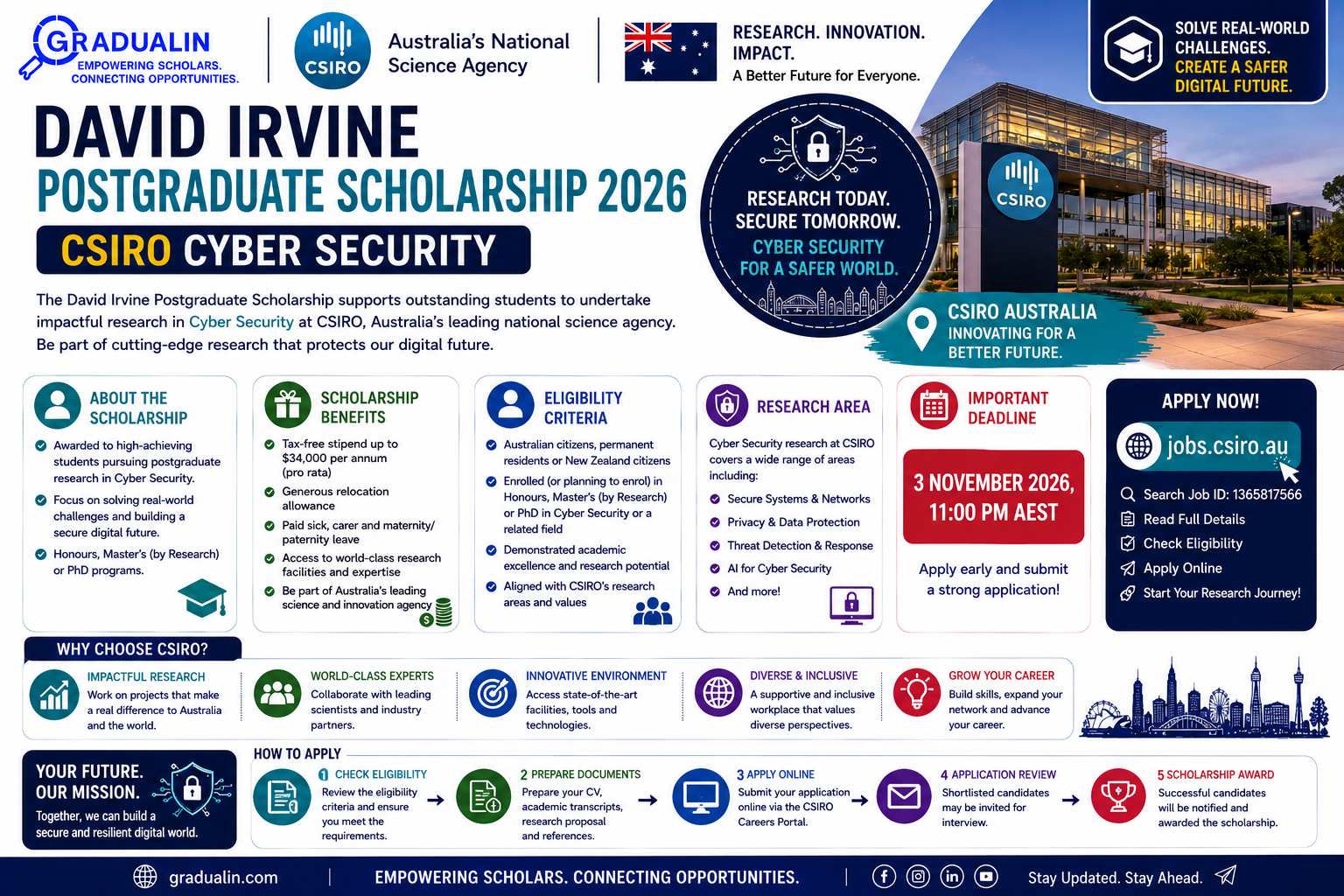
Australia’s national science agency is offering stipends of up to AUD $46,000 per year for PhD students in cyber security — and this new cycle, posted in August 2026, closes on 3 November 2026. If you are enrolled or planning to enrol at one of six CSCRC partner universities and hold First Class Honours in Cyber Security, Computer Science, or Artificial Intelligence, the David Irvine Postgraduate Scholarship is one of the most financially generous research positions available in Australia right now. This guide covers everything you need to know about eligibility, funding structure, research themes, and how to build a competitive application — including a clear note on whether Pakistani and South Asian students can apply.
| Detail | Information |
| Organisation | CSIRO (Commonwealth Scientific and Industrial Research Organisation) |
| Country | Australia |
| Degree Level | PhD (up to 3.5 years) / MPhil (up to 2 years) |
| Field | Cyber Security, Computer Science, Artificial Intelligence |
| Funding Type | Full Scholarship or Top-Up Scholarship (stipend only — tuition not covered) |
| Deadline | 3 November 2026, 11:00 PM AEST |
| Open To | Australian citizens, PRs, and temporary residents from approved countries |
| Pakistani Students Eligible | No — Pakistan is not on the approved country list (see eligibility section for details) |
| Official Link | Apply on CSIRO Jobs |
🎓 About the David Irvine Scholarship and CSIRO
CSIRO is Australia’s equivalent of a national research council but with significantly more industrial reach — it employs around 5,000 scientists and engineers and has been behind some of Australia’s most consequential technological innovations, from Wi-Fi to polymer banknotes.
The David Irvine Postgraduate Scholarship was established within CSIRO’s Technology unit (formerly Data61) to honour the legacy of the late David Irvine AO, who played a central role in founding the Cyber Security Cooperative Research Centre (CSCRC) — Australia’s principal national hub for applied cyber security research. The CSCRC brought together universities, government agencies, and industry partners to address real-world digital threats rather than purely academic problems.
What makes this scholarship structurally different from most Australian postgraduate awards is that it operates through the CSCRC partnership model. Scholars are not simply registered at a university — they are embedded in CSIRO’s research ecosystem with a dual-supervisor arrangement: one from the enrolled university and one from CSIRO itself. This means graduates emerge with both an accredited research degree and demonstrated experience inside Australia’s leading science agency.
Compared to the standard CSIRO top-up scholarship (which typically adds AUD $7,000–$10,000 on top of an RTP stipend), the David Irvine scholarship offers a significantly higher base stipend and is purpose-built for cyber security — making it considerably more valuable in both financial terms and career positioning.
🎓 Benefits and Funding
The scholarship offers two tracks — a full scholarship and a top-up option — with separate stipend scales:
Full Scholarship — PhD
- Year 1: AUD $44,000
- Year 2: AUD $45,000
- Year 3: AUD $46,000
- Year 4: AUD $23,000 (partial year)
Full Scholarship — MPhil
- Year 1: AUD $44,000
- Year 2: AUD $45,000
Top-Up Scholarship (PhD or MPhil)
- Years 1–3: AUD $10,000 per year
- Year 4 (PhD only): AUD $5,000
Additional allowances:
- PhD scholars: AUD $7,000 Learning and Development allowance over the life of the scholarship (allocated annually at the CSIRO Supervisor’s discretion)
- MPhil scholars: AUD $5,000 Learning and Development allowance
For Pakistani students currently residing in Australia, the full PhD stipend of AUD $44,000–$46,000 per year converts to approximately PKR 16–17 million annually at current exchange rates (verify current rates). This is a substantial living allowance by any standard, though it should be noted that tuition fees are not covered under this scholarship, and relocation costs are not reimbursable. Scholars will need to secure a tuition fee waiver from their enrolled university by the commencement date — without this, the scholarship cannot proceed.
🎓 Eligibility Criteria
To be considered, you must meet all of the following:
- Be an Australian citizen, New Zealand citizen, Australian Permanent Resident, or an Australian temporary resident currently residing in Australia with a valid visa, and originate from a country listed in the Defence Trade Controls (Foreign Country) Instrument 2024
- Hold First Class Honours (or equivalent) in Cyber Security, Computer Science, or Artificial Intelligence
- Be admitted to or enrolled full-time in a PhD or MPhil program at one of the six CSCRC participant universities
- Be no more than 12 months into a PhD candidature, or no more than 6 months into an MPhil at the time of application
- Have at least one confirmed university supervisor and at least one confirmed CSIRO supervisor
- Have received or be in the process of obtaining a tuition fee waiver from your university
- Meet the English language requirements of your host university
- Not have previously completed a PhD
- Be able to commence no later than 1 March 2027
English language requirement: Set by each CSCRC participant university individually — not by CSIRO. Check the specific requirements of Edith Cowan University, Adelaide University, Deakin University, UNSW, Charles Sturt University, or QUT directly, as thresholds vary (verify on official university websites).
Pakistani students: Pakistan is not listed on the Defence Trade Controls (Foreign Country) Instrument 2024 approved country list. This means Pakistani nationals studying in Australia on a temporary visa are not eligible to apply, regardless of their academic qualifications. Pakistani students who hold Australian Permanent Residency or citizenship may apply and should confirm their status meets all requirements. See the FAQ section for more detail.
🎓 Who Should Apply — and Who Probably Shouldn’t
✅ Strong candidates include:
- Students already enrolled (within the early candidature window) at one of the six CSCRC universities in a cyber-security-adjacent PhD program
- Prospective PhD students who have secured a CSIRO supervisor contact and can demonstrate research alignment with CSIRO’s Cybersecurity and Digital Resilience focus areas
- Graduates with genuine First Class Honours in Cyber Security, Computer Science, or AI who can articulate a research problem within one of the eight CSCRC themes
- International students holding Australian PR or citizenship who meet the residency and country-of-origin requirement
- Applicants who have already made contact with a CSIRO research supervisor — the listing specifically provides an email for connecting with potential supervisors before applying
❌ This scholarship is not suitable for:
- Pakistani nationals or other South Asian students residing in Australia on student or work visas who do not hold Australian PR or citizenship — the country list excludes Pakistan, India is listed but the Defence Trade Controls instrument applies specifically to technology transfer, so check your visa and residency status carefully (verify eligibility on the official page)
- Students seeking funding that covers tuition fees — this scholarship explicitly does not cover tuition; a separate university fee waiver is required
- Graduates in unrelated disciplines looking to pivot into cyber security without the undergraduate foundation
- Students who have already completed a PhD
Note on Indian students: India appears on the Defence Trade Controls (Foreign Country) Instrument 2024 list. Indian students currently residing in Australia with a valid visa may be eligible — confirm your specific circumstances with CSIRO directly at TechPathways@csiro.au.
🎓 Research Themes and Eligible Fields
The scholarship covers eight approved CSCRC research themes. Your project concept proposal must align with at least one:
- Resilient Systems — infrastructure hardening and system redundancy under cyber attack
- Security and Configuration Management of IoT Systems — securing connected devices at scale
- Development of Next Generation Authentication Technologies — moving beyond passwords and traditional MFA
- Predict, Detect, Respond to and Investigate Cyber Threats — threat intelligence, forensics, and incident response
- Platform and Architecture for Cyber Security as a Service — cloud-native security frameworks
- Security Automation and Orchestration — SOAR systems and automated response pipelines
- Privacy Preserving Data Sharing in a Connected World — differential privacy, federated learning, and data governance
- Law and Privacy — legal frameworks, regulatory compliance, and digital rights
Eligible undergraduate disciplines that feed into these themes: Cyber Security, Computer Science, and Artificial Intelligence. Students from adjacent disciplines (Engineering, Mathematics, Law) should confirm alignment with their prospective CSIRO supervisor before applying.
The six CSCRC Participant Universities where the scholarship can be held:
- Edith Cowan University (WA)
- Adelaide University (SA)
- Deakin University (VIC)
- University of New South Wales — UNSW (NSW)
- Charles Sturt University (NSW)
- Queensland University of Technology — QUT (QLD)
🎓 Required Documents
Submit the following as part of your application:
- CV / Resume combined with a Cover Letter — uploaded as a single PDF in the Resume/CV field on the CSIRO application portal
- Official academic transcripts — for all tertiary qualifications, demonstrating First Class Honours or equivalent; uploaded in the Cover Letter field (yes, this is counterintuitive — follow the portal instructions exactly)
- Completed MS Form — the David Irvine Scholarship Microsoft Form, accessed through the official listing, which includes your project concept proposal and theme selection
- Research concept proposal — maximum 500 words; must clearly articulate the research problem, proposed methodology, and potential real-world impact; must align with one or more CSCRC research themes and CSIRO’s Cybersecurity and Digital Resilience focus areas
- Two academic referee details — name, institution, phone number, and email address; note that your university supervisor cannot serve as a referee
For international students already in Australia: No additional HEC attestation or embassy documents are mentioned in the official listing — however, you may be required to produce proof of visa status and country of origin during the security clearance stage. Contact TechPathways@csiro.au if uncertain.
🎓 Step-by-Step Application Process
Step 1: Confirm university eligibility Verify that you are enrolled (or accepted) at one of the six CSCRC participant universities. If you are not yet enrolled, begin the admissions process first — the scholarship requires university enrolment and cannot be held independently.
Step 2: Find a CSIRO supervisor This is the step most applicants skip and the one that matters most. Email marthie.grobler@csiro.au specifically for CSIRO research alignment and supervisor connection. Do this before writing your project proposal — a confirmed CSIRO supervisor strengthens your application significantly and ensures your proposal is genuinely aligned with current CSIRO priorities.
Step 3: Develop your 500-word project concept Choose one or more CSCRC research themes. Write a proposal that defines a specific research problem (not a broad topic), describes your methodology, and explains the impact. Generic proposals that describe a theme without proposing original research are the most common reason for rejection at this stage.
Step 4: Prepare your application documents Combine your CV and Cover Letter into one PDF. Gather official transcripts for all degrees. Identify two academic referees who are not your university supervisor.
Step 5: Submit via the CSIRO jobs portal Apply on the CSIRO Jobs portal. Upload your combined CV/Cover Letter in the Resume/CV field. Upload your academic transcripts in the Cover Letter field (as instructed). Complete the MS Form separately.
Step 6: Security clearance Shortlisted candidates will be subject to a national police check and may face additional security, medical, and character clearance requirements. Allow time for this process — do not assume clearance is automatic.
Practical tip: CSIRO explicitly warns that applications may close early for specific projects as suitable candidates are accepted. Submit by mid-October at the latest — do not wait for the November 3 deadline.
🎓 Important Dates
| Milestone | Date |
| Posting Date | 14 August 2026 |
| Application Deadline | 3 November 2026, 11:00 PM AEST |
| Expected Start Date | No later than 1 March 2027 |
| Scholarship Duration | Up to 3.5 years (PhD) / 2 years (MPhil) |
Bookmark this page — we update deadlines as soon as changes are announced.
🎓 Why Australia, Why CSIRO, Why This Scholarship
Cyber security is one of the fastest-growing fields in Australia’s economy. The Australian federal government has committed billions of dollars to national cyber resilience, and CSIRO’s Technology unit sits at the centre of that investment. A degree completed inside CSIRO’s research environment does not simply produce academic publications — it produces researchers who have worked alongside government agencies and industry partners on active national security challenges.
CSIRO operates across multiple Australian cities including Sydney, Melbourne, Brisbane, Perth, and Canberra, which means scholars have access to one of the most liveable countries in the world while working in a research environment that consistently ranks among the top scientific institutions globally.
The stipend of AUD $44,000–$46,000 per year is considerably higher than the standard Australian Research Training Program (RTP) rate of approximately AUD $32,000–$34,000 per year in 2026 — meaning scholars under the David Irvine program receive a materially better financial package than the typical domestic PhD student.
Gradualin Editor’s Note: This is a genuinely exceptional scholarship for the right candidate — but “right candidate” is specific. If you do not already have a confirmed CSIRO supervisor and a clear research angle aligned with the CSCRC themes, your application will be weak relative to candidates who do. The dual-supervisor requirement means this is not an open application where ideas are developed after acceptance. The strongest applicants will have already made contact with Marthie Grobler’s team before submitting. For students who are just beginning to explore PhD options in Australia, consider this a target for your next intake after you have established the necessary connections and supervisor relationships.
🎓 Frequently Asked Questions
These questions are based on what students most commonly search about this program.
Can Pakistani students apply for the David Irvine Postgraduate Scholarship? This is the question we receive most about this scholarship, and the answer requires careful reading. The eligibility rules state that applicants must originate from a country listed in the Defence Trade Controls (Foreign Country) Instrument 2024. Pakistan is not on that list. This means Pakistani nationals on student or work visas in Australia are not eligible. However, Pakistani students who hold Australian Permanent Residency or Australian citizenship are eligible — in that case, your status as a PR or citizen overrides the country-of-origin restriction. If your situation is unclear, email TechPathways@csiro.au before investing time in an application.
Is IELTS required for this scholarship? CSIRO does not set a specific English test requirement for this scholarship. Instead, applicants must meet the English language requirements of their enrolled CSCRC participant university. Each university has its own thresholds and accepted tests (IELTS, TOEFL, PTE, etc.). Check the postgraduate research admissions pages of Edith Cowan, UNSW, QUT, Deakin, Adelaide, or Charles Sturt directly. Some universities offer English test waivers for students who completed their prior degree in English — verify on official university websites.
What is the difference between the full scholarship and the top-up scholarship? The full scholarship is a standalone stipend — it is your primary source of income during the PhD or MPhil, not a supplement. The top-up scholarship is an additional AUD $10,000 per year on top of another primary scholarship (such as an RTP or equivalent university stipend). If you are already receiving an RTP scholarship from your university, you may be eligible for the top-up rather than the full award. CSIRO will assess which track applies to your situation.
Does this scholarship cover tuition fees? No — explicitly and clearly. The official CSIRO listing states: “Tuition fees are not covered under this scholarship.” You must secure a separate tuition fee waiver from your enrolled CSCRC participant university by the commencement date of 1 March 2027. Most CSCRC universities offer domestic students tuition-free research degrees through the RTP fee offset, but international students will need to confirm their individual fee waiver arrangements.
Do I need to have a research project in mind before I apply? Yes. The application requires a 500-word research concept proposal aligned with one of eight CSCRC research themes. You do not need a fully developed research plan, but you must demonstrate original thinking about a specific problem, a methodology for approaching it, and a realistic assessment of its impact. CSIRO supervisors can help refine the proposal — which is why contacting marthie.grobler@csiro.au before applying is strongly recommended.
Can I apply if I am already 10 months into my PhD? Yes, but with no margin for delay. The eligibility rule states applicants must be no more than 12 months into their PhD (or 6 months into an MPhil). If you are at 10 months now, you are within the window — but confirm your candidature start date precisely, as CSIRO will verify this against your university enrolment records.
🎓 Official Sources and Contact
- Official listing and application: CSIRO Jobs — David Irvine Postgraduate Scholarships
- General application enquiries: TechPathways@csiro.au
- CSIRO supervisor connections and research alignment: marthie.grobler@csiro.au
- CSCRC information: cybersecuritycrc.org.au
- CSIRO main website: csiro.au
🎓 Summary
| Detail | Information |
| Organisation | CSIRO (Commonwealth Scientific and Industrial Research Organisation) |
| Country | Australia |
| Degree Level | PhD (up to 3.5 years) / MPhil (up to 2 years) |
| Field | Cyber Security, Computer Science, Artificial Intelligence |
| Funding Type | Full Scholarship or Top-Up Scholarship (stipend only) |
| PhD Stipend | AUD $44,000–$46,000/year (years 1–3), $23,000 (year 4) |
| MPhil Stipend | AUD $44,000–$45,000/year |
| Top-Up Amount | AUD $10,000/year (years 1–3), $5,000 (year 4, PhD) |
| L&D Allowance | AUD $7,000 (PhD) / AUD $5,000 (MPhil) |
| Tuition Covered | No — separate university waiver required |
| Relocation Covered | No |
| Deadline | 3 November 2026, 11:00 PM AEST |
| Start Date | No later than 1 March 2027 |
| Open To | Australian citizens, PRs, and Australian-resident temporary visa holders from approved countries |
| Pakistani Students Eligible | No (unless holding Australian PR or citizenship) |
| Official Link | Apply Here |
Explore more postgraduate research funding options and international scholarships at Scholarships — or browse Jobs & Internships, Events & Conferences, and Guidelines & Resources for more opportunities.
Related opportunities worth exploring:
- Fully Funded Scholarships in Australia 2026
- Top 10 Fully Funded Scholarships in Asia 2027
- Fully Funded PhD Scholarships in the UK 2026
Stay updated with the latest scholarships, jobs, and opportunities at Gradualin.com — your trusted guide to studying abroad for free.
Author: Faseeh Sultan — PhD Scholar & MSIT | 7 Years in Education