
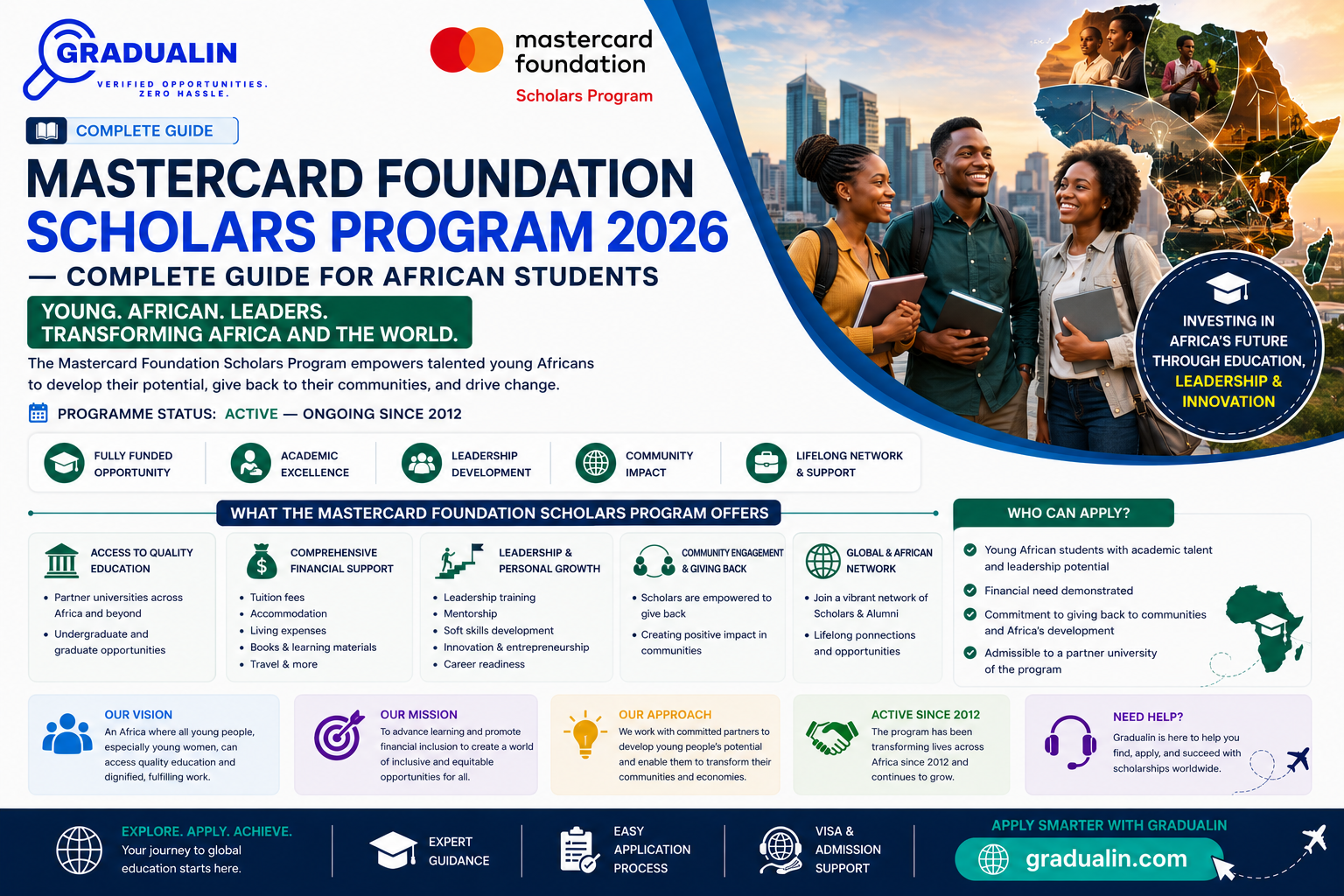
Mastercard Foundation Scholars Program 2026 — Complete Guide for African Students
The Mastercard Foundation Scholars Program is one of the largest and most ambitious scholarship initiatives in the world — over 58,000 scholarships committed across 62+ partner universities in Africa, North America, Europe, and the Middle East, with a target of reaching 100,000 young people by 2030. If you are an African student with academic ability, financial need, and a demonstrated commitment to serving your community, this programme is worth understanding in detail.
This guide covers exactly what the programme offers, who qualifies, how to choose the right partner university, how to apply, and — importantly — who this programme is not designed for, so you can make an informed decision before investing time in an application.
| Detail | Information |
| Programme | Mastercard Foundation Scholars Program |
| Funder | Mastercard Foundation |
| Programme Status | Active — ongoing since 2012 |
| Degree Levels | Secondary, Undergraduate, Masters (no PhD) |
| Funding Type | Fully funded — tuition, accommodation, books, living support |
| Target Beneficiaries | Young people from the African continent |
| Partner Institutions | 62+ globally |
| Total Scholarships Committed | Over 58,000 (targeting 100,000 by 2030) |
| Pakistani Students Eligible | No — restricted to African citizens and residents |
| Official Link | Apply Here |
🎓 About the Mastercard Foundation Scholars Program
The Mastercard Foundation is a Canadian philanthropic organisation established in 2006 with an endowment linked to Mastercard’s initial public offering. Since launching the Scholars Program in August 2012, it has grown into one of the most comprehensive education investment programmes on the planet — not just a scholarship, but a structured pathway from higher education into meaningful employment and community leadership.
What distinguishes this programme from most scholarship schemes is its ecosystem approach. Scholars do not simply receive tuition support and disappear into their universities. They are enrolled in leadership development workshops, receive psychosocial wellbeing support, gain access to mentoring and career guidance, participate in internship placements, and join a growing alumni network of over 20,000 graduates working across Africa and globally. The annual Baobab Summit — a flagship gathering of Scholars and alumni — has become one of Africa’s most prominent youth leadership platforms, with the 2026 edition running as a virtual summit in August 2026.
Unlike programmes such as the Commonwealth Scholarship, which is country-quota-based and spread across all developing nations, or the Chevening Scholarship, which funds one-year UK master’s degrees for students from around the world, the Mastercard Foundation Scholars Program is deliberately and exclusively Africa-focused. Its mandate is the socio-economic transformation of the African continent — which means that selection criteria place significant weight not just on academic results but on demonstrated service to community and a credible commitment to returning and contributing to Africa.
The programme has disbursed over $6.5 billion USD toward education and transitions programmes in Africa since inception — a figure that reflects the scale of institutional investment behind each individual scholarship.
🎓 What the Scholarship Covers — Full Benefits
The Mastercard Foundation Scholars Program is fully funded. The exact components vary slightly by partner institution, but the core package confirmed by the Foundation across its partners includes:
- Full tuition and academic fees for the complete duration of the degree
- Accommodation costs — either on-campus housing or a housing allowance
- Books and academic materials for required courses
- Living stipend to cover daily expenses
- Return airfare to the Scholar’s home country where applicable
- Mentoring and leadership development throughout the programme
- Psychosocial counselling and wellbeing support
- Career guidance and internship placement assistance
- Application fee reimbursement — if a partner university charges an application fee and the student is selected as a Scholar, the fee is refunded
For students applying to North American universities, some partners reimburse or assist with the cost of TOEFL and SAT scores, which are required for international applicants. The Foundation acknowledges that these test costs create a barrier and has worked with partner institutions to mitigate this wherever possible.
The programme covers secondary, undergraduate, and master’s level study. PhD scholarships are not currently available through this programme.
🎓 Eligibility Criteria
A note for Pakistani and South Asian readers: The Mastercard Foundation Scholars Program is restricted to citizens and residents of African countries. Pakistani students are not eligible. This is a firm programme boundary, not a technicality. The programme exists specifically to develop leadership for the African continent, and all partner institutions enforce African citizenship or residency as a baseline requirement.
If you are a Pakistani or South Asian student looking for comparable fully funded international scholarships, consider: the Fully Funded Scholarships in the USA 2026, the Fully Funded Scholarships in the UK 2026, or the Top Fully Funded Scholarships in Saudi Arabia 2026. Browse the full Scholarships category on Gradualin for opportunities open to South Asian applicants.
For African students, core eligibility criteria across most partner institutions:
- African citizenship or residency — you must be a citizen of and reside in an African country. Students temporarily abroad for study or work may still be eligible at some institutions (verify with your chosen partner). Students with dual citizenship that includes a non-African country may be ineligible at some partners (e.g., Sciences Po explicitly disqualifies dual citizens holding non-African passports)
- Age — generally 28 years or younger at the time of application. Extended to 32 years for applicants in the refugee or persons with disabilities categories. Some individual partners set slightly different limits (Cambridge: 35 years; McGill: 35 years; University of Edinburgh: 35 years for 2026/27)
- Financial need — demonstrated financial constraints that have prevented or restricted access to quality education. This is a core criterion, not a formality
- Academic merit — strong academic results appropriate to the level of study. First Class Honours or equivalent strengthens graduate-level applications significantly
- Community service and leadership — a proven record of service, volunteer work, or leadership within your school, community, or professional environment. This is weighted heavily in selection
- Commitment to return — a demonstrated desire to contribute to your home country or the African continent after completing your studies
- Priority groups — the programme explicitly prioritises young women (71% of scholars to date are women, and most partner universities reserve 70%+ of awards for women), refugees and internally displaced persons (IDPs), and young people with disabilities
🎓 Who Should Apply — and Who Probably Shouldn’t
✅ Strong fit:
- African students with strong academic records, meaningful financial need, and verifiable community service history
- Young women from the African continent — you are the programme’s primary target and statistically the most likely to be selected
- Refugees and IDPs holding African status — several partner universities maintain dedicated refugee scholarship tracks with more flexible age limits
- Students with disabilities who are African citizens — the programme’s disability inclusion focus means these candidates receive explicit priority consideration
- Students who have researched which specific partner institution best matches their academic field and career goals before applying
❌ Probably not the right fit:
- Pakistani, South Asian, or any non-African students — you are categorically ineligible; do not invest application effort here
- Students seeking PhD funding — the programme does not offer doctoral scholarships
- Students whose primary motivation is to remain in the host country after graduation — the programme’s ethos is explicitly about returning to contribute to Africa; selection panels assess this seriously
- Students who have not yet built a record of community service or leadership — academic grades alone are rarely sufficient at competitive partner institutions
🎓 Partner Universities — How to Choose the Right One
This is the single most important practical decision any prospective Scholar makes. There is no single Mastercard Foundation application — you apply through your chosen partner institution, which sets its own deadlines, requirements, and admissions process. Choosing the wrong institution for your academic level, field, or career goals is a common reason for avoidable rejections.
The programme works with over 62 partner institutions across the following regions:
Africa (primary cluster — largest number of placements): Makerere University (Uganda), University of Cape Town (South Africa), University of Western Cape (South Africa), Kwame Nkrumah University of Science and Technology — KNUST (Ghana), Ashesi University (Ghana), University of Gondar (Ethiopia), African Leadership University, Carnegie Mellon University Africa (Rwanda), United States International University Africa (Kenya), and many others.
North America: Arizona State University (USA), UC Berkeley — Center for African Studies (USA, 201 master’s places over 10 years), McGill University (Canada, graduate level, African citizens and residents, age 35 or under), University of Toronto (Canada), University of British Columbia (Canada).
Europe: University of Cambridge (UK, one-year master’s degrees, among the most selective pathways in the programme), University of Edinburgh (UK, age 35 or under for 2026/27), Sciences Po (France, only EU institution in the programme, African citizenship required, bachelor’s from a Sciences Po reference institution required).
Middle East: American University of Beirut (Lebanon).
How to navigate the partner list effectively: First, determine your degree level (undergraduate vs. master’s) — this immediately narrows your options, as some partners offer only one level. Second, match your academic field to the institution’s strengths. Carnegie Mellon Africa is ideal for technology and engineering; Sciences Po for political science, international relations, and humanities; UC Berkeley for research-oriented master’s in African Studies. Third, read each institution’s specific Mastercard Foundation eligibility page — age limits, eligible countries, and document requirements vary. Fourth, apply to multiple partners simultaneously where timelines permit; there is no restriction on applying to more than one institution.
🎓 Required Documents
Documents vary by institution, but the following are commonly required across most partner universities:
- Academic transcripts — official, certified copies from all institutions attended
- Proof of African citizenship — valid passport or national identity document
- Proof of residency in an African country — utility bill, government registration, or equivalent
- English language proficiency — TOEFL, IELTS, or equivalent where required (African partner universities often waive this; North American and European partners typically require it)
- Financial need statement or supporting documentation — evidence of economic hardship or barrier to education
- Community service and leadership evidence — reference letters, certificates, or documentation of volunteer or service activities
- Personal statement / Statement of Purpose — your academic goals, service record, and commitment to giving back
- Letters of recommendation — typically two to three academic or professional referees
- Curriculum vitae / résumé
- Application fee payment (where applicable) — reimbursed if you are selected as a Scholar
Fraud warning: The Mastercard Foundation has issued a public alert about fraudulent Facebook posts claiming to recruit for the Scholars Program and requesting application fees. The Foundation does not solicit payments from applicants. Apply only through the official partner institution listings on the Foundation’s website. Report suspected fraud to privacy@mastercardfdn.org.
🎓 Step-by-Step Application Process
- Identify your target partner institution(s). Visit the Where to Apply page and filter by degree level, country, and field. Read each institution’s Mastercard Foundation page in full — do not rely on third-party summaries.
- Verify your eligibility for that specific institution. Age limits, eligible countries, and academic prerequisites differ between partners. Confirm you meet every criterion before investing application time.
- Apply for academic admission to the partner university. At most institutions, the Mastercard Foundation scholarship application runs alongside or after the standard admissions application. You must typically gain or seek admission to the university as a first step.
- Complete the Mastercard Foundation Scholars Program scholarship application. This is a separate form from general admissions at most partner institutions. It will ask for your financial need documentation, community service record, and commitment-to-return statement.
- Prepare and submit supporting documents. Begin gathering certified transcripts, reference letters, and financial documentation well in advance — some documents, particularly certified translations or official institutional records, can take weeks to obtain.
- Track your application status through the partner institution’s portal or admissions office. The Mastercard Foundation itself does not manage individual application tracking — all queries go to the partner institution.
- If selected, confirm acceptance and begin pre-departure preparation. Your Scholar support begins from acceptance, not from your first day on campus.
Practical tip: The Foundation’s own Application Tips Series is a free resource that covers what selection committees look for and common mistakes to avoid. Reading it before writing your personal statement is worth the hour it takes.
🎓 Important Dates
| Partner Institution | Application Window / Deadline |
| Sciences Po (France) | Application fee waiver: October–mid-December 2026; admissions application in parallel |
| University of Cambridge (UK) | Varies by master’s programme — check the Cambridge MCF page |
| McGill University (Canada) | Check mcgill.ca/mastercardfdn-scholars for current cycle |
| University of Western Cape (South Africa) | 2026 undergraduate and master’s cycle — check institutional page |
| African partner universities | Varies by institution and intake term |
| All partners | Each sets its own deadline — verify directly with each institution |
📌 Bookmark this page — we update deadlines as soon as changes are announced.
🎓 Why This Programme Matters — and Is It Worth the Effort?
For African students who meet the criteria, the Mastercard Foundation Scholars Program is one of the few fully funded pathways that simultaneously removes financial barriers, provides structured leadership development, and connects scholars to a continent-wide professional network. The Cambridge and Sciences Po tracks, in particular, represent access to institutions that would otherwise be prohibitively expensive and difficult to navigate for students from financially constrained backgrounds in Africa.
The alumni network — over 20,000 graduates as of 2026 — is increasingly influential in African public policy, technology, health, agriculture, and entrepreneurship. Being a Mastercard Foundation Scholar is a credential that carries weight within African professional circles precisely because the programme is known for selecting candidates with genuine community purpose, not just academic performance.
Gradualin Editor’s Note: This programme deserves serious consideration from any African student who meets the criteria — the combination of full funding and a genuine post-graduation support structure is rare. However, be honest with yourself about the selection standards. Most partner universities at the graduate level are looking for candidates with First Class Honours or near-equivalent results, a substantial and documented record of community service, and a clear, credible plan for contributing to Africa after graduation. Candidates whose service record is thin, whose financial need is borderline, or who cannot articulate a specific post-graduation contribution plan will struggle against the volume of strong applications this programme attracts. Apply to multiple partner institutions across different regions to improve your odds. And for Pakistani or South Asian readers who reached this article hoping to apply: the programme is not available to you, but your ambition is the same — find it directed at the right scholarship.
🎓 Frequently Asked Questions
These questions are based on what students most commonly search about the Mastercard Foundation Scholars Program.
Can Pakistani students apply for the Mastercard Foundation Scholars Program? No. The programme is restricted to citizens and residents of African countries. Pakistani students, and South Asian students generally, are not eligible under any current pathway within this programme. If you are a Pakistani student looking for comparable fully funded opportunities, explore the Scholarships section on Gradualin for programmes open to South Asian applicants.
Does the Mastercard Foundation Scholars Program cover PhD study? No. The programme currently supports secondary, undergraduate, and master’s level scholarships only. PhD candidates are not eligible.
Can I apply to more than one partner university at the same time? Yes. There is no restriction on applying to multiple partner institutions simultaneously. Given how competitive the programme is, applying to several institutions across different regions is a reasonable strategy. Be aware that each application requires significant effort — a rushed application to five institutions is less effective than a strong application to two or three well-chosen ones.
What does “commitment to return” mean in practice? Selection panels want to see that you have a concrete plan for how your education will benefit your home country or the African continent — not just a general statement. Strong applications describe a specific sector (public health, fintech, education, agriculture), a specific community or region, and a realistic post-graduation pathway. Generic statements about “giving back” without specifics are a common weakness in unsuccessful applications.
Are refugees eligible for the Mastercard Foundation Scholars Program? Yes — and they receive explicit priority consideration. African refugees and internally displaced persons are eligible at most partner institutions, with relaxed age limits at several partners. Students with refugee status should look specifically at partner universities in Uganda (Makerere), Kenya, and Rwanda, which have the most established refugee scholar tracks.
I found a Facebook group charging a fee to apply for the Mastercard Foundation scholarship. Is it legitimate? No. The Mastercard Foundation has publicly warned that fraudulent social media accounts claim to recruit for the programme and request fees. The Foundation never charges applicants. Apply only through official partner institutions listed on the Foundation’s website. Report any suspicious activity to privacy@mastercardfdn.org.
🎓 Official Source
- Programme Overview: mastercardfdn.org — Scholars Program
- Where to Apply (Partner Institutions): mastercardfdn.org — Where to Apply
- Application Tips Series: mastercardfdn.org — Application Tips
- Scholars Program Handbook: mastercardfdn.org — Handbook
- Fraud Reporting: privacy@mastercardfdn.org
- Foundation Contact: mastercardfdn.org/en/contact
🎓 Summary Table
| Detail | Information |
| Programme | Mastercard Foundation Scholars Program |
| Funder | Mastercard Foundation |
| Active Since | August 2012 — ongoing |
| Degree Levels | Secondary, Undergraduate, Masters |
| PhD Available | No |
| Funding | Fully funded — tuition, housing, books, stipend, airfare |
| Partner Institutions | 62+ globally |
| Total Committed | 58,000+ (target: 100,000 by 2030) |
| Gender Priority | 71% of scholars are young women |
| Age Limit | Generally 28 (up to 35 at some partners; 32 for refugee/disability category) |
| Pakistani Students Eligible | No — restricted to African citizens and residents |
| Priority Groups | Young women, refugees/IDPs, persons with disabilities |
| Application Fee | Set by partner; reimbursed if selected |
| Official Link | Where to Apply |
Explore more fully funded opportunities:
- Fully Funded Scholarships in the USA 2026
- Fully Funded PhD Scholarships in the UK 2026
- Fully Funded PhD Positions in Switzerland 2026
- Top 10 Fully Funded Scholarships in Asia 2027
- Top Fully Funded Scholarships in Saudi Arabia 2026
Browse all open opportunities: Scholarships | Jobs & Internships | Events & Conferences | Guidelines & Resources
Stay updated with the latest scholarships, jobs, and opportunities at Gradualin.com — your trusted guide to studying abroad for free.
Author: Faseeh Sultan — PhD Scholar & MSIT | 7 Years in Education